“Pregnancy Is in the Mind, Not in the Womb”: The Diloggún Oracle and the Awakening of Fertility in Cuban Regla de Ocha*
Universidade Federal de Goiás, Brazil
Universidade Federal de Goiás, Brazil
https://doi.org/10.7440/antipoda55.2024.02
Received: July 31, 2023; accepted: December 12, 2023; Modified: January 15, 2024.
Abstract: Religions are often acknowledged for their ability to provoke social, psychological, and physiological transformation, prompting recurrent studies in social and human sciences. Within this analytical domain, understanding ailments and methods of healing through various practices —rituals, cosmologies, and divinations— has been extensively explored. However, research on female reproductive ailments and corresponding intervention methods remains nascent in certain religious denominations, such as African-derived religions like the Regla de Ocha (Santería) in Cuba. The purpose of this article is to shed light on the healing of female reproductive ailments through the diloggún oracle utilized in the Regla de Ocha. Conducted between December 2022 and January 2023 in Santa Marta, Cárdenas, Cuba, our research adopts an ethnographic and narrative approach, placing reflexivity on our experiences at the forefront of our discussions. The research, from which our arguments derive, was conducted between December 2022 and January 2023 in Santa Marta, Cárdenas, Cuba. Methodologically, it adopts an ethnographic and narrative approach, placing reflexivity on our experiences at the forefront of our discussions. Consequently, it not only delineates the processes inherent in the practice of this oracle and its socio-spiritual impacts concerning potential realms of well-being but also advocates for conceptual and theoretical-methodological enhancements regarding healing. The article contributes to the evolving the incipient understanding of the connections between female fertility and healing within the Regla de Ocha and the intricate relationships among well-being, discomfort, and spirituality intrinsic to this religious system.
Keywords: Afro-diasporic religions, Cuban Santería, ethnography, female fertility, female reproduction, illness-healing.
“El embarazo está en la cabeza, no en el útero”: el oráculo del diloggún y el despertar de la fertilidad en la regla de ocha cubana
Resumen: usualmente las religiones se reconocen con potencial para movilizar transformaciones sociales, psicológicas y fisiológicas, siendo este uno de los motivos por los que han sido recurrentemente consideradas en estudios de las ciencias sociales y humanas. En este campo analítico, la comprensión de dolencias y formas de sanación, mediante diferentes prácticas —rituales, cosmologías y adivinaciones—, ha sido ampliamente tratada. Sin embargo, en algunas denominaciones religiosas, todavía son incipientes las investigaciones sobre dolencias reproductivas femeninas y sus respectivas formas de intervención. Este es el caso de las religiones de matriz africana, como la regla de ocha (santería) en Cuba. Así, el artículo tiene como objetivo comprender la sanación de dolencias reproductivas femeninas, a través del oráculo del diloggún empleado en la regla de ocha. La investigación de la que se desprenden nuestros argumentos se realizó entre diciembre de 2022 y enero de 2023 en Santa Marta, Cárdenas, Cuba. Metodológicamente adopta un enfoque etnográfico y narrativo, en el que la reflexividad alrededor de nuestras experiencias adquiere un lugar central para abordar las discusiones. En consecuencia, no solo da cuenta de procesos que atraviesan la práctica de este oráculo y sus impactos socioespirituales, en relación con mundos posibles de bienestar, sino que además argumenta a favor de complementaciones conceptuales y teórico-metodológicas sobre la sanación. Por esa vía, el artículo aporta a las comprensiones todavía incipientes sobre los vínculos entre fertilidad femenina y sanación en la regla de ocha y las relaciones entre bienestar-malestar y espiritualidad que se constituyen en este sistema religioso.
Palabras clave: etnografía, fertilidad femenina, malestar-sanación, religiones afrodiaspóricas, reproducción femenina, santería cubana.
“A gravidez está na cabeça, não no útero”: o oráculo diloggún e o despertar da fertilidade na regla de ocha cubana
Resumo: as religiões são geralmente reconhecidas por terem o potencial de mobilizar transformações sociais, psicológicas e fisiológicas, o que constitui uma das razões pelas quais têm sido recorrentemente consideradas nos estudos das ciências sociais e humanas. Nesse campo analítico, a compreensão das doenças e das formas de cura por meio de diferentes práticas — rituais, cosmologias e adivinhações — tem sido amplamente abordada. Entretanto, em algumas denominações religiosas, a pesquisa sobre as doenças reprodutivas femininas e suas respectivas formas de intervenção ainda é incipiente. Esse é o caso das religiões de matriz africana, como a regla de ocha (santería) em Cuba. Assim, este artigo tem como objetivo compreender a cura de dolências reprodutivas femeninas por meio do oráculo diloggún, utilizado na regla de ocha. A pesquisa, da qual derivam nossos argumentos, foi realizada entre dezembro de 2022 e janeiro de 2023, em Santa Marta, Cárdenas, Cuba. Metodologicamente, adota-se uma abordagem etnográfica e narrativa na qual a reflexividade em torno de nossas experiências ocupa um lugar central. Consequentemente, ela não apenas explica os processos envolvidos na prática desse oráculo e seus impactos socioespirituais em relação a possíveis mundos de bem-estar, mas também argumenta a favor de complementaridades conceituais e teórico-metodológicas sobre a cura. Dessa forma, o artigo contribui para a compreensão, ainda incipiente, dos vínculos entre a fertilidade feminina e a cura na regla de ocha, bem como das relações entre bem-estar, mal-estar e espiritualidade que se constituem nesse sistema religioso.
Palavras-chave: etnografia, fertilidade feminina, mal-estar-cura, religiões afrodiaspóricas, reprodução feminina, santería cubana.
In Latin America, the relationship between illness, health, and religion has long attracted the attention of scholars in the social sciences and humanities. Studies have examined different means of diagnosing, experiencing, and treating ailments, ranging from Indigenous healing practices (Flores 2021) and psychedelic therapies (Caynas and Mercadillo 2024; Orozco and Harris 2022) to other forms of spiritual therapy (Da Silveira and Mendonça 2014; Herrera 2021; Saad 2020; Valente, Dias, and Marras 2019). Research has also explored women’s reproductive ailments and their healing practices, focusing on how these intersect with religion, pregnancy, childbirth, maternal mortality, and gyneco-obstetric care (Baer 2005; Herrera 2021).
Scholarly work in Latin America has also examined African-derived religions, highlighting a wide range of issues placed at the core of analysis. These studies often focus on beliefs and practices used to address different ailments (Carneiro and Giacomini 2020; Holbraad 2021; Peixoto 2018; Queiroz 2021; Ramos and Rodríguez 2022; Reyes 2004; Wedel 2004), grounded in the view that such religions mobilize vital energies and states of consciousness capable of generating social, psychological, or physiological transformations linked to healing.
While it can be said, based on what has been discussed so far, that religion and women’s ailments have been treated as key analytical axes in the production of scientific knowledge in the social sciences and humanities, it is equally important to broaden our understanding of how these elements intersect. Ethnographic studies of ailments associated with women’s fertility—together with their diagnoses and corresponding treatments within the Regla de Ocha—illustrate a line of inquiry that remains incipient, even within the Afro-Cuban context itself (Parra-Valencia 2023; Ramos and Rodríguez 2022). This article examines the healing of female reproductive ailments through the diloggún1 oracle of the Afro-Cuban ocha tradition. Theoretically, our analysis is grounded in perspectives on what the literature has termed symbolic healing.
Healing in religious settings has been the subject of extensive study in the social sciences. Within this body of work, myths and symbolic systems have often been emphasized as central to the healing process, both in classic works of the twentieth century (Dow 1986; Frank and Frank 1993; Kirmayer 1993; Lévi-Strauss 1949) and in more recent contributions (Bartra 2019; Hinton and Kirmayer 2017; Kohrt et al. 2020).
A common thread across these different perspectives is their attempt to explain the structuring dimensions of symbolic healing. Lévi-Strauss (1949), for example, offers a structuralist theoretical outline in which healing involves the interplay of myths—understood as cognitive structures—together with individual conditions, ailments, material elements, rituals, and transformations. His work, however, lacks a more comprehensive account of healing processes, their interconnections, and their distinctive features.
Building on this perspective, Dow (1986) and Frank and Frank (1993) sought to clarify the components of symbolic healing. Frank and Frank emphasize that it involves knowledge of afflictions, roles, rituals, places, and expectations. Dow, however, set out to describe the process more ambitiously, outlining a series of structuring phases and engaging with the work of Lévi-Strauss (1949) and Frank and Frank (1993) on the existence of such components. According to the American anthropologist (Dow 1986), transformations aimed at magical healing unfold across four phases: (1) the mythical world, (2) symbolic bridges and persuasion, (3) symbolic/biological transaction and experiential transformation, and (4) healing.
In the first phase—the mythical world—Dow highlights how shared cultural experiences and mythological models between healer and patient make the therapeutic encounter of symbolic healing possible. In other words, both this stage and the healing process as a whole depend on mythological worlds that are culturally shared. Kirmayer (1993) suggests that these worlds function in ways that differ from healing understood strictly as transformation. He later argues (2004, 1993) that symbolic healing derives from the psychological, physiological, and social effects of myths, which, by reshaping individual and collective experiences, operate through ritual practice.
The second phase—symbolic bridges and persuasion—emphasizes the therapeutic relationship as a space where emotions are linked to mythological symbols. Recreated and reinterpreted by healers, these symbols individualize the patient’s mythical world, making it possible to diagnose ailments in mythological terms. They also sustain symbolic manipulations that transfer emotions and generate new patterns of understanding and behavior among those seeking healing. These ideas, which resonate with Kirmayer’s (2004, 1993) emphasis on the transformative power of the symbolic, suggest that emotional healing is not a unilateral process but one shaped by both healer and patient,2 and mediated through communication.
In what Dow (1986) describes as the symbolic transaction stage, symbols take on a decisive role. Their manipulation enables shifts in how patients interpret past experiences and become open to new, meaningful ones (Dow 1986; Kirmayer 2004, 1993). Within religious contexts, this process is further shaped by the emotions projected onto healers, emotions that flow from the symbolic status they hold.
For Dow, the process culminates in the final phase: the psychological and physiological transformation of the patient—healing itself (see also Kirmayer 2004, 1993). Healing, in this view, is grounded in the communicative exchange between healer and patient, and above all in the patient’s ability to access their inner self through emotion. Later studies have built on this, clarifying the role of symbols in healing, especially in the transformation of psychological states and in the reconfiguration of cognitive, symbolic, and emotional patterns (Hinton and Kirmayer 2017).
Although these perspectives—formulated decades ago by Dow (1986), Frank and Frank (1993), Kirmayer (1993), and Lévi-Strauss (1949)—are not recent, they continue to provide a valuable framework for analyzing symbolic healing. More contemporary work (Bartra 2019; Hinton and Kirmayer 2017; Kohrt et al. 2020) has refined understandings of how the process operates, but without substantially departing from the common foundations laid by earlier approaches.
The theoretical framework outlined above serves as the basis for the analysis that follows, which examines a healing process within an Afro-descendant religious tradition—an area still largely absent or only incipient in studies of illness and healing associated with religion (Castro 2008; Holbraad 2021; Reyes 2004; Saad 2020; Wedel 2004). Specifically, we focus on the Afro-Cuban Regla de Ocha and the use of its oracle, the diloggún.
The article is structured as follows. We begin with a section on the methodological considerations that guided the analysis. Next, we present two sections recounting ethnographic experiences with the application of the diloggún, written from our own situated perspectives as researchers shaped by the realities we study. We then establish a dialogue between these experiences and the theoretical premises that framed the study. The final section discusses the findings presented and offers our conclusions.
Methodology
This study is grounded in an ethnography (Strathern 2014) with a narrative approach, shaped by the different—and at times overlapping—positions we occupied during the research. For example, Angélica participated both as a researcher initiated in this religion and as a recipient of a diloggún consultation. Hans accompanied the consultation alongside Angélica, also as an initiate and researcher. Together, we remained attentive to the processes, impacts, meanings, emotions, and uses of the elements that defined the spaces we inhabited around the diloggún, while also navigating our own roles as a married couple seeking motherhood and fatherhood. These positionalities were crucial in weaving together the narratives—our own and those of the study participants—that run throughout the text.
The origins of this analysis trace back to July 2016, following the loss of our baby, Iara Iré. Her death was linked both to extreme prematurity (27 weeks and two days) and to medical negligence in the care Angélica received at the Julio Rafael Alfonso Medina Mother and Child Hospital in Matanzas, Cuba.3 Yet it was only in 2020 that we took the first concrete steps toward shaping this study, at a moment when we had begun to move beyond the depths of our emotional vulnerability. During that period, Angélica was able to embark on and complete her master’s degree in anthropology, breathing life into an analytical journey we had long envisioned but repeatedly deferred. What we now share is both a milestone reached and a new point of departure for the path still ahead.
The fieldwork behind this text was conducted between December 2022 and January 2023, though it was deeply shaped by our prior experiences—both as initiates in the Regla de Ocha and as tentantes or would-be parents.4 The key ethnographic encounter with the diloggún unfolded in the home of Armando (“Mandy”), Angélica’s padrino5 and Hans’s friend—known within the Regla de Ocha as Omi Omi—in Santa Marta, Cárdenas, in Matanzas province, Cuba. This is a place we have visited often, so our time there was one more in a series of stays that together mark our process of committed immersion. From that setting, and from the inward position it fostered, we engaged in detailed (Strathern 2014) and reflexive (Guber 2011) description, through which we observed, participated in, and interpreted the interwoven relationships, practices, and experiences that underpin the analysis that follows.
The Diloggún and the Awakening of Fertility: Mythical Worlds, Bridges, and Forms of Engagement
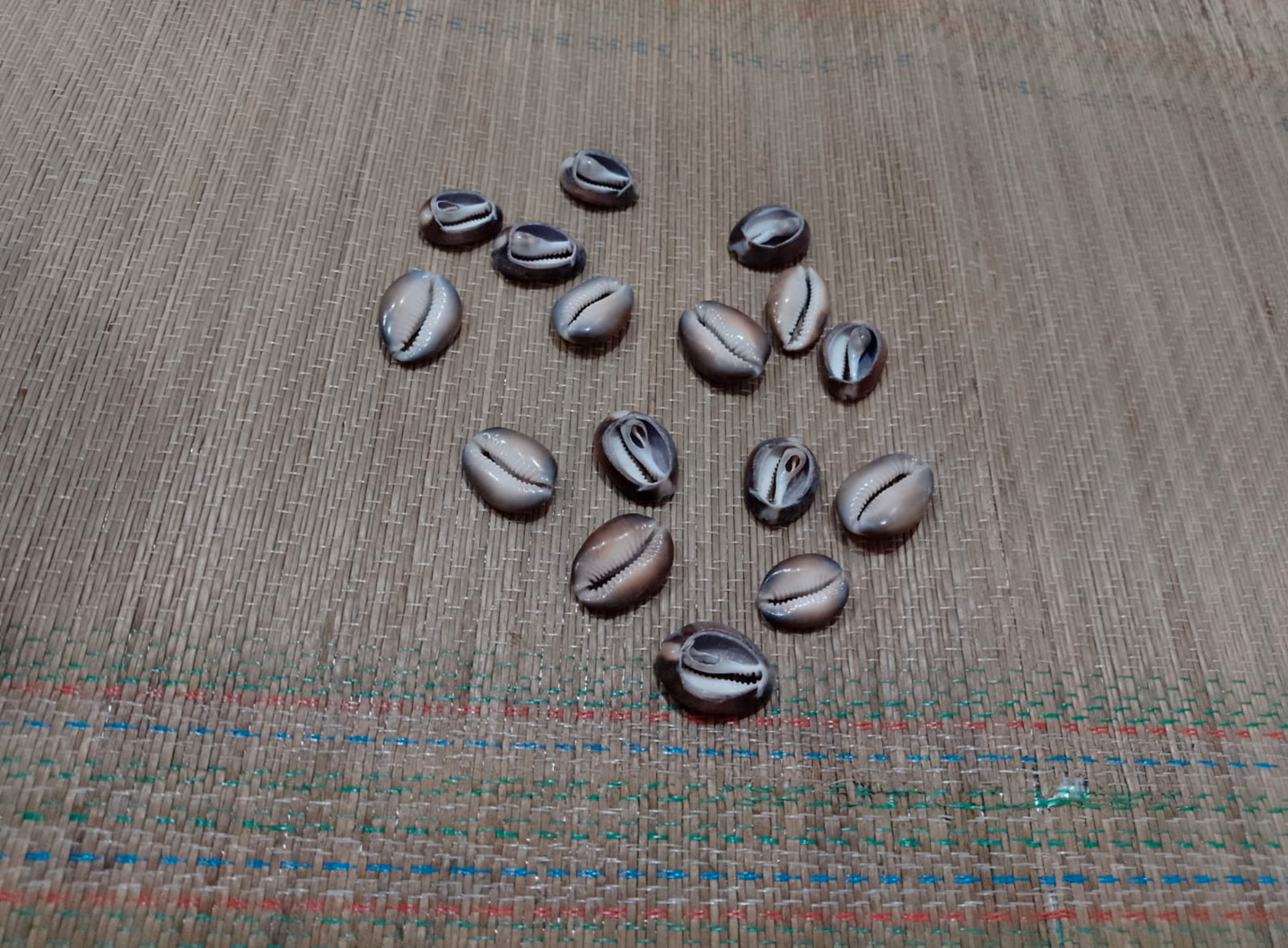
One of the central divinatory systems within the Afro-Cuban Regla de Ocha is the diloggún. This oracle consists of sixteen cowrie shells whose natural openings are understood as the mouths of the orishas. Through them, the deities reveal signs, or odu, that guide communication with human beings (Figure 1). The determination of each odu depends on how many shells fall with their openings facing upward (see Castro 2008; Lele 2003; Matibag 1996).
When the diloggún is cast, two central notions are used to diagnose the circumstances surrounding the person receiving the consultation: iré and osogbo. Iré refers to positive energies—conditions of balance around the individual, as indicated by the odu revealed in the reading. The specific type of energy is identified through additional questions and casts. Osogbo, by contrast, signifies negative scenarios—imbalances that must be investigated in order to be prevented or corrected.
Figure 1. Diloggún of the Orisha Elegguá, Showing the Odu Known as Unle
Source: Authors, Matanzas, Cuba, 2023.
Once iré or osogbo has been determined, the officiant—whether healer or oriaté6—establishes the typology of these energies through further questioning and additional casts, and then interprets the messages conveyed in what is known as the complete prayer (oración completa) of the consultation. This complete prayer integrates several elements: the principal odu of the consultation—for example, Ogunda (3) tonti Iroso (4)7 or Obara (6) tonti Odi (7); the determination of whether the person is in iré or osogbo; the specific type of iré or osogbo; the channels through which these energies manifest—such as the mind and decisions, the orishas, or initiation (elese eleda; elese ocha), among others; and finally, the condition of these energies—whether complete or incomplete (yale tese tese or coto yale).
It is through oracles such as the diloggún that the Regla de Ocha diagnoses problems and prescribes solutions, mediating between the human and the transcendent. These solutions can take different forms—guidance, decisions, and more—one of which is the healing of reproductive problems and, with it, the awakening of fertility.8
Our encounter with this oracle took place on January 1, 2023, in the home of Angélica’s padrino. Our motivation to do so lay in our belief in its efficacy—and in that of the Regla de Ocha more broadly—for diagnosing and prescribing responses to the reproductive difficulties we had faced. The meeting had also been recommended by Mandy, who arranged for the procedure with the oriaté.
Although the consultation was only for Angélica, we both wanted to be present, given the painful and unsuccessful attempts at motherhood and fatherhood we had experienced and the discouraging medical assessments we had been given. At that point, we were anxious to define possible paths for pursuing those attempts.
At Mandy’s house, we greeted the orishas and those present. Such greetings are a way of showing respect both to the orishas and to the other entities that dwell in and protect the home. Present on this occasion were Mandy, Hans’s aunt Rita—known in the Regla de Ocha as Omi Tomi and initiated sixty-four years ago—and the oriaté.
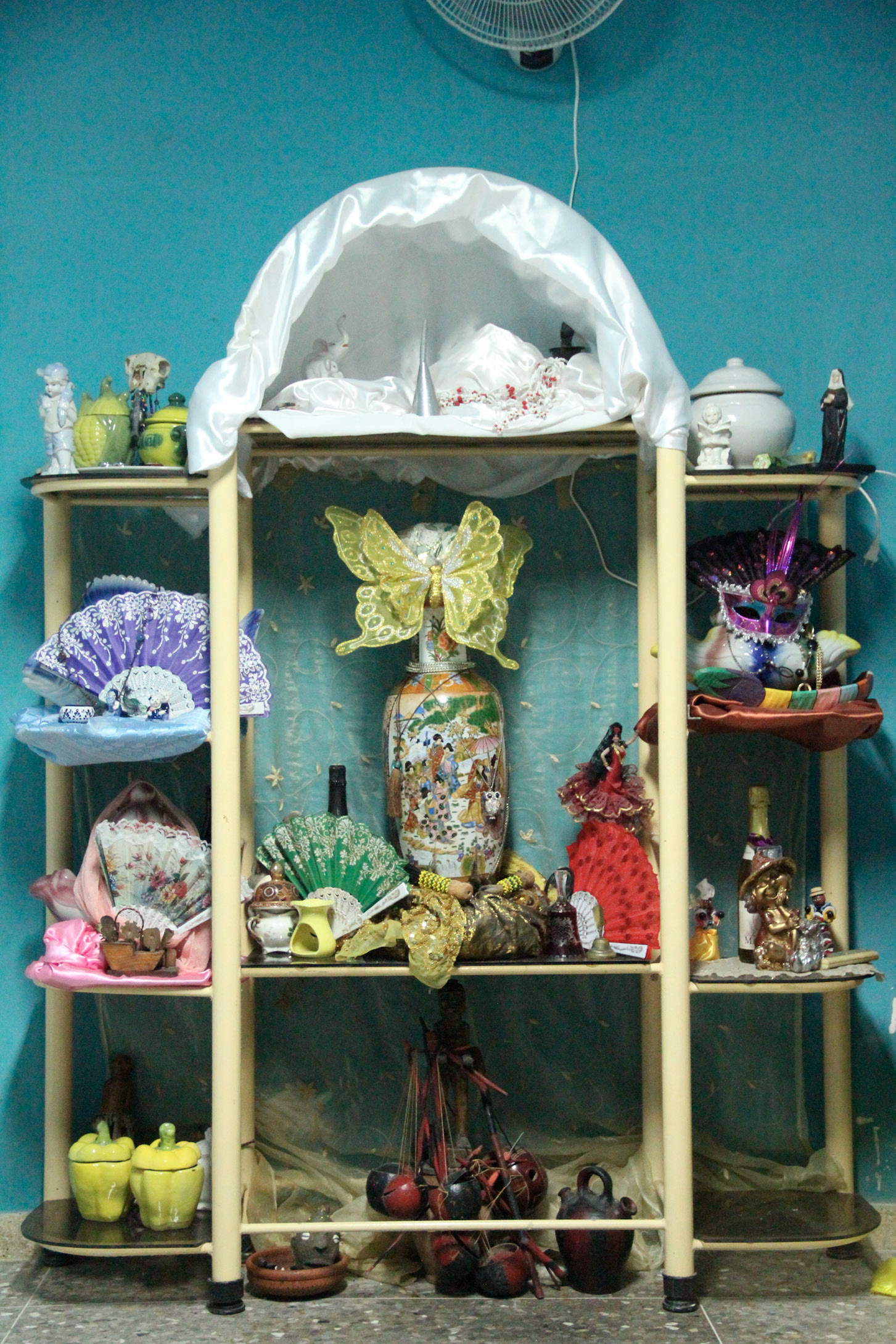
The room of the orishas (Figure 2), where the diloggún was to be cast, had already been prepared and furnished with elements that we recognized as part of the mystical world shared by those present. These objects reflected the social, individual, and spiritual relationships of the context, and conveyed a sense of trust and calm.
To the right of the entrance door, a mat was spread on the floor, covered with a white sheet. Beside it stood a small bowl made of the dried shell of a gourd (jícara)9 filled with fresh water and a small white plate holding five vistas10 or pieces of coconut (Figure 3). There were also two deep white plates containing the diloggún to be cast. These items formed the basic set of elements typically present in any bajada.11
Figure 2. Altar and Room Dedicated to the Orishas
Source: Photograph courtesy of Ana María Rivera Ospina, Havana, Cuba, 2019.
Figure 3. Coconut Pieces Prepared for Ceremony

Source: Photograph courtesy of Ana María Rivera Ospina, Havana, Cuba, 2019.
The oriaté knelt on the mat, kissed it, and recited a prayer in Yoruba to ask permission for its use. He then leaned back against the wall and invited Angélica—dressed in white with a headscarf—to sit facing him on the mat, on a small bench. Once she was seated, Mandy handed her a white cloth to place over her knees, a common practice during consultations with women.
In her right hand, Angélica held the money to pay for the bajada. She touched it to her forehead, navel, left shoulder, and right shoulder before handing it to the oriaté. This gesture serves to activate the body’s energy points and connect that energy with the diloggún through the money. The oriaté placed the payment on top of the diloggún, which rested on the mat. He then dipped the middle finger of his right hand into the gourd of fresh water, sprinkling drops onto the ground and over the diloggún, while pronouncing the Yoruba invocation: “omi tuto, ona tuto, tuto ile, tuto owo, tuto omo, ariku babawa”—fresh water, fresh path, freshness for the home, freshness for money, freshness for children, longevity and life through the Orishas. With this, the consultation began.
The oriaté then took the diloggún and the payment and began making circular movements over the mat with his right hand. At the same time, he recited his moyugba,12 an invocation of respect to call upon the entities in support of the ritual that was now underway.
The moyugba unfolded through different phases of homage. It paid tribute to the supreme being, to supernatural forces, and to ancestral wisdoms: “[…] moyugba Olofin, Olorun, Olodumare […].” This was followed by invocations of the ancestors—spirits of the departed, whether religious or not (“[…] iyalochas, babalochas, bogbo eggun tekun timbelaye, timbelese, Olodumare”)—as well as the orishas, the parents, the godparents, and finally, the people present in the house. After these greetings, the moyugba explained the purpose of the consultation to the invoked entities and concluded with petitions for protection and guidance, to ward off misfortune and secure well-being.
Both the preparation of the orishas’ room and the moyugba illustrate the kinds of bridges established by the oriaté that frame the practice of the diloggún and help build bonds of trust among those present. These elements rest on prior individual, social, and spiritual relations that involve processes of personal and collective learning, investment of time and resources, initiation rituals, and previous spiritual cleansings. For the oriaté in particular, they also draw on earlier experiences of how his spirituality and spiritual connections operate, with the recitation of the moyugba serving as a channel of access to them. In this sense, all these relationships shape the oriaté’s way of being and doing: his skills, vital energies, and spiritual connections. These, in turn, condition his aché13—his spiritual power—and his capacity to interpret the articulations at play, as well as the balances and imbalances—individual, social, and mystical—surrounding our fertility problems.
A brief pause is needed here. The fact that the oriaté interprets the messages of the diloggún concerning our surroundings highlights that he and we are both active participants in shaping the socio-spiritual bonds established in that space, as well as in the diagnoses of adversities and solutions. One example is the harmony created through affective and symbolic engagements between the two sides: when the oriaté’s interpretations capture states of balance or imbalance emanating from our supernatural environment, they align with our lived realities, thoughts, and perceptions. After all, what is being interpreted if not those very realities—the messages or vibrations—radiated by the consultants themselves? This points to an interdependence between the oriaté and Angélica—between us as consultants—where our agency is recognized in the symbolic bridges and multiple affective and symbolic engagements enacted in the casting of the diloggún.
Once the moyugba concluded, the oriaté picked up the diloggún from the mat, joined his hands, and as he rubbed the shells together invoked: “kinkamashe mi babá tobí de osha, kinkamashe mi oyubona, kinkamashe santeros mayores y menores”—a request for the blessings and permission of his padrino de ocha (the person who initiated him), his oyugbona (the “guiding eyes,” second godparent responsible alongside the main sponsor for the initiate), and of the initiated practitioners present. This act reflects the belief that their energies also participate in a collective process that transcends the interaction between the oriaté and Angélica. Mentioning them is both an act of homage and a call for support, acknowledging the mystical bridges linking officiants, consultants, and other energies involved in the emergence of ancestral knowledge through the diloggún.
Following these invocations, the oriaté held the diloggún in his right hand and gently touched Angélica at various points of the body considered emitters of vibration: forehead, head, nape, neck, right and left shoulders, right and left knees, feet, and both hands front and back, ending with palms facing upward. He then marked the four cardinal points above the mat with his closed hand while holding the diloggún. Immediately afterward, he proclaimed: “oshareo” (“the orishas are going to speak”) three times, to which those present responded: “aldashé” (“so be it”). With that, the diloggún was cast, revealing the odu of the consultation: Oshé tonti Ofú (5-10).
The oriaté then asked whether this sign for Angélica came in iré or osogbo, so as to complete the prayer of the consultation. It was revealed to be iré arikú yale tese tese, elese eleda: a firm and perfect well-being, in general, achieved through her own mind.
The oriaté then began to share ancestral knowledge concerning Angélica, drawing on his interpretation of the diloggún as well as on his prior social, individual, and spiritual connections. At the same time, Angélica’s own past experiences—social, individual, and spiritual—were expressed as vibrations that the diloggún captured and that the oriaté interpreted, creating a flow of interdependencies through which this knowledge emerged.
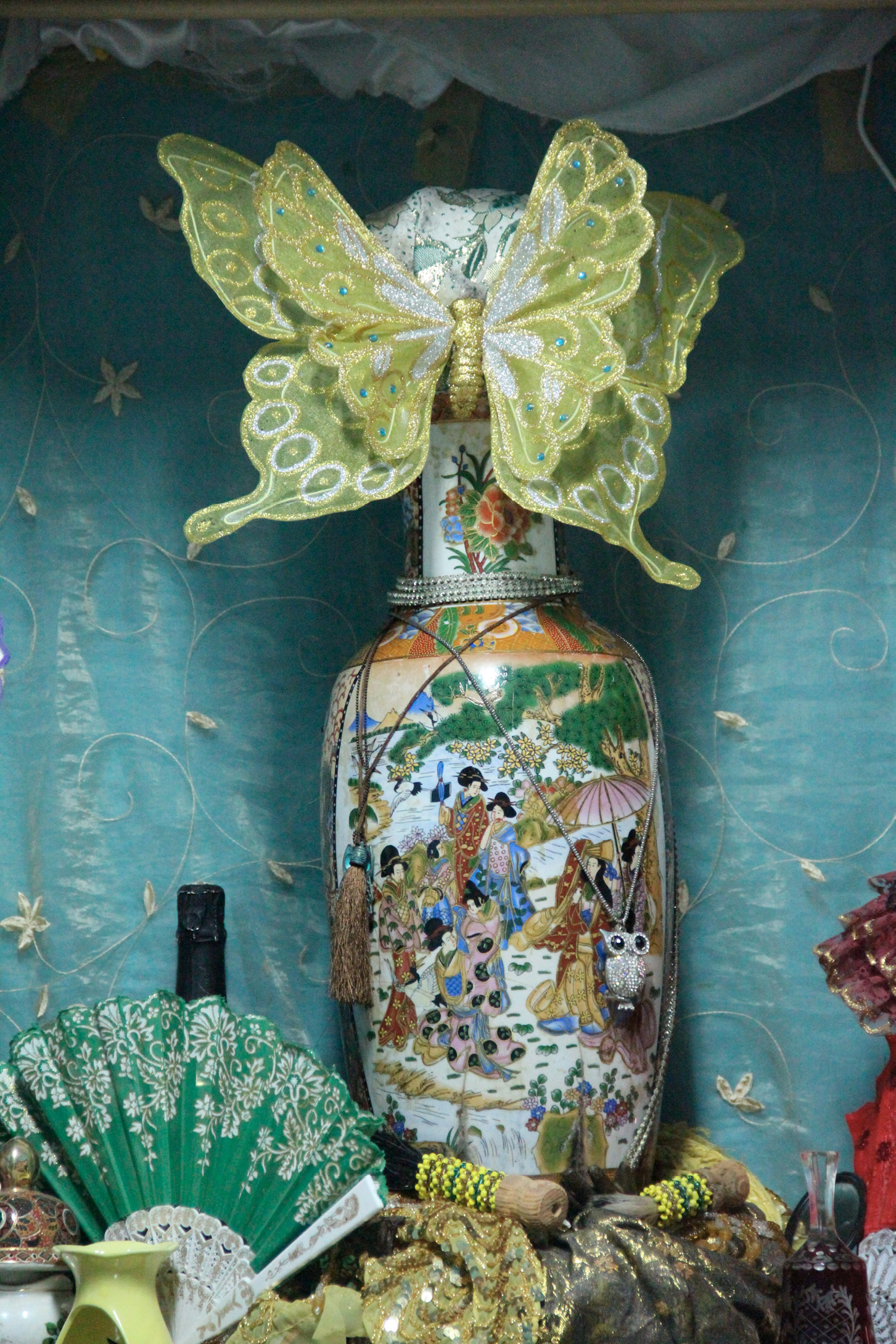
Among the recommendations Angélica received were to perform ceremonies at the foot of Ochún, both at the river and at home, to remove curses from her womb. She was also instructed to carry out fertility works with Yemayá at the sea, over sixteen consecutive days beginning on that date, grounded in the belief that Ochún and Yemayá influence fertility and the aché of motherhood (Figures 4 and 5). Yet another piece of counsel quickly surfaced, one that spoke directly to our deepest concern:
You will have children, but not when you want, only when you are ready. Pregnancy is not in your womb; it is in your mind. The path will not be easy—you will face tense moments that could make you lose faith. But with perseverance, faith, and great strength, you will fulfill your dream of becoming a mother. (Oriaté, January 2023)
Figure 4. Ochún: Goddess of Rivers and Fertility
Source: Photograph courtesy of Ana María Rivera Ospina, Havana, Cuba, 2019.
Figure 5. Yemayá: The Great Mother
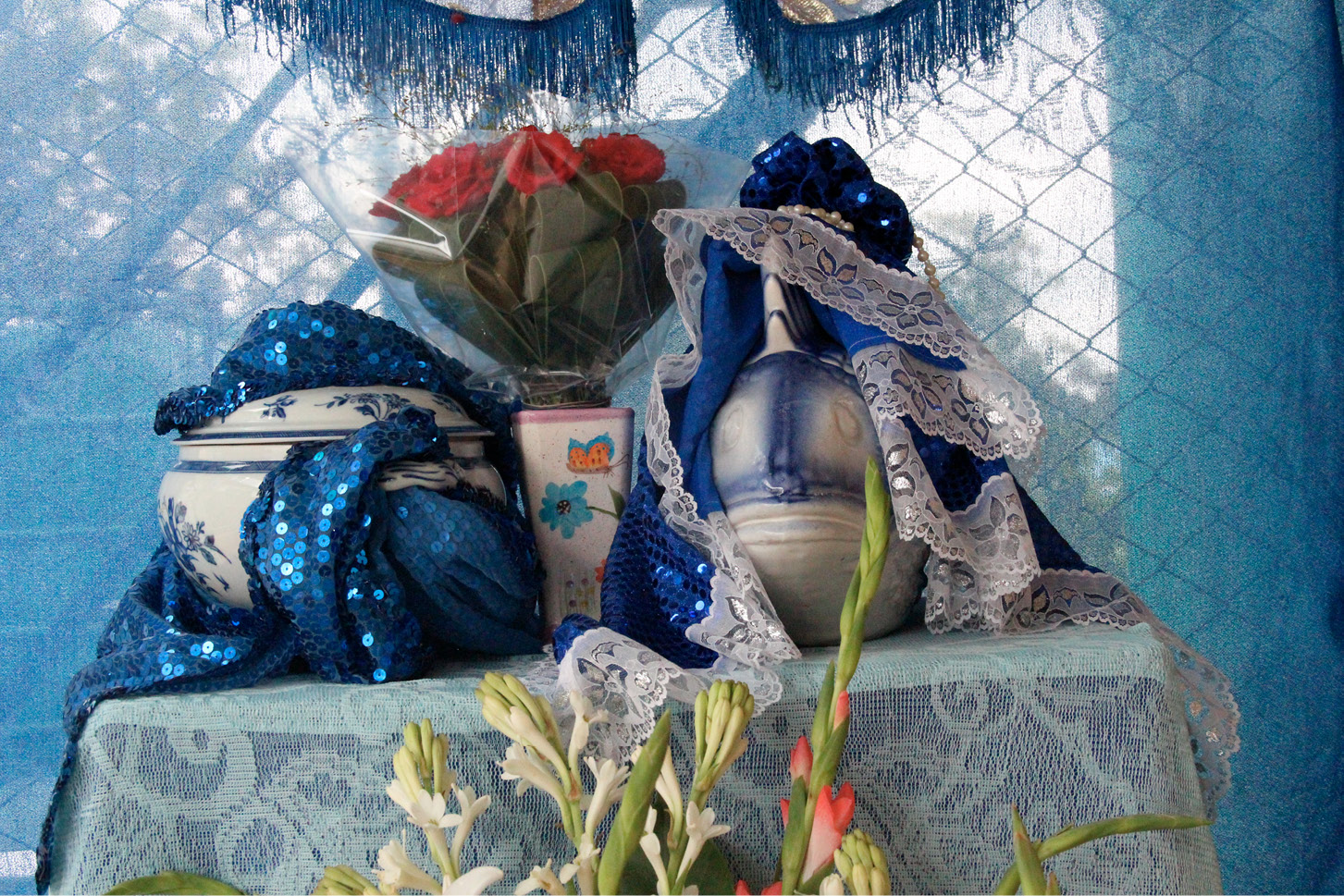
Source: Photograph courtesy of Ana María Rivera Ospina, Havana, Cuba, 2019.
We experienced those words differently. For Angélica, they brought tension and confusion, but also gratitude, hope, renewed strength, and a sense of safety and well-being, since the orishas predicted she would have children of her own. Yet she also felt impatience, pessimism, and anxiety. Hans, for his part, felt hopeful too, though tempered by concern about the magnitude of the challenges that had been foretold.
The oriaté’s words pointed to Angélica’s lack of mental readiness and recommended that she work to neutralize the catastrophic weight of the past, particularly the failed pregnancy of Iara. Angélica questioned how she could prepare for such a future when the past still felt so heavy, and how it was possible that the progress made in emotional healing was not yet enough after so much pain.
At the end of the consultation, the oriaté wrote down on a sheet of paper the ingredients Angélica needed to gather for the ceremony at the foot of Yemayá: a melon, a yellow piece of paper, sugarcane molasses, two candles, a blue cloth, and seven one-cent coins. He then gave us three additional recommendations, shared in the course of cordial conversation. The first was to carry out limpiezas (spiritual cleansings) at the foot of the bóveda espiritual,14 since the odu revealed had warned of curses to guard against. The second, connected to the first, was to prepare a remedy made from soap and quita maldición or curse removal leaves (Caesalpinia major).15 Finally, the third was to perform religious ceremonies with Ochún to prevent ailments of the womb. In fact, the oriaté himself, by way of suggestion, described the purification ceremony he had carried out for his wife before and during her pregnancy.
You take a gourd and anoint it with honey, cinnamon, and perfume. Before going to bed, you invoke Ochún and explain what you are doing and why. Then you cleanse your womb—your husband can also do it—every night before sleeping. When you finish, place the gourd at the foot of your bed with two candles lit. Once the gourd dries out, replace it and repeat the same procedure. This will remove the everyday curses from your womb and make it easier for you to have a calmer pregnancy. Trust me, this never fails—I have always done it myself, and I have three children. (Oriaté, January 2023)
On our way home, we discussed the events and the ethnographic encounters we had just experienced, each from our own standpoint. One phrase in particular dominated those conversations: the oriaté’s assertion that “pregnancy is not in your womb, it is in your mind.”
That statement captured the very essence of the symbolic and affective bridges and engagements that ran through the consultation with the diloggún, shaped as much by the oriaté’s individual, collective, and spiritual trajectories as by our own. In making this pronouncement, the oriaté succeeded in grasping the connections between his own way of being (Castro 2022, 2008) and the social, personal, spiritual, and affective realities that explained our presence there and grounded our engagement with the messages that emerged. This recognition amplified the transactional process of our experiences, as our fertility struggles and their possible solutions took on new dimensions through the cosmologies and spiritual symbolisms articulated by the oriaté.
The Diloggún and the Awakening of Fertility: Transformations and the Configuration of Possible Worlds
Through these spiritual, cosmological, affective, and symbolic bridges and engagements, we experienced transformations in our well-being. These took shape through a reevaluation of past and present painful events—moments marked by anxiety, worry, sadness, and uncertainty about whether we could actually have children. At the same time, such reevaluations were infused with expectations projected onto a promising future.
For Angélica, these reflections centered on the trauma of losing a pregnancy, an experience inscribed directly on her body and mind, and on the violent, socially normalized gaze that branded her as “useless” for not being able to procreate. For Hans, the weight lay in his position as a kind of spectator-mediator, compelled to neglect his own grief in order to manage the suffering of others and prevent the collapse that loomed:
I had to learn and summon strength I didn’t know I had—and quickly—to cope with the situation, so that Angélica, her mother, her father, my aunt, my father, and my mother would not fall apart. Otherwise, the tragedy would have been even greater, because this was a baby deeply desired by the whole family. On top of that, I had to teach others how to handle the situation, taking on a posture of supposed strength and composure, which I could only sustain through my relationship with the cosmology of the Regla de Ocha. Angélica, for her part, believed she had an obligation to give me children in order to be a good wife, and that broke my heart, because it was something I had never even suggested. But there was society, impressing upon her twisted ways of being that left me feeling powerless. My family, meanwhile, suffered at the thought of my suffering. So, I had to pretend that I had accepted Iara’s death calmly, when in truth I had not, because my heart was torn apart. (Diary, January 2023)
Our consultation with the diloggún partially reconfigured these earlier scenarios. The diagnoses of problems and solutions it offered allowed anxiety to give way to serenity, worry to hope, sadness to optimism, and—most importantly—uncertainty to trust in our ability to have children, provided we followed the right paths. These paths included addressing fertility problems through both Western medicine and the spiritual therapies of the Regla de Ocha.
At the same time, the future of these concerns was being shaped through other lenses. Imagining a different future emerged from ongoing re-evaluations of both past and present; these reflections gave meaning and were themselves reinforced by the importance the imagined future held for us. The diloggún, and the engagements it generated, spurred experiential transformations shaped by the interplay of pasts, presents, and futures, opening possibilities for other ways of being, living, and envisioning experiences—both those already lived and those still to come. These visions pointed to the need for balance and cooperation at social, individual, and spiritual levels, as pathways toward bringing the desired future into being. How, then, did this future manifest itself?
The realization of our parenthood, tied to the diagnoses and solutions brought forth by the diloggún, came about differently than we had wished or imagined. This shows that the oriaté’s interpretation of the oracle’s messages—which had underpinned words of encouragement regarding pregnancy—can open a range of transformative possibilities that we may not always anticipate.
Some time after we had carried out the rituals prescribed through the diloggún, Angélica began to suffer heavy bleeding caused by fibroids.16 This led to an emergency hospitalization with a diagnosis of hysterectomy. Faced with this, she surrendered without emotional resistance to the authority of medical judgment, resigning herself to what seemed an inevitable future: to live without a uterus and abandon any possibility of pregnancy. In this context, the symbolic bridges and engagements that had once inspired hope began to fade, though Hans continued to view that apparent ending with skepticism.
Even so, the ways in which we positioned ourselves—in terms of cooperation and the socio-spiritual balances projected through the diloggún as essential to well-being—helped counteract this discouragement, giving rise instead to other forms of well-being. Although our expectations of becoming parents were not realized, since the conditions of fertility did not change, other realities did. Chief among these were new forms of connection with oneself and with the problematic universe of fertility
The hysterectomy diagnoses led Hans to seek an additional consultation, while Angélica was accompanied by friends at the hospital. The message that emerged was the following:
Delay the surgery the doctors are proposing until the very last moment. Encourage them to make every effort to prevent or lessen the bleeding, and if surgery becomes necessary, seek a doctor willing to investigate and treat the underlying cause rather than making a radical decision about your body. That will be the wisest course to take. (Personal communication with babalawo Agboola, January 2023)
After five days of hospitalization, during which we fought to have the doctors prioritize medication, my hemorrhage [Angélica] had lessened, so I could transfer to another hospital and receive different medical care. There, I underwent a successful myomectomy, which meant I could preserve my uterus—and in better condition than before. This also brought renewed self-esteem and physical well-being, as my uterine mobility improved and menstrual cramps diminished considerably. Experiences like these, interwoven with the enduring presence of social, individual, and spiritual cooperation and balance—threads that crossed our symbolic, social, and spiritual engagements with the oriaté—mobilized other forms of healing, shaped by different ways of being and perceiving in the face of our fertility challenges.
That healing did not take the form of a confirmed pregnancy, but rather of improved conditions for well-being. The bridges and engagements we sustained after the diloggún helped us find and follow an alternative path, one that countered the fragility of the connections in which Angélica had been immersed. On this path, they also fostered cooperation and socio-spiritual balance between us as a couple.
Today, Angélica understands that success does not have to be tied exclusively to becoming a mother. First, she had to be alive; then, she needed to ensure her physical and emotional well-being. This is the position that best defines our current ways of being and envisioning, shaped by the experience of the diloggún. It is not a present-future of resignation, since fertility problems matter less now. For Angélica, it is a present-future marked by greater self-knowledge, by the capacity to re-signify and accept herself and her body, regardless of whether or not it proves capable of carrying motherhood into being. For Hans, it is one of satisfaction and emotional well-being, grounded in Angélica’s achievements.
One concrete moment illustrates this new way of being and seeing. During a recent medical consultation in August 2023, I [Angélica] had an ultrasound, and the doctor exclaimed: “You still have fibroids that might make pregnancy difficult.” In the past, those words would have always distressed me.
I [Hans], sitting beside her, turned to watch her reaction. I had always encouraged her to reframe her struggles with infertility, though we had lived with the frustration of not seeing significant progress. That day, however, I was met—happily—with a very different response.
I [Angélica] could see in Hans’s eyes both his concern about how I would react to the doctor’s diagnosis and, almost immediately, his astonishment. Those medical prognoses no longer affected me, no longer devastated me. What did such a confirmation of fertility problems mean for a woman who—thanks to the diloggún and the Regla de Ocha—had already overcome death and the threat of hysterectomy?
The diloggún and the Regla de Ocha have brought forms of well-being and mystical-social balance into our lives. Today, we envision worlds in which biological motherhood or fatherhood, at any cost, is not what matters, and where its absence is not equated with self-devaluation. Angélica’s uterus and mind are in better condition than before, and what now holds value is maintaining a socio-spiritual equilibrium that sustains our social, physical, and emotional well-being.
The phrase “pregnancy is not in the womb, it is in the mind” captured what the oriaté foresaw—something that had been invisible to us. The “mind” here refers not only to its physical form but also to emotions, decisions, connections, and socio-spiritual balances. It was precisely this dimension that needed to be addressed in order to endure the difficult path foretold in the diloggún interpretation, and to arrive at new modes of being—physical, emotional, and spiritual—while opening the possibility of envisioning more favorable horizons of parenthood, in whatever form—biological or otherwise—it may come.
From these experiences, the ways of being and envisioning fostered by the diloggún—which gave rise to worlds of well-being and socio-spiritual balance—emerge not only as a concrete form of healing, alongside the physiological and psychological transformations that prevent greater harm and help carry the burden of fertility problems, but also as healing itself, manifest within the multiple possibilities afforded by certain individual, social, and spiritual equilibria.
Discussion and final thoughts
Through a reflexive ethnography and a narrative approach, we have described the diloggún in the Afro-Cuban Regla de Ocha and its influence on the healing of fertility problems. Our lived experiences point to the contingent nature of the transformations that make up modes of healing, which in our case translated into an awakening of fertility
This awakening can take shape across a wide range of possibilities and timelines. While such healing—whether physiological or psychological—may manifest as childbirth itself, as the prevention of future reproductive or non-reproductive problems, as the disappearance of such problems, or as a way of coping with their impacts, its expression ultimately depends on ways of being and envisioning that sustain particular forms of socio-spiritual balance.
The Afro-Cuban diloggún oracle has played a role in building these balances by providing diagnoses of adversities and ways of addressing them through rituals and new modes of being and envisioning. This study, which includes us as practitioners, bears witness to that role of the diloggún, even if it reveals healing in only one of its possible manifestations: physiological and psychological transformations that help prevent reproductive or non-reproductive problems. The transformations we have described—related both to Angélica’s uterus and to her psychological conditions—suggest that we are still in the early stages of this awakening of fertility. For this to happen—and in our case specifically—it required taking steps that made it possible to preserve the uterus in better condition than in earlier stages.
Beyond our specific case, this study helps validate the relevance of the theoretical frameworks that sustained it—frameworks previously applied in other religious or spiritual contexts different from the one analyzed here. The ideas on symbolic healing (Dow 1986; Frank and Frank 1993; Hinton and Kirmayer 2017; Kirmayer 1993; Lévi-Strauss 1949), which guided our work, proved important not only for alerting us to the various processes that shape healing but also for allowing us to feel the effects of these theoretical-methodological orientations in relation to our own experiences, thereby enabling other possibilities to emerge. These effects were responsible not only for such validation but also for suggesting refinements and extensions to the cited frameworks.
The first such refinement we can propose resonates with several ideas about shared mythologies (Frank and Frank 1993; Hinton and Kirmayer 2017; Kirmayer 1993; Lévi-Strauss 1949), which Dow (1986), under the notion of the “mythical world,” identifies as a universal dimension of healing. This notion assumes that officiants and consultants share beliefs and reference frames that lead them to the diloggún. In our analysis, this assumption was confirmed when we recognized that our turn to this oracle was indeed shaped by converging beliefs shared between us and the oriaté regarding the capacities of the diloggún and the Regla de Ocha to diagnose and resolve problems. At the same time, however, we also acknowledge that such a turn is not always proportional to those affinities, since shared beliefs are often interwoven with divergences that likewise condition the very possibility of such an encounter. What, then, are those divergences?
Those who seek healing may turn to the diloggún as their only way out, without necessarily sharing a belief in the oracle’s healing power. This turn can stem from dissatisfaction in the face of adversity or from curiosity about exploring a last chance, rather than from deeply held convictions shared with the officiants. Even when common beliefs between consultants and officiants exist as conditions for the casting of the diloggún—and for the beginning of the healing process—there are differences in how those beliefs are understood, and these, too, shape the possibility of such an encounter with the oracle.
While consultants—especially in their first encounters—often approach the diloggún driven by magical or miraculous expectations of solving their problems, officiants and healers are generally aware that the solutions to diagnosed problems may not depend on the purely magical or miraculous. Rather, they emerge through the cultivation of a lifestyle shaped by interconnections and balances among spiritual, individual, and social components. Thus, while it is reasonable to assume that shared mythical worlds regarding the diloggún enable its use as an oracle for both healers and consultants, it is equally important to recognize that these worlds are traversed by different cognitive and symbolic universes. These differences not only diversify the role of mythology in shaping the social lives of both actors but also affect the very possibility of using the oracle as a guide for healing.
Our own experience illustrates this. When the oriaté spoke about my [Angélica’s] fertility problems—“pregnancy is not in the womb, it is in the mind”—we realized how much our decision to consult the diloggún had rested on a limited belief, one centered solely on the magical or miraculous: “it was only through the divine action of the orishas that our problems could be reversed.” Yet the diloggún itself revealed a far more complex path, one that required balance between the spiritual and the social.
Building on these reflections, we propose rethinking the first step of symbolic healing—often described as a shared mythical world (Dow 1986; Frank and Frank 1993; Kirmayer 1993; Lévi-Strauss 1949)—by incorporating additional elements that highlight cognitive and symbolic differences between officiants and consultants, which are equally relevant to initiating and sustaining the healing process. Thus, at least with regard to healing through the diloggún, and in order to better capture the dynamics we have described, we suggest calling this step a relatively shared mythical world.
Further contributions from our study relate to the second step of healing, which, following Dow (1986), we term “symbolic bridges and persuasion,” and which has also been recognized by other scholars (Kirmayer 1993). Applying this notion to the context of the diloggún implies that the diagnosis of adversities emerges from the officiant’s particularized reconstruction of the consultant’s world, grounded in shared mythologies and emotional bonds created during the therapeutic encounter. This process also involves persuasion, through mythical or symbolic manipulation, aimed at producing emotional transactions and suggesting new patterns of understanding and behavior for the consultant.
However, our study of the diloggún points to other dimensions of this step, beginning with a recognition of certain limitations in Dow’s (1986) framing of symbolic bridges and persuasion. His account overlooks additional types of bridges that influence emotional transactions and the redefinitions of meaning and behavior that shape healing. It also tends to obscure the agency and active role of consultants themselves in creating symbolic bridges that underlie those very transactions and redefinitions.
The diagnosis of adversities through the diloggún—arising from symbolic bridges that allow for the particularization of the consultant’s world and the consequent persuasive transactions—is also anchored in other types of bridges that unfold across different temporalities: (1) the officiant’s prior bridges—individual, social, and mystical—that prepare the conditions for the use of the diloggún; (2) the consultants’ prior bridges—individual, social, and mystical—that justify their search for and encounter with the diloggún; (3) bridges—mystical, symbolic, and affective—between officiants and consultants that bring forth ancestral knowledge during the diloggún consultation; and (4) the consultants’ subsequent bridges—individual, social, and mystical—that make healing possible after the encounter. These bridges, which precede and extend beyond the ritual moment, should be understood as interrelated and non-linear processes, rather than as a single, momentary connection between emotions and mystical symbols.
Our argument for this cognitive refinement rests on several aspects. First, the symbolic and affective bridges between us and the oriaté took shape because the prescriptions were able to capture various situations of balance and imbalance—individual, collective, and spiritual—that resonated with our realities, thoughts, and experiences. Yet this information was not simply available. It became available through the mediation of prior bridges—our own and those of the oriaté—as well as through the bridges collectively activated during the consultation itself, which brought forth some forms of knowledge and not others. These interconnections point to a relation of interdependence between the oriaté and Angélica—and, by extension, us as consultants—in which our past experiences play an active role in shaping the symbolic bridges established during the casting of the diloggún. Hence, we are inclined to understand what Dow (1986) calls “persuasion” as a broader process of involvement, and we therefore propose renaming this step symbolic bridges and involvements.
From the standpoint of the diloggún, healing can also be approached through other lenses. Some emphasize the process as a symbolic and biological transaction, as well as an experiential transformation (Dow 1986), while others focus more directly on the phenomenon of healing itself. Some relate to what Dow (1986) termed symbolic/biological transaction and experiential transformation; others pertain to the phenomenon of healing itself. The first process reveals that the manipulation of mythic symbols and the application of rituals generate emotional and biological transactions, as well as self-evaluations of the consultant’s past and present. Yet, in the context of the diloggún, these transactions, evaluations, and re-evaluations are not limited to the past and present. They are also oriented toward the future, and that imagined future, in turn, shapes how experiential transformations and the particularization of a relatively shared mythical world unfold in the present for the purpose of healing. All of this occurs not only through the manipulation of symbols (Dow 1986) but through a more complex web of social and spiritual interrelations among the consultant, other entities, and the oriaté—relations in which the oriaté assumes a role not fully captured by Dow’s conceptualization.
Highlighting the distinction between Dow’s (1986) notion of symbolic manipulation and the oriaté’s role is essential. While the former can be understood as intervening in a given situation by altering or distorting it, the oriaté’s work, in our experience, is of a different order. The oriaté interprets, senses, unfolds, and expresses, thereby particularizing the states of affairs that have shaped, currently shape, or may shape the consultant’s life—states that become accessible in that moment due to several factors. Among these are the specific problems that require unveiling, the timing of the consultation, and the characteristics and life trajectories of both the consultant(s) and the oriaté. These elements are decisive for the affective bonds that arise in the consultation and for the transformative possibilities that may emerge. It is on these grounds that we propose naming this stage of healing experiential transformation and the particularization of a relatively shared mythical world.
Finally, our study has also allowed us to advance complementary reflections on the final phase—healing—of what Dow (1986) described as magical healing, but which we find more appropriate to understand as socio-spiritual healing. Initially, this stage was conceived as the materialization of psychological and physiological transformations resulting from the interactions and communications established between healer and patient (Dow 1986; Hinton and Kirmayer 2017; Kirmayer 1993). However, through the lens of the diloggún, new elements come into view that broaden this understanding.
Our experience with the diloggún revealed that socio-spiritual healing should not be reduced to psychological or physiological transformation alone. Rather, it can be seen as a contingent and multifaceted process of transformation. This point is exemplified by the fact that Angélica underwent surgery and re-signified her understanding of motherhood and parenthood, after following procedures and orientations received through the diloggún that had pointed toward a future awakening of fertility.
Therefore, rather than conceiving socio-spiritual healing merely as symbolic, affective, and physiological modifications that eliminate diagnosed ailments, it should be understood as the materialization of ways of being and of envisioning worlds of cooperation and socio-spiritual balance that channel possible forms of well-being. In other words, it constitutes socio-spiritual healing because it entails inhabiting multiple worlds of cooperation and interconnected spheres of social and spiritual equilibrium, with diverse possible outcomes: (1) physiological transformation itself; (2) psychological-physiological transformations; (3) preventive treatment of social, physiological, and psychological ailments; and (4) strategies for coping with or reducing the impact of such ailments.
Up to this point, we have presented the main results and essential contributions of our analysis. Our lived experiences and reflections—drawn from the little-explored context of the diloggún within Afro-Cuban Regla de Ocha—embody theoretical-methodological as well as conceptual contributions regarding healing and its relationship with fertility, while also pointing to broader contributions to ethnographic studies. Within this field, research on Afro-Cuban religions and their impact on the awakening of female fertility remains incipient, and it is in this direction that we hope to continue deepening our investigations.
References
- Abaroa Boloña, Leonel. 2013. “Bóvedas Espirituales: A Theological Study of Cuban Family Religions.” Doctoral Thesis, Department of the Toronto School of Theology Faculty of Divinity, Trinity College and the Theology, University of St. Michael’s College, Toronto. https://hdl.handle.net/1807/43412
- Aguiar Cedeño, Jorge Dayán and Secundino Aldama. 2023. La cultura afrocubana en Cuba, una mirada desde el siglo XXI: testimonios en entrevistas y vivencias religiosas. Havana: Editorial Universitaria.
- Baer, Hans A. 2005. “Trends in Religious Healing and the Integration of Biomedicine and Complementary and Alternative Medicine in the United States and Around the Globe: A Review.” Medical Anthropology Quarterly 19: 437-442. https://doi.org/10.1525/maq.2005.19.4.437
- Barnet, Miguel. 1995. Cultos afrocubanos. La regla de ocha. La regla de palo monte. Havana: Ediciones Unión.
- Bartra, Roger. 2019. Chamanes y robots. Reflexiones sobre el efecto placebo y la conciencia artificial. Mexico City: Anagrama.
- Carneiro, Janderson Bax and Sônia Maria Giacomini. “‘Ninguém vem ao mundo a passeio’: notas sobre sacerdócio feminino, cura e cuidado em terreiros de ‘umbanda traçada.’” Revista de Antropologia da UFSCar 12 (1): 280-302. https://doi.org/10.52426/rau.v12i1.340
- Castro Ramírez, Luis Carlos. 2022. “Habitar mundos humanos-no-humanos en el complejo santería-ifá: relacionamientos medioambientales y flujos diaspóricos Colombia-Cuba-México.” Naturaleza y Sociedad. Desafíos Medioambientales 3: 112-155. https://doi.org/10.53010/nys3.06
- Castro Ramírez, Luis Carlos. 2008. “Tecnologías terapéuticas: sistemas de interpretación en la regla de ocha y el espiritismo bogotano.” Antípoda. Revista de Antropología y Arqueología 6: 133-152. https://doi.org/10.7440/antipoda6.2008.07
- Caynas Rojas, Seriad and Roberto E. Mercadillo. 2024. “Cognición extendida y símbolos de la velada mazateca con hongos psilocibios.” Andamios, Revista de Investigación Social 21 (54): 179-210. https://doi.org/10.29092/uacm.v21i54.1063
- Da Silveira, Emerson José Sena and Izabela Matos Floriano Mendonça. 2014. “Novas tecnologias terapêutico-religiosas: notas sobre a apometria como técnica e campo de expressões religiosas híbridas.” Caminhos - Revista de Ciências da Religião 12 (1): 22-38. https://doi.org/10.18224/cam.v12i1.3026
- Díaz, José Carlos. 2018. Las plantas de la santería y la regla de palo monte. Usos y propiedades. Ciudad de Panamá: Ediciones Aurelia.
- Dow, James. 1986. “Universal Aspects of Symbolic Healing: A Theoretical Synthesis.” American Anthropologist 88 (1): 56-69. https://doi.org/10.1525/aa.1986.88.1.02a00040
- Flores, Maria Ximena. 2021 “‘El toé te cura bonito’: modos femeninos de dar salud en el pueblo awajún (Amazonía peruana).” Cadernos de Campo 30 (2): 1-16. https://doi.org/10.11606/issn.2316-9133.v30i2pe193520
- Frank, Jerome and Julia Frank. 1993. Persuasion and Healing: A Comparative Study of Psychotherapy. Baltimore: Johns Hopkins University Press.
- Guber, Rosana. 2011. La etnografía. Método, campo y reflexividad. Buenos Aires: Siglo XXI.
- Herrera Rodríguez, Tatiana. 2021. “Encuentros entre la antropología médica y la perspectiva de género en Latinoamérica, 2009-2019.” Maguaré 35 (1): 87-126. https://doi.org/10.15446/mag.v35n1.96665
- Hinton, Devon and Laurence Kirmayer. 2017. “The Flexibility Hypothesis of Healing.” Culture, Medicine, and Psychiatry 41: 3-34. https://doi.org/10.1007/s11013-016-9493-8
- Holbraad, Martin. 2021. “The House of Spirits. Care and the Revolutionary State in Cuba.” The Cambridge Journal of Anthropology 39 (2): 112-127. https://doi.org/10.3167/cja.2021.390208
- Kirmayer, Laurence. 2004. “The Cultural Diversity of Healing: Meaning, Metaphor and Mechanism.” British Medical Bulletin 69 (1): 33-48. https://doi.org/10.1093/bmb/ldh006
- Kirmayer, Laurence. 1993. “Healing and the Inventing of Metaphor: The Effectiveness of Symbols Revisited.” Culture, Medicine and Psychiatry 17: 161-195. https://doi.org/10.1007/BF01379325
- Kohrt, Brandon, Katherine Ottman, Catherine Panter-Brick, Melvin Konner, and Vikram Patel. 2020. “Why We Heal: The Evolution of Psychological Healing and Implications for Global Mental Health.” Clinical Psychology Review 82: 1-22. https://doi.org/10.1016/j.cpr.2020.101920
- Lele, Ócha’ni. 2003. The Diloggún: The Orishas, Proverbs, Sacrifices, and Prohibitions of Cuban Santería. Rochester: Vermont: Destiny Books.
- Lele, Ócha’ni. 2001. Obí. Oráculo de santería cubana. Madrid: Arkano Books.
- Lévi-Strauss, Claude. 1949. “L’efficacité symbolique.” Revue de l’Histoire des Religions 135 (1): 5-27. https://doi.org/10.3406/rhr.1949.5632
- Matibag, Eugenio. 1996. Afro-Cuban Religious Experience. Cultural Reflections in Narrative. Gainesville: University Press of Florida.
- Orozco, Maria and Shana Harris. 2022. “Psilocybin and the Meaning Response: Exploring the Healing Process in a Retreat Setting in Jamaica.” Anthropology of Consciousness 34 (1): 130-160. https://doi.org/10.1111/anoc.12162
- Parra-Valencia, Liliana. 2023. “Mujeres y artes: fuerza espiritual y sabiduría ancestral africana.” Boletim do Museu Paraense Emílio Goeldi. Ciências Humanas 18 (2): 1-18. https://doi.org/10.1590/2178-2547-BGOELDI-2023-0008
- Peixoto, Norberto. 2018. As flores de Obaluaê: o poder curativo dos orixás. Porto Alegre: Besouro Box.
- Queiroz, Víctor. 2021. “Quando o ser humano cria, ikú vem à terra: as mediações de exu, a onipresença da morte e a covid-19 em dois contextos afrorreligiosos.” Estudos Históricos 34 (73): 299-319. https://doi.org/10.1590/S2178-149420210205
- Ramos Camejo, Yeney and Silfredo Rodríguez Basso. 2022. “Ikofáfun: el óvulo que viene del infinito.” Disparidades. Revista de Antropología 77 (2): e029. https://doi.org/10.3989/dra.2022.029
- Reyes, Andres. 2004. “Illness and the Regla de Ocha in Cuban Santería.” Transforming Anthropology 12 (1-2): 75-79. https://doi.org/10.1525/tran.2004.12.1-2.75
- Rivera López, Angélica María. 2023. “El paso de mi paso: una etnografía sobre el despertar de la fertilidad en la religión regla ocha-ifá.” Master’s thesis, Faculdade de Ciências Sociais Programa de Pós-Graduação em Antropologia Social, Universidade Federal de Goiás, Goiânia.
- Saad, Marcelo. 2020. Terapias espirituais: rumo à integração ao tratamento convencional. São Paulo: AME-Brasil Editora.
- Strathern, Marilyn. 2014. O efeito etnográfico e outros ensaios. São Paulo: Cosac Naify.
- Valente, Tania Cristina de Oliveira, Davi James Dias, and Stelio Alessandro Marras. 2019. “Curas e terapêuticas espirituais no Brasil: revisão crítica e algumas reflexões.” Interface - Comunicação, Saúde, Educação 23: 2-16. https://doi.org/10.1590/Interface.180132
- Verger, Pierre. 1992. Artigos. Esplendor e decadência do culto de Ìyàmi Òsòròngà “minha mãe a feiticeira” entre os Iorubas. Volume 1. São Paulo: Corrupio.
- Wedel, Johan. 2004. Santería Healing: A Journey into the Afro-Cuban World of Divinities, Spirits, and Sorcery. Gainesville: University Press of Florida.
1 Throughout the text we use ritual terms drawn from a Spanish-inflected Yoruba, characteristic of the practice of the Regla de Ocha, also known as Cuban Santería. To avoid burdening the reading, we highlight these words in italics, and only when they first appear.
2 According to Dow (1986), this situation would apply in curanderismo as the manipulation of supernatural forces.
3 The pregnancy, considered high-risk, demanded an immense physical and emotional toll on Angélica—and on our families as well. For 27 weeks she remained hospitalized under strict bed rest, forbidden even to walk. Over the twelve years leading up to the publication of this text, we had tried to have children, a journey marked by four miscarriages and the painful experience with Iara.
4 We borrow this term from Brazilian Portuguese. It is most often used to describe women who continue trying to have biological children, but here we apply it in a broader sense. We see ourselves as tentantes, since throughout our marriage we have spent twelve years pursuing parenthood (see Rivera 2023).
5 In the Regla de Ocha, the person who takes on someone’s spiritual care is known as a madrina or padrino. In this case, it refers to the person who not only initiated Angélica into this religious tradition but also continued to guide her spiritually. Although Hans was initiated by others, he too regards him as his padrino because of the close friendship they share.
6 Interpreting the odu revealed in a diloggún reading can be done either by santeros/as (those initiated into the religion) or by oriatés (specialists in the Regla de Ocha) who possess advanced knowledge. This includes the ability to discern initiation secrets, work with spiritual energies, and memorize patakís (mythical stories) that carry wisdom, among other skills. Views differ, however, when it comes to women and the practice of diloggún. Some Santería houses maintain that santeras may only cast the diloggún once they have stopped menstruating, while in others this restriction does not exist, and women may perform and interpret the reading as long as they have the proper training.
7 Tonti means ‘accompanied by.’ In this case, it indicates that the odu Ogunda and Obara, represented by the numbers 3 and 6 respectively, are accompanied by Iroso and Odi.
8 By ‘awakening of fertility’ we refer to the idea that, within the cosmology of this religion, fertility is not so much an attribute to be gained or lost as something that emerges or awakens through specific relationships and actions.
9 A container made from the fruit of the güiro tree (Crescentia cujete), whose fruit is known as güira or tapara (Díaz 2018).
10 The views presented here pertain to the oracular system known as obí. Although not exclusively, it is most often used to answer closed yes-or-no questions (see Lele 2001).
11 The term bajada refers to a consultation with the diloggún carried out by the oriaté on the mat. It is a deeper consultation than those performed in everyday practice, conducted on a mat spread across the floor. This act symbolizes the diloggún touching the earth to manifest its messages. A bajada is used to consult the tutelary orisha of a person or of their padrino, in order to make important decisions or seek guidance at critical moments.
12 A greeting performed by every devotee before beginning ceremonies.
13 Aché is the vital force, the fundamental energy that underlies all existence, both human and non-human (see Barnet 1995; Castro 2022; Verger 1992).
14 The bóveda espiritual (spiritual vault) is an altar made up of a crucifix and a set of crystal glasses—usually 5, 7, or 9—filled with water, where spirits are believed to rest. Depending on each person’s practice, other elements may also be included: cascarilla (powdered eggshell), a deck of Spanish playing cards, flowers, or the representation of a particular spirit. The glasses of water, in turn, serve as portals of communication with different spirits (see Abaroa 2013; Aguiar and Aldama 2023). Limpiezas are rituals meant to clear the body and spirit of negative energies, while at the same time strengthening positive ones.
15 On the use of plants in the Regla de Ocha and Palo Monte, see Díaz (2018).
16 This happened nine days after the date when her menstrual cycle was expected to begin—a delay unusual enough to give her time to reach home, rather than be in the accommodations or international flights that had ended just one day before the hemorrhage began. Had it happened in one of those places—another country or on a plane—her life would have been at much greater risk.
* This article is the result of the research project “El paso de mi paso: una etnografía sobre el despertar de la fertilidad femenina en la religión regla ocha-ifá” (‘The Step of My Step: An Ethnography on the Awakening of Female Fertility in the Ocha-Ifá Religion’), submitted by Angélica in fulfillment of the requirements for the Master’s degree in Anthropology at the Universidade Federal de Goiás (UFG), Brazil, 2023. It is also part of the research carried out by Hans as coordinator of the research line Society, Politics, and African–Afro-Diasporic Religions within the Coletivo de Antropologia das Resistências e Ontologias Ambientais (Caroá) at UFG, in which Angélica also participates. The study was approved by UFG’s Ethics Committee (Comitê de Ética em Pesquisa com Seres Humanos/CEP), process CAAE 44911821.3.0000.5083, and therefore complies with informed consent and confidentiality criteria, ensuring the protection of participants’ identities and rights. It was funded by UFG and by the Coordenação de Aperfeiçoamento de Pessoal de Nível Superior (CAPES), Brazil, through a scholarship awarded to Angélica between June 2022 and September 2023. Both authors took part in every stage of the work—fieldwork, analysis, writing, and final review of the text. We are grateful to those who participated in the research, to the anonymous reviewers, and to the editorial team of Antípoda. Revista de Antropología y Arqueología, for the suggestions that strengthened this article. Any inaccuracies or shortcomings that remain are entirely our responsibility. The article was translated with funds from the Office of the Vice-President for Research and Creation at Universidad de los Andes, Colombia, through its program supporting the translation of articles for publication in Uniandes Journals (2025). This article was first published in Spanish as: Rivera López, Angélica María y Hans Carrillo Guach. 2024. “‘El embarazo está en la cabeza, no en el útero’: el oráculo del diloggún y el despertar de la fertilidad en la regla de ocha cubana”. Antípoda. Revista de Antropología y Arqueología 55: 35-61. https://doi.org/10.7440/antipoda55.2024.02
Doctoral candidate with an MA in Social Anthropology, Graduate Program in Anthropology, Federal University of Goiás (UFG), Brazil. Researcher at the Coletivo de Antropologia das Resistências e Ontologias Ambientais (Caroá), UFG. https://orcid.org/0000-0001-7056-9743
PhD in Social Sciences with an emphasis in Comparative Studies on the Americas, University of Brasília, Brazil. Full-time faculty member, Faculty of Social Sciences (FCS), Federal University of Goiás (UFG), Brazil. Member of the Graduate Program in Sociology (PPGS), the Coletivo de Antropologia das Resistências e Ontologias Ambientais (Caroá), UFG, and the Grupo de Estudos sobre Religiões Afro-brasileiras (Calundu), University of Brasília. https://orcid.org/0000-0002-5002-3601