
The Politicization of Colombia’s Foreign Service: Insights from a Novel Dataset of Overseas Appointments, 2000-2024
Universidad Externado de Colombia (Colombia)
RECEIVED: April 16, 2025
ACCEPTED: July 17, 2025
MODIFIED: August 27, 2025
https://doi.org/10.7440/colombiaint124.2025.03
ABSTRACT. Objective/context: This article explores the degree of politicization of Colombia’s foreign service during the period 2000-2024. Methodology: The study constructs and analyzes a dataset of 3,135 appointments to overseas posts between February 22, 2000, and August 7, 2024. The information was gathered through archival research of administrative acts under the purview of the Colombian Ministry of Foreign Affairs during the study period. A descriptive analysis of the dataset examines politicization across three categories of appointments: all overseas posts, ambassadorships, and posts reserved for foreign service officers. Conclusions: The findings indicate that politicization has remained the main pattern in overseas appointments throughout the period, with no consistent improvement over time. Politicization appears in different forms. We find that political appointees constituted more than half of all appointments (53.65%), an overwhelming majority of ambassadorships (80.81% or 72.44%, depending on the classification method used), and nearly half (49.18%) of all posts reserved for foreign service officers. Originality: In the Colombian context, the dataset represents a novelty in longitudinal data collection on diplomatic appointments across posts. The article provides new data-driven insights into politicization throughout the entire period and by presidential term. In the broader field of diplomatic studies, this is the first study to provide replicable information on appointments for all personnel of the Ministry of Foreign Affairs, extending previous research that only focused on ambassadorships.
KEYWORDS: bureaucratic politics; clientelism; Colombian foreign policy; diplomatic politicization; foreign service.
La politización del servicio exterior de Colombia: evidencias a partir de un conjunto de datos inédito sobre nombramientos en el exterior, 2000-2024
RESUMEN. Objetivo/contexto: este artículo explora en qué medida el servicio exterior colombiano ha estado sujeto a dinámicas de politización en el periodo 2000-2024. Metodología: el estudio construye y analiza una serie de datos de 3.135 nombramientos a cargos en la planta externa del servicio exterior colombiana realizados de febrero 22, 2000 a agosto 7, 2024. La información fue recolectada a través de investigación de archivo de los actos administrativos del Ministerio de Relaciones Exteriores expedidos durante el periodo de estudio. Un análisis descriptivo de la serie de datos examina la politización a lo largo de tres categorías de nombramientos: la totalidad de cargos en el exterior, embajadores y los cargos en el exterior reservados para el personal de carrera diplomática. Conclusiones: los hallazgos indican que la politización ha sido la norma prevalente en los nombramientos a cargos en planta externa durante el periodo de estudio, sin mejoras consistentes en el tiempo. La politización se manifiesta de varias maneras. Encontramos que los nombramientos políticos representan más de la mitad de todos los nombramientos (53,65 %), una mayoría abrumadora de los nombramientos como embajadores (80,81 % o 72,44 %, según el método de clasificación) y casi una mayoría (49,18 %) de los nombramientos a cargos de carrera. Originalidad: en el contexto colombiano, la serie de datos representa una novedad en la recolección longitudinal de datos sobre nombramientos diplomáticos. El artículo provee hallazgos novedosos basados en datos sobre las dinámicas de politización a lo largo de todo el periodo y por periodo presidencial. En el ámbito más amplio de los estudios diplomáticos, este es el primero de su tipo que proporciona información replicable sobre los nombramientos de todo el personal del Ministerio de Relaciones Exteriores, ampliando trabajos previos centrados en embajadores.
PALABRAS CLAVE: clientelismo; política burocrática; política exterior colombiana; politización diplomática; servicio exterior.
A politização do serviço exterior da Colômbia: evidências a partir de um conjunto de dados inédito sobre nomeações no exterior, 2000-2024
RESUMO. Objetivo/contexto: este artigo explora até que ponto o serviço exterior da Colômbia foi sujeito à politização no periodo de 2000-2024. Metodologia: o estudo constrói e analisa um conjunto de dados de 3.135 nomeações para cargos no exterior realizadas entre 22 de fevereiro de 2000 e 7 de agosto de 2024. As informações foram coletados por meio de pesquisa arquivística dos atos administrativos sob a alçada do Ministério das Relações Exteriores ao longo do período de estudo. Uma análise descritiva do conjunto de dados examina a politização em três categorias de nomeações: todos os cargos no exterior, embaixadas e cargos reservados para oficiais do serviço exterior. Conclusões: os resultados indicam que a politização tem sido o padrão predominante nas nomeações para cargos no exterior ao longo do período, sem melhora consistente ao longo do tempo. A politização é evidenciada de várias formas. Constatamos que as nomeações políticas constituíram mais da metade de todas as nomeações (53,65 %), uma esmagadora maioria de nomeações para embaixadores (80,81 % ou 72,44 %, dependendo da classificação) e quase metade (49,18 %) de todas as nomeações para cargos reservados a oficiais do serviço exterior. Originalidade: no contexto colombiano, esta série de dados representa uma novidade na coleta de dados longitudinais sobre nomeações diplomáticas O artigo fornece novos insights, baseados em dados, sobre a politização ao longo de todo o período e por mandato presidencial. No campo mais amplio dos estudos diplomáticos, este é o primeiro do gênero a fornecer informações replicáveis sobre as nomeações de todos os funcionários do Ministério das Relações Exteriores, expandindo trabalhos anteriores focados em embaixadores.
PALAVRAS-CHAVE: clientelismo; política burocrática; política externa colombiana; politização diplomática; serviço exterior.
Introduction
Over four decades ago, in their pioneering 1982 manual on the inner workings of Colombia’s foreign policy decision-making process, Lozano de Rey and Marulanda de Galofre described what was already perceived as a recurring practice when appointing individuals to diplomatic roles. They held that
in making governmental appointments, patronage predominates as a criterion… The foreign service has been especially affected by this practice. Frequently, favors obtained during a political campaign are repaid by the winner with appointments to embassies and consulates… Naturally, this circumstance has negatively impacted the levels of professionalism of the officials of the Ministry of [Foreign] Affairs. (Lozano de Rey and Marulanda de Galofre 1982, 77)
Today, despite numerous regulatory efforts and political pledges to strengthen the professionalism of Colombia’s foreign service,1 the perception of its politicization persists. Scholars continue to describe a spoils-style system in which diplomatic and consular positions are distributed as a form of political patronage (Arias Parrado 2019, 46; Cardona Cardona 2011, xxxviii; González Parias and Mesa Bedoya 2020; Márquez Restrepo and Lara Merchán 2021; Muñoz Angulo and Hernández Bernal 2021, 262). This perception is also widely shared by members of the media (Shihab Vergara 2023), politicians (El Nuevo Siglo 2023), and even officials within Colombia’s professional diplomatic service, who have publicly called for “diplomacy not to be a strategy to gain votes or pay political favors” (Rodríguez 2024).
The result of this long-standing practice of politicization is a foreign policy described as unprofessional (Orozco Restrepo et al. 2024, 540), improvised (Sánchez and Mejía 2014, 50), and institutionally weak (Tickner and Monroy 2022, 5). Some have expressed concern that these appointments act as a disincentive to the hundreds of foreign service officers (FSOs) who follow the traditional paths of entry and promotion (Puyana Valdivieso 2008, 69; Tickner, Pardo, and Beltrán 2006, 111). Such concerns have, in turn, fueled recent societal and congressional debates about the need to amend Decree Law 274 of 2000, which currently regulates the country’s foreign service.
And yet, while much has been said about the apparent capture of Colombia’s foreign service by political interests, few studies have reached this conclusion based on a systematic review of empirical data. The few notable efforts in this area (Puyana Valdivieso 2008; Tickner, Pardo, and Beltrán 2006; Universidad del Rosario 2005) were published over a decade and a half ago and often faced challenges in securing full access to all relevant data, due to claims of confidentiality by the Ministry of Foreign Affairs (MFA). At best, these works offered snapshots of the distribution of posts at specific points in time, rather than longitudinal analyses capable of revealing trends in (de)politicization over time and across diplomatic ranks. Beyond these studies, other research efforts examined foreign policy-making elites in the Colombian context; however, these tended to focus on a few high-ranking positions, leaving lower ranks aside (Puyo Tamayo 2017), or on presidential advisers in narrow decision-making contexts (Monroy and Sánchez 2017).
While the gaps in research on the politicization of Colombia’s MFA are unfortunate, they are not unique. Niklasson and Jezierska note that, although the “politicization of diplomacy” receives much public attention, “few scholars have systematically studied this phenomenon” (Niklasson and Jezierska 2024, 1654). There have been significant efforts to assess the extent of politicization in the US foreign service (Fedderke and Jett 2016; Haglund 2015; Hollibaugh 2015; MacDonald 2021). Nonetheless, the number of studies examining MFAs outside of the Global North is much more limited (Niklasson and Jezierska 2024), and often focuses on gender representation in high-ranking diplomatic positions rather than on patronage across positions (Erlandsen, Hernández-Garza, and Schulz 2021; Monroy Hernández 2016). This gap is especially notable in Latin America, where “scholars’ understanding of… bureaucratic politics is limited” (Polga-Hecimovich and Trelles 2016, 56). Overreliance on descriptive accounts and insufficient access to data have contributed in no small part to this shortfall.
Given the above, this article aims to evaluate the degree of politicization of Colombia’s foreign service. To do this, we construct a dataset2 based on archival research of administrative acts related to personnel decisions issued by the MFA from February 22, 2000, to August 7, 2024. We then use this data to analyze politicization across three categories of appointments: all overseas posts, ambassadorships, and posts reserved for FSOs. The methodology section below explains and justifies the choices made in collecting, compiling, and analyzing this data; it also fully defines what we understand as “politicization.”
The initial findings presented here contribute to the disciplinary analysis of Colombian foreign policy in at least two ways. First, the article addresses the critiques made by Amaya (2017) and Tickner and Monroy (2022) that the study of Colombian foreign policy has relied on “commonplace truths” that are insufficiently backed by data and lack nuance. By examining politicization across seven presidential terms and various diplomatic ranks, this paper seeks to add nuance to what has become a generalized assumption. Second, this article views individuals in diplomatic posts (whether or not they are part of the professional diplomatic service) as foreign policy elites who hold a stake in and exert influence over the foreign policy decision-making process. In this way, our examination of these foreign policy elites and their characteristics responds to the calls made by Tickner and Borda (2011), and echoed by others like Lopes, Pimenta da Faria, and Santos (2016) and Amaya (2017), to open the black box of the state and unpack foreign policy as a multi-layered, multi-actor process.
Beyond Colombia, this article aims to contribute to both regional and global literature on the politicization of diplomacy and MFA bureaucratic politics. Lequesne argues that, in recent years, “research has… become more limited when states’ foreign services and institutions are concerned” (2019, 780). A recurring obstacle to advancing work in this field is “the traditional stonewalling around diplomacy: around scholars’ access to diplomats and diplomatic communications… most of which are classified” (Kerr 2023, 112). In the Latin American context, Polga-Hecimovich and Trelles also highlight persistent empirical gaps caused in part by “the difficulty in collecting, maintaining, and sharing data on public agencies, the civil service, and the state” (2016, 71). The value of the dataset developed and analyzed here thus lies not only in its insights into politicization in the Colombian foreign service but also in how it serves as a window into an underexplored region of the world and its potential for future use in comparative studies. In this way, the article answers the calls to explore the diplomatic practices of smaller states (Park and Jakstaite-Confortola 2024).
The rest of the article is divided into five sections. The first section describes the legal framework that structures and regulates Colombia’s foreign service and the provisions it creates to advance its professionalization. The second section reviews previous literature on the politicization of Colombia’s foreign service and related works. This section focuses on identifying existing methodological approaches to data collection and analysis, as well as their gaps. It also delves into efforts to study foreign service politicization from other national and regional contexts. The third section outlines the methodology used to build our dataset and its application in this study. The fourth section offers an analysis of politicization in Colombia’s foreign service across the three categories of appointments described earlier. Finally, we draw conclusions and propose future avenues for research directions based on this work.
- A Normative Perspective on Colombia’s Foreign Service and How It Ought to Operate
In the Latin American context, Colombia was a relatively latecomer to the institutionalization of the professionalization of its foreign service.3 While other large countries in the region began transitioning away from elitist amateurism toward professionalization in the 1960s or earlier (Amorim Neto and Malamud 2019), Colombia’s foreign service only “began its slow process of professionalization” (Tickner, Pardo, and Beltrán 2006, 82) in 1986.4 Under President Virgilio Barco’s administration, what was then a small circle of national elites—comprising no more than 30 individuals—began to adopt more open and formal procedures for recruiting, testing, and promoting members within its ranks. Efforts were also made to enhance the monetary incentives of joining the diplomatic corps and to appoint FSOs to foreign posts.
The latest milestone in Colombia’s journey toward professionalization came in 2000, with the enactment of Decree Law 274. Guided by the principle of specialization, the law made significant improvements to the personnel standards of Colombia’s MFA. Two aspects of the law are particularly relevant to this study. One concerns the rules governing entry and promotion within the specialized diplomatic service. The law stipulates that entry into the diplomatic service is restricted to individuals who, based on their own merit, meet a set of requirements designed to assess their suitability, capabilities, and performance. These include an initial testing and interview process, a subsequent year of academic and professional training at the MFA’s diplomatic academy, and a one-year probationary period as third secretaries. Only those who perform best and successfully complete each stage are eligible to fill one of the limited number of vacancies. The expectation is that this process will curb politicization and encourage professionalization. Similar standards of suitability, capabilities, and performance are used for promotions within the career.
A second relevant aspect of the law concerns the categories of positions (cargos) within the MFA and who may occupy them. The law establishes three categories: those that can be freely appointed and removed by the president (de libre nombramiento y remoción), those reserved for FSOs (de carrera diplomática y consular), and those reserved for civil service officers (de carrera administrativa).
The positions that can be freely appointed and removed by the president generally include the highest leadership roles within the MFA. This category includes vice-ministers, the secretary general, and the directors and chiefs of other top administrative units.5 Ambassadorships can also be freely appointed and removed; that is, they are not the exclusive prerogative of the professional diplomatic service, although the law mandates that at least 20% of these posts be filled by its members. Since the enactment of Decree Law 274, the total number of available ambassadorships (set and modified by decree) has fluctuated, although it has increased over time. Figure 1 presents the end-of-year number of ambassadorships during the study period.6
Meanwhile, the positions reserved for FSOs generally correspond to the diplomatic ranks below the ambassador in the diplomatic career. In the Colombian system, from highest to lowest, these are: minister (ministro plenipotenciario), minister-counselor (ministro consejero), counselor (consejero de relaciones exteriores), first secretary (primer secretario de relaciones exteriores), second secretary (segundo secretario de relaciones exteriores), and third secretary (tercer secretario de relaciones exteriores).7 People in these roles may be assigned to overseas or domestic posts, following rotation (alternación) norms. In addition, most adviser positions, along with the post of Director of the Directorate of Migratory, Consular, and Citizen Service Affairs, also fall into this classification, although these are domestic assignments.
Figure 1. Number of Ambassador Positions, 2000-2024
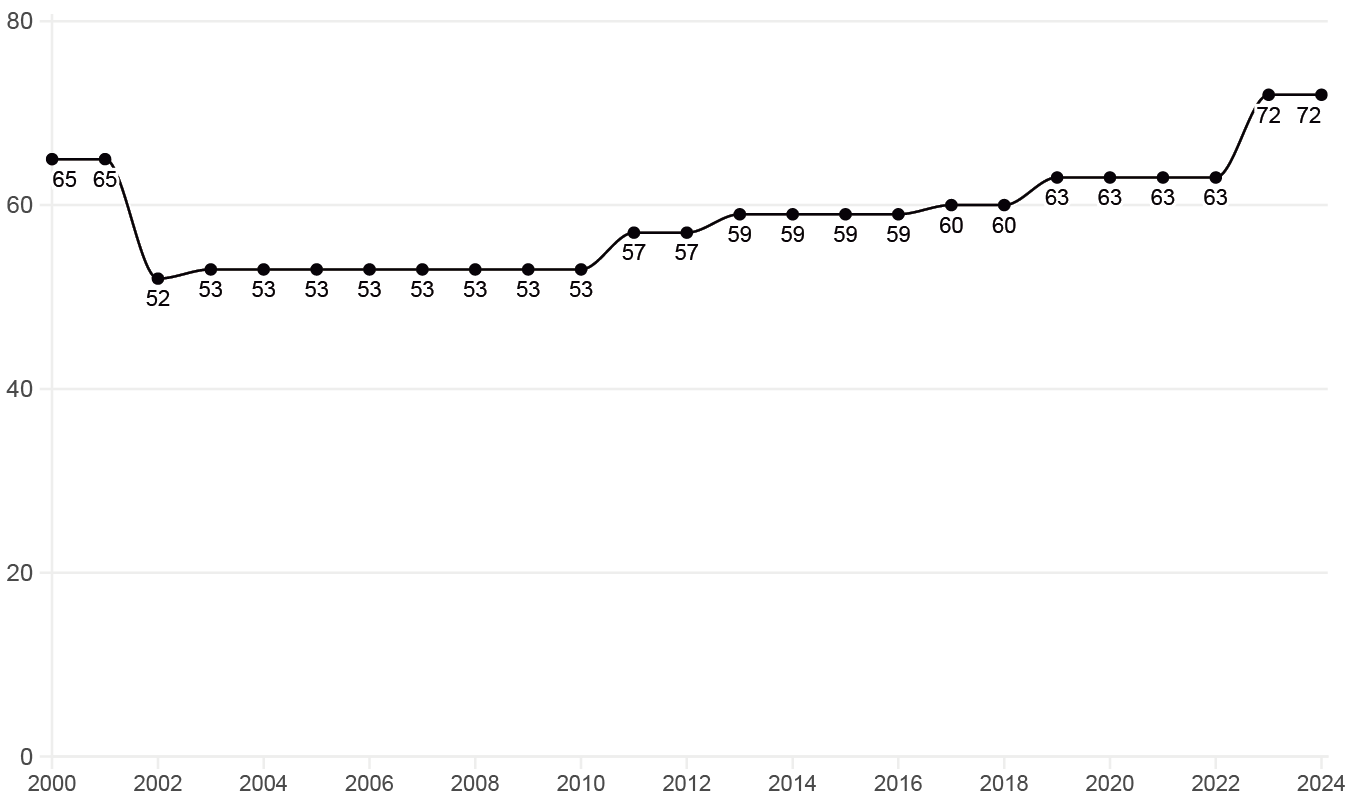
Note: At the time Decree Law 274 of 2000 was issued, there were 66 ambassador posts. During the year, one post was eliminated. The number of posts listed for 2000 in this figure reflects the end-of-year total of 65.
Source: Own elaboration.
As with ambassadorships, the total number of positions in this category has increased in recent years. Figure 2 shows the total number of these positions between 2000 and 2024.
Figure 2. Number of Positions Designated as Reserved for FSOs, 2000-2024
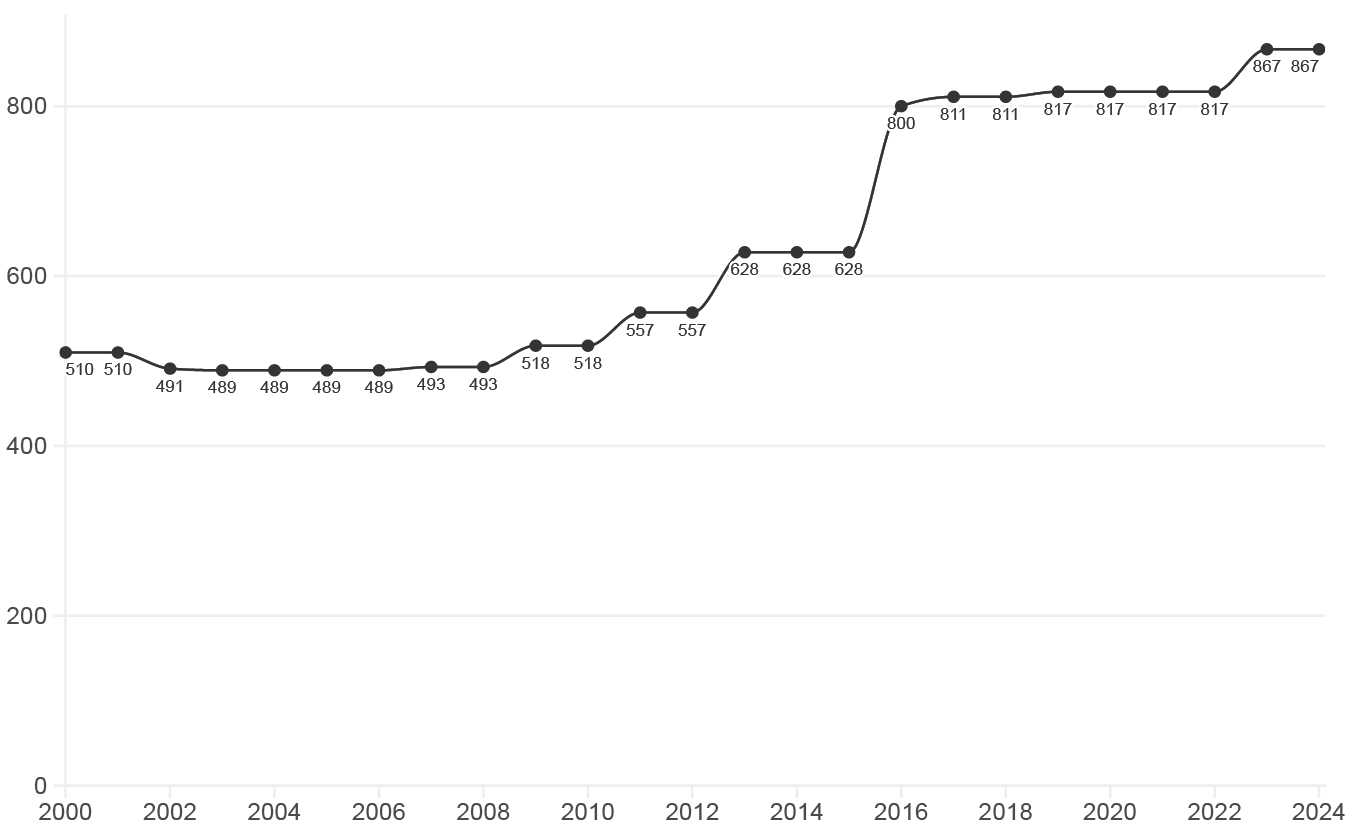
Note: At the time Decree Law 274 of 2000 was issued, there were 512 jobs designated to be filled exclusively by members of the foreign service. During the year, two of these jobs were eliminated. The number of jobs listed for 2000 in this figure reflects the end-of-year total of 510.
Source: Own elaboration.
It is noteworthy that, although Decree Law 274 designates these positions as reserved for FSOs, it does make exceptions allowing political appointees to occupy them under certain conditions. Article 60 of the law states that non-FSOs may be freely appointed to these positions only when no foreign service officer is available to fill them. Just as they may be freely appointed, non-FSOs may also be freely removed. These rules on provisional appointments (provisionalidad) are intended to be exceptional and temporary, allowing for flexibility while still fostering professionalization.
The final category of positions, those designated exclusively for civil service officers, is not included in this analysis, given that individuals in these roles perform non-diplomatic tasks outside the scope of this study. Future works may want to expand their scope to encompass them.
How unique is Colombia’s foreign service? Kerr (2023, 115) reminds us that a defining feature of diplomacy is that it is both context-made and context-making. As a unique social practice, diplomacy has its own set of rules, rituals, and language, making up its “distinctive professional identity” (Kerr 2023, 117). Diplomacy, however, is not a monolith; domestic context (institutions, laws, etc.) also shapes a country’s foreign services, their characteristics, and diplomatic practice. This topic is well-suited for detailed cross-country comparisons. Unfortunately, this area of study remains underexplored. While this article cannot offer a complete comparison of Colombia’s foreign service to that of other countries, we find that it generally aligns with the description given by Lequesne (2020) of the diplomatic corps of major democratic countries (the United States, France, Japan, Norway, and Great Britain). Recurrent features include entry into the professional diplomatic service through standardized exams, a mandatory training period, and the appointment of non-FSOs to diplomatic positions.
Through the previous discussion, we aimed to highlight the steps toward professionalization taken by Colombia’s foreign service, especially after the enactment of Decree Law 274 in 2000. With its strict appointment standards, the barriers it creates around certain exclusive roles, and its narrow exceptions, one would expect the law to have led to reduced patronage. Nonetheless, as noted in the introduction, a widespread narrative of politicization persists. The next section reviews the literature that has examined this phenomenon, with particular attention to their approaches and limitations.
- Existing Approaches to Measuring and Analyzing the Politicization of Diplomacy in Colombia and Other National Contexts
Much has been written about the politicization of Colombia’s foreign service, but few studies have examined patronage practices in detail, and even fewer have produced data on them. In this relative vacuum, the book by Tickner, Pardo, and Beltrán (2006) stands out as a pioneering work, and one of the very few to address the subject directly through data. Its conceptual and methodological approach, along with its findings, serves as a foundation for this article.
Thematically, the book situates politicization within a broader analysis of the state and the characteristics of Colombia’s MFA and its foreign service. Politicization is thus just one of several topics addressed. Although not explicitly defined as a concept, the text does allude to it when criticizing excesses in the provisional appointment of non-FSOs to diplomatic career positions. The authors argue that this turns what should be an exception into a widespread, indiscriminate practice that perverts the principle of professionalization and increases the likelihood that unsuitable people will enter the ranks.
To reach these findings, the authors requested personnel data from the MFA on filled positions, their distribution overseas and domestically, and whether the post-holders belonged to the professional diplomatic service, the civil service, or neither. The data obtained allowed them to determine that, on February 15, 2005—the date for which the MFA provided the information—82.1% of all overseas posts (across all three job categories) were held by non-FSOs. The remaining 17.9% of posts were distributed among foreign and civil service officers (Tickner, Pardo, and Beltrán 2006, 81). Domestically, the picture was less clear, as the MFA either denied or restricted access to the information (Tickner, Pardo, and Beltrán 2006, 100). Nonetheless, the approximate share of non-FSOs (35.7%) still exceeded that of FSOs (30.8%). The remainder of the jobs were filled by members of the civil service.
The results support the idea that Colombia’s foreign service is politicized. Nonetheless, the approach taken in this study raises several questions about the scope and validity of its findings. In terms of temporal scope, the data analyzed represents a snapshot of conditions on a specific date rather than trends over time. For instance, the data offers no insight into whether politicization increased or decreased after the enactment of Decree Law 274 of 2000. Furthermore, as the authors acknowledged, the MFA restricted or denied access to certain data. Questions also remain about how the MFA compiled the data it did provide. Since the data is not replicable, it cannot be tested for validity.
Since the publication of the book by Tickner, Pardo, and Beltrán in 2006, there have been almost no new efforts at systematic data collection on this issue. Puyana Valdivieso (2008), while also examining politicization in Colombia’s foreign service, relied on the same data provided by the MFA, dated February 15, 2005. As the author noted, it was not possible to obtain additional information because the ministry claimed it was “restricted” (Puyana Valdivieso 2008, 63). Subsequent works have cited Tickner, Pardo, and Beltrán (2006) and Puyana Valdivieso (2008) without incorporating new data (Espinosa-Arias 2022; Girón Duarte and Coy Granados 2011; Pastrana Buelvas and Vera Piñeros 2012; Pastrana Buelvas, Velosa, and Vera 2023; Velosa Porras 2012).
Beyond these, two additional approaches in the literature merit attention. Puyo Tamayo (2017) studies the profiles of Colombian foreign policy elites from 1958 to 2010. His work centers on factors like their socioeconomic background, region of origin, prior roles in the public or private sector, academic credentials, and political affiliation. While valuable, this work only considers three positions: the Minister of Foreign Affairs, the permanent representative to the United Nations in New York, and the permanent representative to the Organization of American States. All other positions are excluded. Moreover, the work does not specify its methods of data collection, nor is the data available for replication.
A second approach is presented by Erlandsen, Hernández-García, and Schulz (2021). The authors propose four hypotheses on factors that may influence the appointment of women as ambassadors in Latin America and the Caribbean. They test these hypotheses by constructing and analyzing a dataset of all ambassadors (excluding permanent representatives to international organizations) appointed between 2000 and 2018 by the governments of 10 countries in the region, including Colombia. The data was collected “through freedom of information requests, supplemented with publicly available information, such as institutional reports and websites” (Erlandsen, Hernández-García, and Schulz 2021, 6). The resulting dataset, which is publicly available, tracks each ambassador’s gender and whether they belonged to their country’s professional diplomatic service. The article makes a valuable contribution to better understanding the gendered factors influencing appointments from a comparative perspective. However, it centers on gender rather than politicization and only examines ambassadors, not other positions. It also places greater emphasis on the experiences of Argentina, Brazil, Chile, and Costa Rica, all of which have had women presidents.
Outside Colombia, analogous inquiries into the politicization of the foreign service in other countries have fallen into similar patterns and shortcomings. The US foreign service has received the most attention. The determinants of ambassadorial appointments (Hollibaugh 2015), the relation between ambassadors’ backgrounds and their handling of international crises (MacDonald 2021), analyses on the ambassadorial performance of career diplomats versus political appointees (Haglund 2015), and the role of familiarity with a president in the appointment of non-careerists to ambassadorships (Goldfien 2023) are some of the topics covered. One should note, however, that all these focus on ambassadors, who represent only a small percentage of all foreign service staff.
There has been some research on politicization in the lower ranks of state agencies. One of the most comprehensive studies is by Brieba et al. (2024), which examines how closely the Chilean central government bureaucracy aligns with a Weberian bureaucratic model. By reviewing government records, the authors construct a dataset of over 323,000 distinct individuals employed by the Chilean central government between 2006 and 2020. Their data analysis allows them to identify six descriptive findings, including two on the balance between patronage and merit. Nonetheless, the Ministry of Foreign Affairs is just one small agency within the larger Chilean bureaucracy and receives little to no attention. Similarly, Bersch, Praça, and Taylor (2017) construct a dataset on the personnel of 95 Brazilian federal agencies, but Itamaraty is not mentioned. The same is true for the US Department of State in the study by Hollibaugh, Horton, and Lewis (2014), which examines the qualifications and backgrounds of 1307 executive agency appointees during the first six months of the Obama administration.
Regarding the gender-diplomacy nexus, research has been even more prolific. Country-specific works abound (Alvarado Navas and Siriwato 2024; Calin and Butterbaugh 2019; de Souza Farias and do Carmo 2018; Park and Jakstaite-Confortola 2024; Rumelili and Suleymanoglu-Kurum 2018). Additionally, valuable cross-country, multi-year comparative studies have also been developed (Chehab 2024; Niklasson and Towns 2023). However, as insightful as these works are on gender, they do not focus on the dynamics of politicization, as we understand them in this study. They also fail to review appointments below the rank of ambassador, leaving the largest share of appointments unexamined.
The review of the literature reveals significant gaps in studying politicization in states’ foreign services, including Colombia’s, with most research focusing on appointments to a handful of high-ranking positions, typically ambassadorships. In the study of politicization in the Colombian context, few works begin with a comprehensive definition of politicization. The limited efforts to analyze politicization across roles beyond that of ambassador roles have offered only snapshots of conditions at a specific time rather than tracking patterns over time. More often than not, these attempts relied on data from over two decades ago. Methodologically, scholars have often resorted to requesting data from the MFA. Often, the ministry refused to provide complete data. When it did share data, the MFA was not transparent about its own data collection methods. Finally, all but one of the studies analyzing bureaucratic politics in the MFA based on data did not make their datasets publicly available.
Aware of these shortcomings, the next section outlines the methodology used to construct our dataset and its application in this article.
- Methodology
To assess the degree of politicization of Colombia’s foreign service, we developed a novel dataset that builds on previous efforts while addressing some of their shortcomings. To that end, this section defines politicization, explains the theoretical rationale, and describes the practical process behind the construction of the dataset, along with its application in the subsequent section on analysis.
Regarding politicization, Kerr reminds us that, despite significant interest in the topic, “the meaning of the term and its impact is under-researched and therefore unclear” (2023, 112). Part of the challenge is that politicization does not refer to a discrete, well-delimited type of action; instead, it is “a multilayered concept… [that] involves social relationships and relations of power between different policy actors” (Kerr 2023, 113).
At a general level, politicization may be understood as the way political actors “seek to favourably influence different arenas of decision-making to steer the final outcome towards a political objective” (Niklasson and Jezierska 2024, 1658). One example is “the power of political actors to appoint individuals by discretion to nonelective positions in the public sector, regardless of the legality of the decision and the merits of the appointee” (Panizza, Peters, and Ramos Larraburu 2022, 5). This final caveat means that politicization can occur even when the law allows political appointees to occupy various positions. Wiseman adds to this by noting that, “loosely speaking, ‘politicization’ can be seen as the opposite of ‘professionalisation’” (2022, 129, cited in Kerr 2023, 123).
Based on the above, in the context of Colombian foreign policy, we understand politicization as happening when a president or minister of foreign affairs appoints a non-FSO to a diplomatic or consular post that could otherwise be filled by a career diplomat. This conceptualization clearly applies to situations where a non-FSO is appointed to positions reserved for FSOs. In light of the caveats raised by Panizza, Peters, and Ramos Larraburu (2022), it is also appropriate to interpret the appointment of non-FSOs to ambassadorships as instances of politicization.
Having established the concept, we chose to examine politicization by constructing a novel dataset that effectively captures the phenomenon over time and across posts. In developing this dataset, we focused our analysis on the period since Decree Law 274 took effect on February 22, 2000. We conclude our analysis on August 7, 2024, marking the end of Gustavo Francisco Petro Urrego’s second year of his four-year term. This endpoint allows us to compare the first half of Petro’s term with equivalent half-periods of previous presidents. Regarding posts, consistent with our definition of politicization, we examine those positions which, under the law’s intent to advance professionalization, should or could be occupied by FSOs. Further details are provided below.
For data collection, we considered the obstacles faced by previous studies in accessing data, as well as the questions regarding data validity raised in the literature review. To address these concerns, rather than requesting figures from the MFA or relying on secondary sources, we conducted archival research of the administrative acts (decrees and resolutions) issued by the MFA during the study period.
Our choice of method is well-supported by Shifrinson’s observation that “archival research can help to craft a dataset or define a universe of cases which can then be subjected to quantitative analysis or mobilized in support of qualitative research. This approach can be valuable if existing datasets in one’s area of interest are absent, ill-defined, and/or substantively problematic” (Shifrinson 2022, 587). We find these conditions applicable to the study of politicization in Colombia’s foreign service, making archival research a useful and innovative strategy for data collection.
Meanwhile, our focus on administrative acts is justified for at least three reasons. First, in Colombia’s government, all personnel decisions (appointments, removals, etc.) must be formalized through administrative acts (Presidencia de la República 2015).8 These documents thus provide a comprehensive record of all personnel decisions, including appointments to foreign service posts. Second, and related to the above, conducting archival research allowed us to access the complete set of documents for the period. Because these documents are numbered sequentially each year, we were able to verify that none were missing. Such “completeness” is an essential criterion “to judge the quality of an original dataset” (Braithwaite 2022, 308) like ours. Third, the documents provide standardized information on all appointees that is useful for this investigation. This includes the appointee’s full name, the official title of the position they are being appointed to, the location of that post, whether they are foreign service officers, and, if applicable, their rank within the professional diplomatic service, among other details.
Under this framework, we submitted a freedom of information request to the MFA for access to its archive of administrative acts. The request was granted in full. We received both physical and digital copies of all documents covering the period 2000-2024.
The review and extraction of data from the documents were performed manually in three steps. First, we categorized administrative acts by their headings, separating those concerning personnel decisions from those addressing other matters.9 Second, for the administrative acts concerning personnel matters, we collected data on the following: date of issue; type of act (decree or resolution); number and year of the act; type of personnel decision; name of the appointee; whether the person was an FSO at that time; if applicable, their rank within the professional diplomatic service; if applicable, the position and location prior to the act; if applicable, the position and location assigned after the act; and any other relevant information contained in the document. This information was extracted and transcribed into a master database.
Third, from the master database, we selected the rows of data corresponding to administrative acts where individuals were appointed to posts that could be filled by career diplomats. We excluded administrative acts related to other actions, such as promotions within the diplomatic ranks, requests for leave, and retirements, among others.
We also chose to exclude domestic posts from this article’s analysis. While domestic dynamics may be of interest for future research, it seemed appropriate to examine overseas appointments separately. This process yielded 3,135 rows of data, each representing a single appointment during the study period. This information forms the dataset used in this article.
The dataset contains extensive information, but our analysis focuses on politicization as defined above. We complement this with other relevant data, such as gender representation—based on the attributed gender of appointees, following Erlandsen, Hernández-García, and Schulz (2021)—and variations across posts. The information is analyzed for the entire study period. It is also studied by presidential term, sometimes dividing each term into two halves of two years each. This subdivision allows for a clearer identification of trends over time; it also highlights the incentives that presidents may face at the beginning and end of their administrations.
Our analysis of the dataset is divided into three stages, corresponding to the three subsections of the analysis that follow. In the first stage, we examine overall patterns of appointments and politicization throughout the entire study period and by presidential term. In the second stage, we focus on politicization in appointments to ambassadorships. Given the MFA’s historic use of various schemes for these appointments, we adopt two approaches to analyzing this data, as explained below. Finally, in the third stage, we examine the numbers for the positions reserved for FSOs. Our goal here is to identify how politicization may manifest differently across the hierarchy of posts. We also compare the results for this category of jobs with those for ambassadorships.
- Analysis
- Overall Patterns of Politicization in Colombia’s Foreign Service
Over the 24 years since Decree Law 274 was enacted, 3,135 appointments have been made to overseas diplomatic and consular posts. During this period, five men have served as presidents of Colombia across seven presidential terms: Andrés Pastrana Arango (1998-2002), Álvaro Uribe Vélez (٢٠٠٢-٢٠٠٦ and ٢٠٠٦-٢٠١٠), Juan Manuel Santos Calderón (٢٠١٠-٢٠١٤ and ٢٠١٤-٢٠١٨), Iván Duque Márquez (٢٠١٨-٢٠٢٢), and Gustavo Francisco Petro Urrego (٢٠٢٢-٢٠٢٦). Figure 3 shows the number of appointments divided into two-year segments of their terms in office (or partial terms, in the case of Pastrana).
Figure 3. Appointments to Overseas Posts per Half of the Presidential Term, 2000-2024
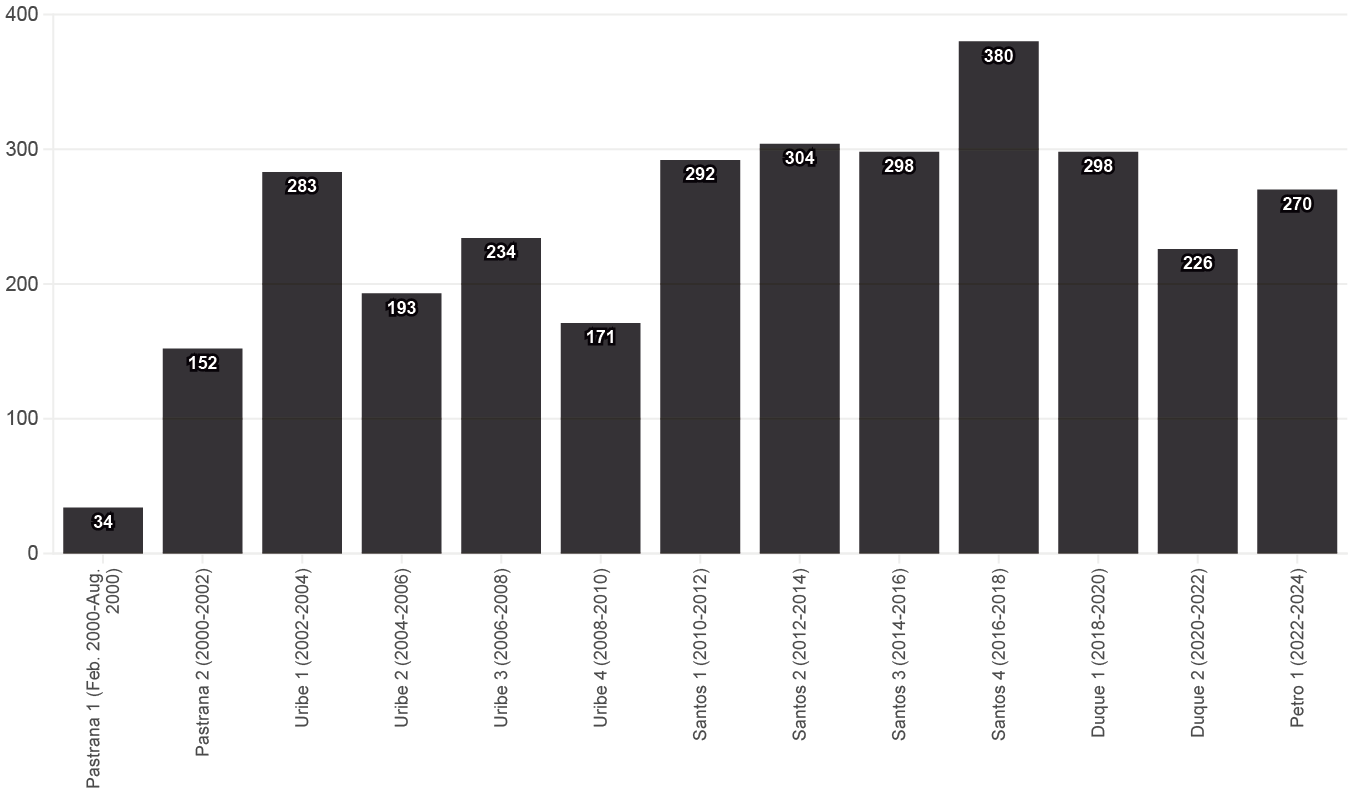
Note: Unless otherwise noted, each period along the X axis starts and ends on August 7th of the specified year.
Source: Own elaboration.
Out of the 3,135 appointments made during this period, 1,453 went to FSOs, representing 46.35% of the total. The remaining 1,682 appointments (53.65%) were occupied by political appointees. This data broadly confirms the view in the literature that politicization remains a consistent practice in Colombia’s foreign service.
The data per presidential term offers a more nuanced picture. Figure 4 illustrates the distribution of political appointees as a percentage of all appointments during each presidential term. The results reveal significant fluctuations in politicization both across different presidents and between consecutive terms of the same president. Of the seven terms examined, only two had the share of political appointees below 50%: Santos in his second term (49.85%) and Duque in his single term (39.50%).
Figure 4. Distribution of Political Appointees by Presidential Term, 2000-2024
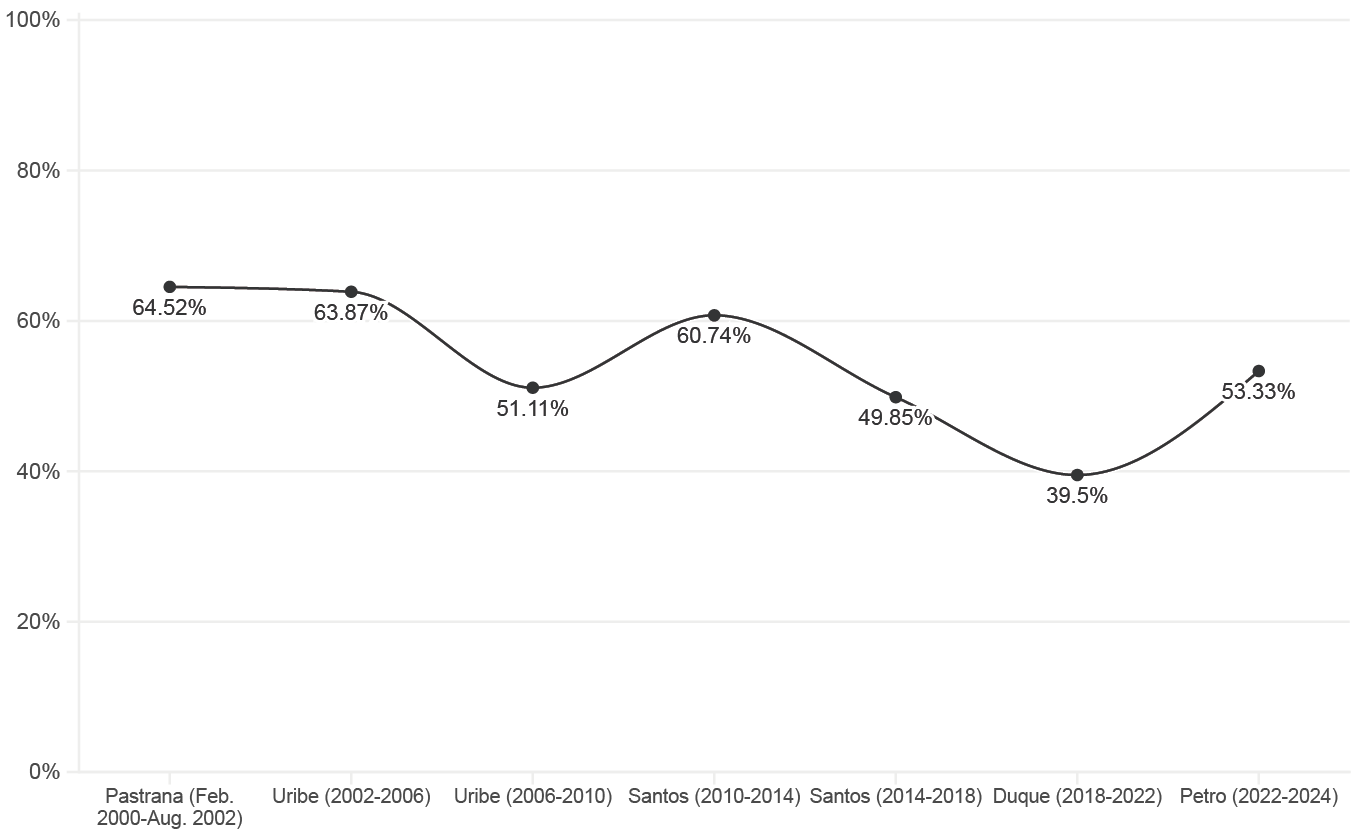
Note: Unless otherwise noted, each period along the X axis starts and ends on August 7th of the specified year.
Source: Own elaboration.
The bi-annual data is equally revealing, showing sharper fluctuations in levels of politicization. Table 1 and Figure 5 summarize this data. The rises and falls in politicization likely reflect the influence of multiple factors rather than a single cause. Identifying these factors, however, is beyond the scope of this article. Nonetheless, we expect that such decisions may be shaped by the expansion or contraction of available jobs, the number of career diplomats enrolled in the professional diplomatic service, events such as the COVID-19 pandemic, and the president’s political will to promote professionalization over patronage.
Table 1. Number and Share of Appointments to Overseas Posts by Type of Appointee (FSO or Non-FSO) per Half of the Presidential Term, 2000-2024
|
Period |
Total appointments |
FSO appointments (#) |
Non-FSO appointments (#) |
FSO appointments (% of total) |
Non-FSO appointments (% of total) |
|
Pastrana (Feb. 2000-Aug. 2000) |
34 |
7 |
27 |
20.59% |
79.41% |
|
Pastrana 2 (2000-2002) |
152 |
59 |
93 |
38.82% |
61.18% |
|
Uribe 1 (2002-2004) |
283 |
87 |
196 |
30.74% |
69.26% |
|
Uribe 2 (2004-2006) |
193 |
85 |
108 |
44.04% |
55.96% |
|
Uribe 3 (2006-2008) |
234 |
111 |
123 |
47.44% |
52.56% |
|
Uribe 4 (2008-2010) |
171 |
87 |
84 |
50.88% |
49.12% |
|
Santos 1 (2010-2012) |
292 |
90 |
202 |
30.82% |
69.18% |
|
Santos 2 (2012-2014) |
304 |
144 |
160 |
47.37% |
52.63% |
|
Santos 3 (2014-2016) |
298 |
126 |
172 |
42.28% |
57.72% |
|
Santos 4 (2016-2018) |
380 |
214 |
166 |
56.32% |
43.68% |
|
Duque 1 (2018-2020) |
298 |
166 |
132 |
55.70% |
44.30% |
|
Duque 2 (2020-2022) |
226 |
151 |
75 |
66.81% |
33.19% |
|
Petro 1 (2022-2024) |
270 |
126 |
144 |
46.67% |
53.33% |
Source: Own elaboration.
Figure 5. Total Appointments by Type and Presidential Term, 2000-2024
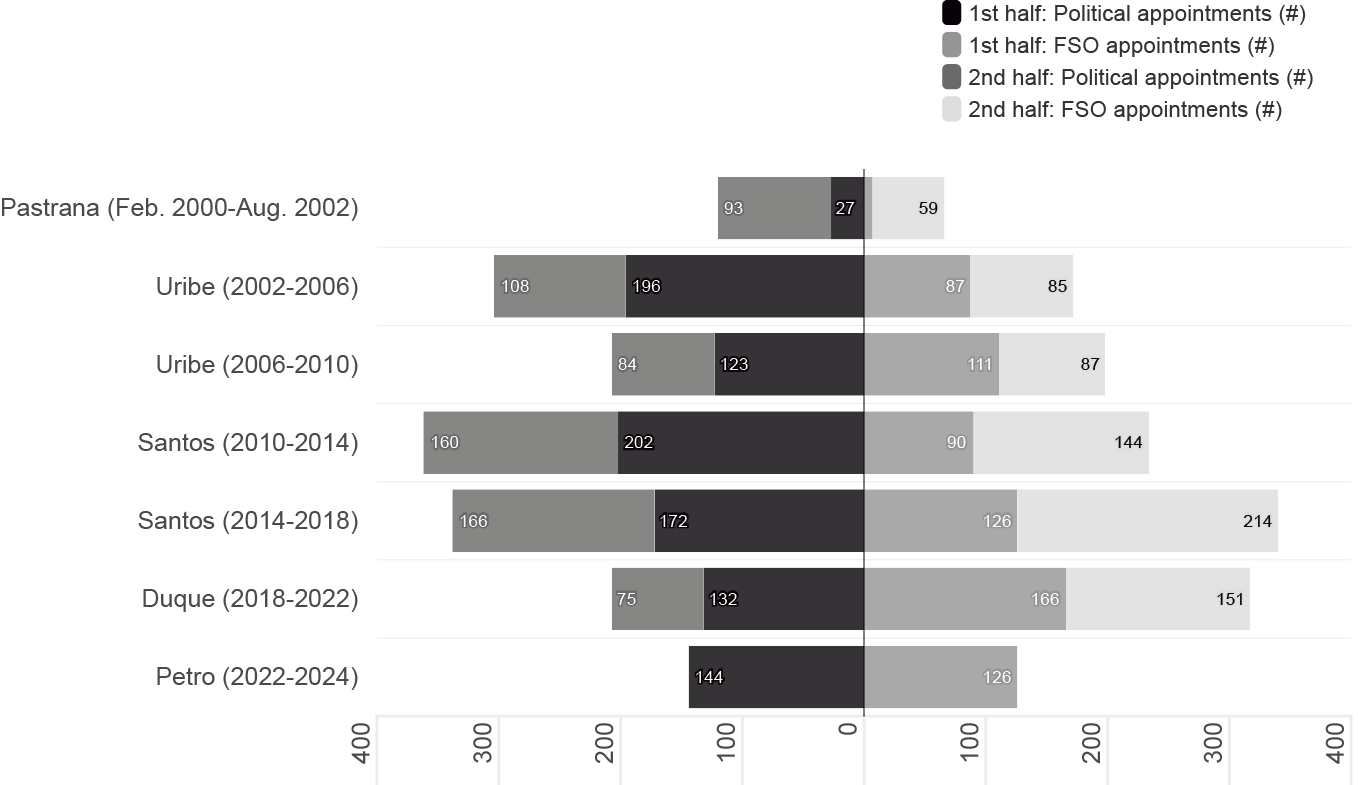
Note: Unless otherwise noted, each period along the X axis starts and ends on August 7th of the specified year.
Source: Own elaboration.
Beyond politicization, the dataset also reveals other interesting patterns, such as gender dynamics in appointments. Out of the 3,135 appointments, 1,774 went to men and 1,362 to women, meaning that men accounted for 56.59% of all appointments during the period. In no full or half-term did any president appoint more women than men. The underrepresentation of women becomes even more pronounced when comparing higher- to lower-ranking positions. This pattern will be explored in greater detail in the third subsection below.
- Politicization in Appointments to Ambassadorships
From 2000 to 2024, there were a total of 443 appointments to ambassadorial posts. Of these, 358 were given to political appointees, representing 80.81% of the total, while only the remaining 19.19% went to career diplomats, amounting to 85 ambassadorships. This figure is not only significantly lower than the overall average of 46.35% for all overseas posts, as noted in the previous subsection, but also falls short of the legally mandated minimum of 20% of ambassadorships to be held by FSOs.
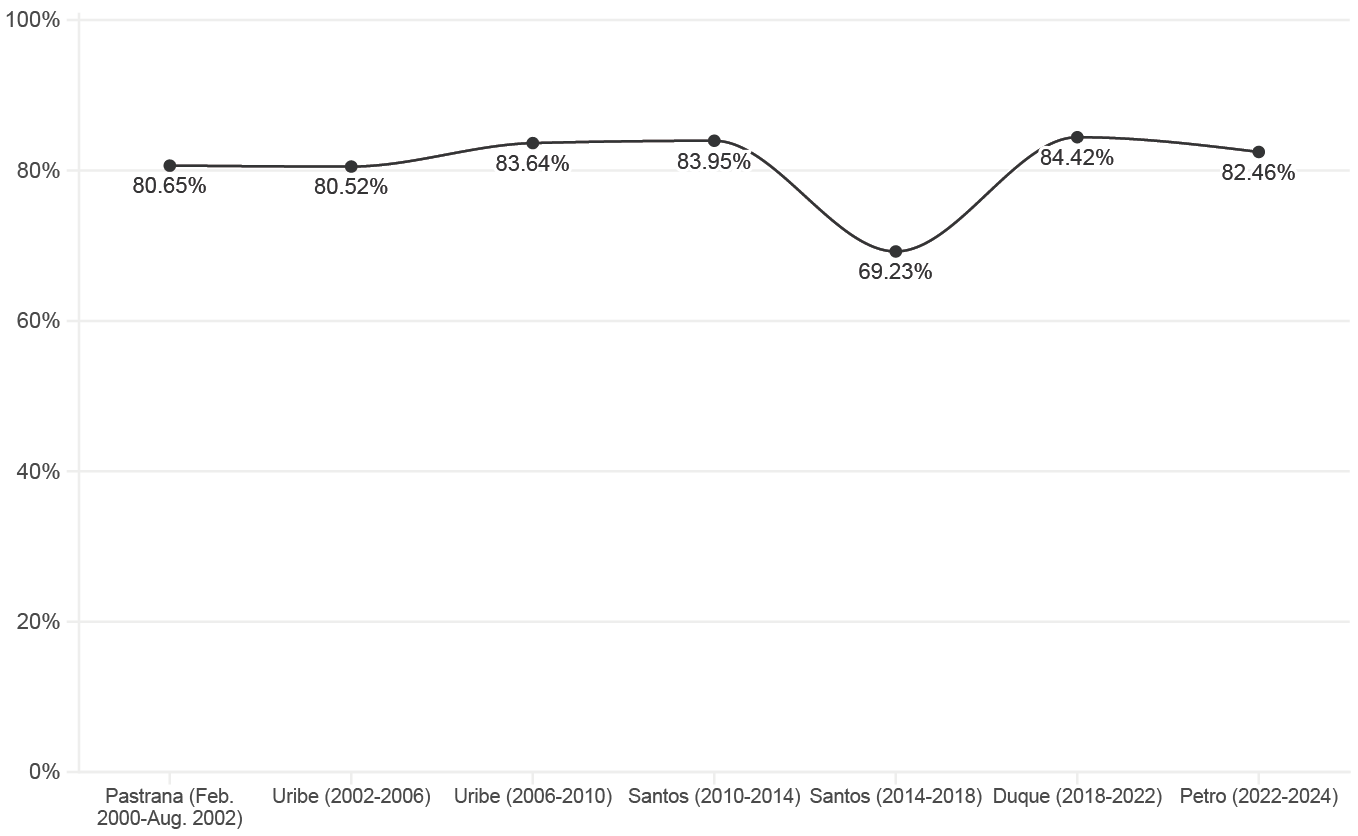
The numbers by presidential term are also quite discouraging. In the first 14 years following the enactment of Decree Law 274, the share of ambassadorships filled by non-FSOs consistently exceeded 80%, even rising from 80.65% under Pastrana to 83.95% during Santos’ first term. That figure dropped to its lowest point during Santos’ second term, when it reached 69.23%. Since then, the figures have again risen to above 80%, with 84.42% under the Duque presidency and 82.46% in the first half of Petro’s presidency. Figure 6 illustrates this data.
Figure 6. Distribution of Ambassadorships Held by Political Appointees by Presidential Term, 2000-2024
Note: Unless otherwise noted, each period along the X axis starts and ends on August 7th of the specified year.
Source: Own elaboration.
The dataset also reveals two additional forms of politicization in ambassadorial appointments. The first is a practice introduced in 2019, where FSOs are assigned to less desirable overseas diplomatic missions and are instructed to serve as chief of mission and credential themselves as ambassadors to the receiving country while formally holding the title of minister rather than that of ambassador. This arrangement frees up posts as ambassador extraordinary and plenipotentiary, which can then be allocated to political appointees who are named as alternate ambassadors in more desirable destinations (Castrillón-Kerrigan 2023).
If we adjust our understanding of ambassadorships to focus on individuals serving as chiefs of mission, regardless of their official title (whether as ambassador extraordinary and plenipotentiary or minister), we find that 435 appointments were made for chiefs of mission during the study period. Of these, 94 were FSOs, representing 27.56% of the total. The proportion of political appointees, at 72.44%, is more than 8 percentage points lower than the figure obtained through the first approach.
While FSO participation appears higher under this alternate approach, a second form of politicization emerges here, in the allocation of destinations. From the literature, we know that decision-makers who practice patronage tend to award ambassadorships in more desirable locations to political appointees, while assigning FSOs to the least attractive posts (Fedderke and Jett 2016; Hollibaugh 2015). To test whether this proposition holds true in the Colombian case, we use the “levels of representation expenses”10 assigned by the MFA to each diplomatic mission as a proxy for their attractiveness. Comparing FSOs and non-FSOs based on the average level of the missions where they serve as chiefs of mission, we find that the FSOs are indeed assigned to lower-level destinations. The average for FSOs is 2.20, compared to 3.17 for non-FSOs. The medians reflect similar results, with FSOs at 2 and non-FSOs at 3. While these results are not definitive and require further refinement, they nevertheless suggest another dimension of politicization in ambassadorial appointments.
- Politicization of Appointments to Positions Reserved for FSOs
Since 2000, 2,692 appointments have been made to overseas positions reserved for FSOs.11 These positions span ten roles. Ranked from highest to lowest, they are: minister, minister-counselor, counselor, consul general, first secretary, first-class consul, second secretary, second-class consul, third secretary, and vice-consul. The positions of consul general, first-class consul, second-class consul, and vice-consul existed until 2009. After that, they were replaced by their diplomatic equivalents (as explained in footnote 5).
While the law allows limited exceptions for non-FSOs to be temporarily appointed to these positions, the data shows that, of the 2,692 appointments made during the period, 1,324 (49.18%) went to political appointees. Careerists account for a narrow majority, with 1,368 appointments (50.82%). Still, this falls short of the strict standard of professionalization mandated by the law.
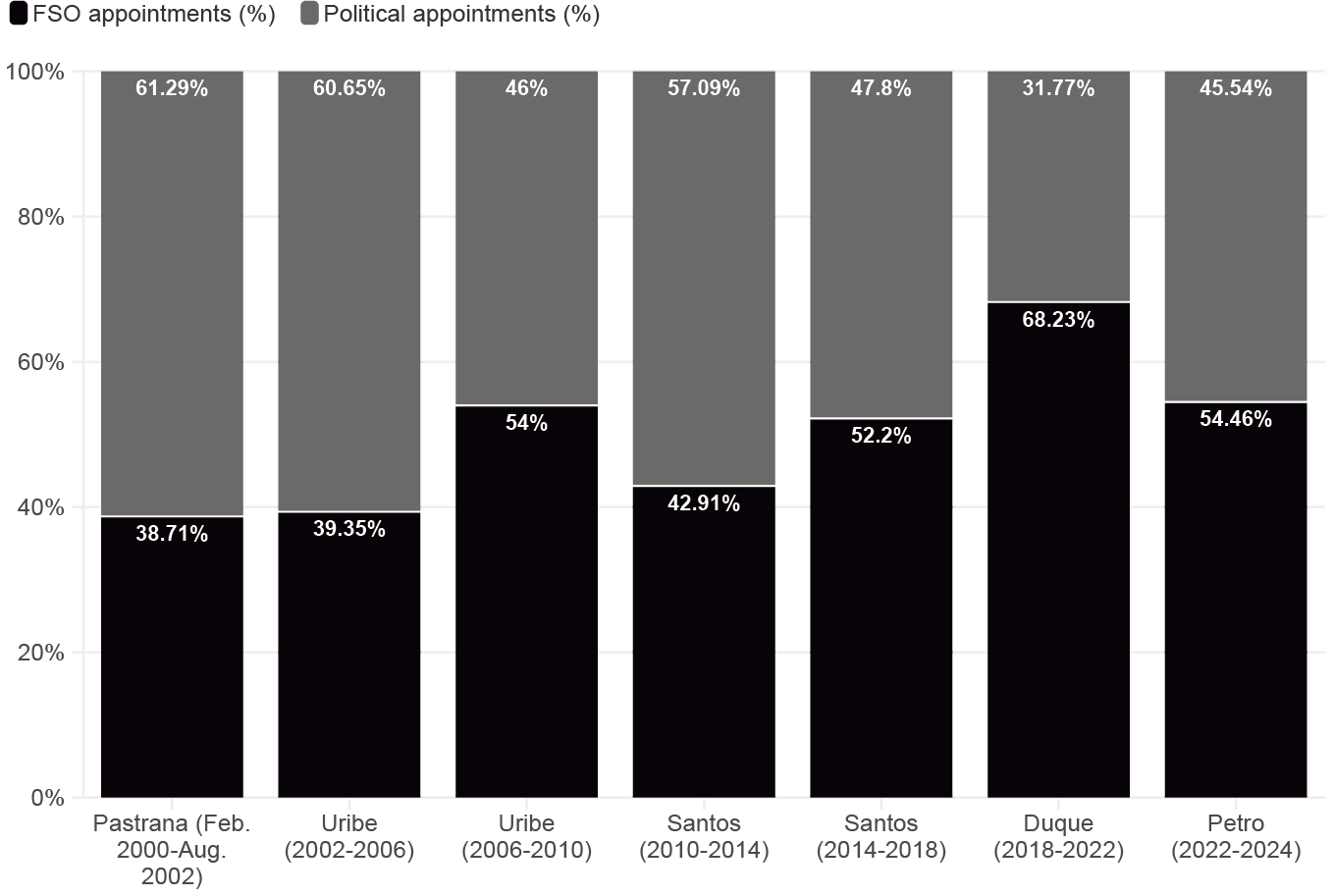
By presidential term, the data reflect the overall appointment patterns, as shown in Figure 4. The participation of Colombia’s professional diplomatic service has increased overall. For example, during the Pastrana presidency and Uribe’s first term, FSOs accounted for less than 40% of all appointments to overseas posts reserved for them. Since Uribe’s second term, they now make up more than 40% of these appointments. In some periods, like the Duque presidency, their share has approached 70%. Nonetheless, this upward trend has not been linear, with considerable fluctuations from one term to the next. Figure 7 represents these values.
Figure 7. Distribution of Appointments by Type (FSO or Political) to Overseas Posts Classified as Reserved for FSOs by Presidential Term, 2000-2024
Note: Unless otherwise noted, each period along the X axis starts and ends on August 7th of the specified year.
Source: Own elaboration.
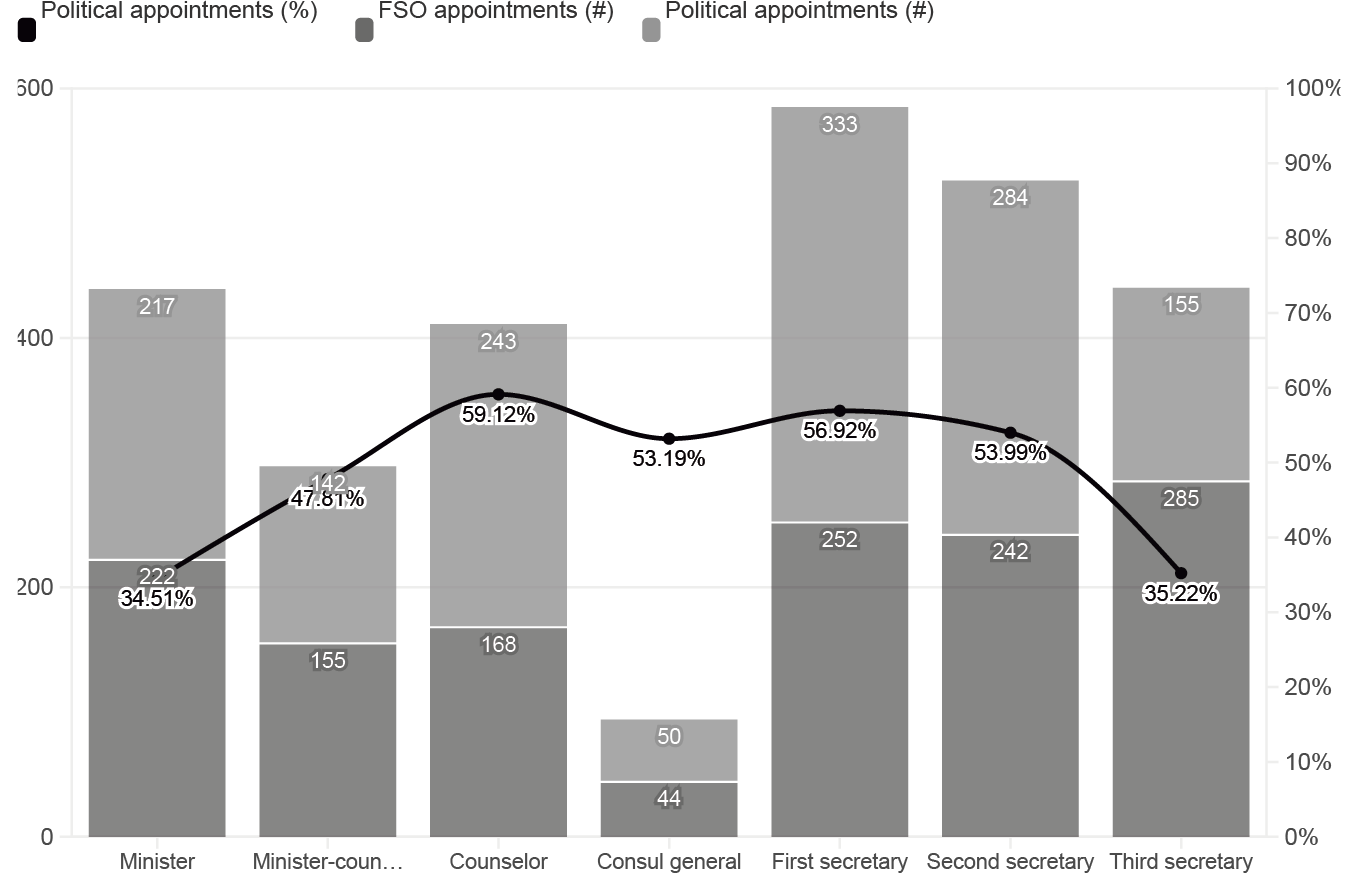
Politicization also varies significantly by post category, with lower participation by political appointees at the highest and lowest ranks, and relatively higher participation in the middle. This becomes most evident when combining the numbers for posts that are diplomatic and consular equivalents, that is, grouping first secretaries with first-class consuls, second secretaries with second-class consuls, and third secretaries with vice-consuls. Since consul generals may be equivalent to ministers, minister-counselors, or counselors, we treat these appointments as separate categories.
In Figure 8, the columns show the number of appointments by type (FSO or political) for each post (along the X axis, from highest to lowest rank) over the entire period. The line indicates the distribution of political appointments within each category. The pattern formed by the line resembles a bell curve, with the highest proportion of political appointments concentrated in the middle ranks and lower participation at the margins. The reason for this variation should be explored in future research, although it is reasonable to anticipate that at least part of the explanation lies in the reluctance of political appointees to accept lower-ranking and lower-paying positions, such as that of third secretary.
Figure 8. Number of Appointments to Positions Reserved for FSOs by Type (Columns) and Distribution of Political Appointments per Post Category (Line), 2000-2024
Source: Own elaboration.
A final point of interest concerns the gender distribution of appointments by post category. As noted in the first subsection, there is a certain imbalance in the appointment of men and women to all posts overseas. Here, in analyzing the 2,692 appointments to overseas reserved for FSOs, the imbalance persists, although it is less pronounced than before: 1,452 appointments were filled by men (53.94%) and 1,240 were filled by women (46.06%). This distribution broadly holds among FSO appointees (54.97% occupied by men and 45.03% by women) and political appointees (52.87% occupied by men and 47.13% by women).
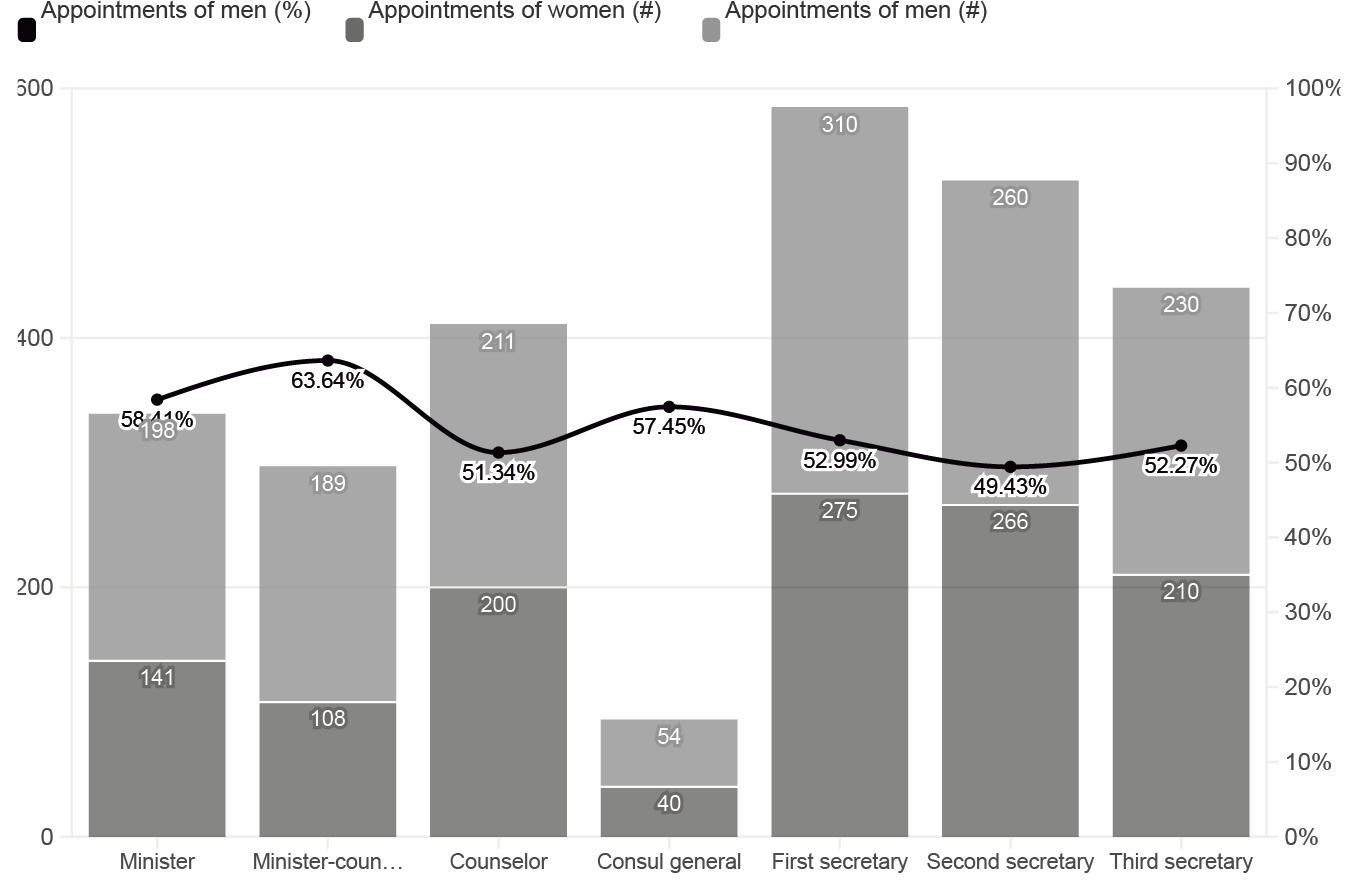
By post category, however, the results are more uneven, particularly among higher-ranking positions. The stacked columns in Figure 9 show the number of men and women appointed to each post category during the study period. The line indicates the distribution of appointments held by men in each category. The figure reveals that men had participation rates above their average in the appointments as minister-counselor (63.64%), minister (58.41%), and consul general (57.45%). In contrast, women exceeded their average in appointments as third secretary (47.73%), first secretary (47.01%), and counselor (48.66%), with the first two falling within the lower ranks.
Figure 9. Number of Appointments Reserved for FSOs by Gender (Columns) and Distribution of Appointments of Men per Post Category (Line), 2000-2024
Source: Own elaboration.
Conclusions
This article set out to examine the degree of politicization of Colombia’s foreign service during the period 2000-2024. To do this, we began by reviewing the normative expectations and standards for the professionalization of the country’s foreign service established in Decree Law 274 of 2000. Next, the article explored the existing literature on politicization in Colombia’s foreign service, along with other studies. The review identified several key works that laid the groundwork for studying this topic. Nonetheless, these works revealed notable gaps in their conceptualization of politicization, their methodological choices, and both the collection methods and the quality of data employed.
In response to these gaps and after developing a pragmatic conception of politicization based on the Colombian experience, we created a novel dataset that adequately captures politicization in the appointment of officials to overseas foreign service posts. Data collection was carried out through archival research of all administrative acts issued by the MFA or under its purview during this period. Using a three-step manual process, the information was collected and organized, resulting in a dataset of 3,135 rows, each representing a single appointment made during the study period.
The analysis was divided into three subsections: the first examined the overall politicization across all appointments, the second focused on politicization in ambassadorial appointments, and the third looked at politicization in posts reserved for FSOs. In all three, the findings consistently show that politicization has been the norm in overseas appointments. This politicization manifests in at least four different ways. First, political appointees make up more than half of all appointments (53.65%) and hold the majority of ambassadorial posts (80.81% or 72.44%, depending on the approach used). Second, political appointees account for nearly half (49.18%) of all appointments to positions reserved for FSOs, despite the law’s stipulations that such provisional appointments should be the exception rather than the rule. Third, there is an emerging practice of sidelining career diplomats from posts they are qualified for to make room for political appointees. Fourth, it seems that there is a practice of assigning FSOs to less desirable destinations compared to those given to political appointees.
While these general findings are of interest, this investigation also raises questions that future research should address. We highlight four of them here. One concerns the determinants that influence higher or lower degrees of politicization over time. In the data review, results varied widely from one presidential term to another. The article presents ideas about some potential factors, but this requires further work. A second question relates to the gendered appointment practices in Colombia’s foreign service, which the article touched on lightly. A third question involves other datapoints from the dataset that were left underexplored. For instance, more work can be done to understand politicization in the choices of appointees’ destinations. Finally, there is other data that can be used from the archival research into the administrative acts that were not included in the dataset. Future works may continue tapping this resource for insights into politicization and even other aspects of bureaucratic politics inside the MFA.
References
- Alvarado Navas, Mirna Amanda, and Sasiphattra Siriwato. 2024. “Examining Gender Equality in Guatemala: A Case Study of Gender Equality in the Ministry of Foreign Affairs of Guatemala.” Asian Crime and Society Review 11 (2): 21–43. https://doi.org/10.14456/acsr.2024.10
- Amaya, Rodrigo. 2017. “Las propiedades de la política exterior colombiana: repensando lo que sabemos del accionar externo del país.” In Nuevos enfoques para el estudio de las relaciones internacionales de Colombia, edited by Arlene B. Tickner and Sebastián Bitar, 39–64. Bogotá: Universidad de los Andes.
- Amorim Neto, Octavio, and Andrés Malamud. 2019. “The Policy-Making Capacity of Foreign Ministries in Presidential Regimes: A Study of Argentina, Brazil, and Mexico, 1946–2015.” Latin American Research Review 54 (4): 812–834. https://doi.org/10.25222/larr.273
- Arias Parrado, David Alejandro. 2019. “Consilium Diversificare. La política exterior colombiana entre 1991 y 2014.” PhD diss., Universidad Complutense de Madrid. https://hdl.handle.net/20.500.14352/16771
- Bersch, Katherine, Sergio Praça, and Matthew M. Taylor. 2017. “State Capacity, Bureaucratic Politicization, and Corruption in the Brazilian State.” Governance 30: 105–124. https://doi.org/10.1111/gove.12196
- Braithwaite, Jessica Maves. 2022. “Challenges and Payoffs of Building a Dataset from Scratch.” In Handbook of Research Methods in International Relations, edited by Joseph Huddleston, Thomas Jamieson, and Patrick James, 300–316. Northampton, MA: Edward Elgar Publishing.
- Brieba, Daniel, Mauricio-René Herrera-Marín, Marcelo Riffo, and Danilo Garrido. 2024. “Inside the Black Box: Uncovering Dynamics and Characteristics of the Chilean Central Government Bureaucracy with a Novel Dataset.” Latin American Politics and Society 66 (3): 107–135. https://doi.org/10.1017/lap.2023.41
- Calin, Costel, and Kevin Butterbaugh. 2019. “Male versus Female Career Ambassadors: Is the US Foreign Service Still Biased?” Foreign Policy Analysis 15: 205–223. https://doi.org/10.1093/isafpa/ory005
- Cardona Cardona, Diego. 2011. “Introducción. ¿Puede tener Colombia una estrategia de política exterior?” In Colombia: una política exterior en transición, edited by Diego Cardona Cardona, xv-xli. Bogotá: Friedrich Ebert Stiftung en Colombia (FESCOL).
- Castrillón-Kerrigan, David. 2023. “De capitán a general.” Diplomacia Abierta, August 18. https://diplomaciaabierta.substack.com/p/de-capitan-a-general
- Chehab, Sara. 2024. “2024 Women in Diplomacy Index.” Anwar Gargash Diplomatic Academy, https://www.agda.ac.ae/docs/default-source/2023/2024-women-in-diplomacy-index-2.pdf
- de Souza Farias, Rogério, and Gessica Fernanda do Carmo. 2018. “Brazilian Female Diplomats and the Struggle for Gender Equality.” In Gendering Diplomacy and International Negotiation, edited by Karin Aggestam and Ann E. Towns, 107–124. Cham: Palgrave Macmillan
- El Nuevo Siglo. 2023. “Leyva defendió moción por nombramientos en embajadas.” El Nuevo Siglo, April 12. https://www.elnuevosiglo.com.co/politica/leyva-defendio-mocion-por-nombramientos-en-embajadas
- Erlandsen, Matthias, María Fernanda Hernández-García, and Carsten-Andreas Schulz. 2021. “Madame President, Madame Ambassador? Women Presidents and Gender Parity in Latin America’s Diplomatic Services.” Political Research Quarterly 75 (2): 425–440. https://doi.org/10.1177/1065912921997922
- Espinosa-Arias, Martín. 2022. “El Análisis de Política Exterior: desarrollo en Colombia.” Desafíos 34 (especial): 1–30. https://doi.org/10.12804/revistas.urosario.edu.co/desafios/a.11933
- Fedderke, Johannes, and Dennis Jett. 2016. “What Price the Court of St. James? Political Influences on Ambassadorial Postings of the United States of America.” Governance 30 (3): 483–515. https://doi.org/10.1111/gove.12254
- Girón Duarte, Jaime, and Francisco J. Coy Granados. 2011. “La Cancillería y el servicio exterior colombiano: diagnóstico, análisis de las anteriores reformas y propuestas de reforma.” In Misión de Política Exterior 2009-2020, edited by Sandra Borda, Gustavo Bell, Hernando José Gómez, Socorro Ramírez, Mauricio Reina, Camilo Reyes, and Juan Tokatlian, 521–552. Bogotá: Universidad de los Andes.
- Goldfien, Michael A. 2023. “Just Patronage? Familiarity and the Diplomatic Value of Non-Career Ambassadors.” Journal of Conflict Resolution 68 (7-8): 1417–1442. https://doi.org/10.1177/00220027231198518
- González Parias, Carlos Hernán, and Juan Camilo Mesa Bedoya. 2020. “Los análisis de la política exterior colombiana: un estado del arte.” Revista Relaciones Internacionales 93 (1): 41–61. https://doi.org/10.15359/ri.93-1.2
- Haglund, Evan T. 2015. “Striped Pants versus Fat Cats: Ambassadorial Performance of Career Diplomats and Political Appointees.” Presidential Studies Quarterly 45 (4): 653–678. https://doi.org/10.1111/psq.12223
- Hollibaugh, Gary E., Jr. 2015. “The Political Determinants of Ambassadorial Appointments.” Presidential Studies Quarterly 45 (3): 445–466. https://doi.org/10.1111/psq.12205
- Hollibaugh, Gary E., Jr., Gabriel Horton, and David E. Lewis. 2014. “Presidents and Patronage.” American Journal of Political Science 58 (4): 1024–1042. https://doi.org/10.1111/ajps.12083
- Huntington, Samuel P. 1968. Political Order in Changing Societies. New Haven: Yale University Press.
- Kerr, Pauline. 2023. “Diplomats and Politicization.” In The Palgrave Handbook of Diplomatic Reform and Innovation, edited by Paul Webster Hare, Juan Luis Manfredi-Sánchez, and Kenneth Weisbrode, 111–142. Cham: Palgrave Macmillan. https://doi.org/10.1007/978-3-031-10971-3
- Lequesne, Christian. 2019. “Why Studying State Foreign Services Remains a Research Priority.” Diplomacy & Statecraft 30 (4): 780–785. https://doi.org/10.1080/09592296.2019.1673553
- Lequesne, Christian. 2020. “States and Their Foreign Services.” In Global Diplomacy: An Introduction to Theory and Practice, edited by Thierry Balzacq, Frédéric Charillon, and Frédéric Ramel, 125–138. Cham: Palgrave Macmillan.
- Lopes, Dawisson Belém, Carlos Aurélio Pimenta da Faria, and Manoel Santos. 2016. “Foreign Policy Analysis in Latin American Democracies: The Case for a Research Protocol.” Revista Brasileira de Política Internacional 59 (1): 1–17. http://dx.doi.org/10.1590/0034-7329201600106
- Lozano de Rey, Ester, and Pilar Marulanda de Galofre. 1982. Cómo se hace la política exterior colombiana. Bogotá: Ediciones Tercer Mundo.
- MacDonald, Paul K. 2021. “Are You Experienced? US Ambassadors and International Crises, 1946–2014.” Foreign Policy Analysis 17 (4): 1–23. https://doi.org/10.1093/fpa/orab026
- Márquez Restrepo, Martha Lucía, and Camila Alejandra Lara Merchán. 2021. “Del acomodamiento al acoplamiento frente a Estados Unidos: la política exterior de Colombia y las relaciones con Venezuela.” In La política exterior de Iván Duque: una mirada de sus primeros dos años, edited by Eduardo Pastrana Buelvas and Stefan Reith, 537–561. Bogotá: Fundación Konrad Adenauer (KAS).
- Monroy, María Catalina, and Fabio Sánchez. 2017. “Foreign Policy Analysis and the Making of Plan Colombia.” Global Society 31 (2): 245–271. https://doi.org/10.1080/13600826.2016.1269057
- Monroy Hernández, María Catalina. 2016. “Percepción de la política exterior colombiana desde un enfoque biologista de género.” OASIS 23: 77–95. https://doi.org/10.18601/16577558.n23.05
- Moya, Dixon. 2011. “Breve historia de la carrera diplomática en Colombia.” Revista Orbis 16: 4–7. https://revistaorbisasodiplo.org/index.php/orbis/article/view/105
- Muñoz Angulo, Luís Guillermo, and José Armando Hernández Bernal. 2021. “La política exterior colombiana frente al posconflicto.” In Paz en crisis: comunicación y lecciones aprendidas de la crisis (Tomo IV), edited by Ricardo García Duarte, Jaime Andrés Wilches Tinjacá, Hugo Fernando Guerrero Sierra, and Mauricio Hernández Pérez, 255–272. Bogotá: Editorial UD.
- Niklasson, Birgitta, and Katazyna Jezierska. 2024. “The Politization of Diplomacy: A Comparative Study of Ambassador Appointments.” International Affairs 100 (4): 1653–1673. https://doi.org/10.1093/ia/iiae116
- Niklasson, Birgitta, and Ann E. Towns. 2023. “Diplomatic Gender Patterns and Symbolic Status Signaling: Introducing the GenDip Dataset on Gender and Diplomatic Representation.” International Studies Quarterly 67 (4): 1–10. https://doi.org/10.1093/isq/sqad089
- Orozco Restrepo, Gabriel Antonio, Gleidy Alexandra Urrego Estada, Jahir Alexander Gutiérrez Ossa, and Yadi Marcela García Tamayo. 2024. “Transformación y desafíos de la política exterior colombiana: un análisis comparativo de los gobiernos 2018-2023.” El Ágora USB 24 (2): 539–560. https://doi.org/10.21500/16578031.7007
- Panizza, Francisco E., B. Guy Peters, and Conrado Ramos Larraburu. 2022. “Introduction: The Issue of Patronage in Latin America.” In The Politics of Patronage Appointments in Latin American Central Administrations, edited by Francisco E. Panizza, B. Guy Peters, and Conrado Ramos Larraburu, 3–30. Pittsburgh: University of Pittsburgh Press.
- Park, Ausra, and Gerda Jakstaite-Confortola. 2024. “Small States’ Diplomacies: Changes in Women’s Representation in the Baltic States’ Foreign Services (1991–2021).” Journal of Baltic Studies 56 (3): 575–598. https://doi.org/10.1080/01629778.2024.2406220
- Pastrana Buelvas, Eduardo, and Diego Vera Piñeros. 2012. “De Uribe a Santos: ¿continuidad o nueva orientación de la política exterior colombiana?” In Colombia, ¿una potencia en desarrollo? Escenarios y desafíos para su política exterior, edited by Stefan Jost, 57–79. Bogotá: Fundación Konrad Adenauer (KAS).
- Pastrana Buelvas, Eduardo, Eduardo Velosa, and Diego Vera. 2023. Política exterior colombiana: la agenda de Gustavo Petro. Bogotá: Fundación Konrad Adenauer (KAS).
- Polga-Hecimovich, John, and Alejandro Trelles. 2016. “The Organizational Consequences of Politics: A Research Agenda for the Study of Bureaucratic Politics in Latin America.” Latin American Politics and Society 58 (4): 56–79. https://doi.org/10.1111/laps.12002
- Presidencia de la República. 2000. Decreto 274 de 2000. Por el cual se regula el Servicio Exterior de la República y la Carrera Diplomática y Consular. Decreto Ley 274 de 2000. Adopted February 22, 2000. https://www.funcionpublica.gov.co/eva/gestornormativo/norma.php?i=80358
- Presidencia de la República. 2014. Decreto 2348 de 2014. Por el cual se dictan normas sobre el Régimen Salarial y Prestacional de los servidores públicos diplomáticos, consulares y administrativos del Ministerio de Relaciones Exteriores y se dictan otras disposiciones. Decreto 2348 de 2014. Adopted November 20, 2014. https://www.funcionpublica.gov.co/eva/gestornormativo/norma.php?i=66070
- Presidencia de la República. 2015. Decreto 1083 de 2015 Sector de Función Pública. Decreto 1083 de 2015. Adopted May 26, 2015. https://www.funcionpublica.gov.co/eva/gestornormativo/norma.php?i=62866
- Puyana Valdivieso, José Ricardo. 2008. “Los diplomáticos colombianos y la toma de decisiones de la política exterior de Colombia.” In La toma de decisiones de la política exterior colombiana, edited by Martha Ardila, Leonardo Carvajal, Javier Garay, Margarita Marín, Javier Niño, and José Ricardo Puyana, 41–102. Bogotá: Universidad Externado de Colombia.
- Puyo Tamayo, Gustavo Adolfo (ed.). 2017. Las élites y la política exterior colombiana (1958-2010). Bogotá: Universidad Nacional de Colombia.
- Rodríguez, César. 2024. “‘La diplomacia no debe ser para pagar favores políticos’, UNIDIPLO a Petro.” W Radio, 23 de diciembre. https://www.wradio.com.co/2024/12/24/la-diplomacia-no-debe-ser-para-pagar-favores-politicos-unidiplo-a-petro/
- Rumelili, Bahar, and Rahime Suleymanoglu-Kurum. 2018. “Women and Gender in Turkish Diplomacy: Historical Legacies and Current Patterns.” In Gendering Diplomacy and International Negotiation, edited by Karin Aggestam and Ann E. Towns, 87–106. Cham: Palgrave Macmillan
- Sánchez, Fabio, and Santiago Mejía. 2014. “De Panamá a San Andrés: mutaciones de la política exterior colombiana.” Comentario Internacional 14: 31–51. https://revistas.uasb.edu.ec/index.php/comentario/article/view/28
- Shifrinson, Joshua. 2022. “Digging Through Documents: The Promise, Problems, and Prospects of Archival Research for International Relations.” In Handbook of Research Methods in International Relations, edited by Joseph Huddleston, Thomas Jamieson, and Patrick James, 583–606. Northampton, MA: Edward Elgar Publishing.
- Shihab Vergara, Laila Abu. 2023. “Favores políticos y algunos amigos sin experiencia: los nombramientos de Petro en el exterior.” Vorágine, 5 de mayo. https://voragine.co/informe/favores-politicos-y-algunos-amigos-sin-experiencia-los-nombramientos-de-petro-en-el-exterior/
- Tickner, Arlene B., and Sandra Borda. 2011. “Introducción. Las relaciones internacionales en Colombia: creación, consolidación y producción disciplinar.” In Relaciones internacionales y política exterior de Colombia, compiled by Sandra Borda and Arlene B. Tickner, 21–46. Bogotá: Universidad de los Andes.
- Tickner, Arlene B., and María Catalina Monroy. 2022. “Política exterior de Colombia: más allá de los lugares comunes.” Desafíos 34: 1–13. https://revistas.urosario.edu.co/index.php/desafios/article/view/12715
- Tickner, Arlene B., Oscar Pardo, and Diego Beltrán. 2006. ¿Qué diplomacia necesita Colombia? Situación, diagnóstico y perspectivas de la carrera diplomática y el servicio exterior. Bogotá: Universidad de los Andes.
- Universidad del Rosario. 2005. Estudio sobre formulación de alternativas de optimización del servicio exterior. Bogotá: Universidad del Rosario.
- Velosa Porras, Eduardo. 2012. “Las ideas y la política exterior colombiana: una mirada desde la teoría del rol nacional y el institucionalismo discursivo.” In Colombia, ¿una potencia en desarrollo? Escenarios y desafíos para su política exterior, edited by Stefan Jost, 39–53. Bogotá: Fundación Konrad Adenauer (KAS).
- Wiseman, Geoffrey. 2022. “Expertise and Politics in Ministries of Foreign Affairs: The Politician-Diplomat Nexus.” In Ministries of Foreign Affairs in the World. Actors of State Diplomacy, edited by Christian Lequesne, 119–149. Leiden: Brill/Nijhoff.
1 While the terms are similar, a distinction must be made between Colombia’s foreign service (servicio exterior) and the specialized civil service career track to which Colombia’s foreign service officers belong (carrera diplomática y consular). The first term refers to all Ministry of Foreign Affairs personnel who carry out the country’s foreign policy, whether promoting national interests or assisting fellow citizens, both overseas and domestically (Presidencia de la República 2000). This includes foreign service officers, administrative staff, and other similar personnel. The second term refers to the “special hierarchical career track that regulates the entry, promotion, continuance, and withdrawal of the officers that belong to said career track” (Presidencia de la República 2000). Thus, all members of the carrera diplomática y consular are part of the foreign service, but not everyone working in the foreign service belongs to the professional diplomatic career track. For clarity, the latter will be called the diplomatic career or professional diplomatic service, and its members as foreign service officers (FSOs), careerists, or career diplomats. Others appointed to serve in the country’s foreign service will be referred to as non-FSOs or non-careerists.
2 This dataset is accessible at: https://revistas.uniandes.edu.co/index.php/colombia-int/article/view/11326/11034
3 In their discussion of this subject, Amorim Neto and Malamud cite Huntington’s definition of institutionalization: “Institutionalization is the process by which organizations and procedures acquire value and stability. The level of institutionalization of any political system can be defined by the adaptability, complexity, autonomy, and coherence of its organizations and procedures” (Huntington 1968, 12, cited in Amorim Neto and Malamud 2019, 814). Subsequently, they affirm that “in a foreign ministry, these features [of institutionalization] are decisively affected by the degree of professionalization of the diplomatic corps” (Amorim Neto and Malamud 2019, 814).
4 The first contemporary efforts to formally regulate and professionalize Colombia’s foreign service came earlier, through Decree 1732 of 1960 and Decree-Law 2016 of 1968 (Moya 2011); however, as Tickner, Pardo, and Beltrán (2006) and Puyana Valdivieso (2008) note, the rules set forth in these norms were not put into practice at the time.
5 There are some exceptions to this general rule. Diplomatic mission assistants who serve overseas are freely appointed and removed. Certain advisers and administrative staff working in the offices of the Minister of Foreign Affairs and the vice-ministers also fall into this category. Finally, the individuals leading the consulates in Miami, New York, and Madrid are also freely appointed and removed.
6 The values in Figure 1 include three types of ambassador-level positions that have existed during the period: ambassador extraordinary and plenipotentiary (embajador extraordinario y plenipotenciario), alternate ambassador (embajador alterno), and alternate permanent representative (representante permanente alterno). The first has been in place throughout the entire period. The latter two existed when Decree Law 274 of 2000 was enacted, but they were later eliminated by Decree 3358 of 2009. Since then, the practice of appointing people as alternate ambassadors has continued; however, they now hold one of the posts as ambassador extraordinary and plenipotentiary. Under the Colombian system, this means that not all individuals appointed as ambassadors serve as chiefs of mission; rather, some hold the job title—and the benefits that come with that title (salary, etc.)—but serve in a subordinate role to another ambassador who is the chief of mission.
7 Until the enactment of Decree 3358 in 2009, overseas missions included, in addition to the diplomatic positions just mentioned (minister, minister-counselor, etc.), other positions serving as their consular equivalents. From highest to lowest, these were: consul general (cónsul general), equivalent to the ranks of ambassador, minister, minister-counselor, or counselor; first-class consul (cónsul de primera clase), equivalent to the rank of first secretary; second-class consul (cónsul de segunda clase), equivalent to the rank of second secretary; and vice-consul (vicecónsul), equivalent to the rank of third secretary. With the enactment of Decree 3358 in 2009, these positions were eliminated and replaced by those listed in the previous paragraph, which may now be assigned to either diplomatic or consular functions (for instance, an individual appointed as a second secretary may be tasked with consular duties). The values in Figure 2 encompass all these positions throughout the period.
8 Article 2.2.5.1.3 of Decree 1083 of 2015, titled “formalization of appointments,” specifies that “the appointments made by the President of the Republic, governors, and mayors must be made through decrees; those made by ministers… through resolutions” (Presidencia de la República 2015). Similar rules apply to other types of personnel decisions.
9 Administrative acts are used not only to officialize appointments and other personnel decisions but also to grant permission, allocate funds for official trips, grant official awards to honorees, and decide on asylum and naturalization requests, among many other functions.
10 Decree 2348 of 2014 vaguely states that representation expenses are used by chiefs of mission “to attend to those diplomatic activities that stem from their post” (Presidencia de la República 2014). Ministerial resolutions determine the level of representation expenses for each mission. They range from 1, the lowest, to 8, the highest. Chiefs of mission in level 1 missions receive up to US$1,200 per month, while those in level 8 missions receive up to US$11,300 per month.
11 The data analyzed in this section includes FSOs posted to serve as ministers but tasked with acting as chiefs of mission, which were discussed in the previous subsection.
David Castrillón-Kerrigan is a PhD candidate in Political Studies at Universidad Externado (Colombia). He holds a Master of Arts in Asian Studies from Seton Hall University (USA). He is a research professor at the School of Finance, Government, and International Relations of Universidad Externado de Colombia. His research focuses on regional studies, global governance, and theories of international relations. Recent publications: “Política exterior colombiana hacia Asia-Pacífico durante el gobierno Duque: profundización con discreción,” in Bitácora de política exterior colombiana: balance de la política exterior de Iván Duque y horizontes para el gobierno Petro, edited by Andrés Molano-Rojas and Federmán Antonio Rodríguez Morales, 215–229, (Bogotá: Universidad del Rosario, 2023), https://doi.org/10.12804/urosario9789585002401; and “China-CEE Relations in a New Era: The Drivers behind the Development of the Platform for Regional Cooperation 16+1.” Revista CS 37: 63–84, 2022, https://doi.org/10.18046/recs.i37.5227. * david.castrillon@uexternado.edu.co ✳ https://orcid.org/0000-0001-7060-3331