
How to Cite: Tafur Victoria, Manuela. "Speculative Futures: Beyond the Site Plan. An Interview with Liam Young". Dearq no. 43 (2025): 79-92. DOI: https://doi.org/10.18389/dearq43.2025.08
How to Cite: Tafur Victoria, Manuela. "Speculative Futures: Beyond the Site Plan. An Interview with Liam Young". Dearq no. 43 (2025): 79-92. DOI: https://doi.org/10.18389/dearq43.2025.08
Manuela Tafur Victoria
Universidad de los Andes, Colombia
In this interview, Liam Young reflects on speculative futures as a practice of imagining and testing possible worlds through a critical lens on the present. Moving beyond the building as a physical object and the site plan as a tool of representation, Young engages with concepts such as worldbuilding, planetary scale, and geological time to broaden the scope of architectural practice in an era marked by technological transformation and global crisis. The conversation further examines how interdisciplinary collaboration and narrative strategies serve as resources to intervene in the present, anticipate the implications of emerging technologies, and construct more inclusive imaginaries.
Keywords: Speculative futures, worldbuilding, planetary scale, geological time, emerging technologies, science fiction, architectural representation.
Liam Young is an Australian-born architect, designer, director, and producer working at the intersection of design, fiction, and speculative futures.1 Drawing on his academic research and expeditions as co-director of Unknown Fields Division,2 he develops projects that explore the environmental, social, and technological implications of global change through speculative narratives. Through worldbuilding,3 he envisions spaces, cities, and landscapes of possible futures, materialized as immersive environments presented in exhibitions. He currently runs the MA Fiction and Entertainment program at SCI-Arc in Los Angeles.
Manuela Tafur Victoria (M. T.): To begin, what prompted you to explore speculative futures within the field of architecture?
Liam Young (L. Y.): I was originally trained as an architect and worked in what you would call traditional architecture offices—traditional in the sense that they focused on designing and constructing buildings as physical objects. However, over time I grew frustrated as the forces shaping contemporary cities were shifting. Buildings were no longer the main protagonists in how we experience space or relate to one another within the urban realm.
For a long time, architects had both the scope and the authority to shape public space—its character and the rules that defined how it worked. Cities were once structured by fixed, large-scale, permanent forms of infrastructure, which naturally shaped the scope of action for architects, planners, and urban designers. Today, however, our urban experiences depend as much on the physicality of the piazza as on digital infrastructures. And the rules governing those spaces are no longer established by publicly elected governments, but by shareholders and young billionaires in sneakers and hoodies.4
Architecture, as a medium, is incredibly slow, which makes it difficult to keep pace with rapid change. Traditional modes of practice have left us on the sidelines, away from the front lines of technological transformation. In many ways, the role of the architect has been relegated. To remain relevant and effect real change, I saw the need to move beyond traditional architecture toward a practice capable of engaging with emerging technologies—artificial intelligence (AI), drones, autonomous vehicles, mobile technologies, and networked infrastructures.
That was when I started working with speculative futures. At their core, they involve imagining and extrapolating possible scenarios from emerging technologies, reflecting on what they might mean for who we are and how our cities could be transformed. I take these systems and play them our across different scenarios to explore their potential implications.5
A lot of these technologies have arrived faster than our cultural ability to make sense of them. I call them "before-culture" technologies—meaning they emerge before we are able to fully understand their meaning or potential impact.6 In this sense, speculation becomes a valuable tool: it helps us to anticipate scenarios and evaluate their potential consequences before they materialize. What I am trying to figure out is: which of these technologies might prove useful, which require regulation before they fully emerge, and which are so potentially disastrous that we should avoid them altogether?
In this context, the role of speculative futures—and even science fiction—has shifted. In the 1960s, 1970s, and 1980s, science fiction asked questions such as: What if cars could fly? What if we had jet packs or food in pill form? At that time, it was about envisioning remote and extravagant technologies. Today, however, speculative futures focus more on imagining the wild consequences of technologies that are already here.
M. T.: What transformations, in your view, mark the transition to an era in which technologies shape the planet?
L. Y.: The Anthropocene7 is defined by the fact that humans were the dominant force shaping the planet, but today technologies are assuming that role. For me, this marks the transition to the post-Anthropocene: the era in which we now live. It is an era in which we have extended the limits of human agency by creating artificial intelligence and other automated systems that are transforming the planet on our behalf.8
Therefore, I believe architects have a fundamental role to play. In this new context, science fiction has, in many ways, become a design medium. Once the domain of writers imagining what did not yet exist, it is now about interpreting what is already here through design.
M. T.: In that context, would you say speculative futures function primarily as cautionary tales?
L. Y.: They can act as cautionary tales, or they can serve as roadmaps toward more hopeful futures. I don't think it is always about dystopia. Technology is neither intrinsically good nor bad—it is, after all, an extension of ourselves. For this reason, it cannot be separated from culture: technologies produce culture and are, in turn, produced by it.9 For example, drones can be deployed to drop bombs, to surveil private spaces, or to deliver vaccines to remote villages. Through speculation, we seek to anticipate such scenarios and consider how technology might be directed toward more productive ends.
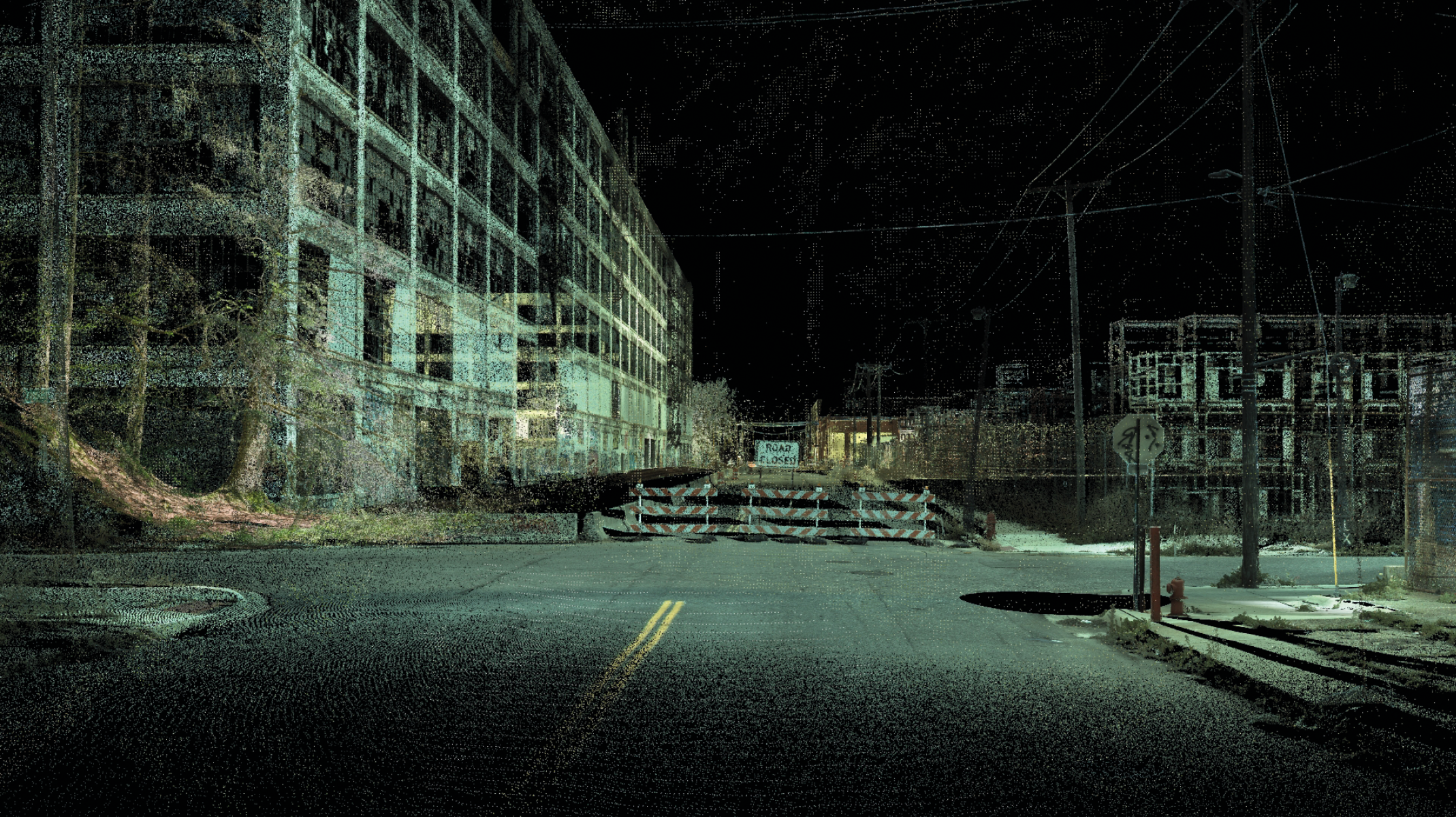
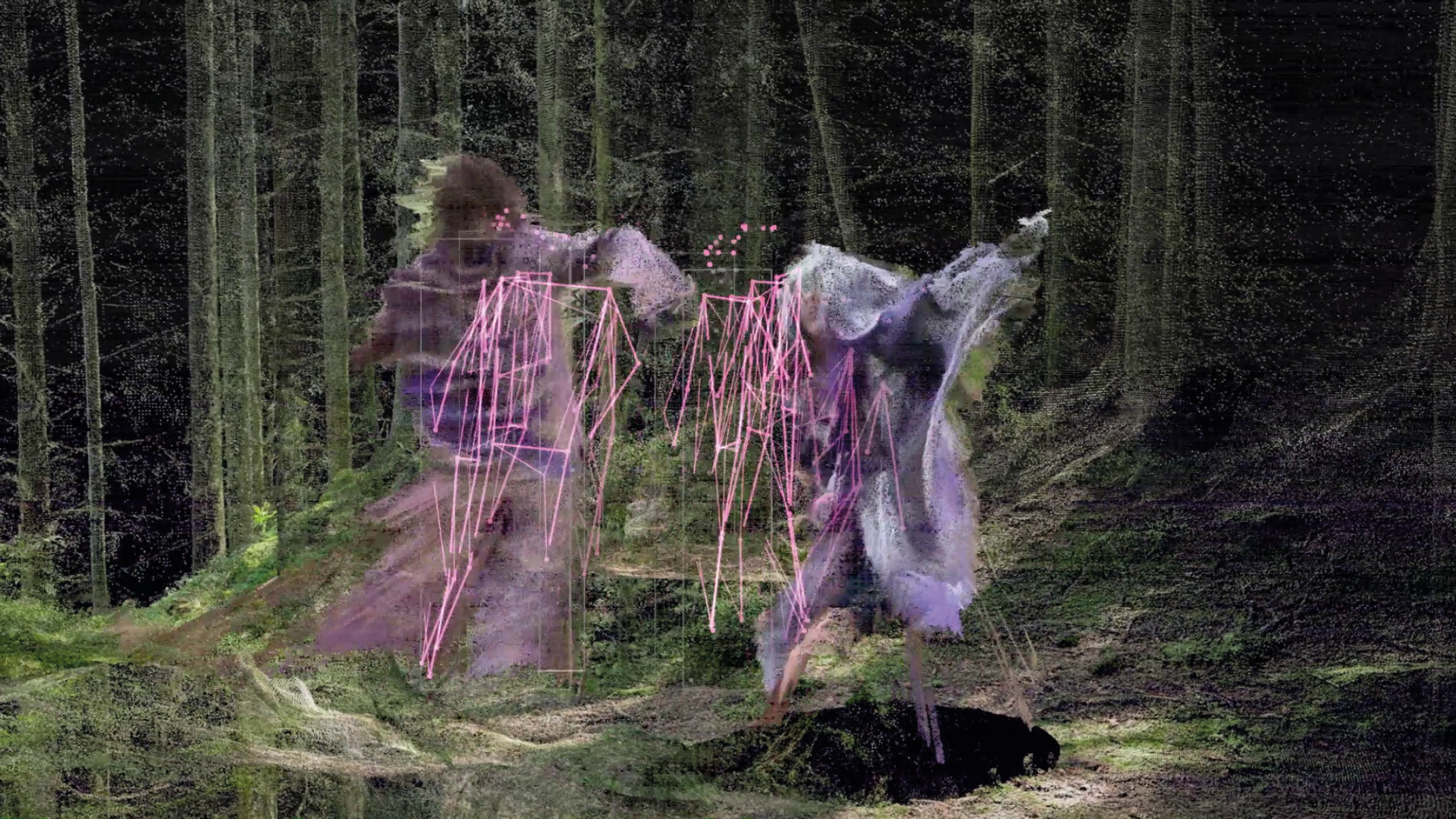
Figures 1 and 2_ Stills from Where the City Can't See, Designed and Directed by Liam Young, Written by Tim Maughan, VFX Supervisor Alexey Marfin.
I like to imagine the future as a dark, unknown landscape. Each narrative we create is like a small beam of light, illuminating only a fragment of what lies ahead. The more futures we imagine—positive or negative, utopian or dystopian—the more light we cast on that landscape. And the more visible it becomes, the easier it is to determine our next steps. So, while many stories lean toward cautionary tales—what I call productive dystopias—I believe the narratives we urgently need are those that serve as roadmaps to aspirational futures. Yet, these are incredibly difficult to create, since imagining a better future often means overlooking the mounting evidence that things are only getting worse.
One of the great tragedies of our time is that many of science fiction's cautionary tales have been misread—especially by the tech industry—as blueprints for aspirational futures. When Neal Stephenson described the metaverse in Snow Crash (1992), his intention was to sound the alarm. Yet some Silicon Valley enthusiast read it and thought, "This is great, let's build it." And now we find ourselves in a world where four billionaires shape policy through dystopian technology companies.10
We need new narratives that grapple with urgent questions: How do we confront climate change? How do we move beyond fossil fuels? How do we manage resources without perpetuating exploitation and new forms of colonialism?
M. T.: Regarding past fictions—such as Archigram's designs of the 1960s or the Ghost in the Shell manga of the late 1980s—do you think there is value in revisiting those speculative visions of the future? Would you say those narratives still hold relevance today?
L. Y.: Rather than any supposed predictive capacity, what is interesting about speculative futures is what they reveal about the context that produced them. They function as glimpses into the moment of their creation. When they appear to be fulfilled, it is not due to foresight but to their resonance with dynamics that were already in play. Their value ultimately lies in helping us better understand the present and, from there, make more informed decisions.
I often cite George Orwell's 1984 as an example. Orwell imagined a world of constant surveillance, where a single government or a technology sector could monitor everything we do. Today we live in a comparable reality, but that does not mean Orwell was a prophet— it means we failed to heed his warning. In fact, 1984 is not about the future; it is about 1948, the year it was written, and about the authoritarian tendencies Orwell observed at the time.
When I look at speculative futures of the past, I see them as snapshots: reflections of the values, dreams, fears, and contradictions of a given moment. Beyond that, I do not think they hold any special value. I am far more interested in the futures we need now.
M. T.: Much of your work involves envisioning futures that are vivid, layered, and often provocative. What role does imagination play in your practice? To what extent does imagining become a way of intervening in reality?
L. Y.: The futures we imagine often become the ones we ultimately inhabit, because they help create the very conditions for their emergence.11 History offers many examples.
When Jules Verne envisioned A Journey to the Center of the Earth or life Twenty Thousand Leagues Under the Sea, he was dreaming of possibilities that would later inspire the development of diving and marine exploration, sparking the imaginations of generations of scientists or engineers who would bring those visions to life. Or consider the story of a young girl in America who watched Star Trek and saw Lieutenant Uhura12— an image that inspired her to become the first African American woman to travel into space. Even the inventor of the pacemaker has cited Frankenstein as a source of inspiration.
M. T.: If the futures we imagine can become the ones we inhabit, how far can—or should—we take that imagination? How do you determine the scale and impact of such projections? And how does this shape your approach to speculative design?
L. Y.: I think what defines this moment—what some call the polycrisis,13 or what I have described as a live-action dystopian film unfolding in real time—is that the scale of the crises we face today is unmistakably planetary.
For a long time, speculative futures drew heavily on local mythologies. There was a belief that, to address the climate crisis, it might be enough to retreat into small-scale movements—growing food at home or generating energy from our rooftops. In the 1960s and 1970s, at the dawn of ecological consciousness, that vision held promise. But today, given the scale of the crisis, such solutions alone are insufficient.
There is no such thing as a local iPad; even a banana is a global object.14 The major challenges we face—reducing emissions, abandoning fossil fuels, feeding ten billion people—are fundamentally planetary in scope. We cannot feed the planet by growing tomatoes in our backyard. We need technologies such as vertical farming, hydroponics, and other assisted production systems—responses proportional to the scale of the problem.15
I am interested in telling stories about futures at a planetary scale precisely because most existing depictions are dystopian: Bond-villain worlds or sinister mega-corporations. Consider the idea of densifying cities, which is often portrayed negatively—as crowded, chaotic, and polluted. But, unless we rethink urban density to make it both sustainable and desirable, we will have no viable way forward. So, I ask: how can we reimagine density? How can we design cities that are at once sustainable and livable? How can we conceive of massive energy networks—wind, solar, hydroelectric—while also accounting for those without the resources to build their own infrastructures? That is where my work sits today: visualizing collective action at a planetary scale—imagining futures that are not dystopian or destructive, but hopeful and aspirational.
One example is Planet City,16 which imagines a multigenerational retreat into a single, hyper-dense city designed to house the Earth's entire population. This is a thought experiment—a speculative model of urbanism at an unprecedented scale—designed to provoke reflection: if we can imagine a Planet City functioning for ten billion people then we can begin to rethink cities such as Los Angeles, Bogotá, or London.


Figures 3 and 4_ Stills from Planet City, Designed and Directed by Liam Young, VFX Supervisor Alexey Marfin.
Another project, The Great Endeavor, envisions a planetary infrastructure network dedicated to carbon removal. It is not only about halting future emissions or phasing out fossil fuels, but about actively extracting the carbon already in the atmosphere. This, I argue, should be our new "moon landing."


Figures 5 and 6_ Stills from The Great Endeavor, Designed and Directed by Liam Young, VFX Supervisor Alexey Marfin.


Figures 7 and 8_ Stills from The Great Endeavor, Designed and Directed by Liam Young, VFX Supervisor Alexey Marfin.
M. T.: I understand that if the scale of action is planetary, then the corresponding timeframe is geological—or deep. What does it mean to design within horizons that extend beyond any duration we can truly comprehend?
L. Y.: Yes. When we speak of action on a planetary scale, we are referring to processes that unfold not in human time but in geological—or deep—time. Building a global energy grid or reversing atmospheric carbon levels, for example, are long-term projects. Even Planet City is conceived as a multigenerational endeavor, evolving over decades.
The crisis we face today is due in large part to the fact that design and policy have been confined to four- or five-year cycles—the political cycle of most governments. Elected leaders are reluctant to invest in transformations whose benefits will only materialize decades later. Making sacrifices today for results that may be credited to someone else in the future—perhaps even to a rival party—rarely appeals to politicians acting in their own self-interest.
We are not good at setting long-term goals, and we are even worse at addressing crises that unfold on those same timeframes. This is precisely the dilemma of climate change: it advances slowly enough to be ignored, yet by the time its full impact becomes visible, we are already facing an almost irreversible reality. That is why it is essential that, as designers, we learn to think and act across expanded timescales.17
Today, I describe what I do—and the field in which I work—not as architecture or urbanism, but as worldbuilding: a practice for thinking, speculating, and designing internally coherent worlds to explore ideas at systemic scale before they exist. It is about grounding fiction in real and emerging knowledge to explore possible futures from the vantage point of the present. I see this as the design genre of our time, because nothing happens in isolation anymore—nothing unfolds in a single place or within a fixed timeframe.
M. T.: If everything unfolds within global and systemic frameworks, what role do details play in maintaining the coherence of those worlds?
L. Y.: Details are essential, but the way we approach them must change. Each detail should act as a microcosm of the world we are designing, embodying the values and consequences of a much larger system. The effects of action on a planetary scale must be visible at every level, from the global to the smallest joint or material connection.
Take a product designer at Apple working on the next iPhone, for example. The choice of material for the back of that phone—something that literally fits in the palm of a hand—generates chain reactions that ripple across the planet and extend across geological time. That single decision sets in motion extractive industries, massive logistical systems, and impacts the lives of people on the other side of the world.18 So what does it mean to make that design decision—not in terms of how it looks in your hand or how easily it slips into your pocket, but in terms of its impact on a mining community in Congo?
M. T.: In this context, how does such reflection shape the way we think about and represent architecture?
L. Y.: Even when we design a single building, we cannot confine our thinking to the immediate site or its surroundings. We must also consider, for instance, the concrete plant in India emitting alarming levels of carbon to produce the materials we use, or the mobilization of those resources across long distances.
Time, too, comes into play: the plastics embedded in walls today could remain on the Earth's surface for tens of thousands of years. From the hole in the ground where the steel we specify begins its life, to the landfill where parts of our building may one day end up. From this perspective, I believe every architect should think like a worldbuilder: someone who recognizes that even a single building is part of an interconnected global system. And this concerns not only how we design but also how we represent.
Today, the site plan is likely the architectural drawing with the greatest contextual scope, yet it still defines the project's boundaries too narrowly: anything outside its edges is, in practice, excluded from the problem at hand. As a result, the dominant modes of architectural representation are not equipped to address geological timescales or planetary relationships. This compels us to ask: what should be the new language of architectural design? What kinds of documents are needed to map the global entanglements of a building? And what might a plan look like that accounts not only for the site of construction, but also for the holes in the earth, on the other side of the world, where its material life begins?19
M. T.: And what role does language play in this process?
L. Y.: For example, with virtual technologies such as the cloud, networks, or signal, everything appears intangible—without weight or substance. But, in reality, these systems rely on vast physical infrastructures: colossal excavations, energy-intensive data centers, and networks operating at a planetary scale.20 We have deliberately used language to obscure the material realities underlying these systems.
Something similar occurs in architecture. We contrast the "light" with the "heavy," the "immaterial" with the "material." We celebrate the poetics of the ephemeral, such as the instant when sunlight falls perfectly across the page of a book in a library. Yet that moment is made possible only by a concrete aperture, a precise architectural decision with very real physical consequences. All of this is mobilized merely to produce what we call—almost casually—an "ephemeral" experience. This is why I believe it is essential to critically examine the language of architecture: the persistent notion that what we do is light, transitory, or fleeting. We must confront the reality of the impact, scale, and duration of our decisions as designers. For me, that is the urgent reassessment architecture requires.
M. T.: If even what we consider "immaterial" leaves deep and lasting traces, what trace—geological or symbolic—do you think our present will leave in the future? If we could look ahead and glimpse the future ruins of today, what do you think will define the architectural remains of the 21st century?
L. Y.: What I hope is that the ruins we look back on in the future are the ruins of the fossil fuel industry. My most recent project, After the End, imagines a post-fossil fuel world. It pictures a moment—hopefully not too distant—when we collectively decide to shut everything down: gas plants, oil platforms, mining sites. At that point, fundamental questions arise: What should we do with those ruins? Leave decommissioned platforms and plants as scars on the landscape, reminders of how destructive we once were? Erase them and try to forget the infrastructures that shaped our world? Or seek ways to heal those landscapes?
After the End explores this transformation. It imagines repurposing existing infrastructures: transforming concrete platforms from old gas plants into launch sites for a new Indigenous space industry; sinking obsolete oil platforms to create artificial reefs that sustain fisheries and support island communities historically displaced by the fossil economy; reforesting the vast craters left by mega-mining. My hope is that, from the vantage point of the future, the ruins we look back on will be the infrastructural remains of this extractive era—transformed into foundations for something better.
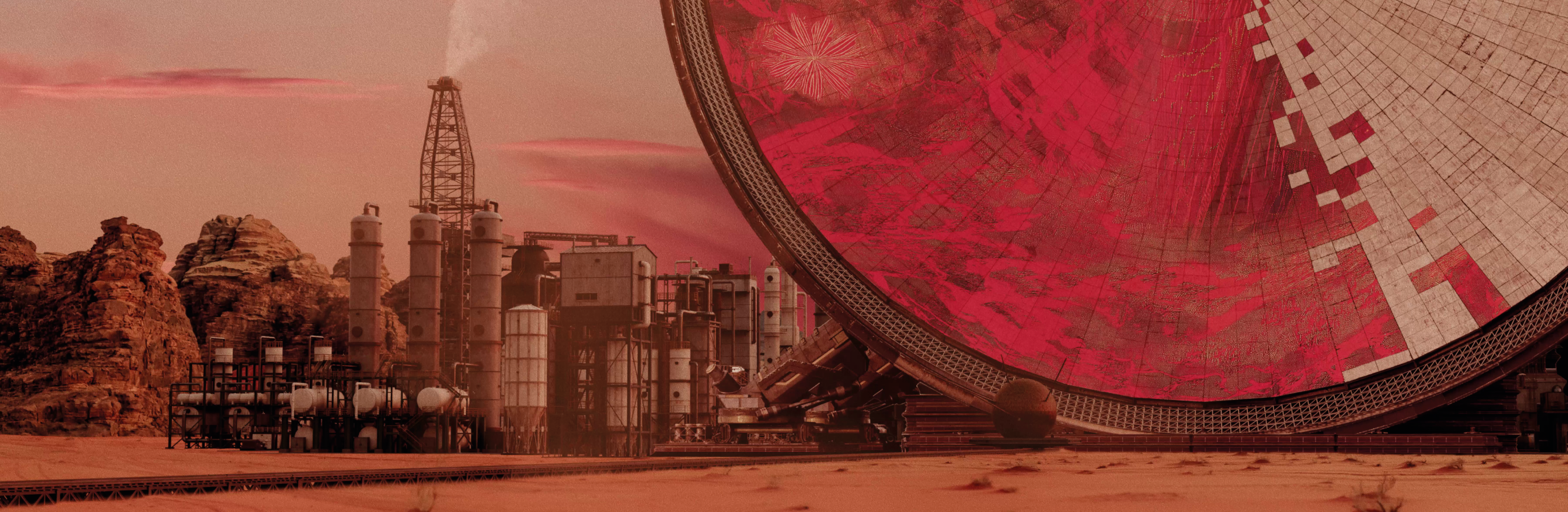
Figure 9_ Still from After the End, Designed and Directed by Liam Young, Co Written by Natasha Wanganeen and Liam Young, VFX Supervisor Alexey Marfin.
M. T.: Collectivity seems to be key to the very existence of speculative futures. Yet given that spatial, temporal, and material variables are so deeply intertwined, how do you approach and develop these dimensions in collaboration with others? And what about practices that still revolve around the figure of the "solitary genius"? How can we move beyond individualistic speculation toward a truly collective construction of the future?
L. Y.: There has always been this myth of the solitary genius, sketching some grand idea on a napkin and then willing it into existence. Even today, many architects still operate in this way. When Bjarke Ingels imagines his Masterplanet or floating cities, he does so in a manner that perpetuates that very myth.
For me, this is why such projects often feel dystopian, even unsettling: they represent one person's vision of the future imposed on everyone else. This was, in fact, the central problem of modernity—a handful of architects with oversized egos who believed they knew better than the rest of the world, producing panoramic visions of the future and then imposing them on the public.21
What I am proposing is something different. If worldbuilding—as I understand it—is truly the design medium of our generation, then we must acknowledge that it is not a solitary act. It is an inherently complex undertaking that requires collaboration across times, geography, disciplines, and cultures.22
Planet City, for example, was a deeply collaborative project, developed in dialogue with scientists, technologists, cultural theorists, political scientists, writers, artists, costume designers, and activists. My role in that project was more like a curator: I assembled what we called the "city council," a group of brilliant and curious thinkers from diverse fields who explored together how such a city might function at an extraordinary scale. That approach has been central across all my work—from Planet City and The Great Endeavour to the more recent project Emissary, which imagines a spacecraft designed to last for eternity, developed in collaboration with materials engineers and systems designers from JPL and NASA.

Figure 10_ Still from Emissary, Designed and Directed by Liam Young, VFX Supervisor Alexey Marfin.
If we are serious about engaging in the complexity of the futures we are trying to build, we have to make space for all of those voices to contribute. In many ways, I now see my role as that of a scientific illustrator. I visually shape ideas, theories, sciences, and engineering that are often buried in specialized journals or confined to academic conferences. My goal is to build connections between this complex knowledge and a broader public by presenting the technological and scientific developments most likely to shape our future lives.23

Figure 11_ The Great Endeavour Exhibition at 2023 Venice Biennale, Designed and Directed by Liam Young, VFX Supervisor Alexey Marfin.
* This interview, conducted on April 3, 2025, has been edited for clarity and fluidity. Footnotes represent the author's interpretations, intended to provide additional context, references, and potential connections. They do not form part of Liam Young's statements and should not be taken as an accurate reflection of his practice. All translations are by the author, unless otherwise noted.
1 Although speculative futures are referenced here, they can be placed in dialogue with the notion of futures literacy, understood as an open conceptual framework that invites us to engage with multiple futures, reframe the present, and question the assumptions underlying our imagination. From this perspective, the goal is not prediction but exploration and learning within contexts of novelty and uncertainty, by broadening—or at times narrowing—possible courses of action (Miller 2018; UNESCO n.d.).
2 Unknown Fields Division is a nomadic design studio, directed by Liam Young and Kate Davies, that undertakes expeditions, develops speculative narratives, and engages in critical mapping to reveal the hidden global networks that sustain contemporary urban life (Unknown Fields Division n.d.).
3 Worldbuilding can be defined as the "process of constructing a complete and plausible imaginary world that serves as a context for a story" (Zaidi 2019, 17). The resulting storyworlds "provide detailed contextual rulesets that develop a larger reality that extends beyond a single story" (Stackelberg and McDowell 2015, 25-26).
4 In Easterling's (2014) framework, infrastructure space is not limited to physical networks; it also encompasses standards, protocols, and repeatable formulas that function as a kind of "spatial software," conditioning and shaping the city (8-9). Conceived as an operating system, this space is governed by "new constellations of [...] players" whose often undeclared activities operate "outside of, in addition to, and sometimes even in partnership with statecraft." Easterling terms this regime of practices extrastatecraft (10).
5 In the tradition of speculative design—whose critical pioneers, Anthony Dunne and Fiona Raby (2013), employ artifacts and scenarios not to solve practical problems but to raise questions and provoke debate about the present and its possible futures—Young adopts this logic and expands it to another medium and scale. As he explains, "the world is the medium in which I prototype futures" (Young 2019, 113), marking a shift from the prototype-object to the prototype-world.
6 This does not suggest that such technologies exist outside culture, but rather that they operate in registers prior to their cultural assimilation. For instance, Hayles (2017) develops the notion of nonconscious cognition to demonstrate how both humans and technical systems process information and generate responses without conscious mediation. Similarly, Bratton (2015) describes how planetary infrastructures—what he terms the Stack—organize contemporary life through layers (Earth, Cloud, City, Address, Interface, User) that function at scales and speeds beyond individual perception. Read together, these perspectives suggest how technical processes participate in reconfiguring the conditions of the livable, often through effects that remain almost imperceptible.
7 Geological epochs, unlike human time scales, are divisions of Earth's history defined by stratigraphic boundaries. The Holocene, which began roughly 11,700 years ago, is still recognized as the current epoch by the International Commission on Stratigraphy (ICS). The term "Anthropocene," popularized by Paul Crutzen and Eugene Stoermer (2000), was proposed to signal that the human footprint on the planet might warrant a new geological epoch. However, in 2024 the ICS and the International Union of Geological Sciences (IUGS) decided not to formalize it within the official geological time scale.
8 In Young's work, the post-Anthropocene does not denote a formal geological epoch but serves as a critical and narrative framework for exploring scenarios that move beyond Anthropocene discourse.
9 In that sense, following Latour (2005), these speculative futures can be understood as "associations" in which agency emerges through connections between humans and non-humans. From a relational ethics perspective (Braidotti 2013) and Haraway's call (2016) to "make-kin," design would be understood not as a tool of external control but as a process of co-composing bodies, machines, and ecologies. These futures, therefore, do not aim to predict technological artifacts but to open and assemble shared worlds. An example is Where the City Can't See (2016), filmed entirely with LiDAR—technology used in autonomous vehicles—which produces a point-cloud aesthetic that suggests a machinic perspective. The project explores how this mode of vision conditions what becomes visible and what remains hidden, revealing the active role of technologies in shaping sensibilities and ways of inhabiting.
10 In Snow Crash, the metaverse is depicted as a satire of a virtual space governed by corporate logic and inequality. Over time, however, the technology industry reinterpreted it not as a warning, but as an aspirational business model.
11 As Young suggests, "science fiction has this extraordinary capacity to act as a mirror through which we can see ourselves; [...] the new normal is constantly being evolved and updated" (Young 2025a, 5:20-5:44). From a theoretical perspective, imagination in science fiction can operate through estrangement, "transforming our own present into the determinate past of something yet to come," thereby enabling a critical reframing of the present (Jameson 1982, 152; cf. Suvin 1979). In this sense, imagination does not predict, but acts as a guide: following Appadurai, it is the "capacity to aspire," a "navigational capacity" formed in interaction and shaping collective trajectories from the present toward possible futures (2004, 69).
12 Young refers to Mae Jemison, who has acknowledged the influence of Nichelle Nichols, the actress who portrayed Nyota Uhura in Star Trek (Jackson 2013).
13 The term polycrisis, first formulated by Edgar Morin and Anne-Brigitte Kern in the 1990s, has recently been revived by Adam Tooze—most notably in the context of the World Economic Forum (WEF)—to describe the convergence of multiple interconnected crises that, by amplifying one another, generate systemic instability ("What Does the Term Polycrisis Mean?" n.d.).
14 For example, Unknown Fields Division's Unravelled (2017) traces the journey of fashion, which begins "in the cotton fields in India, and stretches through textile mills, dye yards, garment factories and shipping ports" to expose the complexity of global supply chains that remain largely invisible to consumers.
15 Young argues that "all the systems, all the infrastructures, all the technologies we need are already here [...] working at smaller scales around the world" (Young 2025b, 3). So, the problem is not primarily technical but rather a "cultural and political crisis of imagination" that hinders the translation of shared imaginaries into effective frameworks for action at a planetary scale (Young 2025b, 3; cf. Ghosh 2016). Hence, these smaller-scale pilots must gain "vigorousness in both regulatory and cultural frameworks" in order to operate at "the scale of the problem" (2025b, 3-4), conceiving the planetary not as centralization, but as multiscale coordination. The Great Endeavor (2023) dramatizes the kind of unprecedented planetary collaboration required to close this translation gap (Young 2023).
16 Planet City (2021) is a speculative design exercise that takes Edward O. Wilson's conservation proposal in Half-Earth: Our Planet's Fight for Life (2016) as its point of departure, in which he proposes allocating "half the surface of the planet" to biodiversity reserves. Young extrapolates this idea by imagining a scenario in which the entire human population is concentrated in just 0.02% of the Earth's surface, leaving the remainder for ecological regeneration (Hill 2023). The aim of the project is not to provide a solution but to test a speculative scenario capable of provoking debate on hyper-dense urbanism and sustainability (Young 2025b, 2).
17 Morton (2013) defines hyperobjects as phenomena "massively distributed in time and space" that exceed our capacity for direct relation (1). Their comprehension is hindered by a constellation of properties—viscosity, nonlocality, temporal undulation, phasing, interobjectivity—that together make them "invisible to humans for stretches of time" (1). These effects culminate in what Morton terms "the end of the world" (2): not the destruction of the planet, but the collapse of an anthropocentric conception of the world. While Morton theorizes these limitations, Young materializes them, making perceptible what so often lies beyond our reach.
18 For Unknown Fields Division's (2015) Lithium Dreams, Liam Young and Kate Davies undertook an expedition to Bolivia's Uyuni salt flat, home to one of the largest lithium reserves on the planet. Using drone imagery, they trace how the materials that power our electronic devices originate in volcanic formations millions of years old, while exposing the social and environmental costs of producing so-called "clean energy."
19 Over time, representation in architecture has not evolved linearly but has instead accumulated diverse forms. As our relations with the world are transformed, so too are the scales of the architectural. For instance, Evans (1986) reflects on the anticipatory role of the drawing; Corner (1999) on the agency of mapping; Latour and Yaneva (2008) on the moving building; and Mattern (2015) along with Design Earth (Ghosn and Jazairy 2018, 2021) on planetary-scale narratives. What matters in each case is less the medium itself than the operation it enables—the means of intervening in the real: drawing as producing, mapping as intervening, following actors as revealing processes, narrating as rehearsing worlds, among other possibilities.
20 Gonzalez Monserrate (2022) demonstrates that the so-called "cloud" relies on massive physical networks, resource-intensive consumption of energy, water, and minerals, and large-scale extractive processes with profound ecological impacts. Similarly, Crawford (2021, 23–52) shows how artificial intelligence is sustained by complex global systems of extraction and supply chains—costs that large technology companies systematically render invisible.
21 In the 1960s and 1970s, Italian radical architecture collectives—Superstudio, Archizoom, Gruppo 9999—developed counterscenarios and speculative photomontages that exaggerated and subverted modernist paradigms of order and homogenization: the aim was not to "put forward a different world from the present one, but rather [to] present the existing one at a more advanced level of cognition" (Andrea Branzi 1984, cited in Buckley 2019, 266).
22 To have cultural impact, Young conceives of "critical ideas as Trojan horses," inserted into widely circulated formats of popular culture—particularly film—where he "encodes" questions about the future into accessible narratives. In his view, change unfolds through "paradigm shifts" and "big cultural moves" (Young 2019, 114). This process is aligned with his commitment to "build consensus across all aspects and landscapes of the political map" (Young 2025b, 4).
23 For Young, worldbuilding and storytelling not only enable the visualization of data and patterns but also their dramatization: the transformation of abstraction into experience, where information is infused with drama and emotion so that it becomes difficult to ignore (Safian-Demers 2022). In this sense, he draws on situationist practices—particularly the dérive—to invite viewers to oscillate between the inhabited city and the fictional one. His fictions thus occupy a "sweet spot" between reality and speculation: "I'm interested in a level of credibility, or realism, that makes the narrative, the story, the set design feel urgent, visceral, or inescapable" (Young 2019, 115). The aim is to generate an emotional connection that activates urgency and empathy, without lapsing into escapism.