
How to Cite: Tafur Victoria, Manuela. "Temporalities, Rhythms, and Scales". Dearq no. 43 (2025): 4-6. DOI: https://doi.org/10.18389/dearq43.2025.01
How to Cite: Tafur Victoria, Manuela. "Temporalities, Rhythms, and Scales". Dearq no. 43 (2025): 4-6. DOI: https://doi.org/10.18389/dearq43.2025.01
Manuela Tafur Victoria
Universidad de los Andes, Colombia
This issue proposes a framework of reading to articulate the differences in this issue: reading through a temporal lens. We begin with Quetglas’s assertion that "architecture does not occur in time; rather time occurs in architecture" (1994, 37). This formulation envisions an architecture that is more than a passive container, an architecture capable of organizing time into distinct temporal orders—durations, sequences, cycles—through infrastructures, uses, and norms. By architecture, we refer not only to buildings, streets, and squares, but also to bodies, infrastructures, ecologies, norms, and technologies. Rhythm—time marked by repetition and difference—is the sensible manifestation of the interaction of those abstract temporal orders.
If rhythm is the sensible manifestation of temporal orders, what gives shape to it? We draw on Lefebvre's triad (1991, 38-41)—spatial practices (the perceived), representations of space (the conceived), and spaces of representation (the lived)—as an interface for reading the spatial alongside the temporal. This is not an equivalence but an interpretive resource. In our account, the triad does not operate as a system of layers but as interacting moments; rhythms emerge from their couplings and frictions.
We propose an operative translation between Lefebvre’s spatial triad and his rhythmanalysis1: the perceived materializes temporalities through supports and practices; the conceived programs and regulates them; and the lived re-signify them in affective experience. Rhythms emerge precisely from the tensions—couplings and frictions—among these three moments.
Agents that organize and regulate temporalities through their practices. For example, bodies and communities that synchronize, interrupt, or reorder temporal orders through mechanisms that activate material or normative supports, thereby generating shared rhythms.
Material and normative supports enact the temporal orders programmed by agents. They do not function autonomously but require activation through mechanisms set in motion by those same agents. For example, in infrastructural space (Easterling 2014), standards and protocols (supports) operate as "spatial operating systems": they are activated by replicable formulas (mechanisms) applied by constellations of actors (agents).
Scales provide the observational framework through which rhythms appear in the interaction between abstract temporal orders and their material and affective inscriptions. Consider, for example: the arrangement of a table that choreographs dinner and inaugurates festive time; the dancing body that maps time and synchronizes breaths, steps, and gazes; a park that reuses vestiges and recycled materials, rendering the long-term temporality of place legible; the monumentality of a school building that inscribes a political-modernizing time; laws, calendars, and facilities that regulate access to free time; urban and "citizen gardens" that anchor urban voids to seasonal and social cycles; or urban layouts that extend relief and regulate flows according to ecological times and morphological patterns.
Taken together, these examples reveal festive–convivial, corporeal, palimpsestic, institutional, regulatory, community–seasonal, and ecological–morphological rhythms that, from the body to the landscape, become legible across different scales. Reading, then, requires two operations: calibrating the focus and opening the horizon.
On the one hand, Josep Quetglas calls attention to the gaze: naming with precision what is already present in order to render it legible and sharpen the reader’s focus. On the other, Liam Young broadens the scope: from the bodies to the planetary system, from human time to geological time. Taken together, these frameworks guide a reading that is both attentive and expansive.
We understand orders as the abstract and regulated level that organizes time; rhythms as the sensible and lived level that arises from the interaction of these orders; and scales as the observational level that allows us to situate and articulate rhythms.
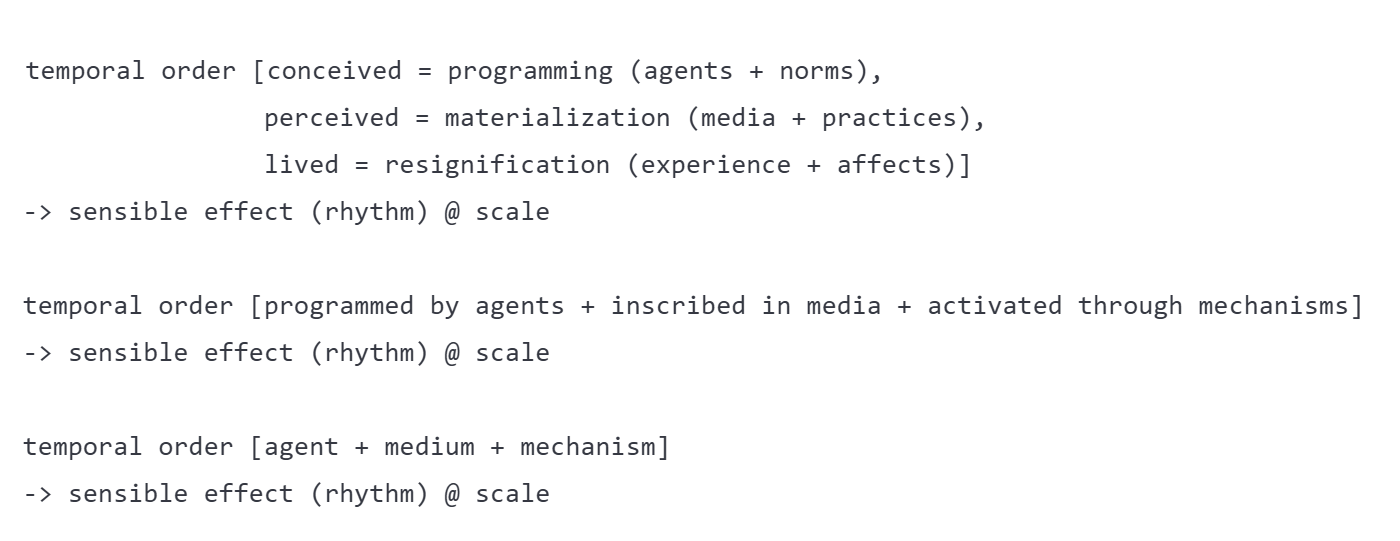
Within this framework, we invite readers to approach this issue through rhythms, articulating the heterogeneous—architecture, city, territory, and planet—without flattening differences. We trust that this proposal, which brings times and scales into relation, will resonate throughout the issue and enable crossings among the texts. Ultimately, reading this issue is also a way of dwelling in time: sustaining oneself in duration, in that in-between where rhythms meet and are negotiated.
1 See Lefebvre (2004) for a broader discussion of rhythm, understood as the interference between cyclical and linear repetitions, polythythmia, and the notions of eurhythmia and arrhythmia. In this framework we use these categories only as reference. Our interest here is to emphasize how temporalities are perceived, conceived, and lived across diverse scales and supports, rather than to diagnose them in those technical terms.