
How to Cite: Mombiedro, Ana. "Space, Perception, and Body: A Transdisciplinary Dialogue Between Music and Architecture. An Interview with José María Sánchez-Verdú". Dearq 44 (2026): 91-96. https://doi.org/10.18389/dearq44.2026.09
How to Cite: Mombiedro, Ana. "Space, Perception, and Body: A Transdisciplinary Dialogue Between Music and Architecture. An Interview with José María Sánchez-Verdú". Dearq 44 (2026): 91-96. https://doi.org/10.18389/dearq44.2026.09
Ana Mombiedro
Universidad de Alicante, Spain
In light of this special issue of Dearq dedicated to the body, perception, and movement, we interviewed the Spanish composer José María Sánchez-Verdú (1968), one of the most influential figures in contemporary music. His widely acclaimed work is distinguished by an approach to sound that exceeds its strictly auditory dimension, integrating elements traditionally associated with architecture, such as phenomenology and the sensory experience of space.
This conversation took place in June 2025 at the Royal Academy of Fine Arts of San Fernando. Together with the composer, we explored the relationship between space, the body, and sound from both historical and contemporary perspectives. Our discussion ranged from archaeoacoustics, the discipline that studies the acoustic properties of historical spaces, to the interplay of time and memory in musical composition, ultimately underscoring the need for transdisciplinary methodologies in artistic research.
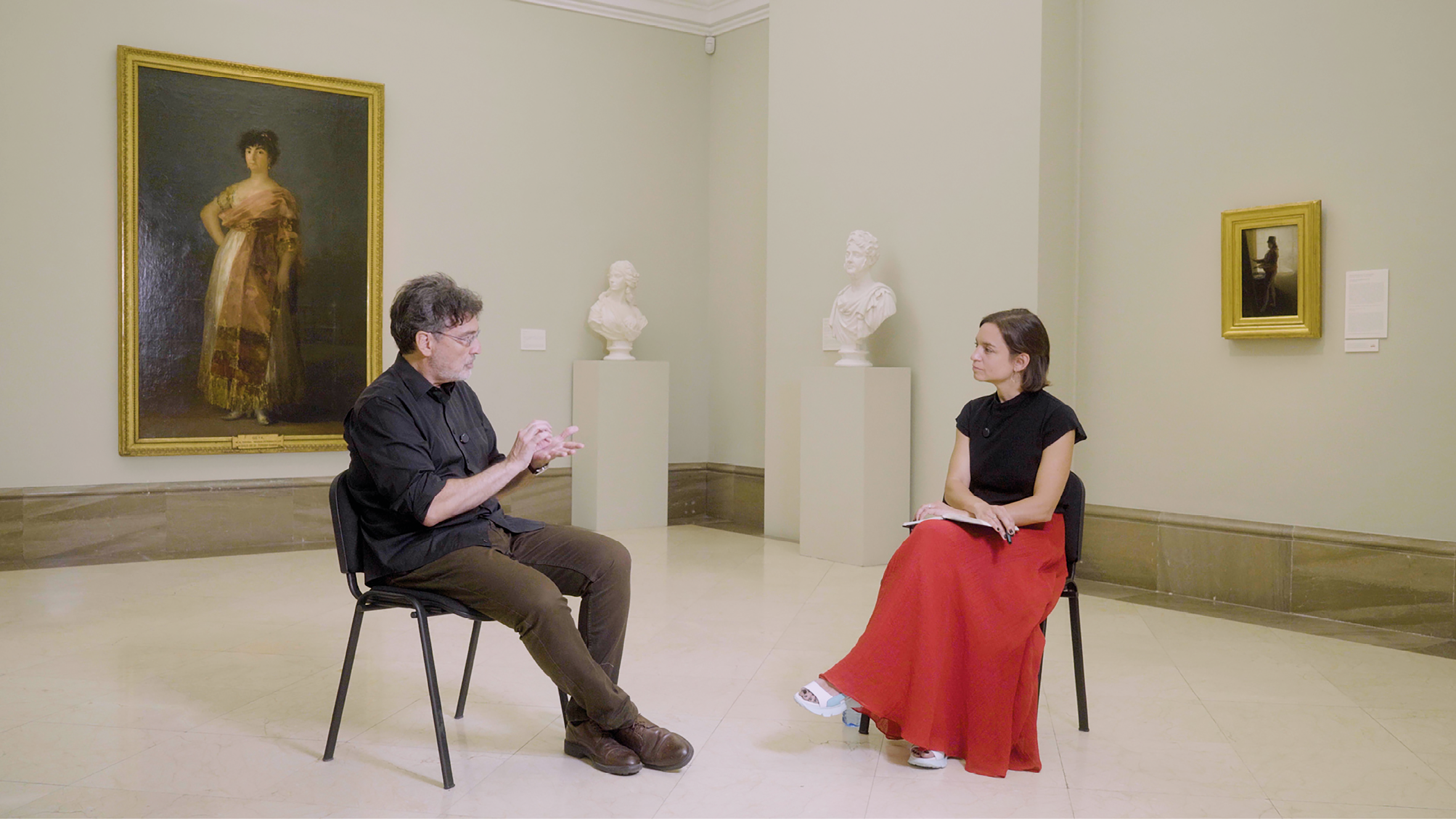
Figure 1_ José María Sánchez-Verdú and Ana Mombiedro at the Royal Academy of Fine Arts of San Fernando. June 2025. Photograph by Jorge Martín.
This dialogue with José María Sánchez-Verdú clearly reveals how contemporary music, when approached as artistic research, can transcend the traditional divisions between science and art. Space does not occupy a secondary role; rather, it becomes interwoven with the sensory dimension that defines human experience. His approach, grounded in the body as a perceptual axis and in space as a compositional material, invites us to rethink creation as a practice that activates all the senses and opens new pathways for knowledge and experience.
Ana Mombiedro (A.M.): José María, thank you very much for taking the time to meet with us. This conversation will be part of our issue on body, perception, and movement. Given our respective backgrounds in music and architecture, how do you understand the limits and points of convergence between these two fields?
José María Sánchez-Verdú (J.M.S.V.): Rather than divisions, I believe there are areas of overlap. There is a deep connection between music and architecture that concerns the ways in which the body perceives and moves through space. Both disciplines work with space-time: music through its temporal dimension, and architecture through its spatial configuration. In both cases, the body is not a passive entity, but rather the point where perception and experience converge. Today, the temporal dimension is already fundamental to architecture, just as space has become essential to music.
For decades, and dating back at least to the 1960s with the emergence of sound art, installations, and performance, the body has been understood as an active element in the artistic experience. This perspective has extended into music, opening fields of inquiry that either did not exist or had been previously confined to other practices, generating vast bodies of work. One of these particularly recent areas is archaeoacoustics.1 It is especially suggestive because it brings together the study of sound, space, and the memory of the past, a kind of archaeology in which both the spatial environment and its sound properties are central.
A. M.: You mentioned that space and the body are inseparable from music. But there is another fundamental dimension at play: time. Music exists only through time. How do you engage with that temporal dimension (silence, stillness, memory) in your work?
J. M. S. V.: Music is an art that unfolds only in time; it has no other mode of existence. A musical creator can even manipulate the listener's perception of time: suspending its psychological flow, redirecting its trajectory, altering its sense of linear progression. Since Henri Bergson, time has led us to new ways of defining and experiencing it in philosophy, in the sciences (Einstein), and in music (Messiaen, Stockhausen). Every moment of the present passes instantly into the past. For this reason, memory and projection into the future play a central role in composition. Depending on the dramaturgical criteria one adopts, as in classical music, recognizable elements are constructed that project forward while simultaneously entering into dialogue with what has already been heard. These are strategies for binding past and present within the musical material, while also establishing a framework of references or logics oriented toward the future. In a broad sense, this is one way of speaking about musical form. Yet this logic, rooted in the past and projected toward the future, coexists with other strategies that abolish any sense of perspective or predictability. Hence the wide range of aesthetic trajectories that twentieth-century music has forged in the realm of musical form, in the relationship between form and content, and in questions of predictability. In this field, rhetoric, as the art of memory, remains ever present, although today everything related to memory seems shrouded in a fog of distance and oblivion. This interplay of past, memory, and future has been fundamental since the Middle Ages. Rhetoric was understood not only as a mode of structuring (as in the art of oratory) but also as a way of shaping musical forms in time. In Europe, since the medieval period, we find this confluence of architecture, memory, and time. Rhetoric was linked to the perception of architectural space as a support through which memory could travel (Quintilian, Cicero). Contemporary music continues to work with these parameters, although classical and romantic traditions have steered us in other directions, relegating space to a secondary role and setting aside this architectural conception of memory and time. What has changed in today's music is precisely this relationship between time and space.
Figure 2_ José María Sánchez-Verdú at the Royal Academy of Fine Arts of San Fernando. June 2025. Photograph by Jorge Martín.
A. M.: You have spoken about how, throughout history, human beings have been biologically connected to the spaces they inhabit as well as their sounds. However, modern technology seems to have disrupted that relationship between time and architectural reality. How do you integrate space as an active element in your music? How does this dialogue between sound and space unfold?
J. M. S. V.: Each musical creator decides how to navigate these parameters, but certain traditions offer important clues. Beyond archaeoacoustics as a scientific discipline, I am interested in what the Sufi masters or medieval Arab art accomplished, where space played an essential role. Even in the Neoplatonic mysticism of Ibn Arabi, poetry interacted with space and generated geometric figures. In medieval Arab and Islamic thought, geometry and mathematics were linked to the pursuit of emotion through minimal modifications, such as repetition, micro-variations, symmetries, or the subtle deviations and vibrations of color in a mosaic. All of this was directed toward the perceptual experience of the person receiving the artistic proposition: how they perceived space, color, and time, including their poetic and mystical dimensions.
States of fascination or ecstasy were even associated with specific spatial forms. Within archaeoacoustics, there is an ongoing debate about whether the geometric motifs found in Paleolithic cave paintings, such as those in Lascaux, might be visual projections of perceptual phenomena occurring in altered states of consciousness. Some suggest they represent distorted visions similar to those produced by hallucinogenic experiences, such as with LSD. Today, many contemporary artists (not only in music but also video and sculpture) seek this same confluence in which space assumes an active role. Space has been a crucial dimension for many artists since the Renaissance. However, it was in the twentieth century that space not only acquired a central role but became fundamentally intertwined with time, what Deleuze identified as the great conceptual element of the century, opening the door to a new and expanded conception in which both parameters are fused into a single dimension. Space and time coexist in similar ways within the sciences, and art continues to engage in one of the most compelling dialogues with scientific thought in modern intellectual history.
A. M.: We are then speaking of space not merely as an element that contains music, but as an active participant in it. Can space itself become an instrument?
J. M. S. V.: Yes, of course. There are many possible approaches. One is to extend the body into space through sensors or photoelectric cells, so that any movement triggers spatial sound processes. The inverse is also possible: allowing the phenomena of space, be it through its resonances or its interaction with electronics, to determine the resulting sound. Many years ago, I developed a process that combined technology with sound sources (voices, acoustic instruments) to create an expanded form of sound in space; that is, to enable sound and space to interact directly in real time. I called this process, implemented in many different technical configurations, auraphon. What the auraphon does is project into space the "aura" or "resonance" of original instruments or voices, generating sounds that no performer physically produces, but that occupy specific locations in the chosen space. One could say that it creates transformed copies of the originals and launches them into space to form sound architectures that are acoustic yet virtual. In practice, a singer or instrumentalist can move through the space and activate resonances in walls or in objects, such as aluminum sheets, mirrors, gongs, or tam-tams, creating a dialogue with their own movements. At other times, an instrumental or vocal sound can be reproduced and multiplied in precise locations I determine through the auraphon. All of this is established in the score, and the auraphonist, operating from the sound board, controls the spatial territory of these sounds, which arise as auras or resonances of the originals, all in real time. The score becomes a cartography of sound and space. In my work, spatiality is never an afterthought or ornament; it is integrated as a map with exact locations that form an essential part of the dramaturgy of the musical project. Examples include works such as my opera AURA, Libro de las estancias, and ATLAS: islas de utopía.
A. M.: You mentioned that sound is not perceived solely through the ear. What role do the skin and the rest of the body play in your music?
J. M. S. V.: It is fundamental. Music, ultimately, is the vibration of particles in the air. Although we process sound primarily through the middle and inner ear, the skin also receives and interprets these vibrations. In one of my operas (ARGO), for example, I worked with loudspeakers capable of producing frequencies between 4 and 6 Hz using oscillators. These vibrations are so slow that they are not perceived as sound, but as a physical sensation. In that context, the audience experiences the sound not through hearing, but through the skin, through an unusual spatial vibration, a kind of compression perceptible in the air or on the surface of the skin. This expands bodily perception beyond hearing and allows for the exploration of other sensory modalities, including visual or olfactory stimuli. Here we enter a vast territory: that of synesthesia. All of this requires a broadening of the body's perceptual capacity so that it can recognize and assimilate sound materials that unfold and circulate through space.
A. M.: We are witnessing a growing convergence between the arts and the sciences that is opening new pathways for exploring the dimensions of the body. In the context of this conversation, within a journal committed to disseminating scientific knowledge among young architecture students and practitioners, where do you think research at the intersection of space and sound is heading? What kinds of results or developments do you foresee emerging from these investigations in the coming years?
J. M. S. V.: I believe this is one of the most important areas of dialogue we have today, as I mentioned earlier. In fact, it is not an entirely new idea: in the medieval Quadrivium, music appeared alongside geometry, arithmetic, and astrology as a form of knowledge, not merely as intuition or emotion. For me, emotion can also be found in numbers, in a musical score, or in the geometry of Islamic art, the excitement of number itself. I say this because a way of understanding art still prevails that equates emotion exclusively with feeling, a conception inherited from the Baroque theory of the affections and, above all, from the sensibility shaped by Romanticism. Today, I believe, as may authors have argued, that we must move beyond disciplinary compartmentalization. I sometimes speak of anti-disciplinarity or counter-disciplinarity: the goal is not to simply add more disciplines, but to blow apart boundaries, to unsettle canonical and academic limits in order to create forms of art that no longer correspond to the divisions inherited from the Renaissance (with its re-creation of the Greek and Roman world) and especially from the Baroque academies. What matters is that art remains alive and responsive to contemporary society, opening perspectives that move us beyond traditional confines and creating new territories that define our present and shape the possibilities ahead.
A. M.: Finally, what advice would you offer to those beginning their path in artistic research or in transdisciplinary fields?
J. M. S. V.: I believe the key lies in understanding art as a form of research. When we speak of artistic research, we are not referring to a mere exercise in documentation or to a traditional academic thesis, but to a process that generates knowledge through creation itself.
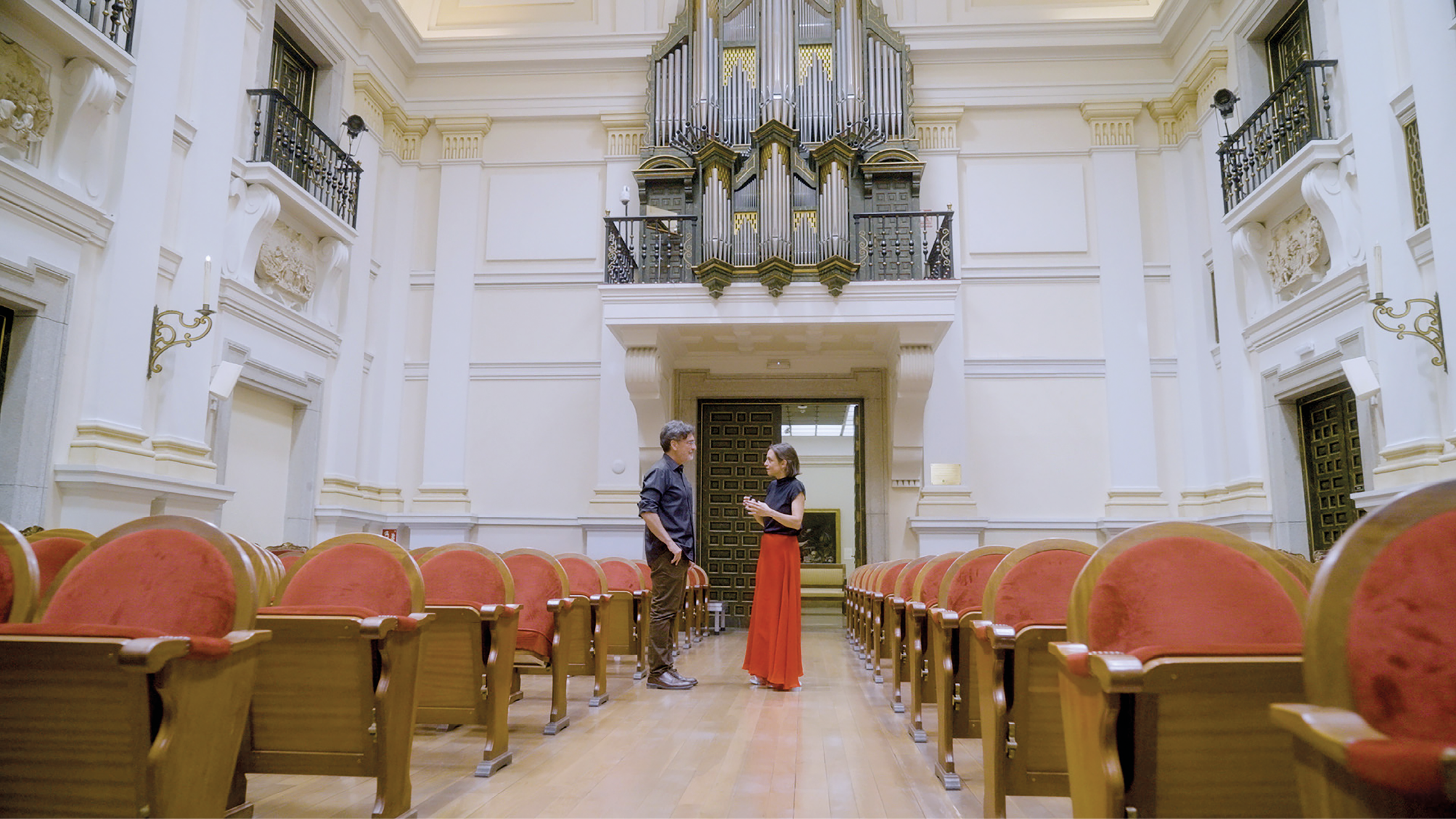
Figure 3_ José María Sánchez-Verdú and Ana Mombiedro in the auditorium of the Royal Academy of Fine Arts of San Fernando. June 2025. Photograph by Jorge Martín.
This interview was made possible thanks to the collaboration of Lucas Ariza and Camilo Isaak.
We also thank the Royal Academy of Fine Arts of San Fernando for opening its doors to us, and José María for so generously taking the time to meet with us.
1 Archaeoacoustics is a discipline that integrates archaeology, anthropology, and acoustic physics to analyze how ancient societies engaged with the sound properties of ritual or domestic spaces (Scarre and Lawson 2006). Studies such as those by Reznikoff and Dauvois (1988) have shown that certain Paleolithic caves containing rock art exhibit resonances that amplify low frequencies, suggesting that these acoustic characteristics played a significant role in the symbolic or ritual experience of those spaces.