Introduction
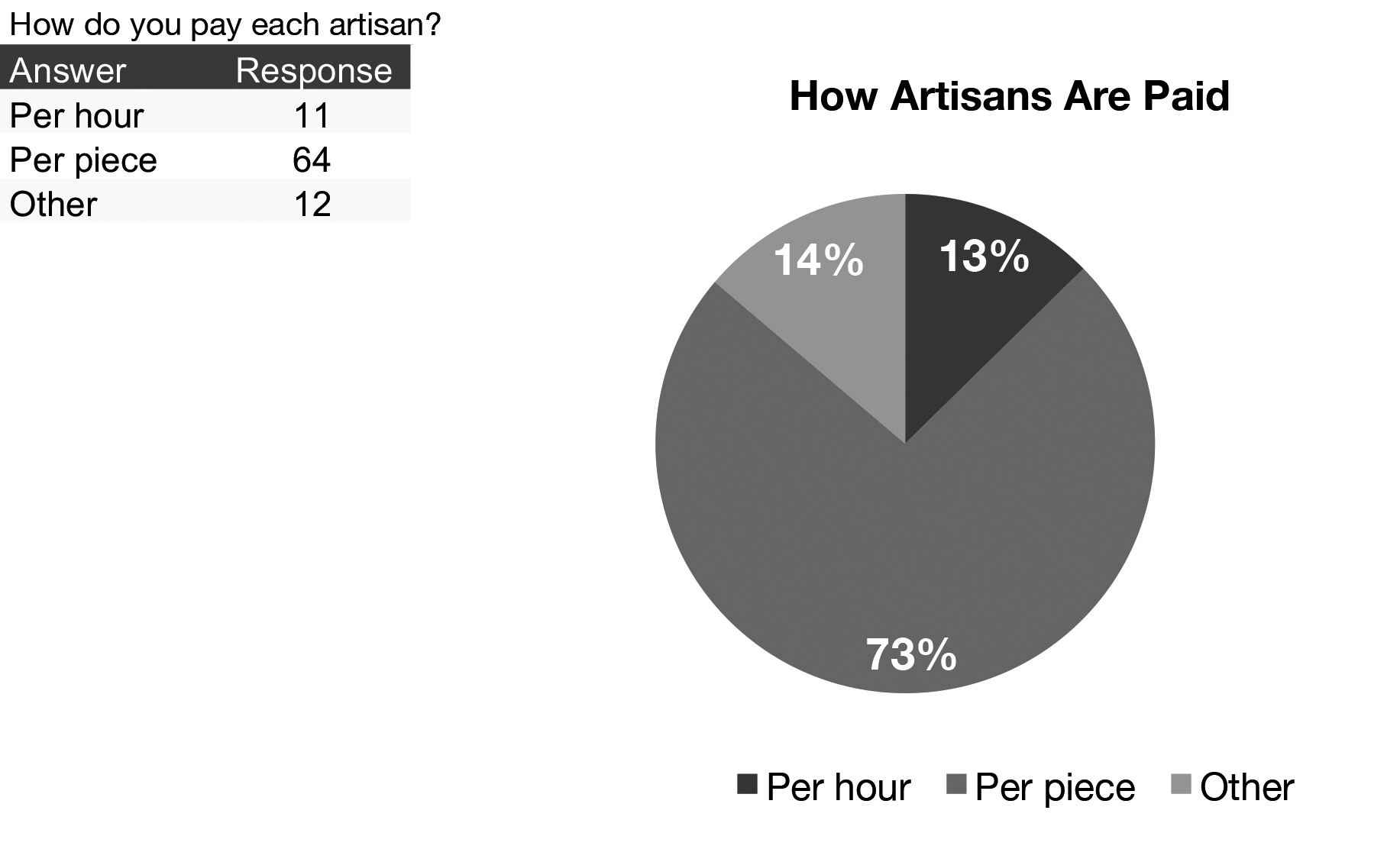
“Artisan”, “craftperson”, “handworker”: the terms evolve, yet they each point to people who are now involved in producing up to 60% of the worldwide garment industry’s supply chain (Siegle 2011). For the purposes of this paper, our interest lies in artisans from emerging economies. The majority are women (Nest 2018), and they work with a range of hand crafts including weaving, ceramics, and beading using techniques most often learned from their elders. As defined by the Colombian government organization Artesanías de Colombia, the artisan sector can be classified into three areas: “indigenous,” the craft produced by ethnic groups that is learned and passed on generation after generation; “traditional” including local cultural groups and early colonizers, the trades of which have also been passed on through generations; and “contemporary,” distinguished as work that incorporates new technologies and/or new aesthetic approaches (Artesanías de Colombia S.A. 2014). What is key to our argument is not necessarily about which of these three groups we are discussing but the common and critical characteristics regarding the artisans’ labor and livelihoods: most often paid for by each piece sold rather than by the hour (meaning they are essentially as freelancers) (Bohrer and Lawson 2012). They live either in rural/marginalized areas or have been displaced to major urban areas, and more often than not are lacking at least one basic need (Strawn and Littrell 2006).
The Role of Designers
The critical role design can play in the artisan sector has to do with the “the production of goods that provide income and generate wealth for poor producers” (Thomas 2006). Based on the research that one of the authors carried out for more than ten years, this income-generating goal seems to be aspirational and may instead need to be more clearly framed as a “hope” or “desire” and not fact. This is because it is just the top artisan elite (who participate in visible partnerships and can afford the big gift/trade shows), who are generating a sustainable income. Thomas points out that the role of the external designer is to bring knowledge of potential markets to the artisans. These designers understand the [capitalist!] systems within which the artisan-produced goods will be sold, which include trends, trade shows, and import/export regulations. The challenge, however, is how to create and sustain models between artisans and designers that do not just reduce the former to cheap labor.

Many designers who have collaborated with, or sourced from, artisans, are presented with consistent challenges. They struggle to obtain the quality they need for the particular market they are reaching; find it difficult to maintain open and fast communication channels with artisan groups; and experience great difficulty in meeting the timing demands of their buyers (Wrigley 2019). On the other hand, artisans know and understand that the “industrialized framework” from which designers come does not necessarily match their [often-indigenous] culture in terms of their life, labor, and craft. In fact, Wayuu artisan Maria Cristina Gomez asserts, “Asking us to adapt and conform to those frameworks is like asking us to jump into the void.” (Gomez 2019)
These challenges are, precisely, the backdrop for the mission of organizations such as New York-based Global Goods Partners (GGP). GGP has a unique application process through which artisan organizations are assessed to then become “partners”. In addition to producing, marketing, and selling their own products, GGP is a resource for large retailers or designers looking for artisans to create products. GGP invests much of their time in ensuring artisans are actually ready to deliver on large orders. They acknowledge the challenges of starting up such collaborations, and, therefore, maintain a valuable roster of experienced artisan groups that can enter into additional partnerships without the burden of repeating the challenges outlined above.

Another model is Abury, a Berlin-based company, which works with artisans in Morocco and Ecuador. Their signature products “Berber Mini Bags”, can be recognized as traditional Moroccan bags that are imbued with design details (color, scale, finishings, etc.) with which the Abury team provides the artisans. They are very committed to ethics and sustainability, so much so, that they will only work with brands who share their commitment. “In the spirit of our Manifesto, we have partnered only with Brands that can sign our Code of Conduct to ensure transparency and the upholding of our values.” Something else that is very positive is that they continually work with the same artisan group. The downside is that all of this is only possible thanks to their Foundation arm. Though they are a for-profit, they acknowledge that centering the artisan within a more just model requires additional fundraising.
Duka is a fairly new brand, with co-founders based in New York and Kenya, where they work with artisans. Having two full-time staff and one artisan community works quite effectively. What distinguishes their model is their commitment to employing a group of artisans week after week. What remains to be seen is how sustainable this model is, both in terms of time as well as scale. It is known that the artisan sector is replete with founders’ burnout because of the small financial margins, the emotional labor required, and the cross-cultural nature of the work.

Brooklyn and Guatemala-based nonprofit Mercado Global has excelled in their long-term commitment to specific groups of Mayan artisan women in Guatemala. Founder and Executive Director Ruth DeGolia is extremely critical of one-off projects (DeGolia 2018), intentionally does not take on these kinds of collaborations, and instead, like Duka and Abury, establishes an ongoing commitment to specific artisan women (currently over two hundred and with plans to scale up to eight hundred) (Mercado Global 2018). Their mission is poverty alleviation, and their 990 tax filing clearly shows how much they have to fundraise to be able to support their community development initiatives (Department of the Treasury 2016).
Market and Gig Economies
Many artisans in the developing world work from home and view themselves as perpetuating ancestral skills and practices; they are trained by their community (peers and elders) and, therefore, are embedded in a social and cultural fabric. The organizational structure of production in the artisan sector is, in many ways, similar to that of pre-industrial European societies. In that guild system, the master would work directly alongside apprentices, and hierarchy was linear (from apprentice to journeyman and eventually master) rather than pyramidal. Everyone in the hierarchy was a producer (rather than a wage worker) who generally retained full control of the production process and the sale of the finished product. Many artisans in the developing world are also independent producers (or freelancers) in that they are, as mentioned before, paid by the piece, and are not necessarily guaranteed a fixed number of paid weekly hours at a given hourly rate. A significant difference is that in the guild system there were no intermediaries between the workman and the market. Today many artisans in the developing world are completely disconnected from the markets for their finished product to the extent that these are located in other countries or because it is unclear to the artisan if a market even exists short of a product re-design specifically targeting potential customers.
As Karl Polanyi argues in The Great Transformation (1944), central to the emergence of a capitalist market economy was that the use of the factors of production (land and labor) would no longer be governed by existing pre-modern allocation mechanisms (such as tradition, redistribution, or reciprocity). Instead, labor (and land) would be sold at market-determined prices. During the Industrial Revolution, the increase in wealth was achieved at the cost of complete reorganization of labor and production—from the guild system of pre-industrial European societies to the mid-nineteenth century English factory. In the transformation process of independent producers into wage workers, workers became the “proletariat” and lost their control over production. The linear hierarchy of the guild system was eventually replaced by the more centralized hierarchical pyramid structure of the factory. Tasks became so minute, repetitive, and specialized that workers no longer had a product to sell. The capitalist would be the one aggregating all separate components of production into a final marketable product. Wage advances came to provide workers some income stability but also maintained them in a state of dependence. It was arguably not until the beginning of the twentieth century (through decades of labor activism) that workers achieved significant improvements in labor conditions and wage increases with benefits (e.g. paid vacation).
Figure 5.
“Organization Chart of Tabulating Machine Co., 1917.” Tabulating Machine Co., December 1917. Source: Picture by Marcin Wichary used under a Creative Commons Attribution 2.5 Generic license.

In most cases, artisans in the developing world are unable to make a living (earn a “living wage”) through the sale of their craft. This raises two issues. First, the issue of whether the current compensation of artisans fairly remunerates their contribution to the productive enterprise. In economics, the traditional approach to “human capital” is that labor should be compensated for on the basis of “marginal productivity”: a worker’s individual contribution to output (see Piketty 2014, Ch. 9 for an overview). Productivity is, in turn, determined by a worker’s skills and the supply and demand for those skills in the marketplace. The question remains: What is the proper value split between those who help bring the product to market and the artisans who are making the products? Is economic rent (namely unwarranted profit) being extracted from the supply chain at the expense of artisans? A second issue relates to the economic viability of the business model to begin with. It is possible that even if no economic rent is being extracted, artisans will be unable to earn a living. This could be because customers are unwilling to pay a price which is commensurate with the labor required to make the product or because other costs associated with bringing products to market (e.g. shipping and marketing) are too high. In short, this could be because the profit margins associated with the current model are insufficient or cannot be scaled to include more artisans in it.
Interestingly, it is the lack of access to the marketplace rather than the minute specialization and division of labor that has effectively stripped artisans in the developing world of some degree of control over the production process. The question is how to achieve a living wage without creating a proletarianization of artisans, which was what happened at the beginning of the Industrial Revolution. Can we use wage advances without creating dependency? Does the adoption of mechanized processes and the re-design of pieces significantly alter work processes and products so as artisans are alienated from their product? And if artisans are able to make a decent living through their craft, do we care that it may be at the cost (down the line) of massive social dislocation and uprooting of their cultural fabric?

As “independent contractors” without a steady predictable income, artisans are somewhat similarly situated as those working under alternative work arrangements in the United States (U.S.). There has been a shift in the nature of U.S. employment relationships in the past decade, with an increase in the percentage of workers working as temporary help agency workers, on-call workers, contract company workers, and independent contractors or freelancers. This is the so-called “on demand” or “gig” economy. A recent paper by Katz and Krueger (2018) says that the percentage of such workers rose from 10.7% in February 2005 to up to 15.8% of workers in late 2015: a significant increase. A neoliberal economic narrative praises the gig economy as creating more opportunities and flexibility for workers, customers, and companies (such as Uber, Airbnb, TaskRabbit, Rappi, etc.), for instance by reducing transaction costs and promoting labor competition. However, as highlighted by Frank Pasquale (2017), there is an alternative economic narrative that sheds light on deep issues such as whether the classification of workers as “independent contractors” can be used to reduce wages, avoid labor laws (such as minimum wage and benefits), and overall maintain workers in a precarious economic (and even psychological) state (Gullo 2018). There is now more intense scrutiny on the potential of this gig economy to exploit workers, as illustrated by a recently settled six-year-long case with Uber (Hawkins 2019).
The recent survey by Katz and Krueger showed that there is mixed evidence in the U.S. as to whether workers are benefiting from the gig economy. Independent contractors typically do earn a wage premium (presumably to compensate for lower benefits and the need to pay self-employment taxes) but also tend to earn less than employees with similar characteristics because of lower weekly hours. Though more than 80% of independent contractors and freelancers preferred their work arrangement to working for someone else, temporary help agency workers, on-call workers, and contract company workers expressed that they would prefer more income stability and work hours.
Similar issues arise for artisans in the developing world. Are the current business models that rely on artisan labor an economic opportunity for artisans, or do they result in economic exploitation doing little-to-nothing to alleviate economic precarity and poverty? As with the gig economy, these issues can be framed with two conflicting economic narratives: one that emphasizes the income generating economic opportunity for under-employed artisans to be drawn into the labor market (and the flexibility for artisans to produce and sell at their own pace); the other emphasizes the low-paid nature of the work and the fact that artisans would prefer stable long-term relationships with designers and marketers as well as more income stability and work hours. Ultimately, the persistence of poverty is evidence that this business model has not delivered significant economic benefits to artisans.
Towards Fairness
How, then, can the artisan sector be fair for all stakeholders? May the solution be adhering to “Fair Trade” requirements? This now-globally-known label has various organizations that supervise its certification process including the World Fair Trade Organization, which has designed a system for “Fair Trade Enterprises.” Their website describes these as enterprises that “exist to put people and planet first…they pioneer solutions to broader issues like overuse of natural resources, women’s empowerment, refugee livelihoods, human rights, inequality and sustainable farming” (World Fair Trade Organization 2019). And, specifically, on the matter of wages, the fourth (of ten) fair trade principle requires “Fair Payment” (World Fair Trade Organization 2017), which is described as being made up of “Fair Prices, Fair Wages and Local Living Wages.” They continue, “Fair Wage is an equitable, freely negotiated and mutually agreed wage, and presumes the payment of at least a Local Living Wage.” Also, “Local Living Wage is remuneration received for a standard working week (no more than 48 hours) by a Worker in a particular place, sufficient to afford a decent standard of living for the Worker and her or his family. Elements of a decent standard of living include food, water, housing, education, health care, transport, clothing, and other essential needs, including provision for unexpected events.”

The stated solutions point to “fair trade enterprises” that serve as aspirations for those committed to fairness. However, the definition of “Fair Payment” is most likely not applicable to the artisan sector. First, the suggestion that a fair wage would be “freely negotiated and mutually agreed” puts artisans, who often have little-to-no math literacy, at a disadvantage as they may not be well-versed in issues of wages and pricing. Second, as has been discussed, artisans are, for the most part, not wage workers. They are being paid by each piece produced, and, due to the inconsistencies relating to time and skill across craftspeople, it is almost impossible to reach an agreement about hours worked per week and related compensation. Finally, it is also critical to look at the literature that, in fact, debunks the myth that workers are better off working for fair trade organizations. The 2014 “Fairtrade, Employment and Poverty Reduction in Ethiopia and Uganda” report asserts, “unambiguously … Fairtrade has made no positive difference – relative to other forms of employment in the production of the same crops – to wage workers.”
Conclusion
Regardless of trendy labels, achieving a sustainable living wage will require business models that both properly value artisan labor (i.e. eliminate economic rent) and are economically viable (and sustainable). Is it possible to imagine compensation models that account for the centuries of time invested in learning and carrying forward a craft technique? The challenges to eliminating economic rent are the poor bargaining power of artisans, their disconnection from the end markets for their product, and the fact that, short of labor laws that ensure a minimum wage, wage advances can be used to maintain workers in a state of dependency as a source of cheap labor (i.e. the proletarianization of the workforce). As discussed, we do not see that the “Fair Trade” requirements have made any significant dent in tackling these issues. The current challenges posed by the gig economy in developed economies illustrate that the logic of capital accumulation continues to put pressure on workers in new ways (the innovative technologies of the digital economy) and suggest that that these are very much ongoing concerns associated with capitalist development.
Creating viable economic models for the artisan sector will ultimately depend on whether the market for produced goods generates profit margins that can support proper valorization of artisan labor and is large enough to achieve any significant systemic positive impact on poverty. One historical lesson that should be drawn from the Industrial Revolution is that, ultimately, poverty alleviation was achieved through a complete reorganization of labor and production; the long-term cost was social and cultural dislocation. Is a different path possible for artisan communities in the developing world? And, if not, is this the price to pay for lifting communities out of poverty?