Introduction
Handcrafts and the people who practice them are often imagined in opposition to digital technologies and computing. Building on scholarship from computational design, science and technology studies (STS), and human-computer interaction (HCI), this paper presents a set of principles that begin to materialize a concept I call Situated Computations, which challenges this split. Drawing from my ethnographic and design studies on the wire-bending craft in the Trinidad and Tobago Carnival, and my development of an experimental digital design tool based on this craft, the article offers guidelines for the development and introduction of computational tools for craft-making based on their social, technical, and material contexts.
The article begins with an introduction to the historical, social, and political aspects of the Trinidad Carnival, the role wire-bending plays in it, and an account of its culture.1 It is followed by an indicative overview of relevant scholarly work bringing together craft, computation, and technology. In the second section, Methods, I describe my ethnographic and design studies on wire-bending in Trinidad and Tobago as well as my development of an experimental digital design tool to create lines in space informed by these studies. The eight principles for the situated development of computational design tools are then introduced and described. In the Discussion section, I consider some implications for design as well as some of the work’s limitations. The Conclusion summarizes the study’s findings and makes projections for future research.
Outlining the Trinidad Carnival
The Trinidad Carnival, also called Mas’, is a contested design space, political arena, and creative outlet through which individuals and communities express their imagination, innovation, and craftsmanship (Brown 1990; Liverpool 1998; Mendez-Franco 2016).2 French planters introduced Carnival to Trinidad in the 1780s, but Africans, the Spanish, British, and free-coloreds shaped it. Under Spanish rule, the Carnival celebrated Chistendom’s victories over Amerindians and Africans, and free-coloreds considered themselves equal to whites (Liverpool 1998).3 However, under the British colonial system, which relies on structures of separation, classification, and “closed-loop[s] [of] cultural purity,” free-coloreds were relegated to second-class citizenship (Eglash 2019, 240).4 Though assigned to this position, they did not join Africans in Carnival celebrations but instead observed a European-style carnival “show[ing] where their values and aspirations lay (Liverpool 1998).”5 Though Africans engaged in Carnival festivities during the period of their enslavement, they reinvented the Carnival after slavery was abolished in 1834. While Europeans participated in Carnival for “fun and frolic,” for Africans, it was religion and a “psychological release of tensions” from domination, segregation, oppression, and violence from white systems of control (Liverpool 1998, 32).6 Through Carnival, Africans celebrated their freedom, expressed their creativity and aesthetic sensibilities (Liverpool 1998; Brown 1990).7
Wire-bending in Trinidad & Tobago
In wire-bending, wire, fiberglass rods, and other linear materials are shaped with hand tools to create two-dimensional (2D) and three dimensional (z) artifacts and sculptures. A highly sophisticated practice, wire-bending has been practiced in the context of the Trinidad Carnival since the 1930s (Crowley 1956, 211).8 Wire-bending inscribes “a milieu of interactions between community, senses, and the moving body while designing and making with static and dynamic linear materials for concurrent expressions of each in three-dimensional space (Noel 2019b; 2019a)”9
As scholars of Carnival remind us, design activities in the Carnival —including the practice of wire-bending— were born in a context of oppression against the African population living under colonial rule (Liverpool 2001; Teelucksingh 2016).10 To this day, through design and other crafts practiced in the Carnival, Trinidadians and Tobagonians reconnect with their history, each other, and cultivate a shared sense of belonging. These innovative wire-benders design and build costumes and dancing sculptures up to 20 feet tall for carnival competitions and street parades. These are large three-dimensional structures supported by the bodies of dancers, which communicate human energy and amplify their movements. Unfortunately, this practice is disappearing due to a number of factors, including the death of the older generation of craftsmen, the lack of a system for pedagogy to pass their knowledge to others, and the younger generations’ lack of interest in handcrafts, along with their desire to engage with digital technologies (Noel 2015; 2019a)11
Socio-technical systems
Influential to the work I present here, the concept of situated knowledges argues for a revealing of histories, human dimensions, and recognition of the partiality of knowledge within specific contexts in research (Gregory et al. 2009; Haraway 1988).12 Anthropologist Lucy Suchman builds on this ‘partiality of knowledge’ and asks that designers refuse to remain ignorant of political and economic structures in their research (Suchman 1993).13 She presents the notion of “artful integration” with hybrid technical systems that foster interactions between different ‘partial knowledges’ and cultivate new forms of material practices (2002). Also, in our construction of technical systems and computational tools to facilitate these interactions, we should engage in these activities with the knowledge that technological artifacts and design embody, enact, and reproduce power relations and authority (Benjamin 2019; Rosenberger 2014; Winner 1980).14 Aligned with the concepts briefly indicated above, some researchers have sought to combine culture, craft, and computation through designing and making, with different degrees of success. Examples include information and design scholar Ron Eglash’s Culturally Situated Design Tools (CSDTs), a series of web-based software applications that provide a “space for students to reconfigure their relations between culture, mathematics, and technology” (Eglash et al. 2006).15 Another example is the experiments on the digital design and fabrication in the ancient craft of ostrich eggshell jewelry (Jacobs and Zoran 2015).16 Moreover, current research in design through a socio-technical lens has made possible new understandings and approaches in design, craft, and technology systems (see, for example Brown and Duguid 2000; DiSalvo 2015; Rosner 2018; Sengers et al. 2005; Vertesi et al. 2016).17
Methods
Building on the conceptual and historical elements described above, this section outlines my ethnographic and design studies of wire-bending in Trinidad and the development of a digital design tool these has inspired.
Ethnographic Study: The Culture of Craft in the Trinidad Carnival
To understand the state of affairs in design in Carnival, learn wire-bending techniques, understand wire-benders’ identities, document activities and unpack these connections to history, I studied mas’ camps in Port of Spain, Trinidad between 2012 and 2016. Data collection included interviews and discussions with wire-benders over meals and while they worked; conducting surveys; analyzing physical artifacts they created; documenting their steps, tools, and methods in design with photographs, drawings, and video (Noel 2013; 2015).18 Visits at mas’ camps would last between 3.5 and 7 hours. To learn how computational tools and processes might work in wire-bending, design pedagogy and practice, I organized and conducted three design workshops in December 2017: one with architecture and design students in the Department of Architecture at the Pennsylvania State University (PSU), two with students and teachers at Bishops Anstey Trinity College East (BATCE) in Trinidad & Tobago (Noel 2019),19 and taught a semester-long design seminar in Spring 2019 with architecture students in the College of Design at the Georgia Institute of Technology (GATech).
Imagination, history, local and global issues, tools, and wire-benders’ bodies shape artifacts for Carnival. Most practitioners’ sketch their concepts, draw, and design on paper. I encountered one expert, Albert Bailey, who bends his ideas directly into wire because he claims he “cannot draw” (Bailey 2013).20 They use their bodies to draw, shape, sculpt, measure, and manipulate materials and tools (Figure 1). Feelings of togetherness, care for each other and their community, mentoring, and creative expression forms and sustains this community of practice. Noticeable during fieldwork was the absence of female and youth practitioners of the craft.
Figure 1.
Wire-benders Narcenio “Señor” Gomez – deceased (up), and Stephen Derek bending a costume for the Trinidad Carnival – deceased (down).

Many designers used digital technology in their design and manufacturing processes, while most wire-benders did not. Designers and wire-benders had access to computers and the internet at their mas’ camps and homes. They used them for research, email, and other online communication and marketing their designs. One fashion designer sometimes used an online manufacturing service for her garments, and a graphic designer used Adobe’s suite of tools to create, represent, and market his designs. Though I did not come across any wire-benders who designed or fabricated with digital technology, they were knowledgeable of existing design technologies —via their internet research— and were eager to use them to advance their designs and their craft (Derek 2013; Frauenfelder 2013; Frederick 2012; Miller 2013).21 For one sculptor, designing in digital space with a pen -a drawing tool- was attractive (St. George 2013).22
Design Studies: A Wire-Bending Grammar
Documenting the craft of wire-bending in technical detail demanded a different approach. As part of my study, I codified the Bailey-Derek Grammar (Figure 2), which aims to describe these craftsmen’s technical knowledge in wire-bending visually via shape rules.23 My ethnographic encounters with the craftsmen gave me access to the details of their practice. As I discuss in detail elsewhere (2019), the resulting grammar makes wire-bending procedures available to both experts and novices, is inexpensive, facilitates physical interaction with materials, and fosters community building.

Computational Tool-Making
Informed by my ethnographic fieldwork and design studies (Noel 2016; 2017),24 I developed a digital tool to generate designs with lines and fabricate artifacts with linear materials using manual and computational approaches to wire-bending for creative expression. The tool combines rule-based design, pattern generation, drawing, traditional wire-bending, and digital fabrication to design and make artifacts. It has two parts: one part generates designs, and the other creates 3D geometry that can be 3D printed.
Generative Design
Developed as a Rhino plug-in, this digital tool gives users the ability to re-describe surface geometry and generate design options using points and lines. Rhino 3D was used as the platform for this tool because of its popularity in the design community, relative affordability compared to other design software, incorporation of custom plug-ins, and the relatively little amount of computational power required to use it. The tool contains a set of methods that allow users to create intricate designs with straight or curved lines. Designers first create a surface in Rhino then use the software’s design methods. They are then prompted to enter numerical values that will divide their surface into a grid. The values entered divide surfaces in U and V directions: the higher the number, the greater the number of divisions and the better the resolution of the re-description. Next, they enter a list of points (O, A, B, C, D, E, F, G, and H) to generate designs. Figure 3a (left) shows the grid and its reference (labeled) points on the surface, Figure 3b (middle) design created with straight lines connecting points A, C, E, and G, and Figure 3c (right) design generated with interpolating curves.
Figure 3.
From left to right: Grid points and their relationship to the surface domain (3a), the shape made with A, C, E, G, and connected using straight lines (3b), the shape made with the same points but drawn with interpolating curves (3c).

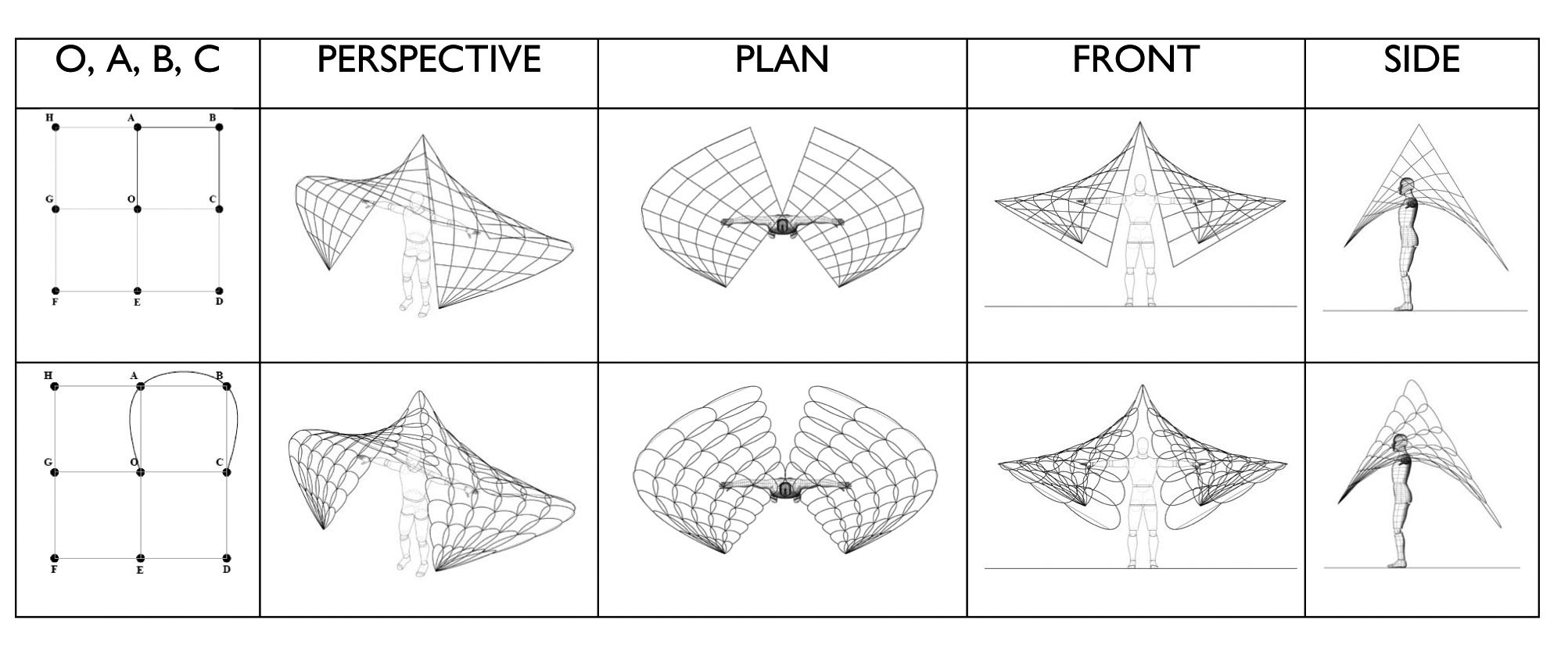
Figures 4-7 reveal designs generated by the digital tool for artifacts, dancing sculptures in Carnival, and architectural elements that shape and affect space. Figure 4 shows examples of 3D surface forms, the points chosen to design with, the shapes created on the grid, and the resulting designs. Figure 5 presents us with potential wire-bending designs for dancing sculptures. Figures 6 and 7 show the possibilities when wire-bending is translated into architectural elements for expressions of wire-bending at the architectural scale.
Figure 4.
This figure shows the inputs and outputs of the design plug-in. The first row shows the points entered by users, second and fourth row show 2D representation of the lines joining the points; third and fifth rows show the 3D re-description of the form using those lines.



Fabrication
Users of this tool could fabricate designs generated by employing manual wire-bending techniques and digital fabrication methods (Noel 2016).25 Designers can use methods from the Bailey-Derek Grammar to materialize their designs. If they want to 3D print connections, they will call the software’s fabrication method, and it will prompt them to select the points that they would like 3D geometry generated. Designers then enter the desired length of the connector’s leg, its inside diameter, and its wall thickness, and the geometry is created. They then export the geometry for 3D printing and assemble the artifacts with their linear rods.
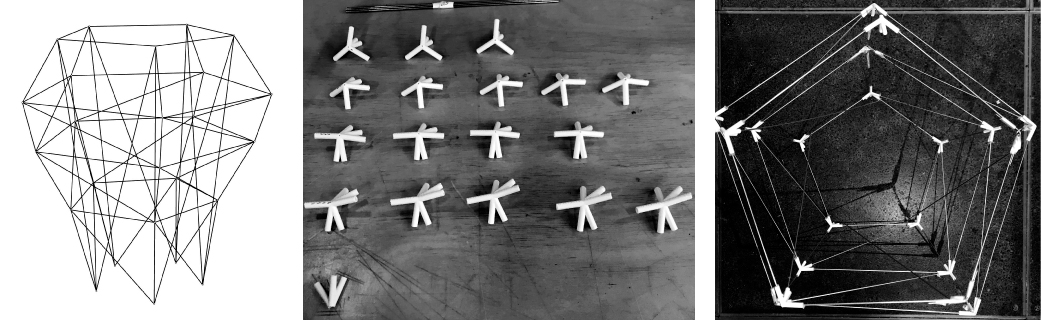
Figures 8 - 10 illustrate how someone would use this digital tool to fabricate artifacts using manual wire-bending and digital fabrication techniques. Figure 8 shows the original digital design (Fig. 8a), the new design re-described using straight lines (Fig. 8b), and the final artifact fabricated from 3D printed connections and straight wire (Fig. 8c). Figure 9 shows another design (Fig. 9a), the 3D printed connections (Fig. 9b), and the final assembled artifact. Figure 10 displays three different physical outputs from the digital tool; each began with the same surface form (Fig. 10a). In Figure 10b, the design generated is bent manually out of wire and assembled using the Bailey-Derek Grammar as a guide. In Figure 10c, wires are bent using a CNC wire-bending machine and assembled using the Grammar as a guide. In Figure 10d, 3D printed connections, and wooden sticks are used to make the artifact. Unlike this practice, which is usually engaged in by older males, in design workshops and seminars I conducted with these tools, the majority of the participants were young and female (Noel 2019).26
Figure 8.
(8a): Digital model of artifact; (8b): Design generated from user inputs and 3D connections; (8c): assembled artifact. Project by Daniel Oddo and Aditi Nagabhushan Bharadwaj, 2019.


Principles of Situated Computations
In this section, I present eight principles for a Situated Computations approach to design and development of computational design tools. Computational design tools should:
-
1) Be built on an ethnographic study:
An ethnographic study of these practices —especially those at risk— allows for a better understanding of a setting’s culture, people, and traditions. Design (this includes making) is a situated practice that lives in and depends on particular social, historical, material, political, economic, and technical contexts. A close study of complex interactions, conflicts, and challenges are rich data to comprehend people and their ways of life concerning culture, design, and technology.
-
2) Be situated
Situated Computations take into account partial knowledges and creates spaces for interactions between these partial knowledges. More than creating space, Situated Computations celebrate diverse knowledges not privileging one particular type. Situated Computational tools (digital and analog) should also be informed by and respond to its social, material, and political contexts. This principle tries to prevent the development and integration of computational tools that do not relate back to people, their culture, processes, and the contexts within which they exist.
-
3) Build on existing skills and knowledges:
Situated Computations build on individuals’ and groups’ existing skills and knowledge. Shedding light on the computational, historical, spatial, and human dimensions of current practices in these contexts can aid in providing an understanding of computation that is grounded in the social and material rather than the purely abstract and technological.
-
4) Facilitate sensory, perceptual interaction, and physical manipulation of materials and tools:
Situated Computations resist structures of separation and purity. Since Alberti’s separation of design from making, mind from matter, the mental from the material, a divide separates architects from the materials with which they design such that materiality is relegated to representation rather than sensory interactions and physical manipulation (Cardoso Llach 2015; Carpo 2011).27 Situated Computational tools resist this separation and its tinge of colonialism by fostering active engagement and intermingling with senses, bodies, and materials, recombining design and making, mind and matter, mental and material, privileging no one way of engaging with ideas and the world.
-
5) Build communities, not individual isolation:
Situated Computations foster community building and create spaces for participation and shared learning. Technologies build communities, and they can put them at risk. From my ethnographic study of design in the Trinidad Carnival, one of the most enjoyable aspects of those engaged in these activities was the strong sense of community. Frederick spoke of the “family bonding, friends, friendships,” Derek the “feeling of togetherness,” and Frauenfelder, the “person to person interaction[s]” (Frederick 2012; Derek 2013; Frauenfelder 2013).28 Situated Computations create communities where its members can experience these bonds and interactions.
-
6) Cater to experts and non-experts in CAD and Computer Programming:
Situated Computations allow experts and non-experts in Computer-Aided Design (CAD) access to and participation in computation and digital design. Professionals, researchers, and students of architecture, engineering, and industrial design have historically used CAD tools. These tools and technologies are not the only ways to engage with or represent design and computational thinking. They can also create spaces for participation and interest in other aspects of design and computational tools, for example, their histories, politics, and relations with society.
-
7) Not require large amounts of computational power and infrastructure:
Situated Computations acknowledge and respond to a setting’s social and technological infrastructures. A refusal to remain ignorant of economic and political structures drives this principle. Technological infrastructures of a region depend on its social, political, and financial abilities. Nations have gained and lost economic power through wars, colonialism, slavery, and other forms of domination. Some technical systems require resources that some societies and individuals are not able to afford due to the lingering effects of domination and other local issues.
-
8) Narrative:
Situated Computations tell the stories, histories, and innovations of marginalized and disenfranchised groups and their settings. Media researcher and artist Kamal Sinclair writes that “story and narrative are the code for humanity’s operating system” (Sinclair 2018).29 These tools should contribute to building multiple expressions that highlight how groups grapple with and challenge racism, colonialism, and other types of domination (Benjamin 2019).30 Telling stories includes integrating these tools, artifacts, and stories into multiple aspects of culture, including education, economics, art, engineering, and architecture, to name a few. Another opportunity might be in the names given to these tools–tying them back to the people, culture, and stories.
Discussion
In this paper, I have proposed eight principles for a Situated Computations approach to design and tool-making (Figure 11), drawing from my ethnographic and design work developed around the Trinidad Carnival and my development of a digital design tool based on wire-bending which is practiced there. The work suggests that our capacity to design tools —and our understanding of computation itself— can be enriched by closely engaging with crafts and the people who practice them. I will now discuss the implications of this study, i.e., the digital tool and what Situated Computations might mean for design.

Mediating artifacts such as drawings, tools, and methods facilitate interactions between craftspersons, novices, and digital designers (Jonassen and Rohrer-Murphy 1999).31 The outcome suggests that a simple sketch of a grid with nine points (Figure 3) can empower these different designers by enabling them to (1) document design, (2) engage in speculation and design play, and (3) communicate with others design communities. Designers (wire-benders and computational designers) can use these drawings to document their steps and help design, and for archiving and replicating their projects. Furthermore, they can speculate on design and learn computational design thinking through play. The ability to play and compete through this tool reinforces its situatedness since play and competition are vital aspects of the Trinidad Carnival (Schechner 2004).32 Also, these drawings and the list of points (Figure 4) can communicate a design or design goal to others involved in the process. The designs generated from this tool neither prescribe the materials nor the techniques to be used, meaning that even with one representation, a designer can make several different designs from a variety of materials and methods.
A second implication is that new expressions in Carnival and architecture are possible. Currently, sculptures in Carnival are covered with fabric and other decorations for performance resulting in the concealment of wire-bending techniques. With this tool, its many design possibilities, and its celebration of lines (Figure 11), I propose that sculptures remain uncovered to celebrate the craft and its tectonics so that they are even more narrative. The same goes for architectural elements such as wall screens and architecture–let’s celebrate the practice, techniques, and people.
Craftspersons can learn computation and digital design while engaging in wire-bending, and digital designers can learn wire-bending while engaging in digital design. The tool creates a space for shared learning and knowledge advancement in wire-bending, making, computational design, and thinking (Noel 2016).33 Wire-benders and digital designers can fabricate artifacts using digital fabrication and traditional wire-bending techniques, gaining knowledge and experience in both. While infrastructures required to implement Rhino 3D on computers in schools and mas’ camps in Trinidad & Tobago are not yet known, results indicate that novice wire-benders can learn computation while engaging in wire-bending (Noel 2019).34 This software facilitates participation and interaction between craftspersons and the computationally-informed. Both can enter unfamiliar territory and engage in mutual learning and partial translations with each other, use their perception, physically manipulate materials, and gain technical knowledge and skill.
While further studies will be necessary to test these principles of Situated Computations, the results provide evidence that it may offer a new approach to design, computational tool-making, and research outside the field of design. Additionally, although this study focuses on a design practice outside the current imaginations of design and computation and in the global South, evidence shows that a Situated Computations approach can open up practices to include participation by currently missing groups and further contribute to our understanding and development of new theories, methods, and tools in different design practices.
Conclusion
Drawing from my work developing an experimental digital design tool that makes lines in space based on wire-bending as practiced in the Trinidad Carnival, this article has proposed eight principles aimed at developing computational design tools that (1) ground computation in the social world by acknowledging historical, cultural, and human contexts around design, making, and technology; (2) shed light on the computational dimensions of handcraft practice; (3) facilitate new social roles, design options, and possibilities; (4) create spaces for participation by those missing in both craft and computational/technological practices; (5) enable computational thinking and making through crafts; (6) resist segregation and privileging of intelligences and skills by building practices that engage multiple ways of seeing, knowing and doing; and (7) amplifies the stories of marginalized groups by deploying them in numerous areas of design practice and education. Future directions for this work include testing the concept and framework of Situated Computations in other craft and design practices, testing it outside design fields, and more closely analyzing the implications of these principles on processes of technology design.