Introduction: Towards the “Other”
In order to understand the context of computation and digital fabrication in Latin American architecture, we must look both inwards and outwards. The procedure involves recognizing part of their own structural conditions, and how they stand regarding the cultural and technological dynamics of globalization. From our region, the action of thinking about the “other” has some antecedents: the theoretical discussion about the identities of the Latin American architecture in the 1990s and the late advances on decolonial theories.
In terms of architecture, the discussion was based on alternative views of the concept proposed by Kenneth Frampton1 called “critical regionalism”. The author sought to name acts of resistance to universal modernism through synthesizing modern architecture, local architectural, and cultural identities and emphasizing the geographical context, the climate, and tectonic characteristics. In this debate, theorists such as Ramón Gutiérrez,2 Cristian Fernandez Cox,3 Marina Waisman,4 and Jorge Francisco Liernur,5 as well as designers including Gui Bonsiepe,6 focused the debate on the unsatisfactory representation of binomial concepts such as center and periphery, the spirit of time and identity of a place, avant-garde, and backwardness as bases to analyze the Latin American architectural and cultural context.
Since that moment until now, decolonial theories have achieved prominence, not only in cultural studies7 and aesthetics,8 but also in technology.9 From this perspective, terms such as “Epistemologies of the South”10 and “global South”11 have been formulated to nominate projects regarding other narratives in the context of globalized capitalism.
In technological and economic terms, there are conditions in the region defining a context of hybridity: 1) between a structure of late and incomplete industrialization12 and the introduction of logics from the third and fourth digital revolutions, 2) between the imported models of technology and the development of social technologies,13 3) between cultural traditions related to crafts and the informal economy, and the emergence of the “maker culture” and the new entrepreneurship discourse.14
In this sense, recognizing “Other Computations” triggers other lines of thought about knowledge and the appropriation actions in Latin America, from the architectural, cultural, and technological fields. In search of otherness, this article aims to outline the recent dynamics of digital fabrication in Latin America, investigating the laboratories that are exploring the use of these technologies in experiments in architecture and object design linked to their own contexts and problems. In short, we are interested in capturing “other digital fabrications” emerging in our own environment.
From Computation to (Other) Computations
Despite the fact it can be affirmed that “contemporary debates about the role of digital technologies in architectural practice and pedagogy tend to be framed in theoretical developments from global knowledge and economy centers”,15 the culture of inequalities and differences defined by Canclini can be identified as an important reference to “Other Computations” in Latin America since its beginning. The context of its evolution is different and “other” in a similar way although it tries to legitimize itself from abroad.17
Marina Waisman18 argued that, in general terms, for “Europeans and Americans the path to high technology has been one of the sustained evolutions so that its adoption was the logical way to answer to their own circumstances.” Concerning the digital fabrication scenario in the USA and some European universities, digital fabrication laboratories have been installed with advanced technologies due to the connection with industries that manufacture machines (robots, industrial 3D printers, and milling machines) and partnerships with industries, which provide materials for research and experiments. In these regions, technology was promoted in the beginning from the practice of architecture instead of academia:19,20 the industry entered into dialogue with academia to achieve common goals.
In contrast, in Latin America, academia turned itself in the principal focus of experimentation on computational design and digital fabrication, where educational practices disseminated novel technologies,21 and computational experiments tried to bring answers to technological curiosities.22 An important part of this process emerged in the second half of the first decade of the 21st century: the return of doctoral and master’s students in computation design from the northern hemisphere to their countries of origin (Image 1). This technological expertise was mixed with knowledge developed locality in universities that, until then, had almost never been implemented in the area, which led to the emergence of local appropriations in less than a decade. This is a dynamic that has already been previously discussed as migratory movements.23
Image 1.
Examples of Latin American technological exchanges at the beginning of the 21st century. Source: Based on Sperling; Herrera and Scheeren, 2015.

A second period was characterized by exchanges between the first generation and their postgraduate students, who became professors and implemented new laboratories, or started to work in architecture offices. In a previous study, we have already pointed out these dynamics, involving the occurrence of regional nucleation24 and their insertion into larger economic, cultural, and academic processes.
This context of migration movements and regional nucleation dialogues with what Canclini stated about migrations, differences, and interculturalities: those who migrated to new horizons “changed their ways of belonging, identifying and facing oppression or adversity.” These appropriations encouraged a particular mode of computation in the context of digital fabrication that is systematically shown in this research’s analysis.
Mapping Computations and Digital Fabrication in Latin America
According to Mumford,26 we should not explain the existence of the new instruments —in his case, the mechanical ones— but the culture that was willing to use them, and then we should extensively explain their use. A complementary approach about the need to comprehend technological scenarios that is in line with the cultural contexts and exchanges can be found in Lemon & Medina; it looks to “how scholarship on Latin America can enrich investigations of technology and how the history of technology can broaden studies of Latin America history”.27
In order to comprehend the emerging digital culture in the architectural field in our region, with the overall aim of mapping digital fabrication technology appropriation processes,28 the research project Homo Faber: Digital Fabrication in Latin America was started in 2014. The methodology involved included: 1) setting up a database about digital fabrication laboratories in Latin America, 2) sending structured surveys to the laboratories, 3) constant updating of the database, 4) qualitative and quantitative analysis of the collected data, 5) elaboration of maps, diagrams and charts from the data, 6) writing of scientific articles focused on contexts, concepts, and case studies, and 7) organization of triennial exhibitions.
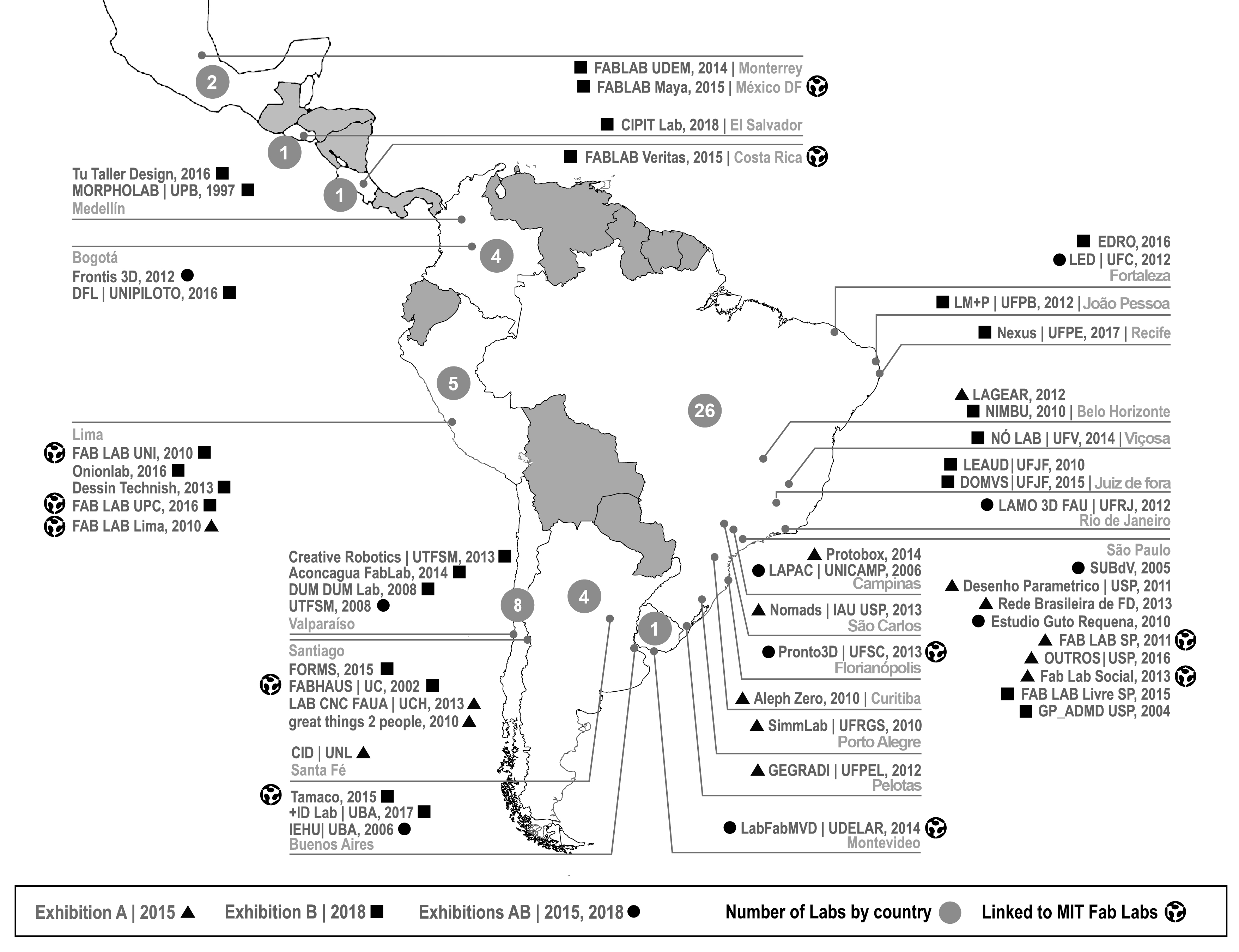
Although there are worldwide follow-ups of the groups associated with Fab Labs29,30 or Makerspaces,31 the specificity of digital fabrication laboratories in the region has not been investigated from a manufacturing, infrastructure, or human resources point of view in Central and South America.32 Also, the current information has not been expanded beyond the laboratories connected to networks including Fab Foundation or Fab Lat. While only 11 of the 52 laboratories mapped in this study are linked to networks, the other 41 are “independent” but sharing their work in conferences and publications. This research was supplied by the authors’ individual investigations and by advising and mentoring master’s and doctoral postgraduate research on the following topics including: computational design, visual and textual programming, fab labs, digital crafts, theories, and design processes.
The first results of the Homo Faber: Digital Fabrication in Latin America Project showed initiatives from South America at the exhibition held as part of the CAAD Futures 2015 “The Next City” Conference, in São Paulo, Brazil. The authors presented “a recent context of starting and development of fab labs in Latin America. Beginning in university research centers, and consolidated in university platforms, this movement expands with the formation of laboratory networks and the emergence of studios and independent researchers investigating and exploring new uses for digital fabrication in architecture and in related fields.”33
The texts “Form and Material”, “About Forms and Formulae”, and “The Factory” were published in the book The Shape of Things. A Philosophy of Design (1999)34 by Vilém Flusser. They were used to compose the conceptual basis of the first exhibition. Using these, “by understanding the digital fabrication as a process that takes both two-way, ‘informing materials’ and ‘materializing forms’, we tried to articulate common aspects of the works presented, based on four informing lines: surfaces, objects, spaces and social processes.”35
The second edition of the exhibition, Homo Faber 2.0: Politics of Digital in Latin America, was held as part of the XXII SIGraDi Conference “Technopolitics” 2018, in São Carlos, Bvrazil. Including Central and South America, its objective was “to be bound to politics and society, showing the potential of digital fabrication and its impact on communities, evidencing how the identity of the projects evolves the constant experimentation of form and material for the development of new products or the improvement of existing ones, from the object to the architectural scale.”36
Discussions from ideas developed in texts including “Do Artifacts Have Politics?”37 “Arquitectura y política. Ensayos para mundos alternativos”38 and “Politics and Digital Fabrication. An ongoing debate”39, directed the theoretical framework of the second exhibition and its organization in sections as follows: Collaborative Processes & Technological Subversions (CP&TS); Conceptual Prototypes & Technological Products (CP&TP), and Artisanal Digital & Cultural Artifacts (AD&CA).
Image 2 shows the laboratories displayed on Homo Faber 1.0 (2015) and Homo Faber 2.0 (2018) according to their location, and Table 1 shows them in relation to the categories used in each exhibition.

Recent Data from the Latin American Digital Fabrication Scene
Comparative data analysis between the two selections and their evolution in the triennium is relevant to help understand the Latin American scene (Table 2). In this study, the laboratories were classified according to their profile, Teaching, Research, and Extension (TRE) and Architectural Design Studios (ADS). Their focuses were subdivided in categories: Experimental Research (EXR), Application of Technology in Construction (ATC), and Social Technology (SOT).40 Each one of these categories was further subdivided to emphasize: Process (PCS) or Product (PDT). Additionally, the manufacturing application scales were defined as Object Scale (OS) and Architectural Scale (AS).
Table 2.
Comparative data analysis between Homo Faber 2015 and Homo Faber 2018 (black = 2015, white = 2018, grey = 2015 and 2018). Source: Authors.

Experimental Research is considered to be oriented to the development of processes or objects, at an experimental level, still without immediate application in the productive sector. Application of Technology in Construction is understood as the development of processes or products that are already at an application stage in construction. Social Technology is understood as technologies developed with or for communities meeting social demands.
The existence of technological appropriation was identified according to local constraints (FL = From the Local) and global references (FG = From the Global). In this aspect, the incorporation of cultural references and the articulation with elements of the constructive traditions of the region were considered.
Comparative analysis bettween the general data of 2015 and 2018 indicate that: 1) Experimental Research remains the main focus, followed by Technology Application in Construction and Social Technology; 2) Social Technology presented a small growth between the two samples; 3) there was an increase in the number of laboratories working in Architectural Scale; 4) there was an increase in the technological appropriation from local conditions.
The cross-references between profiles, focus, emphases and scales from 2015 and 2018 show other significant correlations: 1) Teaching, Research, and Extension laboratories are mainly oriented to Experimental Research (emphasis on Process and Product), and then to the development of Social Technologies, 2) Architectural Design Studios are mostly oriented to the Product emphasis on Technology Application in Construction, without applications in Social Technology, 3) technological appropriation in dialogue with local cultural identities is significantly more present in the Teaching, Research and Extension laboratories than in the Architectural Design Studios, 4) Teaching, Research, and Extension laboratories and Architectural Design Studios that participated in the two surveys kept the focus of their production, oscillating between the emphasis on the process or the product, 5) there was a growth of Architectural Scale jobs developed by Architectural Design Studios.
Local Appropriations in Latin American Digital Fabrication Laboratories
From the categorizations shown in Table 2, it was possible to identify that 32 laboratories from a total of 52 are working on local appropriations and reinterpretations in the context of “Other Computations”; they are rewriting the history of computer technology in the region. After analyzing similarities in their work, we classified them into six groups: Bottom-Up; Community / Digital craft in communities; Components; Mobile FabLab; Low-High Technologies; and Hacking. In keeping with this Dearq call-for-papers, these six groups are promoting “histories, theories, or projects across the architectural, artistic, and pedagogical”41 in their countries. Driven by academic networks, the work of these laboratories is increasing in relevance and visibility. Table 3 shows the intersection of the 52 laboratories with these six groups that have case studies in nine countries in the region. Image 3 shows examples of local appropriations in Latin American Digital Fabrication Laboratories.
Table 3.
Local appropriations in Latin American Digital Fabrication Laboratories (black = 2015, white = 2018, grey = 2015 and 2018). Source: Authors.

Image 3.
Examples of local appropriations in Latin American Digital Fabrication Laboratories. Source: Authors.
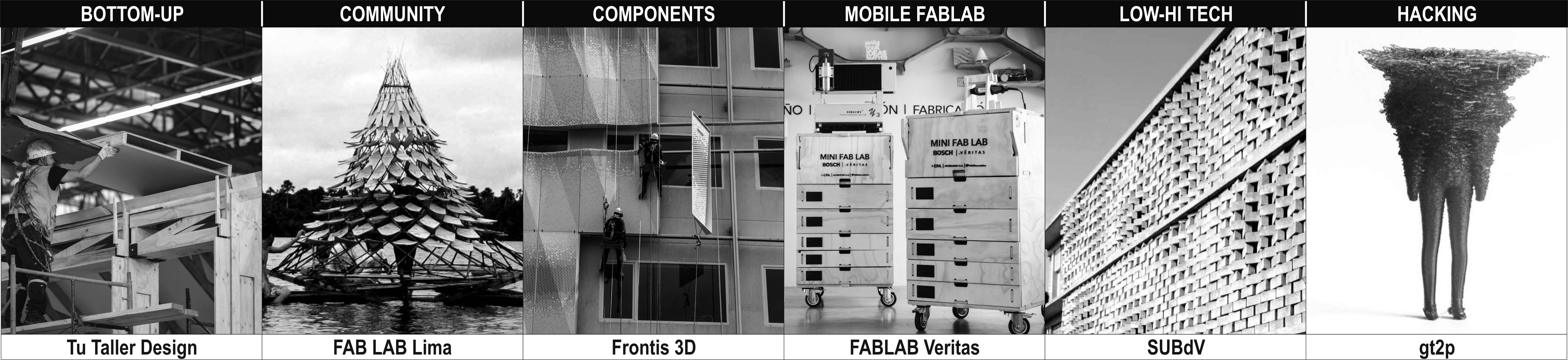
Bottom-Up: proposals that are somehow linked to the industry, but working on alternative technological solutions promoting Top-Down implementation processes. New ways of exploring industrial equipment and materials, as well as the use of machines that the local industry does not have, are promoting the integration of emerging technologies with automated processes. The component or module ceases to be a unique prototype: assemblies and joints are studied based on local techniques that reach the architectural scale. Protobox (Brazil), UTFSM (Chile), and Dessin Technish (Peru) are examples of this group.
Community / Digital craft in communities: initiatives that identified particular needs in each community, and some potentialities of including individuals or groups in the processes (from the periphery to academia). This includes working with artisans and local groups that promote improvements or variability in traditional proposals:42 FABLAB Livre SP (Brazil), FABLAB Maya (Mexico), and FABLAB Lima (Peru). These are not welfare practices, but participatory projects that integrate local processes with public policies and academics in a synergy of mutual benefit.
Components: investigations or products focused on parts of a project or building and include the CNC production of flat panels or joints on an architectural scale. Examples are LAPAC (Brazil), Frontis3D (Colombia) and its façade modules, UDEM (Mexico) and the exploration of wood ceilings, and FORMS (Chile) and the development of a set of modules reaching a height of 10 to 20m creating a fog barrier to optimize the capture of rainwater on the coast.
Mobile FabLab: initiatives that created mobile infrastructures to move to peripheral communities and small cities. Most of them work in collaboration with other institutions and public policies, in order to promote social transformation and technological inclusion. This is the case of FABLAB Veritas (Costa Rica), Pronto3D (Brazil), Aconcagua FabLab (Chile), and FabLab Maya (Mexico).
Low-High Technologies: experimentations that perform reinterpretations of local construction processes (metal, wood, concrete) using diverse digital fabrication technologies. SUBdV (Brazil) is the emblematic case in this group, which drives a “tropicalized” digital aesthetic. NEXUS (Brazil) explores the malleability of coconut fiber to create the Leaf Brick and boosts the regional economy and drives different aspects of sustainability. Along the same lines, the brick architecture of the Uruguayan Eladio Dieste is reinterpreted by the LabFabMVD (Uruguay) by using plywood boards to achieve the same double curvature shape.
Hacking: experiments investigating the error in manufacturing objects by 3D printing machines. They are exploring the failures of the standards, altering or demystifying the perfection of technology. Dysgraphia from gt2p (Chile) is the result of a “programmed error” that exposes some weakness of the systems. Moreover, “3D error” from Outros (Brazil) is a collection of 100 pieces that exhibit waste and failures unintentionally produced in 3D printing machines.
These six local appropriation groups (Bottom-Up, Community / Digital craft in communities, Components, Mobile FabLab, Low-High Technologies, and Hacking) are recognized by this investigation as being the leading Latin American digital fabrication laboratories that are developing a deep connection with local realities, picking up demands, and then working with them to find new solutions and other lines of questioning. The pertinent question here is the synthesis these groups are making between advanced technologies of fabrication and local common situations. Instead of replicating experiments from abroad, they are applying new technologies to solve real problems, indicating ways of acting inside both socio-economic and cultural situated realities as co-participants in collaborative processes. Nowadays, they can be seen as creative findings to face and to consider the Latin American context of hybridity we pointed out at the beginning of this text.
Conclusions: Actions Between the Local and the Systemic
Transformations in Latin American architecture and design that have arisen since the introduction of computing and the most recent introduction of digital fabrication, are currently characterized by different gradients in teaching, research, and the construction industry. In teaching, while the introduction of software is widespread due to the information available in the networks, the opening to other design procedures and formal proposals still occurs in a particular and gradual way, more by professors’ initiatives than from systemic changes in teaching programs.
These initiatives have been clearly started from investigations carried out by academics. While there are still only several actions in each locality, these proposals have established some level of network and knowledge exchange through conferences such as SIGraDi and the sister societies from other continents. Technology transfer and technology appropriation centers have been established by these actors as laboratories oriented towards Teaching, Research, and Extension. Their path is composed of one or more of the following aspects: 1) previous experience on training abroad, 2) insertion of CAAD and digital fabrication in undergraduate courses, 3) coordination of postgraduate studies, 4) providing updated courses for architects, 4) regional nucleation of other research centers, 5) dissemination of research in congresses and publications, 6) induction, from actions 2 to 5, to the creation of new digital Architectural Design Studios.
The performance of the Architectural Design Studios is more directly linked to the development of products for the construction industry or the artistic field. In general, they are developing research with less short-term applications in the construction sector and having more dialogue with local cultural identities.
The Teaching, Research and Extension initiatives of Social Technology development are significant, but still incipient, considering the Latin American context of hybridity pointed out at the beginning of this article. One of the differences highlighted by “Other Computations” in this topic is that, unlike in the northern hemisphere that has social initiatives supported by welfare programs, the implementation of technologies, and funding programs, the southern hemisphere turns to hybrid manual and digital craft processes. These in-process experiments are being made on the scale of the object in Argentina, Brazil, Colombia, Mexico, Peru, and Uruguay.
Furthermore, there are technology parks capable of dealing with digital fabrication in several Latin American cities. However, the technological transfer and appropriation of digital architectural design and digital fabrication by the construction sector is still a challenging factor in the face of super-structural conditions such as: low investment in design innovation, production chains based on the assembly of serial products, and availability of low-cost manpower. At this point, “Other Computations” is clarified with the integration of Low-Tech and High-Tech that is being used by some of the laboratories. This is an important assessment of synergy since, instead of trying to change the system by top-down actions, they are proposing new bottom-up processes, again by exploring the hybridity condition.43
Although it seems that this process should be systemic or its results should follow articulated actions to encourage innovation, the initiatives selected by the Homo Faber: Digital Fabrication in Latin America Project shows that there is a significant appropriation of local identities enhanced by computer technologies and digital fabrication in the region. This fosters the adaptability of widespread control techniques into projects focusing on solving small local problems and establishing knowledge to face the challenges of scarcity technological accessibility. In this scenario, some postgraduate programs located mainly in Argentina, Brazil, and Chile are playing a decisive role. They still do not represent a considerable percentage of the programs in the region; however, they are, in our view, the faithful reflection of “Other Computations”, which inspire new paths for their systematic implementation.
Looking at the examples selected by this investigation, the historical positions of dependence or resistance cannot explain their production conditions and what they are producing. They should be understood as re-existences: in other words, as the creation of new syntheses between cultural and technological processes in the Latin American context.