The gap between the idea of the single detached family home and people’s experience of home is widening.1 In recent decades, housing in many urban centres has become less affordable. The numbers of people living alone or in less conventional and more flexible family groups has continued to rise. Simultaneously, the mid-century cultural imagery of the family continues to be exclusively based on racial, sexual, economic, age, or health-based grounds. This standardized idea of home, based on the upper- or middle-class nuclear family, is an outdated model for designing proximities and relationships. The simplistic idea of the closed and introverted single-family home, in its reductive simplification of intimacy, is limiting and outdated, reinforcing political, economic, and social hierarchies of the early and mid-twentieth century.
The subsequent research of these concerns is grounded in architecture’s historic interest in bodily and societal health (Colomina 2019), with a focus on links between home and psychological conceptions of self (Ahmed 2006, Bachelard 1969). It uses the uncanny as a methodology to examine the gaps between the idea and experience that misunderstandings of vulnerability and intimacy generate regarding the boundaries of home (figure 1). The co-influence of these emotions on interpersonal well-being and understandings of self are examined by drawing five uncanny homes, or unhomes, inspired by Le Corbusier’s five points, which calibrated the subject and values of modern architecture a hundred years ago. The drawings speculate adjustments to Le Corbusier’s points and evolve into five principles for a vulnerable and intimate architecture.

The influence of vulnerability and intimacy on the architectural boundaries and apertures of home and self comprises two parts: the relationship between vulnerability, intimacy, and the architecture of home; and home’s influences on understanding of self in relation to the world. In architecture, vulnerability, and intimacy describe an emotional response corresponding to spaces designated as interior or exterior based on the boundary of a house. Interior is conceptualized as a safe and intimate refuge from exterior threats. However, if vulnerability and intimacy are considered in a social context, it is easier to understand that there is no intimacy without the potential for vulnerability. Both are present in every relationship, in every space and across every boundary. Their architectural separation is embedded within social, cultural, and economic history foundations of the idea of home and tends to be concealed. Vulnerability and intimacy are treated as binaries, as though perfect separation is a desirable goal. Revealing contradictions in this binary is uncanny, as it troubles culturally accepted narratives of a stable boundary between inside and outside in the preconceived concepts of home on the self.
The uncanny can be understood through the German terms heimlich and unheimlich, homely and unhomely (Freud 1919). Homely represents the intimate and secret, while unhomely captures that which is revealed from within the safe and secret (the repressed, the forgotten, the ignored) (Kunze 2003). Yet the two definitions coincide when something that should be intimate surfaces and is revealed (Kunze 2003). Visualizing the internal on the exterior provides an opportunity for the subject to consider the fictitious construct of an internal-external binary and the unrealized influence of one side on the other, as the change of thought triggered by the external stimuli demonstrates the functioning of internal mechanisms or apparatus of thought (Kunze 2003). In this way, the uncanny brings attention to influences on identities, values, or desires (such as home), suggesting that the personal, emotional subject is the object of greater cultural influence than realized (Kunze 2003).
As the uncanny exposes the interrelations of logic and emotion, this essay blends emotional drawings and reason-based arguments to expose how the emotional transgresses the rational, and that which is perceived as rational is present in the emotional. The drawings of five uncanny homes or unhomes and the five principles for a vulnerable and intimate architecture question the boundaries of home and self. The term unhome is inspired by the provocative nature of Reyhner Banham and Francois Dallegret’s “a home is not a house” 2 while each unhome and principle are rooted in Le Corbusier’s five points, from which they speculate new opportunities. Developed in constant interplay, the principles and drawings reflect a methodology where “to draw” is re-imbued by its many meanings3, such as to expose, use a skill, be the cause of a response, and achieve a tied finish. Understood in their complexity, they bring forward the emotional/psychological and normally concealed (the repressed and poetic in architecture) and suggest a less prescriptive or codified symbolic home (Pérez-Gómez 2018).
The uncanny questions the forgotten history of the cultural and architectural balancing act responsible for the prevailing structures. With the private home, presumptions that intimacy, socialization, public space (for inhabitants) are centered in the home have become ingrained (Chermayeff and Alexander 1963, 210-211). However, increased trends in solitary living, in distances between those who care for one another, in use of technological communication, and in concerns of medical sanitation or isolation associated with Covid-19, there may be cases where this is no longer appropriate.
Examining unconventional and undesired unhomes trouble the conventional desired homes by showing that the culturally promoted idea of a desirable home, in fact, has undesirable features; showing the undesirable home has some desirable aspects and potentials; and by showing that their classification as desirable and undesirable is a fictional construct. The uncanny homes expose current homes as a mélange of both and speculate that homes of the future could amplify and remix these decisions. In visualizing a past, present or future situation, architecture evokes emotion, thought and reaction from the public about a situation or idea (Ockman 2016; Young, 2012; Pérez-Gómez, 2006). The unhome drawings are speculations intended to yield emotional responses that motivate softening and expanding the boundaries of home and community by challenging understandings of vulnerability and intimacy. The intention is to reinvest architecture with intimacy and desire through a process that, by allowing space for dreaming, develops spaces that dream.
The first principle of a vulnerable and intimate architecture is to acknowledge structures of separation. This principle and its corresponding unhome (figure 2), evolve from Le Corbusier’s pilotis, which restructured an understanding of architecture based on concrete, prefabrication, and standardization. Applying an uncanny methodology, the basis or foundation of the unhome is the revelation of contextual and narrative transparency. The first principle and unhome exposes resource consumption, isolation, access, and propriety by making home’s boundary transparent. The x-ray views questions whether the conceptual boundaries of home act as a structure of separation and miss-frame spheres of interest and care established by the uniform, prefabricated Levittown homes. These popularized the post-WWII American dream of a privatized, nuclear residence, as an intimate, familiar, private, and affordable retreat. Many of the Levittown premises continue to underly suburban and urban individual family homes and multiunit residential buildings (ex. condominium towers). Classifying, grouping and separating, home’s boundary and internal walls have social implications (Preciado 2020). The uncanny transparency of the boundary draws attention to how home supports and re-enforces the societal fetishization of property, power, permanence, and scale that drive an anthropocentric model of extraction and consumption. Possessions within the unhome, enclosed with its inhabitant but separated from others, reveal the economic, social and environmental effects of making public resources private (Wigley 1992), and expose the extents of the resources collected.
Figure 2.
Principle 1: Structures of Separation. What if the boundaries of home miss-frame spheres of interest + care?

The transparency of the first unhome blurs the boundary between inside and out, creating a gradual continuum between public and private. In the unhome, the vulnerability and contestation of those left outside by a society’s housing models becomes harder for those inside to ignore. The transparent unhome makes variations and specificities of different inside adaptations a visible performance, unlike the model homes of Levittown, recognized now for their racism, sexism, classism and concealments of any minor variations behind opaque, prefabricated standard models and regulated conformity (Marshall 2015). The unhome exposes the personal, unique and pluralistic rather than the singular, standardized, and sterilized idea of home.
The second principle is temporarily curated insulating facades. It expands on Le Cobusier’s free façade. Interpreted through the lens of the uncanny, the facade becomes operable, developing a flexibility that exposes (and personalizes) the inhabitant’s internal desires. This develops from Gaston Bachelard’s belief that the space we inhabit influences our thoughts, emotions and dreams and in turn, we select and shape the spaces around us (Bachelard 1969). This shaping is described by Sara Ahmed as a bodily orientation in time and space, where one is “at home”, when familiar with one’s positioning and that which is proximate or in reach (Ahmed 2006). Conversely, for Ahmed one is “not at home” in situations where one’s life path has differed from conventional ones, structuring unique relationships of proximity and alternate opportunities (Ahmed 2006). Home’s boundaries can be read as a narrative of which bodies or subjectivities have (not) been considered. Prioritizing the experiences of some, suggests which subjectivities or bodies are cared for by a culture, and which relationships of care are promoted by a culture. This influences who will experience feelings of homelessness in the modern, emotional sense of a melancholy or resulting from chasing an unattainable dream or achieving it and finding it unsatisfying. According to Jane Rendell, Sigmund Freud has stated that this melancholic loss is “a loss in instinctual life” and related to a loss which is concealed from consciousness, such that the subject cannot mourn it, and is stuck in the resulting emotional experience (Rendell 2019, 237). Between the cultural, consumerist idea of home and experience, there is a concealment responsible for the melancholy and emptiness common in modernity. It hides the dynamics of vulnerability and intimacy, while culture and media contribute to a misplaced targeting of intimacy as a goal to isolate, and vulnerability as something to insulate against. The result is a simultaneous suffocation and annihilation of the intimacy that is meant to be protected.
Historically, architecture and its boundaries are influenced by the field’s medical interest (Colomina 2019, 13-30). However, for the architecture of home, to address vulnerability today suggests a reassessment of this paradigm that aims at maximum insulation. While airborne-respiratory diseases, such as the 2019 coronavirus, remain a global risk (World Economic Forum 2019), in most recent years, the leading cause of fatalities have been because of cardiovascular diseases (World Health Organization 2017b). Their risk factors include stress, and behaviors that are influenced by stress (World Health Organization 2017a). The rates of anxiety and depression have increased close to 50% between 1990 and 2013 (World Economic Forum 2019, 34-35), and correlate with increased suicide rates across wealthier countries. These increases in diseases of the heart and mind can be understood as an effect of the gap between the ideas of home (and self) and the experience. The costs and boundaries of homes presumed to satisfy our dreams may also encourage behaviours that contradict needs for socialization, intimacy, and relaxation.
To target stress and melancholy, the second unhome (figure 3) expands opportunities for inhabitant participation and customization within the design process and over time. This exploration of personalization has some similarities with N. John Habraken’s concept of “supports” and “infills” (Habraken 1972), and the unhome seeks opportunities for the inhabitant to curate layered domestic objects as temporary insulating facades. The unhome façade responds to mood, health, care, and sanitation. Home’s insulation could, like its etymology of the creating of an island from dry land,4 be temporally dictated based on physical and emotional state. A home could be a mechanized expression of interest in the external world, balancing nuanced personal emotional experience of separation, adjustable for levels of care, visitors, and unique personalities.
Figure 3.
Principle 2: Temporarily Curated Insulating Facades. What if boundaries were responsive to mood, health, care + sanitation?

The third principle is the unbounded plan, which developed from Le Corbusier’s open plan (which is limited to those inside the building). The corresponding unhome drawings (figure 4) expose how relocating home’s interior program (and furniture) to the perimeter provides opportunities for dialogue between inside and outside. It gives those outside a seat at the table and conceptually suggests that all boundaries are a dialogue, shared and influenced by internal and external constituents. This approach is based on Elizabeth Grosz’s conceptualization of the boundary as an open site of exchange and change (Grosz and Eisenman 2001, 193), and inspires the unhome boundary to be closer to contemporary bio-medical conceptions of the body as being porous (a subject of flows and change over time) (Kovar 2018, 3-4). It modifies the Anthropocentric approach (Haraway 2016) to home where self and the internal are primary and the external is only resource, which encourages the stable and fixed boundaries associated with ideological polarizations and growth in socio-economic disparity. The third principle emphasizes the need for public space for accidental encounters and a political realm for the expression of opinions and negotiation of positions. The operable walls of the home’s program elements are shared by inside and outside. Its revolving windows, doors and screens are operable from both sides, and their positioning is a negotiation of the personal interests of those involved. Diagrams of their movement are inspired by Hannah Arendt’s position that this public domain or dialogue requires constant re-enactment to exist (Arendt 1998). This social boundary conceptualization teases opportunities for unexpected and informal chance encounters, opportunities for mediating new understandings. The unhome is not modelled on nostalgia, escapist tendencies or on the mechanized rhythms of the industrialized and standardized clock. Instead, it evolves based on the relationships and rhythms with its neighbors in the most inclusive sense. It is modelled on the events of living.
Figure 4.
Principle 3: The Unbounded Plan. What if boundaries permit dialogue between inside and outside?

The fourth principle is the unbounded window, which exposes how boundaries reflect the hospitality and generosity of the inhabitant. It builds from Le Corbusier’s (horizontal) window, which curates aspects of the exterior that are permitted into the house (light and fresh air), to protect against tuberculosis. Based on the uncanny aspects of hospitality in philosophy (Dufourmantelle and Derrida 2000), its unhome drawings (figure 5) develop an understanding that vulnerability is usually presumed to be to that which is external to self, the guest (or other) that is unknown or not understood. Homes reveal the boundaries the inhabitants have drawn around themselves, exposing their psychological relationship with those outside, as they mediate which aspects of the exterior are welcomed in. However, the desires of the inside are intricately linked to those outside. The vulnerabilities to which the extra-communal outside (travelers, homeless wanderers, couriers, essential workers, treaters of physical and emotional needs, and foreigners) are subjected or condemned, are inevitably susceptibilities of the community that imagines it has protected itself against them (Preciado 2020). As no boundary can ever perfectly protect, there is a danger in not protecting or considering the most vulnerable within a larger system (to protect them is self-preservation).
Figure 5.
Principle 4: The Hospitable Window. What if boundaries reflect the hospitality + world view of the inhabitant?

The fourth unhome draws a range of hospitalities, and temporal or communicative commitments between a host and guest, ranging from plug and play servicing for travellers, to opportunities for home entry and use in the host’s absence, or affectionate visitations that are climactically separate. The variations in degrees of hospitality show opportunities for intimacy that equate to vulnerabilities. The private home is indicative of the public ideologies of a culture, and the treatment, hospitality or generosity towards the guest, the outsider, reflects one’s own openness and ethical position to one’s neighbors and the world. The uncanny appearance of the exterior (guest) on the interior (home), reflects the exposure of the inhabitant’s unconscious values, beliefs and fears (Dufourmantelle and Derrida 2000, 125-135). This uncanny reveal is like a deeper, adult version of Jacques Lacan’s mirror stage in which an infant recognizes the separation between the mirror projection (public narrative of self and values) and the personal (private self and true behaviour) (Krukowski 1993). The confrontation of the inhabitant with their response to the guest (and their public values) in relation to their private space permits a reassessment and recalibration.
The fifth principle is that of return and generosity, which explores the uncanny circulation of the human body’s materiality, possessions, and memories in death to question ways funerary practices reflect and reinforce boundaries and values. It is inspired by Le Corbusier’s fifth point, the roof garden, that returns the ground it occupies elsewhere.
The homes of the dead often demonstrate a similar basis to those of the living. The cemeteries and crematoria that house the dead represent a continued resource consumption long after a person’s passing. The challenge of housing increasing bodies is evident in densely inhabited cities with restrictive geography, like Hong Kong or Venice (Riggs 2010; Young 2019; Isola di San Michele, Wikipedia, 2018). The consumptions of a life is also evident when someone downsizes near the end of their life, or dies, and many of their possessions become waste.
Inspired by ideas of return or re-gifting thought through the body and life cycle, the sketches of the fifth unhome (figure 6) explore the return of what was occupied, used, and presumed over the course of a life. The reciprocities and social obligations associated with gift-giving and generosity (Ekerdt et al. 2004) are relevant to those in the most vulnerable condition. The condition of the almost dead or dead who cannot care for or remember, themselves (Philips 2015). The unhome drawings seek new ways to re-imagine dying as a process of giving that strengthens memories and encourages appreciation in the living. The focus on death as the loss of an individual life and an ending is shifted. Instead, transmittal (of thoughts, memories, and objects), generative potential (as these items are modified and reinterpreted) and continuation (one day they may be transferred again) are emphasized. This finalizes the departure of a material, possession-based definition of self, replaced with one that is based on systems of generosity and accumulated encounters with others, developed through the unhomes. These refocus architecture to the life of its inhabitants, emphasizing the moments in life that those dying often regret not prioritizing during their lives.
Figure 6.
Principle 5: Return + Generosity. What if funerary practices repeat the collective boundaries + values of homes?

A final unhome (figures 7-12) combines the principles and expands on the ideas of the individual unhomes, by imagining them in the context of a co-housing community. It speculates a vulnerable and intimate architecture that acknowledges the influences of the pandemic and environmental crisis as an opportunity to reconsider basic architectural principles moving forward. Cleansing stations may remain a fixture in public spaces or at entries. Forms of entertaining at home or social gatherings in public spaces may continue to be influenced by desires to either not admit guests as deeply into the home or concerns at penetrating as deeply into an interior public space. The unhome explores extending thresholds and the programing of a thicker, softer, or stepped architectural boundary. It shows a vulnerable and intimate architecture responsive to context and capable of mediating between that context and its occupants, instigating a range of interstitial realms between “public” and “private” and spaces for new activities and explorations.
Materiality may mean layering or spacing wall elements for inhabitable interstitial spaces. This spacing and the possible temperature or air permeations across fragmented boundaries is a new response to envelopes that are too sealed and have become culprits of sick building syndrome, and internal, insufficiently ventilated conditions that heighten risks of disease transmissions. Feeling and hearing the external environment a little more (rain or neighbours) may provide welcome and necessary slowing, or interruptions. Permitting a less mediated temperature or breeze in semi-exterior, porch-like rooms may aid in combating feelings of confinement by providing spaces for visitation.

Figure 8.
Co-Home Level 2. Peripheral spaces for every day interactions, central spaces for bathing + changing


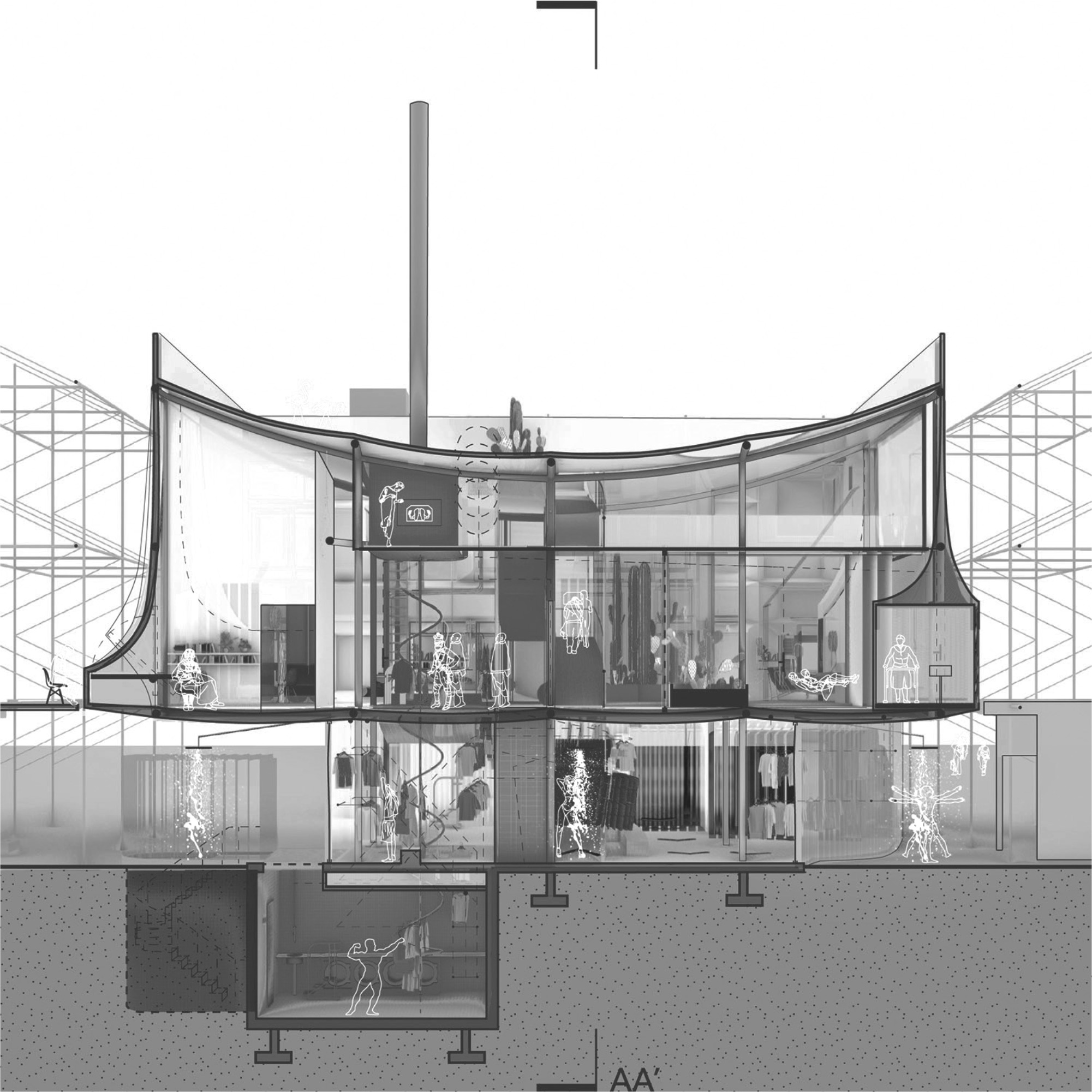

This might be accomplished on the boundary of a building, with traditional building materials or more recent ones (such as ETFEs), pulled apart for an enclosure that is more permeable or layered as a series of overhangs, porticos, balconies penetrating inwards from the outside and outwards from the inside. The zones could have different degrees of acoustic and visual transparency and may represent a model somewhere between local and central heating. The layers could be separated and inhabited as a series of climactic zones, selectively hosting a range of hospitalities.
The principles of a vulnerable and intimate architecture may also apply to the boundaries or interfaces that often occur between high-rise units to give them some flexibility for an unpredictable future. For example, including semi-public gaps between units such that there are interstitial spaces for external expression and the cultivating of relationships between neighbors. Similar, more varied spacing may provide ways for those interned in a home to feel an autonomy in their relationship to the external world while acknowledging and not eliminating barriers. Sometimes, these communicative boundary windows might even be electronic screens.5 In refocusing home to interactions with others and in recognition of a larger system, a vulnerable and intimate architecture is empathetic to the external context and reconciles itself with tensions between desire and distance in a time when those who are emotionally closest are increasingly physical outside. It weighs internal needs and a gradation of external interactions. It takes pleasure in personal and unique mediations as it balances physical and mental health, the personal and the public.