Introduction
In the central areas of São Paulo, architectural diversity exists because of the transformations that have occurred in the last 150 years. These range from different buildings and a variety of compositional principles. For example: diverse architectural styles, generated morphological discontinuities, alternations in heights and facade rhythms. A growing deterioration in urban quality, with a lack of identity and absence of qualified free spaces to stay in, has also occurred.
According to data published by the Brazilian Institute of Geography and Statistics (IBGE), in 2019, the population in Brazil reached 210 million inhabitants, with São Paulo reaching 12.3 million inhabitants. As a result, the housing deficit in São Paulo is 1.4 million homes.
There are “cohabiting” families who share the same house. The biggest problem in cohabitation between these families is the need to share small rooms, often without freedom and/or privacy. In 2020, this situation worsened because of the pandemic caused by the new Covid-19 virus.
Habits are culturally developed and implicitly diffused within each society. Throughout the 20th century, we noticed that universal habits cannot be easily dealt with, as well as spaces for social housing for populations in different countries, with the same architectural proposal. As cities like São Paulo expand without control, mainly because of large-scale migration, a substantial and growing housing deficit is being created, making rethinking domestic spaces more urgent.
Faced with this problem, it is natural to draw attention to the following question: How to generate new types of housing units for the new ways of contemporary living? In this sense, it is essential to create guidelines and parameters for new proposals of collective housing in these deteriorated central areas. In this context, it is reasonable to use parametric modeling (PM) to promote new ways of thinking about culturally diverse spaces. Therefore, the relevant question of this article is how to use PM during the design process for new types of social housing?
This work can be classified as applied investigation or is research through practice because a step-by-step practical experiment was reported while parametric housing was being created, and because it meets a real demand from society. The aim of this article is to contribute to the debate about how to apply PM during a social housing design process.
1. Principles and Guidelines for Social housing
During this investigation, we came across many innovative proposals for horizontal housing estates and social housing. However, after 100 years of collective housing, it is possible to identify different ways and strategies of occupying land. Studies by Per, Mozas and Arpa (2009) and Per, Mozas, Ollero and Deza (2015) show that density is based on the interaction between agents, fluxes, and territory, and can vary according to the type of urban form that is adopted. Leupen and Mooij (2011) provide a remarkably interesting analysis of the basic organization of private dwelling space in the twenty-first century. Robinson (2018) shows -with case studies- successful approaches to designing for density in the Netherlands, including different architectural styles and organizational strategies. Levitt (2010) sets out design principles for all the essential components of successful housing design. The architect Moisei Ginzburg (2017), well-known for his many works on the design of residential buildings, published a book in 1934, as a result of an intensive research produced during the 1920s in URSS. His most important building, Narkomfin, inspired Le Corbusier in Marseille years later. Sbriglio (2013) provides a complete graphic documentation about this building. Henderson (2013) examines the New Frankfurt am Main considering the social and political debates that shaped it, highlighting the careful work coordinated by the architect Ernst May.
The research by Scanlon, Whitehead, and Arrigoitia (2014) uncovers the actual situation of social housing in 12 European countries. According to Sposito (2012), “the social, economic and political dynamics of the last few years have modified not only life-styles” but also shaped “the need for flexibility and adaptability” of the living space”. In large parts of Latin America, social housing is marginalized. The study of Balchin and Stewart (2001) shows the critical situation in big cities. All authors mentioned demonstrate the state-of-the art regarding collective housing.
A set of principles on housing developments were drawn from this literature, particularly guidelines for social housing. Flexibility, as a guiding principle of the project, allows us to create new ways of thinking internal spaces for a diversity of habits. The first guideline adopted in this investigation is the urban unit. The buildings to be proposed should follow the morphological attributes identified in the existing blocks. Therefore, alignments, building heights, and existing massiness must be properly studied in order to guide the design actions.
Interventions in central areas, endowed with good infrastructure, require proposals for new buildings that increase the plot occupancy, while the free areas for public space expand. The implementation should avoid segregation, generating greater integration between private and public spaces. The intention is to seek design alternatives that favor the creation of constructions focused on the concept of “open block”, well defined by Christian de Portzamparc.
In order to generate flexible housing units that are adaptable to changes over time, it is essential to propose a circulation system that provides spatial alternatives for the units. As discussed in section 5 of this article, horizontal and vertical circulations, with different stair positions, enable alternative arrangements of housing units.
Another guiding principle was to generate housing units with different areas, in order to promote a diversity of types. In addition, duplex or triplex units facilitate the creation of different sectors in the social, intimate, and service areas.
Due to technical restrictions, which weigh on housing costs, regular geometry was adopted for the units, and a specific area for the sanitary.
With the purpose of generating diversified facades, another principle was to create windows with different geometries, which promote distinctive visuals and light penetrations in indoor spaces. Also, with the same purpose, varied shapes were proposed for zenith openings on the roof level.
Using a set of principles, section 4 discusses how the diversity of options for housing units, derived from the combinations between parameters (circulation system, stairs, sectors, connections between levels and position of sanitary amenities), suit the new ways of contemporary living.
2. Parametric design and the form-finding process
Leading authors (Picon 2010; Oxman 2005; Kolarevic 2003) have recently warned of substantial changes in the design process arising from the impact of new digital technologies. However, there is still a lack of a systemic discussion on the effects of PM on the design practice to create alternative solutions for collective housing. Research by Barrios (2006), Davis, Burry and Burry (2011), Woodbury (2010), Alvarado (2013) demonstrates the state-of-the art related to the applicability of PM in the design process.
The word algorithm can be defined as “the complex set of rules that allow the resolution of a given problem” (Breton 1991, 59). An algorithm specifies the sequence of basic instructions for obtaining an expected result.
Architectural design is called parametric when its construction elements are defined and manipulated using variables in the PM (Florio 2017). The design is parametric when the computer is used to modify it automatically, while the parameter values are changed during the design process.
A parametric model involves constraints, defined a priori, which allow us to combine research parameters, with unexpected findings. Thus, the algorithm propagates changes based on known restrictive parameters, but with normally unexpected results. The propagation of a change between parameters, which are related, produces fast and efficient changes.
The major change in the parametric design is that this process does not seek to create a single form, defined a priori, for each constructive element or a building, but alternatives are sought to later select the most appropriate option.
Parametric modeling contains three algorithms (Woodbury 2010, 15). The first is the sequence ordering of nodes that contain the parameters and their properties. The second is propagation, which evaluates each node and its constraints expressed by formulas, functions, or operations. The third allows showing data in three dimensions.
The so-called form-finding process implies that a form can be unexpectedly discovered through the combination of parameters previously established in the algorithm (Florio 2011). Thus, the shape is found “a posteriori”, through variations, also called generative, as it allows to experiment, compare, and select new families of complex shapes, delineated by parameters. Using plug-in Grasshopper, we explored this concept during the design process.
3. Method
In this investigation, the project is produced using principles and guidelines presented in section 2 and parameters presented in section 3.4. However, the nature of the research required the use of new digital technologies, such as digital modeling and fabrication. The 5 main stages of this study were as follows (Figure 1).

3.1 Analysis of relevant collective housing
38 emblematic buildings were carefully analyzed to identify the design parameters for the social housing PM, among these the Unitè D’Habitacion (1947) by Le Corbusier; Quinta da Malagueira (1977) by Alvaro Siza; Rue des Hautes Forms (1979) by Christian de Portzamparc; Nemausus (1988) by Jean Nouvel; IJ Plein Housing (1988) by OMA; Gifu (2010) by Sanaa; and Silodam (2002) by MVRDV.
3.2 Survey and intervention analysis in São Paulo
Two areas were selected for the survey of existing buildings and the development of collective housing projects. In this article, we only mention the Barra Funda region, which is a Special Zone for collective housing within the limits of the Urban Operation Center.
The study of the intervention area was conducted following four procedures: a) Aerial survey by drone; b) Photographic record by serial views; c) Survey by CAD Mapper; d) Digital fabrication of physical models.
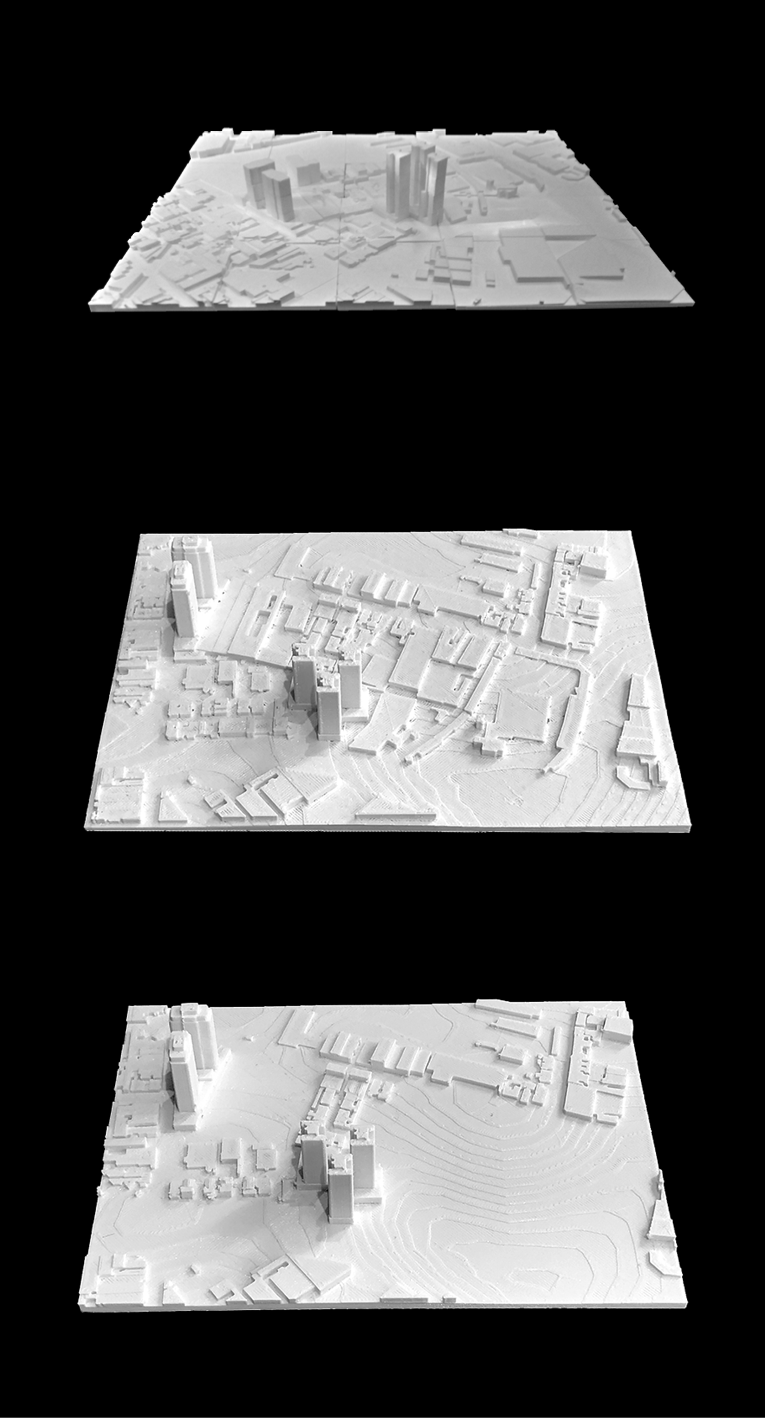
Using the milling machine (CNC) the physical model, more tangible, complemented the perception and identification of the existing built and empty areas (Figure 2, top). 3D printed models of the Barra Funda intervention area were produced (Figure 2, below). As a result, a better decision could be made on the actual area for the new housing. These physical models were based on the geometric model generated by CAD Mapper (available online), and the complementary information gathered with the drone and Google Maps/Earth.
3.3 Housing identification and classification within the intervention area
As a result of the previous evaluations, we identified the types of housing present in the intervention area (Figure 3). We considered diverse housing types identified in the same block. In this article, we only explain the horizontal housing typology with three floors, since this is the average height of the two surrounding existing villages and of most buildings in this block.

3.4 Parameters Definition for the PM
Specific parameters for the algorithms were conceived for this horizontal housing to introduce a correct analysis of the case studies (mentioned in section 3.1), as well as to answer the question of this article. The initial aim was to define the general parameters. As the research progressed, we established some design strategies to meet specific needs.
The reference projects analyzed (mentioned in section 3.1) provided the necessary parameters to begin the algorithm design for the creation of the residential units through PM. There are two types of parameters: i) For the general definition of the building; ii) For the specific building elements.
3.4.1 Parameters for the general definition of the building:
a) Housing unit types and sizes of; b) Variations in the collective housing sectors; c) Type and location of the horizontal and vertical circulation; d) Position and dimensions of the hydraulic areas; f) Internal space flexibility (wall removal); h) Terraces location and dimensions; i) Definition of the building geometry.


4. Results: Algorithm for a social housing unit
We planned a three-story housing complex with longitudinal circulation on the first floor, which gives access to different types of apartments, single, double, or triple story. The aim was to provide dwelling for families with one (15 m² units) to six people (90 m² units), which represent the main public in the central areas.
This algorithm (Figure 4) contains a set of parameters for the building: a) Variations in width and length of each unit (from A to F); b) Single, double or three-story units; c) Specific location for hydraulic areas; d) 5 types of stairs; e) Dimensions and positions for the mezzanine voids; f) Type and position for the window frames (based on the Modulor); g) Dimensions and position for the walls; h) Dimensions and location for 6 types of zenith openings; i) Dimensions for terraces, windowsills and benches; j) Two types of doors; k) Dimensions for the kitchen and sink countertop.

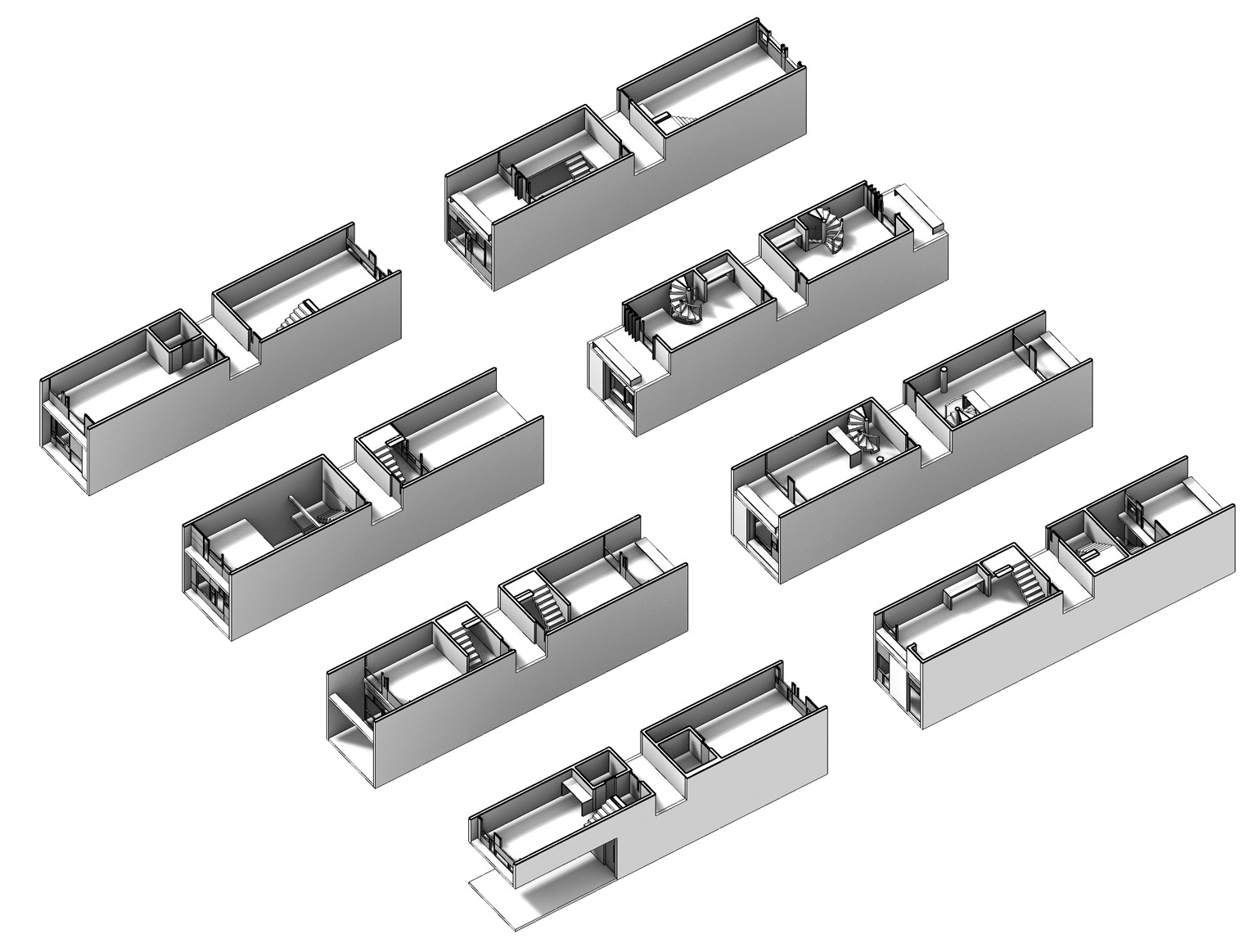
The units were generated from the combinations of units A, B, C, D, E and F (Figure 5). The parameter manipulation made it possible to generate many unit types, with large area variations, 30-90 m². As the established goal was to create varied unit types, mainly derived from the strategic position of the circulation, the parameters in the algorithm made such combinations possible.

The carefully planned algorithm allowed us to generate a diversified set of units, creating three for each modulation (Figure 6). After this stage, we detailed the units’ elements (i.e., floors, stairs, walls, windows, doors, benches and sink countertops).

The flexibility regarding the types of stairs in the duplex and triplex units made it possible to distribute the social, intimate, and service areas in different positions. In addition, it was possible to generate different voids in the units to provide alternating heights and internal visuals (Figure 7).

Figure 8 shows the bathrooms, situated in the internal areas, next to the central circulation that crosses all the units of the housing complex. It helps to visualize a diagram of the main decisions made to define the components of the building.

The Modulor system by Le Corbusier was adopted to define the windows contributing to the dynamic facade. The parametric approach promotes a great number of openings alternatives for single, duplex, and triplex units (Figures 9 and 10).


The unit diversity, resulting from the manipulation of parameters, meets the new contemporary ways of living, which require flexibility and the ability to adapt to different internal and external environments.
5. Discussion
The design process started after surveying the existing typologies in the blocks selected for the intervention. The first guideline adopted was to value the urban unit. The “urban villa” was created to promote typological diversity and respect the existing villa’s height. The proposed new housing respect the attributes of urban morphology identified in the existing blocks. The alignment of the existing buildings and their heights have been properly studied to guide the design actions.
Four design strategies were established for the collective housing: 1) Creation of algorithms for each of the construction elements; 2) Creation of algorithms for the design of unit types, without subdivisions; 3) Design and development of algorithms for each type of collective housing (horizontal and vertical); 4) Generation of shapes and spaces based on algorithms that combined previous algorithms. Therefore, we could test each algorithm before combining them into larger algorithms.
The parametric design could be modified and updated more quickly after the constant changes that normally occurred during the design process. Changes propagated within the three-dimensional model without the need to restart the modeling, making the process non-linear, and allowing constant updates with greater agility.

The definition of parameters, their connections, and the necessary verification tests are time-consuming, until they prove to be efficient in generating combinations and achieve good results.
It can be concluded that the location of the circulation system, the hydraulic areas and the spatial distribution of the units are the main design strategies to define the architectural parti of the building. The flexibility to integrate social or intimate spaces depends on the position of the stairs, as well as the kitchen and bathrooms. Therefore, three strategies were assumed: a) To adopt the central position for public circulation; b) To concentrate hydraulic areas next to this central circulation; c) To promote different spaces adopting types of stairs localized in different places.


Instead of having to share rooms in the same house, for those who cohabit, privacy can be maintained by using furniture or mobile devices. Consequently, non-compartmentalized spaces allow flexibility and spatial adaptation for the users over a family’s lifetime.
By adopting a set of types of stairs, localized in different positions, we generated fluidity between floors in the same unit. On the other hand, the internal voids created in the units allowed us to achieve the desired expansion of internal views, facilitating the entry of natural light throughout the day. The creation of different types of zenith openings, in various roof locations, provided natural light to environments located far from the windows.
Using parameter combinations, we created many options for window design. Consequently, the side- by-side units show formal and spatial diversity, which reflects the diversity of families nowadays.


The tangibility of the physical models, produced by a CNC machine and a 3D printer, contributed to a better understanding of the proposed buildings.
We summarized the principles and guidelines adopted for the creation of the collective housing using PM, which respect the existing morphological diversity and promote improvements in the public space in central areas. These principles are: 1) Typological diversity for the new buildings, in dialogue with the existing diversity; 2) Housing units that meet the requirements of large families with different characteristics; 4) Improvement for the open block ground level, mitigating the impact of the building in relation to its surroundings; 5) Rhythms and variations of the facade elements to achieve its own identity; 6) Flexibility and spatial adaptation of the units for news ways of living.
A unique opportunity to create an alternative for ready-to-use houses can be explored by PM, in order to customize the units for recent different ways of living. Once more, the intention is to create affordable and customized dwellings for different kinds of new habits.
Therefore, to understand this process, this article collaborates with the debates over how to use PM during the design process for social housing. In fact, to produce parametric projects, it will be necessary to rethink a new professional (Florio 2017), with contemporary skills, capable of designing using algorithms. Therefore, it is fundamental to define design strategies for architectural conception based on an accurate set of parameters, set by the project requirements and the requirements imposed by the designers.