INTRODUCTION
From Le Corbusier to Wiener & Sert, and from Karl Brunner to Leopoldo Rother, no architect in the mid-twentieth century doubted that the way forward in terms of government architecture in Colombia was associated with the idea of Civic Centres; not only as government headquarters but as nerve centres in the city. The civic centres consolidated their appearance on the world scene in the VIII International Congress of Modern Architecture (1951), with the theme the Heart of the City, and the tutelage cultivar el cuerpo of Josep Lluis Sert. This approach privileged the human and spiritual dimension of the city over the universalism promoted by Le Corbusier (Colon 2004,13). The latter supported different pilot plans and civic centres in Colombia, designed by Wiener & Sert for the cities of Tumaco (1948), Medellín (1949), Cali (1950), and Barranquilla (1953). In Bogotá, the project began with Karl Brunner (1936), Secretary of Public Works at the time, and was later commissioned to Le Corbusier (1950).
Due to their scale and dimension, these complexes required large empty spaces in the city, a strategy that sought to promote urban development in uninhabited areas, which was partially applied in Colombia through the construction of large specialised centres. University centres like the National University, housing centres like the Antonio Nariño Urban Centre, or administrative centres like the C.A.N. followed this urban logic. These new “centres” embodied a functionalist logic of urban growth, following four directives of the modern movement (live, work, cultivate the body and spirit, and circulate) which materialised a new way of making the city when translated into educational centres, health centres, recreation centres, and housing centres. Between these “centres”, the most significant was the civic centre, not only because of its character and symbolism but also it was the only urban centre that avoided mono-functionalism by integrating different programmes and activities with the sole aim to create a new heart of the city.
If we want to give our cities a definite form, we must classify them and subdivide them into sectors, establishing centres or urban hubs for each of them. These hubs will act as catalysts and around them, the life of the community will unfold. In them, public buildings of different kinds will be grouped, following a harmonious line of form and space. They will be the meeting points of people, the common centres of life in which pedestrians will prevail over the interests of traffic and business. (…) The social function of the new centres or hubs is fundamentally to unite people and facilitate direct contact and exchange of ideas that stimulate free discussion. (Translated from CIAM 8 1955, 12)
The centrifugal (to encourage urban growth) and centripetal (to bring people together in public spaces) characters summarise two of the main project logics of civic centres. Therefore, one of the main characteristics of Barranquilla’s Civic Centre was the mixture of activities and functions, derived from the integration of different programmes and buildings articulated in a civic square. This is because:
…the Civic Centre must be more than a mere administrative centre. It must constitute the true heart of the city, the pride of the community, the symbol of the cultural level and the true place of meetings and concentrations for its citizens. Therefore, Barranquilla’s Civic Centre will have a municipal theatre (h), a regional museum with a public library and an art gallery (i), a building for conventions and congresses (…)Descriptive text for the Barranquilla’s Civic Centre. Town Planning Collaborative 1957 (PROA 110, 10)
The differentiation between civic centre and administrative centre was fundamental for this research. While urban plans civic centres were projected for different cities in Colombia, in reality, these centres did not reach such a level of poly-functionality. This explains why after their construction they were called administrative centres rather than civic centres.

STATE OF THE ART
Since this is historiographical research, the state-of-the art was shaped from three constitutive angles: The conceptual origin of civic and administrative centres, the notion of public space developed in these centres, and finally, the connection between the international discourses CIAM VIII and the local reality (as a manifestation of an idea of the public in the projects analysed.
From an international perspective, the most recent study on Civic Centres approaches the topic from a theoretical perspective. The book “The heart of the city. Legacy and complexity of a modern design idea” (Zuccaro 2018), presents a historiography of the concept of the heart of the city. This allowed understanding of the project’s sense of civic centres, applied to the design of administrative centres in Colombia. Zuccaro explains how two ideals of the modern city converge in this concept. One is the notion of “heart” as a functionalist metaphor of a living organism of limited size and growth that, strategically located, enables the existence of the other organs in the human body. The other is the idea of “heart”, as a humanist symbol whose evocative aura of emotions derives in a centrality not only unavoidable but also attractive for the other components of the city. These two ideals explain the reason for the acceptance of this concept in Colombia, and its diffusion through texts that support CIAM ideas. For example, the text by architect and Mayor of Bogotá, Jorge Gaitán Cortés titled “Qué es un centro cívico y por qué se preconiza esta solución urbanística y arquitectónica en las grandes ciudades” (What is a Civic Centre and why this urban and architectural solution is recommended in large cities), in reference to the Symposium held in 1957 regarding the official administrative centre of Bogotá.
In Colombia, civic centres have been investigated mainly from the perspective of rationalist urbanism historiography. Books like “The modern ideas of the Plan for Bogotá in 1950. The work of Le Corbusier, Wiener and Sert” (Hernández 2004), or “Jose Luis Sert and Colombia” (Schnitter 2007) report on this approach.
In these investigations, it is possible to understand the role of the civic centre, as an integral part of the pilot plans and the subsequent regulatory plans. However, the analysis of these civic centres’ architecture is out of the scope for this historiography, as its emphasis is on the study of the regulatory plans and their impact on urban planning in Colombia.
This urban perspective was useful to understand the conceptual relationship between the notions of Civic Centre and Administrative Centre. In this regard, Schnitter’s research confirms that “the concept of the civic centre proposed by Sert and Wiener did not materialise in any of the previous cities”. The impact of these projects was not on –materially – as a concept, since “the concept of the civic centre was transformed, becoming a place that concentrates the administrative activities of the municipality or the nation” (Schnitter 2007, 243). This explains the move of the civic centre concept towards administrative centre projects in Colombia, a phenomenon that the author refers to as “from the civic centre to the administrative centre”. The connection between international discourse and local discourses is also evident in the descriptive memoirs used by planners such as German Samper and Raúl Fajardo to define the administrative centres of Cali and Medellín.
THE CIVIC SQUARE. The architectural ensemble should comprise buildings and public spaces. It is the centre of civic political life with its many activities. It is the site for the development of popular assemblies. It’s the spatial link between civic development and the city. The civic square stands out and gives prestige (to the buildings) serving them as access and pedestal. In summary, the square is a place of citizen contact, for outdoor living, and a symbol of authority and government. (Translated from Esguerra, Sáenz, Urdaneta, and Samper, 1967 11)
Figure 2.
Cali’s Administrative Centre (1967). Esguerra Sáenz and Samper. Model presented in the competition. Source: Escala 28 (1967 16)

We also wanted to highlight as an important aspect, the creation of the main square, representative of the administrative centre, which should be emphasised since it converges the social and democratic values of the entire community, achieved through architectural, volumetric and spatial values. (Translated from Fajardo et al. 1962,99)

From another angle, and considering that one of the fundamental characteristics of civic centres is their public space, we asked: what is the concept of public space considered in civic centres? In “The CIAM discourse on urbanism, 1928-1960”, Eric Mumford explains Sert’s diagnostic of European cities in the mid-twentieth century (from Sert’s unpublished speech about CIAM VIII), which is characterised by a tendency towards abandonment as “most people in the cities have gone to the suburbs” (Sert in Mumford 2007). This observation leads Sert to conclude, in the same text, that “if we want to do something with our cities, we have to talk again in civic and urban terms”. For Sert, the only effective advantage of living in a city (unlike in the countryside) is the possibility of “bringing man closer to man, and making people exchange ideas and be able to discuss them freely”. In response to this problem, Sert proposes “to bring open space within cities” (Mumford 2007, 113). This is a concept of public space based on the need to recover urban life, through the creation of spaces that encourage the exchange of ideas, within the free encounter of citizens.
In Colombia, the discussion of this concept of public space was further refined. For example, Gaitán Cortés’ paper at the 1957 Symposium clarified the meaning of the concept of public space as an interaction between society and institutionality, since for Gaitán (following Toynbee) society results from:
…the relations between human beings (which) are maintained by means of social mechanisms called institutions, without which societies could not exist, and the individuals are related to each other by virtue of coincidence, on common ground (…) this common ground being what Toynbee calls a society… Translating these concepts from the sociological field to our urbanistic terms, the physical place that groups the different institutions that originate a structured society is, precisely, the Civic Centre. (Gaitán 1957,22)
From this perspective, the civic centres’ notion of public space seeks to vindicate the role of the “public” (the citizen) through “the public” (the institutions), a conceptual approach that is as modern as it is historical. Modern, not only for the radically geometric and abstract design of a space that is both open and delimited by the architecture of the institutions that comprised it, but also for the decision to generate large free spaces, empty of buildings but full of meanings, in the middle of the city. Historical, because of Gropius’ observations of “the squares in Mexican towns and the Piazza San Marco in Venice” that led him to consider “returning to the pedestrian’s right of way” (Mumford 2007, 113). In summary, this is a notion that contextualises and explains the sense of public space assumed in the architecture of civic centres and, by extension, in administrative centres.
In architecture of civic centres and administrative centres in Colombia, it is important to note that relevant literature is scarce. “The Civic Centre for Medellín: From the Pilot Plan of Wiener and Sert to the Administrative Centre La Alpujarra” (Cuervo 2017) is one of the few investigations that take on the challenge of studying an Administrative Centre. However, its approach is explained in the context of the Pilot Plan, so its contributions are more urbanistic than architectural. Other research projects that use case studies of government architecture are “Architecture and power: planning, construction and a “reading” essay of the National Administrative Centre in the military government of Gustavo Rojas Pinilla (1953-1957)” (Ariza 2015) and “The buildings that passed and the institution that remains. The Governorate of Tolima between 1886 and 1957” (Francel 2017). In these, the government architecture historiography is explained by the political debates that triggered the development of the projects. Nevertheless, these investigations allowed us to glimpse other ways of managing government architecture, through private entities outside the Ministerio de Obras Públicas M.O.P.
Regarding administrative centres, only publications of the competitions held in the 1960s and 1970s were found in the Escala magazine. These served to document this research, but lacked analysis of government architecture, an aspect considered in the book Architecture and State:
Increasingly, private offices acquired a decisive preponderance. (…) Although there were some good projects carried out under contract with private firms, or with respectable and talented young architects, in this period, one longs for the years when the best examples of our architecture came out of the MOP… However, this was not the reason for suspending the analysis of this book in 1960. Therefore, this colophon has nothing to do with the later production, which projects are little known. (Translated from Niño 2015,479)
However, the previous studies’ diversity coincides regarding the topic’s historiographic approach as a methodological strategy to reach its conclusions, either through work with graphic sources (plans and photographs) and/or through the study of documentary sources. In the investigations of Colombian cases, except in the book Architecture and State, there is also a tendency towards isolated studies, without addressing the post-1960 government architecture from a panoramic perspective. This article contributes towards that end.
The above led this research to propose a panoramic approach to government architecture between 1960 and 1975, a period in which civic centres and administrative centres were the dominant typologies. It asks what was the idea of public embodied by these projects, in comparison with the previous period?
METHODOLOGY
Being historiographic research, the methodology used was analytical-descriptive, since the descriptive memories and planimetry of the government architecture projects corresponding to the period studied were dissected (1960-1975) to detect the design strategies used to materialise an idea of public. However, the methodology also included comparative activities to establish how an idea of the public was expressed and materialised in the studied projects, regarding the period just before 1960.
The hypothesis that drives this research is based on the fact that government buildings are, as affirmed by architect Thomas Reed “the house of all” (Saldarriaga et al. 2010). Therefore, public buildings, par excellence, are mediating buildings between the State (public) and the citizen (the public). They are understood “as ideological elements, functional administration headquarters; besides, as educational factors, diffusers of ethical and cultural values integrated to the historical project and the conformation of the nation” (Niño 2015,24). Consequently, they are vehicles promoting an idea of the public through their architecture.
Towards an idea of the public in architecture
It was necessary to take a position regarding the notion of “the public” in government architecture, since this concept takes on various meanings:
Despite constituting one position of what has been called “the great dichotomy” of Western political reflection, the idea of “the public,” like most of the relevant political concepts, is far from an indisputable definition. Their use in the context of different political vocabularies constructs or identifies different problems, assessments, and courses of action. It is used to ‘adjectivise’ a “space”, “a field”, it is ‘substantivised’ (sometimes substantialised), it is used normatively or descriptively, and it is not always taken into account that the delineation of the boundaries between the public and the private is historically modified (…) (Translated from Rabotnikof 1993, 75).
Therefore, this research assumes a notion of public in architecture, from the perspective of Bonamusa et al., in which “the public is the meeting point between the State, civil society organisations and to a lesser degree, although also present, the political society and the market” (Bonamusa et al. 1996, 6). According to this notion:
Democracy is not only a form or a system of government but the product of a relationship between a system of government and a type of society; a changing relationship, a process that responds – among others – to a conception of the social man that evolves and modifies itself (Translated from Debuyst 1987, quoted by Bonamusa et al. 1996, 6).
The notion of public in government architecture assumed here is at the meeting point between a government system, the governing State and society. With government buildings, it is found in public spaces and their architecture, and it is manifested in representativeness, openness, and the project location in the city.
RESULTS
From the civic centre to the administrative centre: An idea of public
The closure of the Dirección de Edificios Nacionales (national buildings directorate) at M.O.P. resulted in the need to hire private companies for the design of government buildings. Out of 23 projects between 1960 and 1975, 14 were built, and 21 were competitions carried out in 17 cities in the country, titled as Administrative Centres, Government, National Buildings, Departmental Buildings, Departmental Palaces, Municipal Buildings, or District Buildings. From 9 Administrative Centres projected, those in Cali, Palmira, Medellín, and Risaralda were built, as well as the awarded District Administrative Centre of Bogotá.

The analysis of these 23 projects showed that regardless of their title of “Administrative Centre”, “Government”, or “Palace”, they used the same conceptual inputs as a base (State policies and international discourses on the idea of the “heart of the city”). This, applied to a government architectural programme, produced a common idea of public, made visible by including public spaces that articulate political and daily life. Such reiterations show an acceptance of the conceptual postulates derived from civic centres, but reveal a rupture in the face of the compact government building typology used until the end of 1960.


A civic centre in Colombia
Although the government architecture of this period was based on the idea of Civic Centres, in practice, this reality was not achieved. Therefore, within the findings of this research, the Civic Centre of the National University of Colombia (1968) caught our attention. Although it is not proper government architecture, it contemplates all the project variables that Sert foresaw to form a government centre, in this case, an academic building within a university campus. The project comprised the Rectory Tower, an administrative centre, a library, an auditorium-theatre, and a sports and student centre around a civic plaza. It was developed by the Planning Office of the National University and coordinated by architects Eduardo Mejía and Gonzalo Vidal. The office also “had the support of an Advisory Committee comprised by architects Arturo Robledo, Fernando Martínez, Rogelio Salmona, Arcesio Constain, and Guillermo Bermúdez” (Cortés 2008, 50).
Figure 6.
Civic Centre, National University of Colombia - Bogotá. Source: Statistical Bulletin 1980. Cover: Architect Luz Amorocho.

This civic centre was based on conceptual guidelines, which were summarised by the dean of the National University, at the time, Jose Felix Patiño:
The idea is to create within this large but cold university campus, a heart, a living centre. Fig. #64 shows the so-called “civic square”, bordered by the large Central Library on the right, the tower and administration buildings on the left, and the large Student Centre in the background. The Student Centre will be one of the core [buildings] where most of the student welfare services will be concentrated, including cafeterias, cooperative stores, recreation halls, theatres, and the offices and student organisations departments. Figs.#65 and 66 show other aspects of this civic centre or plaza which, we hope, will give not only offer better service but also a new and more pleasant environment … (Patiño 1966, 67).
Figure 7.
The new constructions, Figure # 64 (1966). Source: The reform of the National University of Colombia.
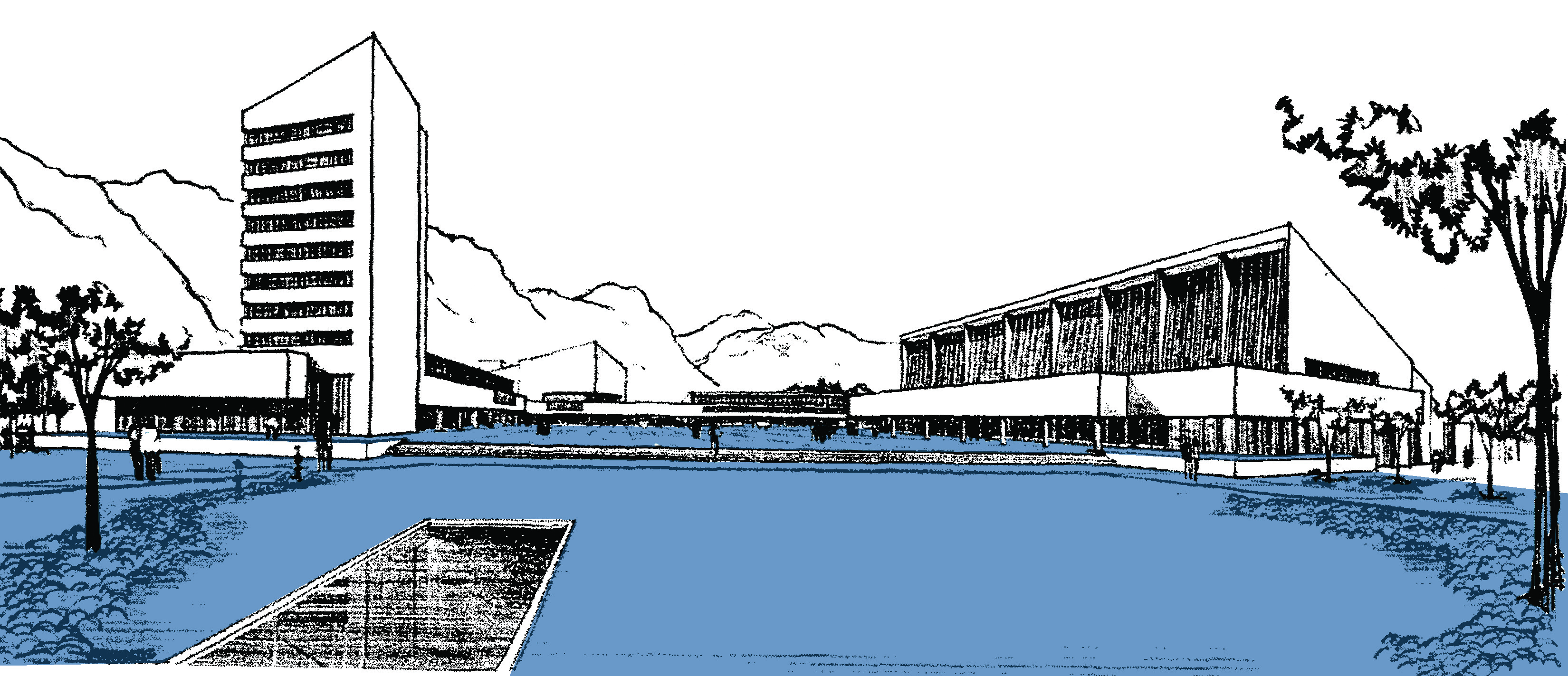
Patiño’s direct allusions to the categories of “heart”, “living centre”, and “civic square” show that Sert’s ideas were acknowledged and invoked in the conception of the Civic Centre for the Ciudad Universitaria (university campus). From its origins in 1936 and by that time (1968), the campus was totally open to the city of Bogotá, so the notion of the campus’ public space was thought and designed as part of the city’s public spaces.


In the different versions of this civic centre, an effort was made to unite the various facilities in a single urban complex, whose buildings were designed by architects Jairo Novoa and Luis Hernandez (Tower-Administrative Centre), Eugenia Mantilla (Auditorium-Theatre), Gonzalo Vidal (Student Centre), Alberto Estrada (Library) and Carlos Martinez (Civic Plaza).
Figure 10.
Aerial view of the Ciudad Universitaria. Bogotá (1971) Photograph: IGAC. Note the absence of the perimeter fence.

In this way, the Ciudad Universitaria was provided with a public and civic space following the theories and precepts formulated by CIAM VIII, the effects of which can be felt especially in its main square, Plaza Che. The effect that this space has had, both in university and in national life, is indisputable since many cultural, artistic and political meetings (spontaneous and planned) are held in this square daily. Throughout its history, this civic centre’s square has hosted not only the cultural expressions of students and citizens but also significant meetings and visits of important politicians, such as the taitas (authorities) of an indigenous community or some of the country’s presidents. This place has been consolidated in the memory of the academic community as a space par excellence for the manifestation and dispute of ideas. These discussions have even affected the naming of this public space because the directives originally named it Plaza Francisco de Paula Santander and erected a statue in his honour. For different reasons, a group of students rejected such designation and renamed it Plaza Che, painting the image of this revolutionary leader on the auditorium’s facade, while the statue of Santander was demolished. Therefore, we notice how in this civic centre, it is the democracy of the citizens and not the autocracy of the elected which has manifested and continues to manifest as the heart of this university campus. It is the organ with which this academic centre has consolidated much of its identity and public vocation. In this project, architecture has accommodated the differences, not homogenised them; a catalyst for ways that are always new, always traditional and thus fulfil Le Corbusier’s promise when he mentioned:
The civic centre brings together in spiritual and material harmony, all the collective functions likely to manifest the spirit of a social group of a city, of a society. It unites the past with the present. It constitutes the history of the city, without rupture and without abandonment. (Translated from Le Corbusier’s quote in O’Byrne 2010, 32).

CONCLUSIONS
The research conclusions focus on answering the initial questions: How the idea of the public has been transformed from the private sphere into government architecture, after the closure of the Dirección de Edificios Nacionales? And, what are the ideas of the public that have been conveyed by government architecture of the studied period?
Regarding the first question, it was found that the conception and design of government architecture in the hands of private entities, from 1960 onwards, had different repercussions. On the one hand, it forced the hiring of private institutions, summoned under the modality of architectural competition (Law 4 of 1964). This change in the management model implied changes in the design process. While in the past, the architectural commission was assigned directly to the M.O.P. architects (who designed these projects from their offices), now it was assigned according to the competing proposals’ merits, in a visible process, commented on and exhibited publicly. In summary, the conception and design of government architecture by private entities resulted in a more open process (due to the free accessibility to the competition) and more public (due to the dissemination of the results).
In terms of design, it is paradoxical that when private entities take on the challenge of designing one of the most public architectures, is when these works cease to resemble private, isolated and hermetic buildings. On the contrary, they opted for an architecture that is permeable to the public and the city, through the insertion of public spaces that encourage citizen encounters, following the CIAM notion of civic centres.
For this reason, the idea of public conveyed by the architecture of administrative centres lies in the free encounter between society and its institutions, between the public space and its buildings. This government architecture that harbours a double identity of the public is represented by the high-rise building, a symbol of the vertical and hierarchical power usually associated with institutional power, and by the square, horizontal and open space for dialogue and dispute in which the power of citizens is asserted. Therefore, the main transformation of the idea of the public sector under private institutions occurs when the traditional typology of the government building (compact and agglutinating different agencies in a single volume) is transformed into a fractioned architecture (hierarchised in different volumes) that synthesise an idea of the public in the urban square. This is a space for the encounter “between society and its institutions” as affirmed by Sert (1996) or “between the State, civil society organisations and to a lesser degree, although also present, political society and the market” as mentioned by Bonamusa et al. (1996, 6).
Regarding the second question, it is important to note that administrative buildings and, in general, government architecture in Colombia “act as landmarks in the configuration of the urban fabric” (Niño 2015, 25). However, the idea of public mobilised by these landmarks varied from a symbolic landmark (1905-1960, palaces and national buildings) to an urban landmark (1960-1975, administrative centres and civic centres). There are two ways of representing an idea of the public in government architecture, which in turn embody two ways of promoting and fostering encounters between the State and society. While it is clear that government civic centres were not built in Colombia (apart from academic ones), the influence of their ideas, under the theory of the “heart of the city”, succeed in transforming the sense of public that characterised government architecture after 1960.