“And human life is a representation…”, was said by Pedro Calderón de la Barca in his self-sacramental El gran teatro del mundo (1630). He has a point, I thought one morning as I made my way to where we all move now. I started the day on the way to the east, from my house at the western end of Bogotá. Advancing along 80th Street in a TransMilenio bus, one of those so-called hybrids, I could see through the cracks how the imposing hills rose in the background.
Among the diversity of faces that surrounded me, I revived the idea of the Theatrum Mundi, the trope that interprets social life as a performance. Which character would the entelechy of the Author have assigned us? Perhaps that of the king, the rich, the farmer, or the poor? Who knows! Suddenly, I was attacked by an epiphany. The metaphor of the city as a theatrical stage. A valid equivalence between the street and the stage. Both involve spectators, set designers and actors, who perceive, construct, and imagine the works to which their historical evolution subjects them.
Before arriving at my destination, I had time to review the possible itinerary on a map of Bogotá. The red line marked there is the contemporary la Caracas. A scar that debates between the vocation for circulation and the space for contact. This is a street in Bogotá of metropolitan scale that harbors the memory of multiple urban planning projects, varied architectural styles, heterogeneous scenes, and a sum of wills, some casual and others conscious.
Maps hanging from bus stations show that la Caracas is a fundamental artery within the city’s circulatory system in the north-south direction. It feeds, and it is fed, by flows of traffic and morning and afternoon passers coming from the west and east. If compared with other cartographies, it is noticeable that there are many urban layouts characterising each of the neighbourhoods across this street, which identify an equal number of particular social groups.
I was just short of getting there. Instinctively, I divided the Caracas route into three sections: north, between 69th Street and the Arzobispo River, centre, between the Arzobispo River and 19th Street, and south, between the Fucha River and the 48th diagonal south. I also wondered what I was going to see: the morphology, the definition of the street profile and the buildings uses by niches of activity. On the architectural scale: the corners – understanding that they are points with the greatest permanence in the urban fabric – and architectures with some formal or symbolic peculiarity. Some of that chaotically emerged, but what I evidenced (after reflecting on it) was the overlap of memory layers that hide the history pieces that la Caracas lost.
Satire: Fragments of landscape
My stop was at Flores Station on 69th Street. It was cold. I stood right at the intersection of the pointed junction between Carrera 13 and la Caracas. Looking north, you can see that both tracks merge into one, continuing straight until they get lost on the horizon.
At the beginning of the twentieth century, the Northern Railway track advanced through here, which meant an introduction to modernity intertwined by traditions, a specific time, a peaceful physiognomy. These were meadows enclosed by rammed earth fences with clay tile tops and featuring isolated quintas (country houses) in the original Mercado, Sucre and Quesada urbanisations, which overlooked the overwhelming horizon of the rural savannah and the imposing eastern hills.
In this section, some scenographic patterns can be established, for example, the postmodern facades: a mixture of classical elements, with strong colours and a base of dislocated surfaces. Additionally, the dominant sets, that is the continuity of the same facade pattern on whole blocks. Even the cloning of buildings, which as a hallmark, are in different places.
The satire in the current la Caracas takes place where the natural landscape still resists the hoarding human action. In the middle of the imposing hills and the extended plain is the glimpse of some lanky trees, while impudent money sharks exhibit endless cabinets of abandoned trinkets as pretentious shiny trophies. Unseen behind them is the excitement and sordidness of the bacchanal dens, which house nymphs and satyrs dedicated to the most extravagant celebrations. Hidden among some denser vegetation, some beautiful inert ruins of the past take refuge, some made of brick and others of the water that once flowed freely. To notice them, it is necessary to advance on foot, acknowledging the proximity of the architectural masses and the remoteness of the natural landscape.
I returned to the road and sharpened my senses, as I was approaching one of the degraded areas of la Caracas. Near 57th Street, a residual landscape materialised, caused by alterations to transport infrastructures, in back walls, remaining areas, sealed passages and setbacks. The desert environment had no trace of the old Chapinero’s vaudeville.

Tragedy: A hieratic face
I walked a lot, but now I could be more relaxed, more comfortable. I slowed down the pace to see in detail the refined architectures that surrounded me: very serious, grim, and applied. I tried to move between the central road divider, just as bourgeois pedestrians would have done it in the thirties, but that experience can no longer be reproduced.
The transformation of the railway tracks into an avenue was the idea of the Austrian urban planner Karl Brunner, who imagined the new city based on two components: neighbourhoods and avenue parks. Caracas Avenue was a two-way road lined with trees and furnished. This encouraged a rhetoric walk that had roots in a refined lifestyle: its luxury, its grace, and its sensitive ways to the banal; in short, to the street performance.
Thanks to private urbanisation, cultured architectures prospered: modern houses of English, French, Spanish, Tudor, Victorian and Art Deco style. Towards the centre, the panorama varies, and the facades acquire a brutalist tone; therefore, the structural and tectonic sense of the constituent elements is exposed. Modular windows and a rhythmic series of vertical elements, mainly made in exposed concrete and masonry, are usually repeated.
The tragedy of the current la Caracas (not because it is unfortunate, but because it is solemn) is a memory of foreign but appropriate high aesthetic and cultural values. What once was a competition between stylised houses with front gardens and imposing rental buildings with the best decorum is now being left behind. The former struggles to apply makeup that prevents the exposure of wrinkles, and other efforts have surrendered to the most merciless decadence. No one walks through the middle [of the road] to the calm rhythm of a conversation. The value is placed on frantic races of black, yellow, or red cars with two, four or six wheels, which mark the pavement and leave a toxic trail.
A sudden drizzle forced me to interrupt the hike, and I took a TransMilenio bus. I was heading to a very deteriorated point: 22nd Street. I got off the bus, but the panorama was threatening. I intended to leave the station to briefly tour the area, but I did not dare. In the background, a one-armed man with distressed clothes and skin stained by dirt stood like a Cerberus at the exit. Finally, I fled.
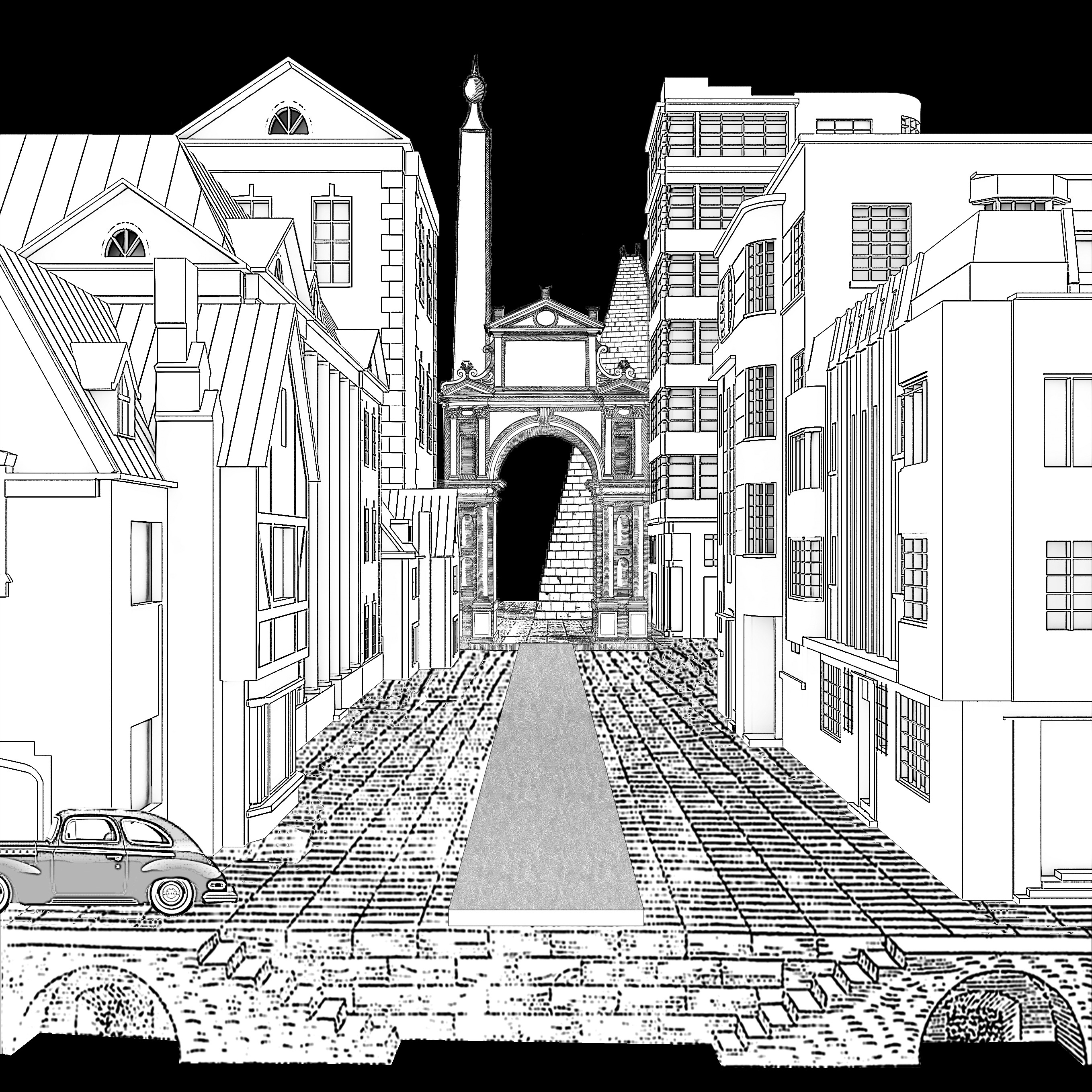
Comedy: Amusing everyday life
Embarked again inside the red worm [bus], I continued my journey south. That was a usual habitat to me, so much so that I got distracted and did not foresee what was coming. In a white shirt and blue jeans [a man] approached, I was not suspicious of his face, but he made a dreaded gesture, lifted his shirt, and pulled out a black-handle knife, a “patecabra”, from his waist. The consequences [were] inevitable. I hurried to follow the thief, but he quickly vanished through the labyrinthine alleys of the Quiroga neighbourhood.
Nearby, in the Santa Lucía neighbourhood, the then Mayor of Bogotá, Andrés Pastrana Arango, inaugurated in 1990, ten days after my birth, the first phase of the la Caracas motorway. The motorway’s logic was to function only as a mobility corridor, but it produced the degradation of the physical and social environment, a space without identity, without history, without a difference, a no place.
La Caracas motorway is a landscape of congestion and overcrowding that produces a permanent state of shock and alertness. The fear is latent during the day or night, its claustrophobic narrowness suffocates. The deteriorated facades and the central divider – now no-man’s-land – leave nothing but the feeling of discomfort and eagerness to leave. Billboards of strident colours and typographies mask the deteriorated architectures, while the smog fills the atmosphere with unhealthy grime.
The current la Caracas is a rolling circus, a comedy starring buffoons of all kinds. From the red throne – blue for the most select – the internal and external spectacles are uncomfortably observed: lights, colours, and texts, which overlap, fighting for attention. The plebs gather standing until they achieve the impossible: to overcome the physical law of the impenetrability of bodies. The verge is metallic, grey, full of confusing signals in the middle of the permanent rattle of the ground.
Tired and disappointed, I already wanted to go home, at least to my first house, in the San Carlos neighbourhood, a few streets further south. I boarded a taxi and the driver asked me: “Do we take la Caracas?”. Oh, my god! I did not want to know more about that ungrateful street anymore.
