Introduction
Urban fountains are a type of architectural object that actively uses water in public spaces. Historically, they have been present in the foundation and development of cities. Nowadays, they do not fulfil their original function, as they have gone from being part of the service infrastructure to being recreational and ornamental components. In the contemporary city, fountains are increasingly used to consolidate a certain image of the city or to embellish the urban landscape.
In Medellín (Colombia), as in many Latin American cities governed directly or indirectly by the Laws of the Indies, fountains were intended to supply water for daily needs and were strategically placed in the first urban settlements along streams. The Aburrá Valley, where Medellín is, comprises many streams that converge in the river. The first settlements in this territory established direct links with these streams, using fountains among other elements. However, the desire for modernity and the transformation of towns into cities changed these relations, and the river and its features came to be considered an obstacle to urban growth.
Since the 1950s, modern planning has guided the development of Medellín with two priorities: land-use zoning and metropolitan road connectivity. An important strategy was to complete the channelling and rectification of the Medellín River and some of its streams.1 The Wiener and Sert’s Pilot Plan emphasised the importance of the city’s growth around the streams. However, the planning provisions drawn up in the 1970s, with the Master Plan approved by the municipality, focused on the establishment and regularisation of the road network and the reduction of green areas.
As María Perfetti points out in her research on the transformations of Medellín’s urban structure in the 1970s, "the valuation office marginalises the practices and ideals of urbanism, [as it] acts by building infrastructure, with roads, many roads" (Perfetti 2005, 409). The prioritisation of the vehicular mobility system and urban layout meant leaving natural structures, such as the river and streams, aside. This limited the possibilities of taking advantage of the landscape and its environmental value and of creating a relationship between citizens and bodies of water.
While the city has stopped using the river and its streams for functional reasons, water fountains have been built or moved to integrate them into the city’s infrastructure and public space. This motivates the question: What has the city’s relationship with the use of water fountains and its urban space been like over the past fifty years?
This work focuses on reviewing some paradigmatic cases of water fountains that have determined the image and experience of Medellín’s public space in the last fifty years. Although these objects can be traced back to the city’s origins (used for foundational or embellishment reasons, as already mentioned), this study is framed between 1967 and 2014, with the construction and consolidation of three types of infrastructure representative of three periods of the city and its urbanism.
The first period is the consolidation of the city for the vehicle, in which the development of road infrastructure was a priority and fountains were urban elements to be contemplated from insude a car. The second period corresponds to the construction of the mass transport system (Metro), in which fountains were included as elements to activate new public spaces in the stations. The third and most recent period was the re-signification of residual spaces at a neighbourhood scale, where supply infrastructure strategies facilitated direct experiences and active recreation with water.
The three periods are contextualised by considering the treatment of the natural bodies of water within the city during each one and the projects commissioned using urban fountains. The projects and fountains were selected based on a review of primary information, including plans, maps, photographs and interviews, and secondary documents, such as scientific articles, other articles and books. A case study was used as a method to analyse the fountains, and a comparative study was conducted of the periods that grouped them according to their architectural characteristics; relationship with the city; and, especially, their use within the public space.
With this information, it is possible to approach the formal, technical, and aesthetic aspects that characterise the water fountains within their location. This guides an interpretation of their value as an urban element in the city’s history, as well as their relevance to public space. Finally, this work reflects on the transformation of the use of water fountains as part of public space, to contribute to the debate on citizens’ relationship with water and its need within the contemporary city.
Water as ornamentation within the city machine
Medellín has been developing significant infrastructure for the management of its water bodies (streams and rivers) ever since the late 1920s. Most of this was intended to support the construction of new vehicular avenues and advance production in general, favouring car mobility and limiting the landscape and environmental enjoyment of the water resources during the following decades. An early road project that restricted the relationship between the city and its water tributaries was the coverage of the Santa Elena stream, in the city centre (González 2018). Its purpose was to improve car mobility and avoid the bad odours produced by the sewage that flowed into the stream.
With this coverage, from the 1920s to the 1950s, La Playa Avenue was established as a promenade with important buildings, crowned to the east with the construction of the Pablo Tobón Uribe Theatre2 and a vehicular roundabout that precedes the building. The roundabout was adorned with an urban fountain in 1968, known today as La Bachué.3
This luminous fountain was designed by the Caputi & Uribe office,4 who also designed the luminous fountain at Parque Bolívar that same year (Figure 1). The design of La Bachué comprised three staggered concrete basins of nine, eleven, and seven metres in diameter, the latter crowned by the sculpture of La Bachué (Figure 2). The basins are mainly irrigated by three dandelion sprinklers.5
Figura 1.
Javier Uribe. Public Companies of Medellín. Plans for the luminous fountain at Parque Bolívar, 1968. The School of Architecture Archives, Universidad Nacional de Colombia. Photograph by the authors.

Figura 2.
Luis Guillermo Gomez. Administrative Department of Planning, Medellín. La Bachué fountain, 1997. Open access image for non-commercial use. Pilot Public Library Archive. Photograph by the authors.

Originally, the roundabout had two walkways to allow closer contact with the water fountain. However, it was fenced off because of security concerns due to the deterioration of the sector, and in the 1980s, was closed off to pedestrians and could only be appreciated by passing vehicles. It wasn’t until 2018, with the centre’s recovery plan, that the roundabout park and the fountain were re-opened to pedestrians.
Medellin’s public companies Empresas Publicas de Medellín (EPM) manage these fountains, in alliance with the municipality. In 1973, EPM and the textile company Fabricato sponsored the construction of a fountain at the San Diego roundabout, also designed by Caputi & Uribe (Figure 3).6 With the extension of Calle 33 to the east and the connection with Las Palmas Avenue, a road interchange was defined in the Asomadera sector.7
Figura 3.
Javier Uribe. Public Companies of Medellín. Plans for the luminous fountain in front of the Pablo Tobón Uribe Theatre, 1968. The School of Architecture Archives, Universidad Nacional de Colombia. Photograph by the authors.

The fountain comprised a six-petal-flower shaped basin of thirty metres in diameter and a raised basin of seven metres in diameter. The water was propelled over the upper basin and flowed into the base through gargoyles to then be pumped again. It also highlighted the vegetation design that complemented the roundabout.
The Fabricato fountain was built as an industrial monument that could be observed from vehicles going around the San Diego roundabout (Figure 4). Due to its size and location, it was a point of reference for years. However, in 19878, the road that connected Oriental Avenue with El Poblado Avenue was widened with a bridge going over it. Finally, in 2019, the fountain was demolished to complete Calle 33 towards Las Palmas Avenue and improve mobility. The BIC fountain between Avenida del Ferrocarril and Calle Colombia, built in 1972 for the enjoyment of motorists, had the same fate (Figure 5). In 1980, this roundabout was removed during the construction of the river bridge to build a more ambitious intersection.
Figura 4.
Gabriel Carvajal Perez. Fabricato fountain at the San Diego roundabout, 1973. Image for non-commercial use, Pilot Public Library Archive.

Figura 5.
Caputi & Uribe. Plans for the BIC luminous fountain at the roundabout between Avenida del Ferrocarril and Calle Colombia, 1972. The School of Architecture Archives, Universidad Nacional de Colombia. Photograph by the authors.

Other fountains at Medellín’s roundabouts are at the Olaya Herrera Airport, at the intersection between Calle 14 and Carrera 65, also designed by Caputi & Uribe (1964), and at the roundabout on Calle 30 with El Poblado Avenue, which was built in the1970s by the Enka companies. The latter, currently closed, includes a contemporary sculpture-waterfall designed by Óscar Mejía, Ramiro Henao, and Fernando Botero (Figure 6).
Figura 6.
Administrative Department of Planning. Study of the road plan for the interchange between Avenida del Ferrocarril and Calle Colombia, 1970. Image for non-commercial use, Historical Archive of Medellín.

The roundabout fountains described refer indirectly to the principles of the Baroque city, in which the promenades, boulevards, roundabouts, or gardens, popular during the eighteenth and nineteenth centuries, were adorned with fountains. Although the influence of American-style highways for fast mobility has been strong since the 1940s, the ornate roundabouts were built as monuments in the 1980s (Botero 1996, 156-157). As Lewis Mumford (1967) indicates, while the great avenue became a highway, and the great roundabout was transformed into a "clover", much of modern urbanism was Baroque. In Medellín, this responded to the needs of building a functional city and projecting an image of power, progress, and modernity.
Water as a vitaliser in a large urban operation
In the 1950s, it was established that roads parallel to rivers should have a wide enough setback to allow the construction of a mass transport line (Restrepo Uribe 1981). These areas were used in 1984 to build Medellín’s Metro system, a project that became, from an urban perspective, one of the most important works in the city.
The final project comprised two lines. The main one (line A), inaugurated in 1995, used the setback along the Medellín River from south to north, entering the city centre through Carrera Bolívar. The second line (line B), inaugurated in 1996, bordered the stream La Hueso, connecting the historical centre with the residential areas in the west. The Metro featured elevated viaducts and ground-level rails, which limited the possibility of establishing a relationship with the Medellín River and eliminated the potential of La Hueso as an environmental corridor.
The Metro stations were designed by Nagui Sabet9 and Laureano Forero, two renowned architects who led most of the city’s building production during the 1980s. The station designs considered not only structural aspects related to the layout of the viaducts and rails but also solved pedestrian accesses. However, the public space was designed by a local architecture firm and the Metro company. Of the twenty-one initial Metro stations, five within the city centre considered treating the urban fabric left after demolitions, especially because of the abrupt appearance of the elevated viaduct within its dense and consolidated urban mesh (Figure 7).
Figura 7.
Administrative Department of Planning. Enka Fountain at the intersection of Calle 30 with El Poblado Avenue, 1986. Open access images for non-commercial use. Pilot Public Library Archive.

San Antonio, Parque Berrío, and Prado (line A stations) and Estadio, Floresta, and Suramericana (line B stations) included vertical jet fountains, placed over grids to collect the water, in the open squares and hard surface areas at the station entrances. These were designed by Caputi & Vieira,10 descended from the original Caputi & Uribe office.
While the fountains were similarly integrated into most squares as objects for appreciation and enjoyment, they transcended the decorative vocation of those in the 1960s and 1970s (in roundabouts) by allowing closer interaction with the water. On the one hand, they recalled the presence of water (as line B was built over sections of La Hueso stream). On the other, they contributed to the habitability, comfort, and permanence of visitors throughout the day by lowering the high temperatures resulting from the aridity of the new Metro access squares (Figures 8 and 9).
Figura 8.
María Bustamante and Edison Escobar. Plan showing the design for the San Antonio station on line A of the Metro. Courtesy of Medellín’s Metro Archive.

Figura 9.
Secular architecture: Juan Carlos Londoño M. Plan of the Floresta station design on line B of the Metro. Courtesy of Medellín’s Metro Archive.

The water fountains in all stations (Prado, Suramericana, Floresta, and Estadio stations)11 are currently out of service, due to technical limitations and costs associated with their operation. San Antonio station was demolished in 2017 for the construction of Carrera Bolívar boulevard.
Water as an infrastructure re-signifying element in the urban periphery
At the beginning of the twenty-first century, new projects began to use water in public spaces for play or interaction. Projects such as Parque de los Pies Descalzos12 (2004) and Parque de los Deseos13 (2008) showed that citizens enjoyed actively playing with water and designers were interested in using water as a central element in urban projects.
In 2011, designers sought to take interactive water playgrounds to neighbourhoods that lacked or had limited public space. To do so, they used the lots and roofs of various water storage infrastructures located in the upper parts of the city. These new buildings and their public spaces were known as Articulated Life Units (Unidades de Vida Articuladas - UVA), and were part of an EPM initiative, in alliance with Medellín’s Mayor’s Office, to reintegrate existing infrastructures into the urban fabric (Valencia Corrales 2016).
This was an urban intervention by EPM’s Department of Sustainable Urban Interventions (DIUS), led by architect Horacio Valencia. This department also oversaw the prioritisation and design of most of the UVAs. One hundred and forty-four tanks in the city were initially considered, but the interventions were defined according to "the available area, population density, and needs of the neighbouring communities, geological restrictions, [and the] expansion of the aqueduct service and its environment" (Valencia Corrales 2019). Between 2012 and 2015, fourteen UVAs were built in different tanks, especially on the city’s outskirts (Figure 10).14
Figura 10.
Luis Guillermo Gomez. Administrative Department of Planning. Suramericana station under construction, 1996. Open access images for non-commercial use. Pilot Public Library Archive.

The infrastructure areas with "the most serious problems of violence in Medellín" (Valencia Corrales 2019) along with those with available areas to be interwoven to connect with neighbourhoods and territories were considered for the initial analyses for the UVA projects. Many of these infrastructures fragmented the urban fabric and generated abandoned or disused spaces, offering great potential due to their location in the city’s densest sectors. The interventions were based on three fundamental premises: respect for the existing infrastructure (the water tanks), the design of the public space considering mainly the topography with its high slopes, and a basic architectural program developed by the surrounding community.
One of the first UVAs to operate was Los Sueños (2014) in Versalles tank, Medellín’s Comuna 3 (Figure 11). This work is an example of many of the goals outlined in this urban intervention strategy: articulation with the immediate surroundings, the creation of living and meeting areas, dynamization through the use of water and light, and the consolidation of an offer of services in accordance with the requirements of each sector.
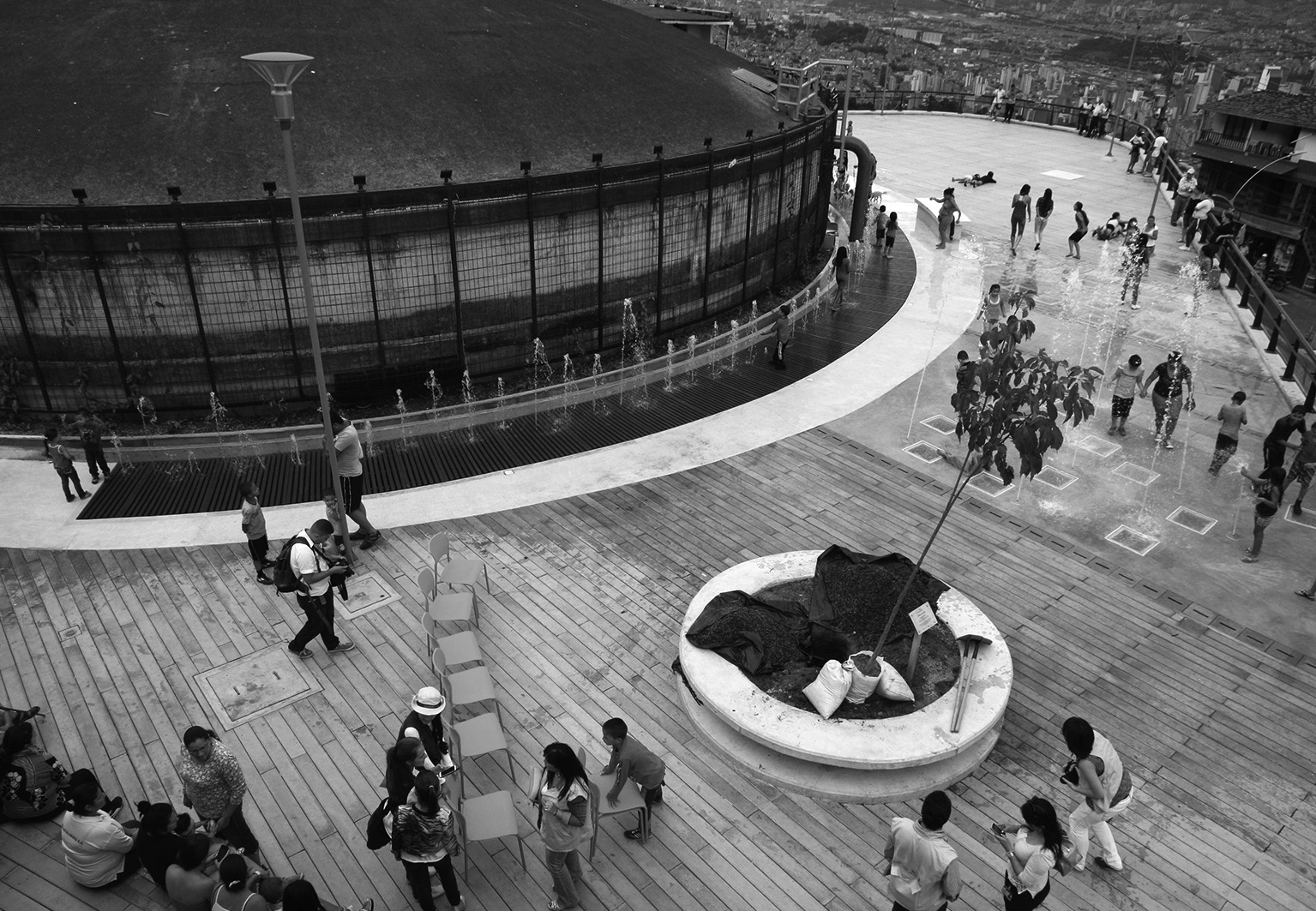
The UVA Los Sueños was built on an inclined topography, connecting different spaces with the terrace and retaining structure. Water is used here as an organising element of the new public space surrounding the water tank in the main square. It comprises a couple of vertical jet water fountains with an additional line that surrounds the tank next to a wide city viewpoint.
The integration of water in the UVA designs goes beyond a merely contemplative purpose within the public space. They use water as a catalyst and organiser of both urban space and new activities for the enjoyment of visitors and direct interaction.
The UVA La Esperanza, in Moscú tank, Medellín’s Comuna 1 uses a repertoire of resources common to most projects. For example, the management of the topography with paths and retaining walls and a central recreational space combining colourful lighting and water games, where water becomes the protagonist directly linked to the infrastructure (Figure 12).

In contrast, the UVA La Armonía, in La Tablaza tank, Comuna 3, presents a distinctive large mirror of water (the tank itself) with paths over and around it. The mirror of water is complemented by two powerful water jet fountains as the main attraction and focus of the project. Low white lighting emphasises the routes, as other colours are not present (Figure 13).

Among all the UVAs, La Imaginación15 (formerly known as Orfelinato) has been widely highlighted and disseminated. It is the only one developed through a public architecture competition and recognised with several awards, including the LafargeHolcim Awards, in 2015. "The flexibility and continuity of the park’s spaces" is outstanding, as well as "the playful activities with water as a reference" (González 2020).
In La Imaginación, water becomes the characterising element of each of the spaces. The architectural project uses circular geometries taken from the existing tank, including a mirror of water and a deep corridor that crosses it, allowing closer interaction with the water. In the most of the project’s open areas, the vertical water jets create a playful space with the movement of water inciting interaction. UVAs generally achieved significant citizen appropriation in a short time and brought people and water fountains closer together in each of the territories where they were installed.
In an urban context, the UVAs contributed to improving the access of certain peri-urban sectors to public spaces equipped with water fountains. However, it is a paradox that in neighbourhoods such as Villa Hermosa, where UVA La Libertad is located, 21% of households are currently without access to the city’s aqueduct. Except for Comuna 14, El Poblado, where UVA Ilusión Verde is located, in all the other Comunas with these interventions, there is a sector of the population that has no access to drinking water (Medellín cómo vamos 2019).
Conclusions
Throughout Medellín’s urban development, the relationship with water tributaries has been conflictive. The city has important debts with the streams and the river, which range from their visibility, the conservation of their environmental conditions, to their full articulation within the city’s green and natural infrastructure, to position them as environmental enhancers related to the urban area and its citizens.
The cases reviewed here highlight this conflict, as the interventions related to the city’s infrastructure during the first two periods demonstrate contrasting positions and water usage. In the first period, resulting from the notion of a mechanic city, water is used in a contradictory way. The urban fountains that were described configured monumental intersections of road axes, which at the time did not favor the citizens’ organic approach to them, at least not in the sense of what would be considered hygienic or civilized. This distancing or ornamental was due to the same reasons for which the Santa Elena stream was covered.
Likewise, these interventions tend to disappear due to the same forces that determined their need within strategic points of the city. Vehicular mobility surpasses the aesthetic character or the possibility of contemplation that was promoted by the business elites of the second half of the last century, and new road extensions make it necessary to demolish them.
In the second period, due to the abrupt introduction of the Metro in the city centre, the riverbank and the streams, water appears as a dynamic element in the public space. These fountains began to make citizens more aware of water on a daily basis. Interactive bodies of water become routine around some Metro stations and their operation.
However, these fountains have been closed since the processes of citizen appropriation revealed a trend that was not sustainable for the administration of these spaces. The presence of street dwellers or the idea of unnecessary water usage leads to extreme monitoring of these spaces with surveillance and, finally, to their closure as meeting points around water.
In the third period, the UVAs represent a positive outlook for spaces where there is citizen interaction with water. The conception of these public spaces, from the re-signification of the water resource and its allegory with the recycling of the tanks, has brought beneficial dynamics both for the communities that reside in the surrounding territories, and for other citizens. It has consolidated a system where the common denominator is precisely the aqueduct network.
From a technical point of view, it is worth noting how the first explorations limited to effects such as vertical jets gave way to experimentation with water curtains, vaporizers, and floor jets with movement and lighting, mirrors, and a wide range of design options and opportunities using water in public spaces.