What is the white table? – A neutral plane surface in connection with man, a plane surface that is so neutral that it can receive anything you like, something that arises only out of the imagination and the skill of man. The white table is as white as white can possibly be. It imposes no regulations, nothing that would compel man to do this or that. It is a peculiar relationship. […] The white table was big; later on it grew still more, but it did not become bigger, it merely multiplied. Aalto (2014, 13)
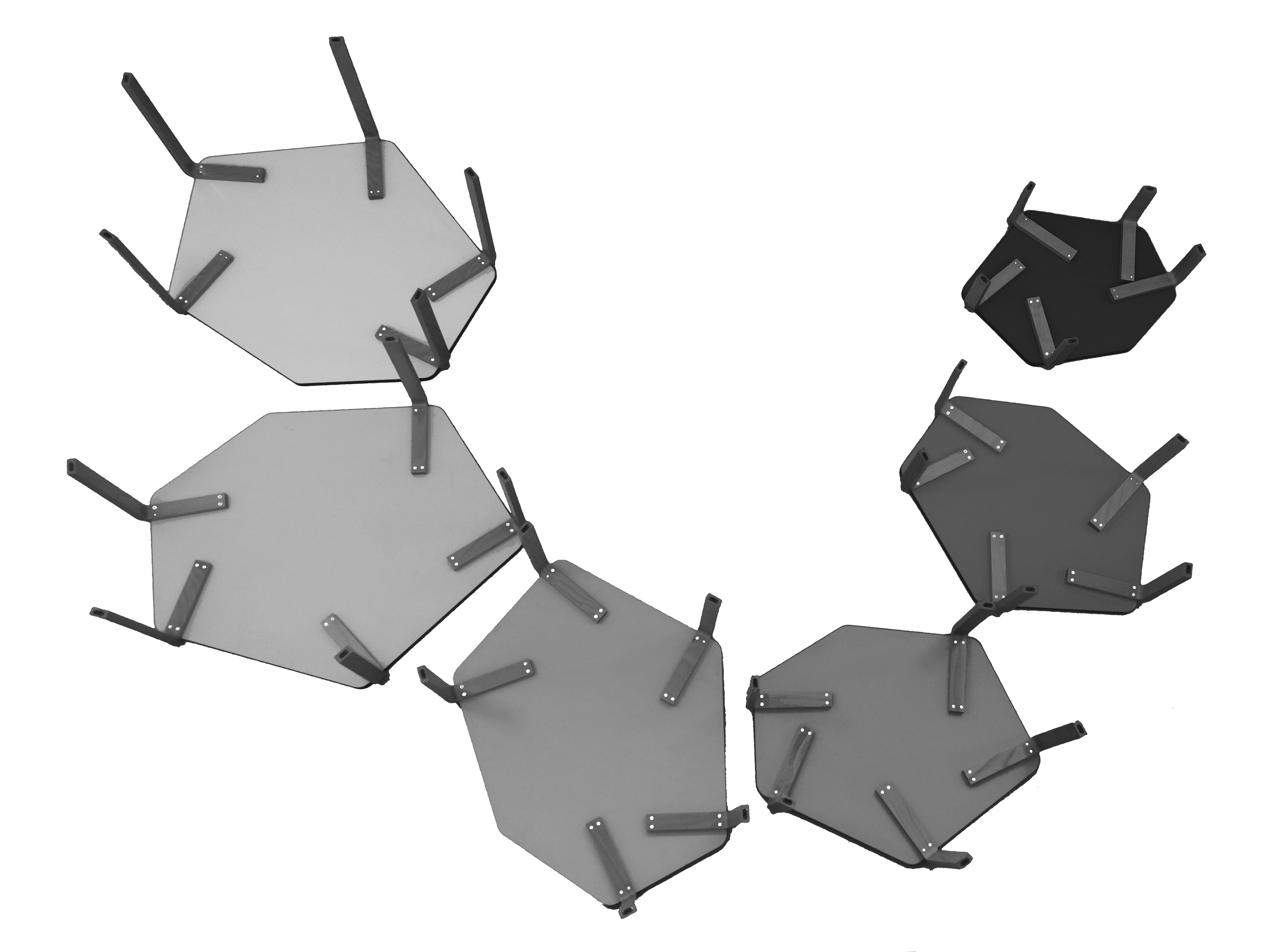
In this paper we break down the design process for an item of school furniture (hEXtable, designed by Clara Eslava and Miguel Tejada of eslava y tejada arquitectos), a medium for pedagogical action (Fig. 1) in whose definition certain choices are adopted while seeking to leave multiple options open.
Figure 1.
hEXtable, multiple options. Design: Miguel Tejada and Clara Eslava, 2019 (http://eaaestudio.com/). Selected at BID’20 (Bienal Iberoamericana de Diseño).
From the education machine to the multi-option school
When the model of the school as education machine (Pineau, Dussel and Caruso 2001) is imposed, the structural consequence—and one that has a long history—is a process of alienation from play and from the collective. Architecture and furniture work together in implementing these dynamics of control, constructing rigid spatial arrangements based on modular repetition of the standard classroom: a hermetic box occupied by an army of desks. Movement is subordinated, channeled rather than free. The physical medium is not neutral: “school is a political institution, where the concept of society is contested and where conflicts between worlds are brought to face-to-face”1 (Garcés 2020, 64).
The difficulty the standard classroom has in addressing other educational models demonstrates the outdated nature of the school’s spatial structure, both as regards the scale of school buildings and that of the spaces within them, which in turn are characterized by the design of the furniture and how it is arranged. Despite the educational collective’s current interest in innovation, school equipment is predominantly determined by normative homogeneity and commercial standardization. Those pedagogical proposals that created their own spaces, furniture and materials in a quest to manifest their educational vision contrast with the broader school context in which we find, with very little variation, the same spaces filled with identical chairs, desks, shelves, blackboards and corkboards.
Some school environments seem to base their approach to educational innovation on upgrading their equipment, carefully choosing a particular brand or model but nonetheless remaining bound by market constraints. In other cases, the classroom is remodeled to create functional zones or to seek change by acting on its physical boundaries. However, the omnipresent legacy of the existing furniture makes transformation difficult to implement due to the intrinsic definition these objects impose on the space they occupy. There are also schools that work collaboratively on reusing and recycling domestic furniture, while others look at ways to make their own or turn to the domestic furniture market, avoiding the school furniture sector in a drive to redefine the underlying concepts. These are alternatives that, entailing varying degrees of input from the design teams, give rise to valuable participatory processes.
We can affirm that rethinking school and classroom furniture constitutes a form of questioning that is both necessary and fundamental within the educational realm. It is a process of reflection that stems from the different pedagogical approaches that, throughout modernity (Carbonell 2017), have considered the physical environment to be the setting that mediates education, occasionally reaching moments of convergence between them that provide significant touchstones worthy of critical and creative reconsideration and review (Fig. 2).
Figure 2.
hEXtable, the medium for action. Source: photographs © Alfredo Hoyuelos and Arbizuko Herri Eskola school.

A living, transformable, community-oriented school that constructs itself and is capable of autopoiesis requires a new approach to architectural design that goes beyond the static notion of type. It applies accepting complexity and contradiction from the perspective of new paradigms, addressing “a complex reality that cannot be conceived simply as the projection of a model. In actual practice, the principles underlying the multi-option school come into conflict and its functioning must be viewed as a set of educational tensions” (Ader 1975, 6). The multi-option school, an approach defined in the 1970s by pedagogue Jean Ader, implies the ongoing construction of the educational project by the community: “This education of choice, essential to this type of school, leads to the organisation of options” (Ader 1975, 6). The concept of options is essential to the construction of the individual within the collective, accepting that individuals learn at different rates and therefore creating flexible and varied spaces that allow attention to be paid to real diversity—essential to equitable construction of the collective—rather than creating homogeneous spaces in the pursuit of equality. The multi-option school is a dynamic process in which “no one formula for education can be regarded as definitive” (Ader 1975, 10). Rather, it is a response by a community at a particular point in time, meaning that “it must therefore be considered and studied in a context of change” (Ader 1975, 10), which has significant consequences as regards the conception of flexible arrangement of the school space and its furniture.
The human context: a project based on dialogue
Arbizuko Herri Eskola is a public school in Sakana, a rural district of Navarre in northern Spain with an identity deeply rooted in the area’s unique cultural and linguistic heritage. It forms part of a common project that aims for rural schools to be places of social interaction and integration (Consejo Escolar de Navarra 2016). In 2015, Arbizuko Herri Eskola school embarked on a transformational journey in the form of a pedagogical project in which each child was invited to design, within particular space–time constraints, a possibility-creating structure (Bonàs 2010, 34). The Arbizuko Herri Eskola project is based on feeling, on reflection, and on a culture of childhood rooted in the community. It thusly seeks to conceive the common from the critical perspective of its loss under a capitalist social and economic model that erodes cooperative child-raising (Del Olmo 2013, 107) and unpicks the structures of mutual support and reciprocity of traditional societies.
The approach is systemic. The common is not reducible to the operational teaching tool of simply instructing children to work in small groups, but rather explores the communal dimension of human actions and relationships in a collective scenario. And it is then, from the awareness of the esthetic, ethical and political nature of the school, that education is again required “as the ground for development of forms of critical intervention via which to engage with a common world and which aspire to transform our lives”2 (Garcés 2013, 85).
Arbizuko Herri Eskola school has grown as a living community, weaving itself into people’s lives, connected to the global and embedded in the local. Within a few years it became necessary to extend the meagre infrastructure, commencing construction of a new school. Teachers engaged with families in a process of collective reflection on the nature of the school space, a process that led to the upgrading of the established parameters and the definition of criteria that would later be adopted by the local government. The design team contributed to the process, working on the configuration of the organizational charts (Fig. 3), a tool for dialogue and mediation between the school and local government and which would eventually be included in the specifications of the call for proposals to design and build the new school.3
Figure 3.
Organizational chart showing the spaces and relationships between them at the school. Source: eslava y tejada arquitectos.

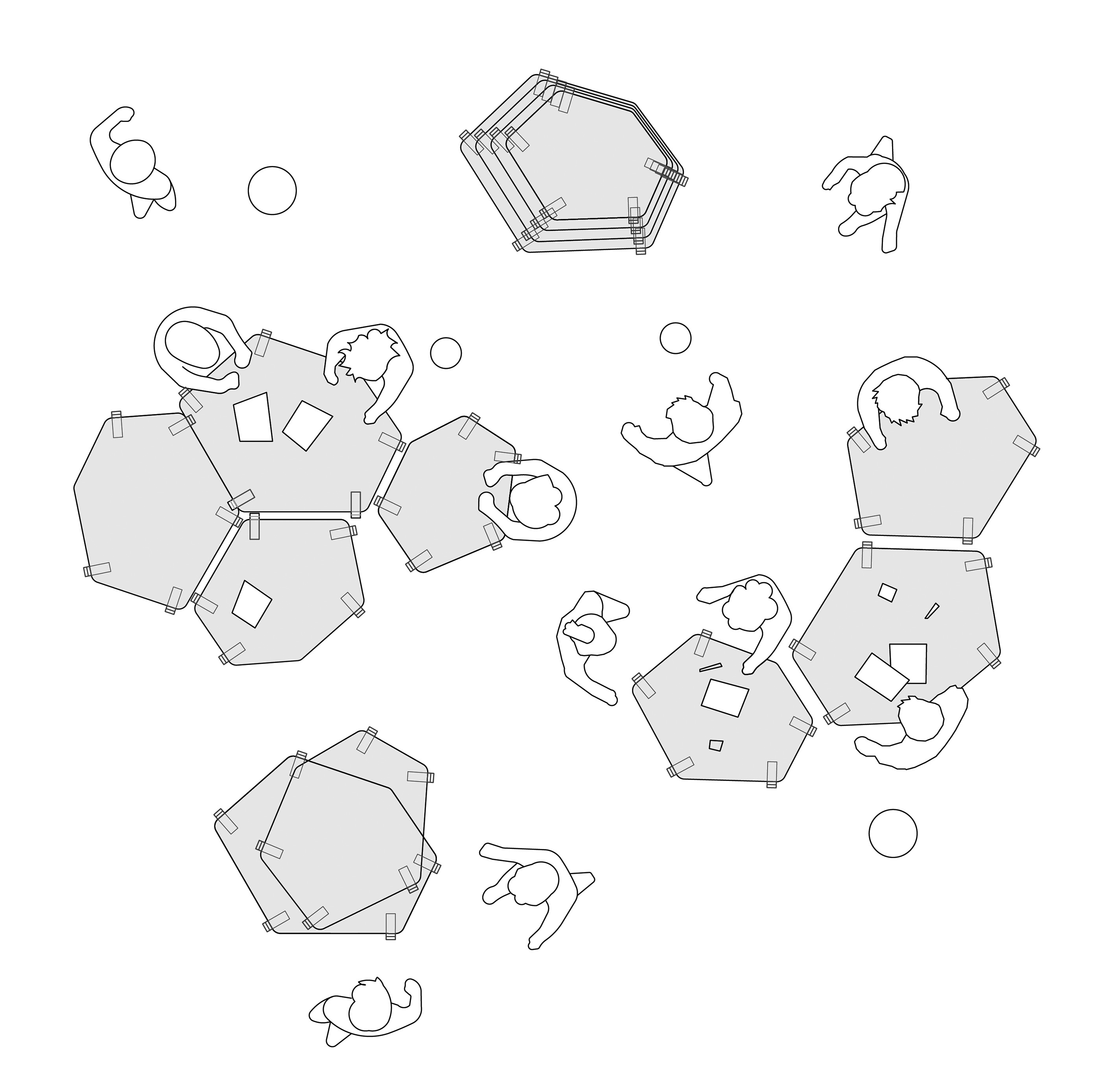
With the new school under construction,4 the focus of the debate shifted to the classroom, the arrangement of which would follow the guidelines set out by El Martinet5 school in Catalonia, creating three interconnected communities of children: three to four year olds, six to nine year olds and nine to twelve year olds. The work revolved around diagrams that represented strategies with which to define a flexible structure for the future spaces (Fig. 4), rearranging three conventional classrooms into a flexible community based on smaller-scale spaces and making use of different furniture options.
Figure 4.
Diagram showing the transformation of the three classrooms into a micro community spanning three age groups. Upper row, spatial layout, initially using conventional furniture arranged in rows and groups and finally using hEXtable. Lower row, complete transformation of the space. Source: eslava y tejada arquitectos.

Addressing the problem at every scale meant specifying the furniture options, which were initially generic, while maintaining consistency with the objectives of the project. An agreement was reached with the local government to focus intervention on a single element. The project gave rise to the following questions: Which item of school furniture structurally conditions the educational space in the classroom? Which object has the greatest capacity for transformation in pursuit of a pedagogy that embraces change? Which piece of furniture is key to generating multiple options?
Teaching staff participated actively in developing the core idea, reflecting on the configuration of spaces, timings and groups within each community; terms such as spaces of reference, free movement and flexible groupings emerged. The teaching staff explained their aspirations and their observations on the day-to-day experiences of children in the school. They emphatically expressed how they wanted to start a new chapter, their keenness to overcome the unidirectionality and hierarchy of conventional solutions, and their rejection of the standard school equipment available on the market. Questioning the desks, an omnipresent part of the classroom, eventually emerged as the key to achieving the transformation sought.
From desk to table: a project rooted in the common
Historically, the desk—a specific type of table that transports us back to a past pedagogical model—has characterized the school. Witnesses of the past, omnipresent desks dominate the school space like a miniature army arranged in rows and columns, reflecting the ideal of isolation, a form of pedagogy where as pedagogue Julio Castro indicated as early as 1942, the child must not only be quiet and still but also alone (Castro 2007).
To begin with, the upgrading of the classroom—the cell within the school body—was approached from the perspective of furniture as architecture (Peláez 2020, 68; Peláez 2021). Working with conventional equipment, various arrangements were explored, as in the case of the extraordinary study of possible configurations (Fig. 5) conducted by architect William Wayne Caudill (1954, 30–35) in 1954. This experimental path that linked architecture and furniture was further explored by Amy Ogata in her essay “Building Creativity in Postwar Schools” (2013).
Figure 5.
Exploration of different possible ways of arranging the classroom, with desks, without desks and with collective tables. Source: Caudill, W. Wayne. 1954. Toward Better School Design. (pp. 30–33).

However, in Arbizuko Herri Eskola school rearranging the desks was not enough; it did not meet the vital need of the educational project and did not engender new meaning. Likewise, the modular designs available on the market and the combinatorial possibilities they offered failed to satisfy the team. There was a need to go much deeper, to go beyond the notion of the desk in favor of the communal, emphatically opting for the collective table (Castro 2007, 13). Unwittingly, we had adopted the manifesto that Uruguayan pedagogue Julio Castro had published in 1942, El banco fijo y la mesa colectiva, a comparative study of two types of school furniture—fixed desks and collective tables—that epitomize two opposing periods and concepts: in Castro’s metaphor, while the fixed desk symbolizes traditional pedagogy, the collective table reflects the trends and movements of modern education (Castro 2007, 32). The team expressed this idea as follows: “the school has to be a celebration of the common: when we share a meal with family or friends we don’t join lots of small tables together to make one big one; rather one big table top unites and connects us.”
At the same time, it was essential to make the project economically viable, which once again brought it into contact with the existing model: how to make the project work in an environment where school equipment was affordably priced? We felt that the communal, which entails a different way of doing things, namely sharing, could also be a source of economy. We changed the rules of the game, we needed less not more: there was no need for a table for each child, but rather a need for everyone to have access to a common working medium, the collective table. It was a question of going beyond quantitative standards that lead to “a desk for each child” and committing to the communal with “a set of tables for everyone”. In the process, and as opposed to the type-based approach that generates a set by addition, the notion emerged of tessellation as a contemporary creative strategy capable of addressing the problem at different scales and of considering different groupings. The autonomy of the individual table is discarded in favor of a totality, a set of tables with space for the collective. The tables would constitute a mosaic that expands to the utopia of an infinite geometry and allows for flexible groupings; a scalar series of irregular hexagons in which each table can be removed from the set, as a separate piece, to accommodate small groups.
We therefore returned to the hexagonal table that transformed primary school classrooms in the 1960s and was already in use in Hallfield Primary School, the work of Lindsay Drake and Denys Lasdun in the United Kingdom, in 1955 (Kozlovsky 2010). Now, however, the pattern is deformed by creating a tessellation of irregular hexagons selected from one of three possible convex monohedral hexagonal forms defined by immutable conditions but variable parameters. We adopted hexagons composed of three 120° angles positioned alternately and symmetrical on the sides they form. The lengths of the sides and the three remaining angles (Fig. 6), however, are variable. It is a highly versatile shape that offers a subtle balance between ordered regularity and its distortion, a complex relationship characterized by the dynamic interplay of order and chaos.

The nesting table: accompanying growth
One of the demands of school is that the tables have to evolve and grow with the children, accompanying them. We considered how to address change that does not occur in a linear or homogeneous fashion, since at the same age children can be of very different sizes. This approach gave rise to the idea of a growing table. School furniture takes this into account at a functional and ergonomic level, applying different sizes to the school as a whole, but not applying them within grade levels and age groups. In our case, sizing explicitly dominates design. Different sizes are deployed in a single space to genuinely significant effect.
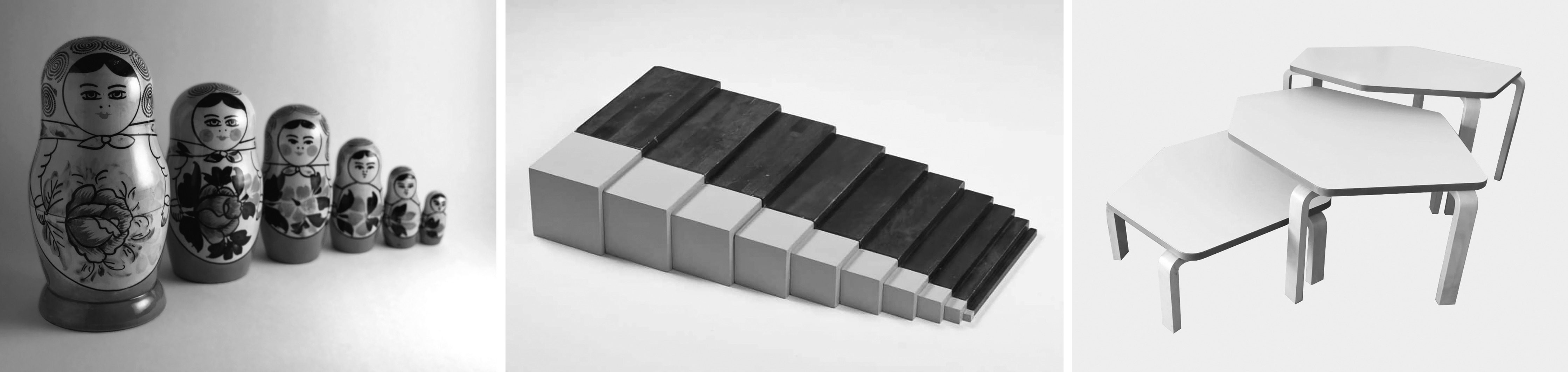
There is also a need for the tables to disappear at certain times to free up classroom space and permit different configurations, recovering the floor as an empty area for free movement or other pedagogical uses. The proposed tessellation aims to colonize the space with its geometry and then be retracted, nesting each table under another (Fig. 7). This once again frees up the classroom’s educational space, creating a changing mosaic, a medium for action, a scenario in which to explore the multiple options that constitute the day-to-day experience of school.

The nesting tables, with their varying heights, satisfy these demands exceptionally well: they meet the classroom’s need for spatial flexibility and the requirements of childhood’s varied developmental stages and ergonomics. They also constitute a rich and welcoming world in themselves, creating a scenario for children to grow and learn. We asked ourselves why the nesting system and its potential for both function and leisure had not already been applied to the classroom.
A look back in time recalled the iconic nesting tables designed by Joseph Albers (1926–1927) for the home of psychoanalysts Fritz and Anna Moellenhof in Berlin, with their delicate color scale in lacquered glass embedded in a wooden frame, or the tubular metal-frame tables in primary colors designed by Marcel Breuer (1925) for Mücke Melder (Fig. 8). The classics of early modernity had already travelled this path, treating the object as an open system deployed within the space, charting new courses by experimenting with color and materials.
Figure 8.
Left: Marcel Breuer, Nesting tables (1925), in three positions. Right: Josef Albers, Nesting tables (1926–1927), in three positions. Source: Produced by the author.

The idea of increasing or decreasing series appears spontaneously in children’s play. Children take pleasure in arranging pebbles, sticks, pieces of string and other objects in order of size, creating consistent sets of elements that are of the same type but have subtle differences in dimension. To paraphrase Gilles Deleuze (2002), it is an oscillating dialogue between “difference and repetition” spontaneously rooted in the playful childhood scribblings (Fig. 9) that seem to speak to Charlotte Perriand’s evocative Petalo design (1951).
Figure 9.
Left: Drawing by a girl aged two years and seven months showing primitive tessellation. Source: Public infant school, Pamplona. Right: Charlotte Perriand, Petalo, 1951, in three positions. Source: Produced by the author.

Maria Montessori (Müller and Schneider 2002) explores this with her tower of cubes, a three-dimensional mathematical scale that draws on numbers, dimensions and topology by placing pieces within one another in a sequence reminiscent of a series of matryoshka dolls (Fig. 10). Sets of pieces of different sizes invite the observer to place and arrange them, to seek balance, to experience the surprising pleasure of toppling the tower and the challenge of ordering chaos by re-establishing the series, the pieces set out and put away time and time again, seducing us in the process.
Figure 10.
Left: Set of matryoshka dolls. Source: Stephen Edmonds, Melbourne, Australia, CC BY-SA 2.0 File: Matryoshka dolls. Centre: Combination of the Montessori Pink Tower and the Montessori Stair. Right: Set of hEXtable nesting tables. Source: eslava y tejada arquitectos.
In opposition to the modularity of the classroom occupied by identical individual desks, we have conceived the collective table as a complex and consistent system, a family of separate parts (Nicholson 1971), each autonomous, capable together of structuring a space and contributing to the communal setting. The irregular geometry encourages other ways of looking, through play, through the richness of diversity and through the inclusion of everyone. Moreover, the creative process is not only articulated through these factors; it is also palpably molded by direct encounters with day-to-day scenes of childhood play: the experiences of children who hide, explore and discover the other side of objects and interact creatively with their environment.
The table’s hidden space: the memory of childhood
Children’s play, in its exploration of objects, integrates the material world, transforming it based on their earliest experiences. It is inserted into the complex framework we cohabit, disrupting the cultural code, altering the logic of the system of objects (Baudrillard 2020). Childhood creatively reveals the value in lack of utility, of hidden space, of the other side of the day-to-day. Its transgressive and subversive metaphors of the real create a rich substrate that nourishes the adult creative process, as Enric Miralles recreates with his Ines-Table (Figure 11) in his journey into the imaginary.
Figure 11.
Alvar Aalto, patent for a laminated wooden table leg, 1934. Source: Aalto Foundation. Right: Enric Miralles. Ines-Table, 1993, a 15 m2 table like no other. Source: Fundació Enric Miralles and Benedetta Tagliabue EMBT Architects.

Walter Benjamin situates his childhood in a form of direct, prelinguistic knowledge of reality: enveloped in the material world, reality was accessible and clear to him, producing a mute comprehension. In Berlin Childhood around 1900,6 in the fragment titled Hiding Places, Benjamin evokes his childhood self who merges with the places and objects of his home. “I already knew all the hiding places in the house, and would return to them as to a home ground where everything is sure to be in its familiar place. My heart would pound. I held my breath” (Benjamin 2006, 99). Looking for their “other side”, a form of knowing arises from objects, which communicate the meaning that is inherent to them with their significant presence: “Here, I was enveloped in the world of matter. It became monstrously distinct for me, loomed speechlessly near” (Benjamin 2006, 99).
Beyond their intended function, in the imaginary deployment of play the places that the domestic environment offers for transgression and hiding are revealed: the space behind the curtains or the door, or under the table. “The child who stands behind the doorway curtain himself becomes something white that flutters, a ghost” (Benjamin 2006, 99). In a living bond with the inert nature of things, the child mimics the objects or is transformed by inhabiting them in the alternating phases of hiding and finding: “The dining table under which he has crawled turns him into the wooden idol of the temple; its carved legs are four pillars. And behind a door, he is himself the door” (Benjamin 2006, 99). Time is elastic, it is forever, even if that only means for as long as the game lasts, until the end of that altered time and the sudden return to reassuring everyday normality. On leaving the realm of the imaginary, the invisible dissipates and, with anticipated pleasure, we recover our own identity. In this way, ‘hiding places’ chart another possible map of childhood’s essential territory, where we can immerse ourselves at one remove from the conventional meaning of things, constructing a constellation “on the other side” and reveling in its hidden facets, in its otherness.
Writer Marisa Madieri opens her memoir Verde agua (2001) with a childhood memory. We find ourselves looking through her eyes as a young girl at the space below the table in the familiar domestic setting of the hall of her grandmother’s home. It is an introspective view of a protective environment created by the combination of the enveloping planes of the table, wall and floor: “Against one of the walls stood a large solid-wood table with strange legs—now thin, now voluptuously full—with enormous bulbous feet”7 (Madieri 2001, 9).
Her child’s fingers traced and memorized the curves and hollows in the gloom; wooden legs that evoked their living equivalent, complete with calves and ankles, feeling the tactile experience of her hands’ journey along them: “In the course of the long journey from table to the floor, the roundness sometimes abruptly gave way to the angularity of a cube before then immediately recovering the form of a new and agile ankle or sturdy calf”8 (Madieri 2001, 9). In that long trip from table to floor, in the tactile terrain and its measurements, we sense the existential dimension implied in the time experienced while travelling that distance, lyrically revealing a child’s scale without the need for contrast with the adult world. The space under the table, a primeval and habitable environment, is recalled in the corporeal; fingers touch objects and these come to life as living protagonists in a private refuge. The domestic environment is also one of emotions: “My child’s fingers slowly traced those curves and hollows, discovering secret nests of dust that not even my grandmother’s rigorous and perhaps excessive love of cleanliness was able to dislodge”9 (Madieri 2001, 9).
The space under the table—and above where the adults insisted on living—is also mentioned in Early influences, the autobiographical article by architect Richard Neutra in which the realm of childhood exploration, under the belly of the grand piano within “a homelike cave” (Neutra 1962, 41), implies a transformed view of the adult world and its dimensions as seen from the floor: “The floor remained a big world to explore” (Neutra 1962, 35).
Another text that reflects on the concept of home is that written by architect Xavier Monteys (2014, 36). Bruno Munari also explores the link between the adult habitat and the “abitacolo” of childhood, a space of his own that he did not have in his childhood and that he evokes in his designs and through his performative actions. Certain everyday spaces, when revisited in memory, offer fertile terrain to explore through design, encouraging us to situate ourselves inside a wardrobe, behind a door or under a table, accessible, everyday—yet sublime—settings.
From personal story to constructive action
How to support the table top emerges as the final question in the design process, to which end the decision was made to reuse an existing version of the classic curved laminated wooden leg patented by Alvar Aalto in 1934 (Fig. 11) and which, in all this time since, has barely been seen in schools. The tables’ different heights allow their underside to become a hidden forest awaiting discovery, a terrain, a world in miniature. Color slips under the table to shelter on its less visible side, leaving the table top blank. The stacked tables’ differing heights mean their tones are reflected onto the table tops below, creating a halo of color and light that draws the gaze and invites exploration of their hidden side (Fig. 12).
Figure 12.
Series of images of the space below the table and of girls playing in the reflected color. Source: eslava y tejada arquitectos and Arbizuko Herri Eskola school.
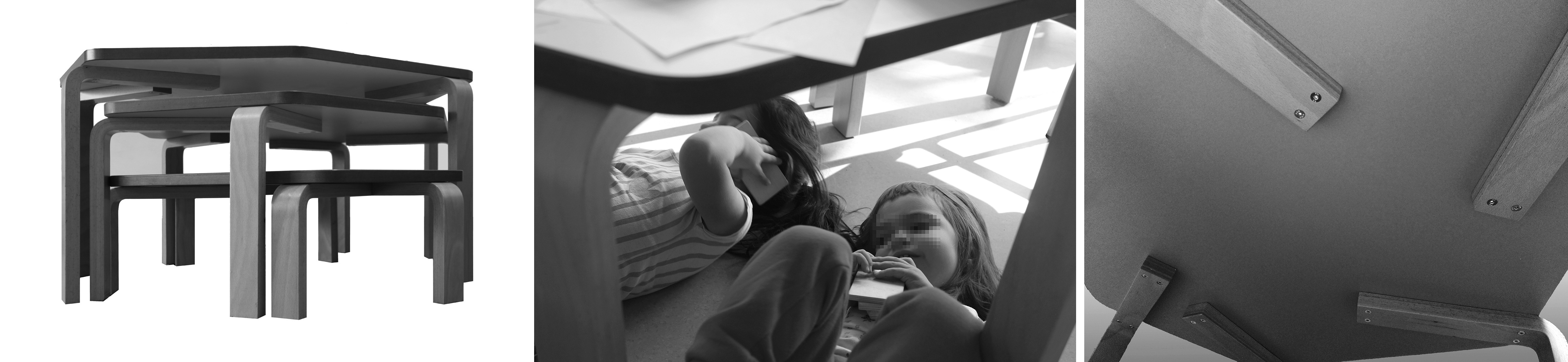
By attaching the legs in a swirling pattern (Figs. 12 and 13) it is possible to group the tables without them interfering with one another. The space “under the table” takes us back to the time and realm of childhood, a recurring and fertile memory: the darkness under the skirts of the side table, the sturdiness of the legs, the coldness of the floor on bare feet…
Figure 13.
Position of the table leg in relation to the geometry of the parts. Source: eslava y tejada arquitectos10.

We opened this article with an excerpt from The White Table, a childhood memory recalled by architect Alvar Aalto of the enormous table on which his father spread his maps of Finland and toiled over with precision instruments while the author, a little boy, lived a privileged existence in the space below (Cabanellas et al. 2005). Aalto recalls the space between the legs of the table, perceived at a child’s scale as a marketplace or temple where the only inhabitant is the little boy until, as he grows, he gains access to the upper story: “In the lower story, I lived from the moment I learned to crawl on all fours. It was like a large marketplace where I ruled all by myself, until I was ready to be moved up to the upper story, the white table top itself” (Aalto 1998, 11). Like a horizon, the table top separates the real and the imaginary while connecting lower and upper worlds. It acts as a bridge between the two, between the world of the child and that of the adult. In the lower realm, the real is transformed by the imaginary, and that richness is conveyed to the upper story to transform the great white plane into a metaphor of growth and the root of his personal creative manifesto, the expression of multiple life options, the infinity of the possible.
We hope that seminal experiences like these will also be created with hEXtable (Fig. 14). The design team also had childlike moments of discovery during the project’s gestation as we integrated the creative impulse into the conditions that make it viable, constantly seeking both to make other school environments possible and to enjoy their exploration.