The dimension of nameless things
Mario Opazo
National University of Colombia
Transmedia artist
( ) …As a child, I used to sit with the photo album between my legs and imagine a movie where I, little by little, moved away from my house and ended up in another world, on the edge of a blue abyss.
It is vital to reflect on the creative processes within the arts. Reflection happens through them as an act of sincerity.
I am grateful for the invitation to “occupy” these pages, which turned out to be a productive exercise for activating visual gestures and literary pieces in my work. I hope that this "occupied" space is shared with the readers, who can recall their own approaches, accents, frequencies, or rhythms related to the creation of forms. I hope we travel through the sensitive environment promoted below, channelled by childhood traces as the driving force for artistic creation.
The objective of this editorial—dedicated to creativity and its processes—is to accentuate the original link between creation and childhood. That loving encounter occurs in the will of living beings and promotes the production of the new. As ancient philosophers would say about forms: “losing the fear of destiny”.
Childhood—as a state of the spirit—explores experiences and promotes tender thoughts that can be shaped. It transforms thoughts that include memory, which liberates the singular and turns the fully subjective into an image-producing machine.
From the outside, the grandfather's room looks like a bunk bed. On the bed, there is a white cap with a black visor and a Chilean navy shield embroidered with gold threads. On my third jump, I take it down and run to the mirror. There is sea life above my head. The closet, like a dark room, preserves his clothes. There are badges on the shoulder of a stiff and starched coat. Its black cloth is whipped by all the southern winds. This coat knows the routes of Neptune in the Magellan Channel by heart and recognises the light from the lighthouses and the cliffs full of penguins in the distance.
Figure 1. Expulsion from Paradise (2009). Plastic installation comprising 5 phases that are used as stations on a route across a performance that leads the public through the ringing of a bell.

Delving into the melting pot of forms is delving into an environment in which forces converge poetic thought, image, time, and memory. These powers are given to movement, which is why they are used in the present to create. I will try to delve into the crucible of forms, activating and composing with them without alluding to them. Forms express and open territory from where we reveal images. I hope this work will be an image-promoting machine for the reader.
Poetic thought
Artistic creation is the act of writing poetic thought, which is a complex and prospective framework. Poetic thought is an arrangement, a text, or a textile without a body. It is a complex system of forces and a phantasmagorical reality (the myth), which claims a body (the ritual). Creation is born as a trace, marking or physical sign for poetic thought. It is born as writing that occurs through experience. All this happens in time (in that authentic time), through ontological time, which is the founder of the forms of living beings and connects experience and understanding. This time can link the words apple, woman, and mountain and form a family in the poem; this time of filiation reveals the image as a congregation of nameless things.
And that, which is not yet / but wants to be, / which appears / and has no words, / no bones, / no shoes, / no weight, / no heart, / no name / and looks at us, / as if wanting to be / within the eye / something, / that is not / an eye, / something lacking bones, / lacking shoes, / lacking weight, / lacking heart, / lacking a name / that looks at us, / as if it was in the eye / something that wants to be something / and that it is / in time.
The appearing image
Revealing the image through a sensitive experience implies a collision of forces. The person who becomes public witnesses the appearance of the image, which is his/her image transforming. The image emerges as an active arrangement in the space in between, the interval or stage. This is the space to generate art or allow the creation process that is also founded and displayed in the artwork and its exhibition.
It appears in the middle of the fog, / little by little, it gains consistency, / warm presence throbs, / breathes, / the light trembles, / let me see! / a voice says.
Figure 2. Mirage (2013). Plastic installation comprising a 16-meter-long and 3-meter-high concrete wall and a digitally controlled lighting system, going from darkness to light in 1.20 min loops.

This vision links the artist and the witness, as someone who returns home at an early childhood age. Through the image, we explore the nature of the artistic creation, its potentiality or moving force, the complex or binding way in which it disseminates, its retroactive, mythical, and ritual temporality, and its poetic or cosmogonic direction.
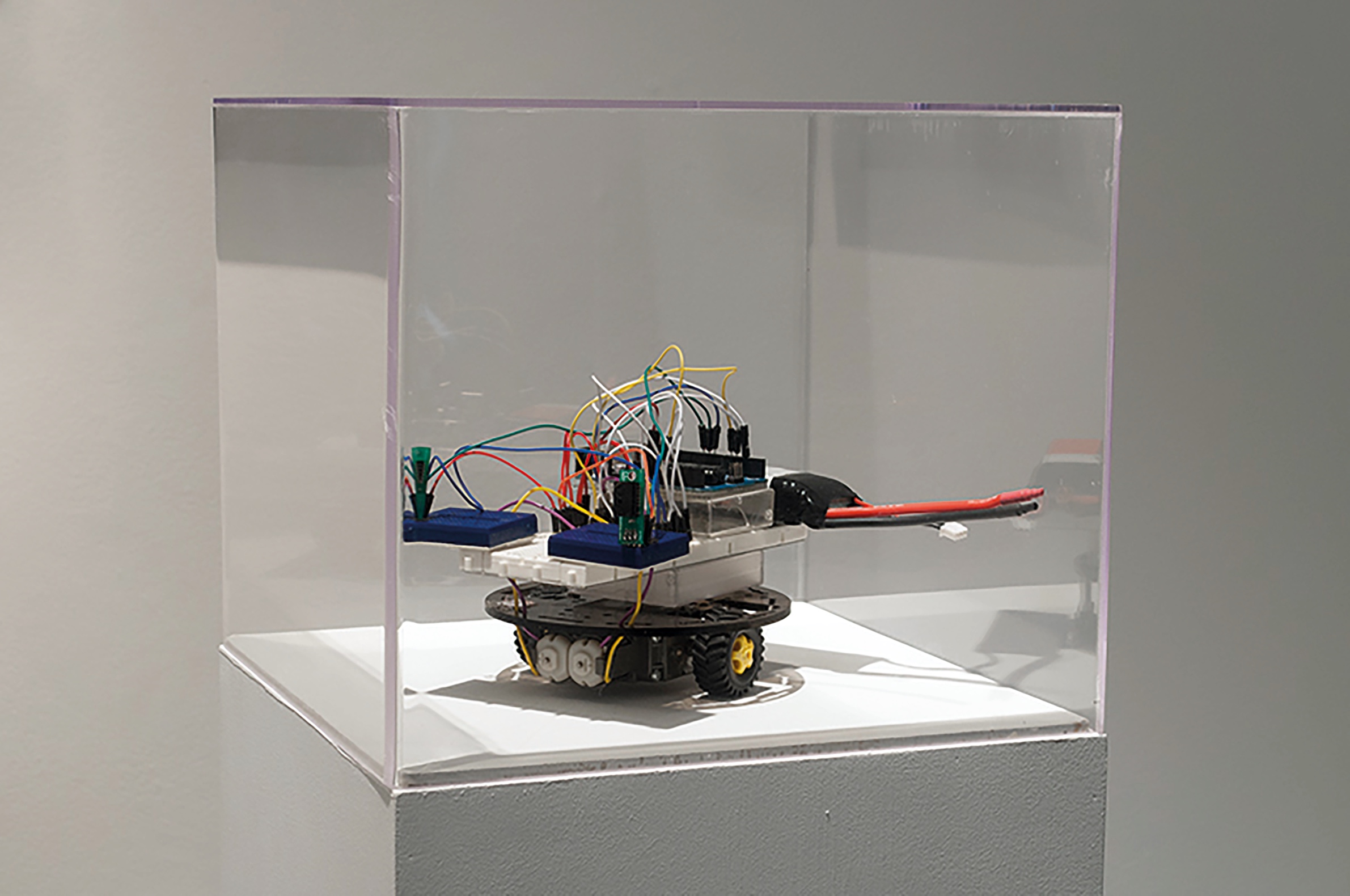
Xon discovers the access and curiously enters the engine room, eagerly trying to understand each mechanism and its general operation. He has always been fascinated by machines; first, the mechanical ones, then, the electronic ones, and later, the digital ones. He likes to think that the old is immersed in the modern, and that the archaic is current and present in the new instruments, which qualities are improved by today's science. He thinks that the abacus is a proto-physical sign of the systematised powers and an ancestor of the computer. He recognises within the abacus modularity, automation, variability, transcoding, and other computational processes. He knows that these result from the escalation of old and complex machines.
Figures 3 to 5. When Robots Made Poetry (2015). Visual poetry made by editing (crossing out words) a theoretical essay on the relationship between old programming (codded) and systematic programming (digital). Only the poetic phrases are legible.


The image results from the early activity
The above capabilities or nature of the creative process show in my work a curious early activity, which is new and prone to a “sacred yes”—to embrace knowledge. It places established values in crisis —a truth link to innocence—which affects the domain of certainty; a resistant and singular indiscipline that corrodes fixed grammars, crosses narrative boundaries and mobilises stories through different linguistic territories.
When I was a child, I would wake up in my bed surprisingly surrounded by objects. My mom said that I had brought them from a dream, but my dad said that I was a sleepwalker. That's how I spent my entire childhood, bringing things from dreams to life and from life to dreams, (...) You know, at that time, one is a kind of inverted sleepwalker, when one is awake behaves as if one was asleep.
When the day / is just a morning / tiny and bright / crystal clear and smiling / on that day—little time period / interval of tiny hours / young stretch / of a few minutes / on that / morning, right there / I will be awake / careful / I will be a new-born man / who walks into a clearing in the forest / and / looks for a squirrel / I will bring fruits, seeds / I will inhabit the sun / within a ray / on the fallen leaves / I will cry / a lot / because I am happy / because I am unfortunate / because yes / why not / just simply crying / and I will keep the light / in my pockets / I will hunt it, / like hunting lizards / flashes of light / wild boar tusks / ivory arrows / little children of the shining sun / freckles of light on the bark / on the trunks / on the earth / and on the stones, / that morning / which is not yet a whole day / entire and robust / but a tenuous beginning of life / of the forest and of the sky, / I will drink water from the river / with onlooker frogs / I will look for you / like someone who searches forever / among the butterflies / an illusion / like someone who imagines the image.
Figure 6. Garden of Light (2010). An audiovisual work made by sequentially scanning plant species, insects and objects found in my father's garden.

Just before forgetting everything, the already sunken boats rise, with captains made of paper cuts, glass bells and bread anchors.
How not to unpack what came after me like a foolish dog, and other things that indicate the way, of course.
How not to unpack the boxes full of who I am.[1]
Figure 7. Children and Dogs (2012). Experimental video using archival images showing dogs and children, taken from art history, cinema and the author's archive.

The time for memory and spirit transformation
Retroactive time has been present in my process and I identify it as the time of memory that capitalises on pieces of the past. It makes a "snowball" that affects the present and sculpts the future.
I also understand my processing time as quality time, which does not refer to duration, but to how we last, or how we unfold temporarily.
I could not say how much time because there you do not know about minutes, hours, or seconds, neither days and nights nor weeks or years. Therefore, time is the quality, not the quantity, of existence. It is not a countable sequence of units of equidistant sections, nor a homogeneous sequence of positions or instants. That refers to long, expanded, boring, slow, fast, light, and brief times or diaphanous, opaque, thick, and diluted times. There are melancholic, rough, and smooth times, some correspond to talent or character, others to humour. Those are times given to subjects, animals, and things; also, times given to events, situations, and natural phenomena. For example, catastrophic, erupted, imbued, expelled, or lonely and trembling times. Other common times are separated or distributed, released, contracted, repressed, imprisoned, controlled, and emancipated.
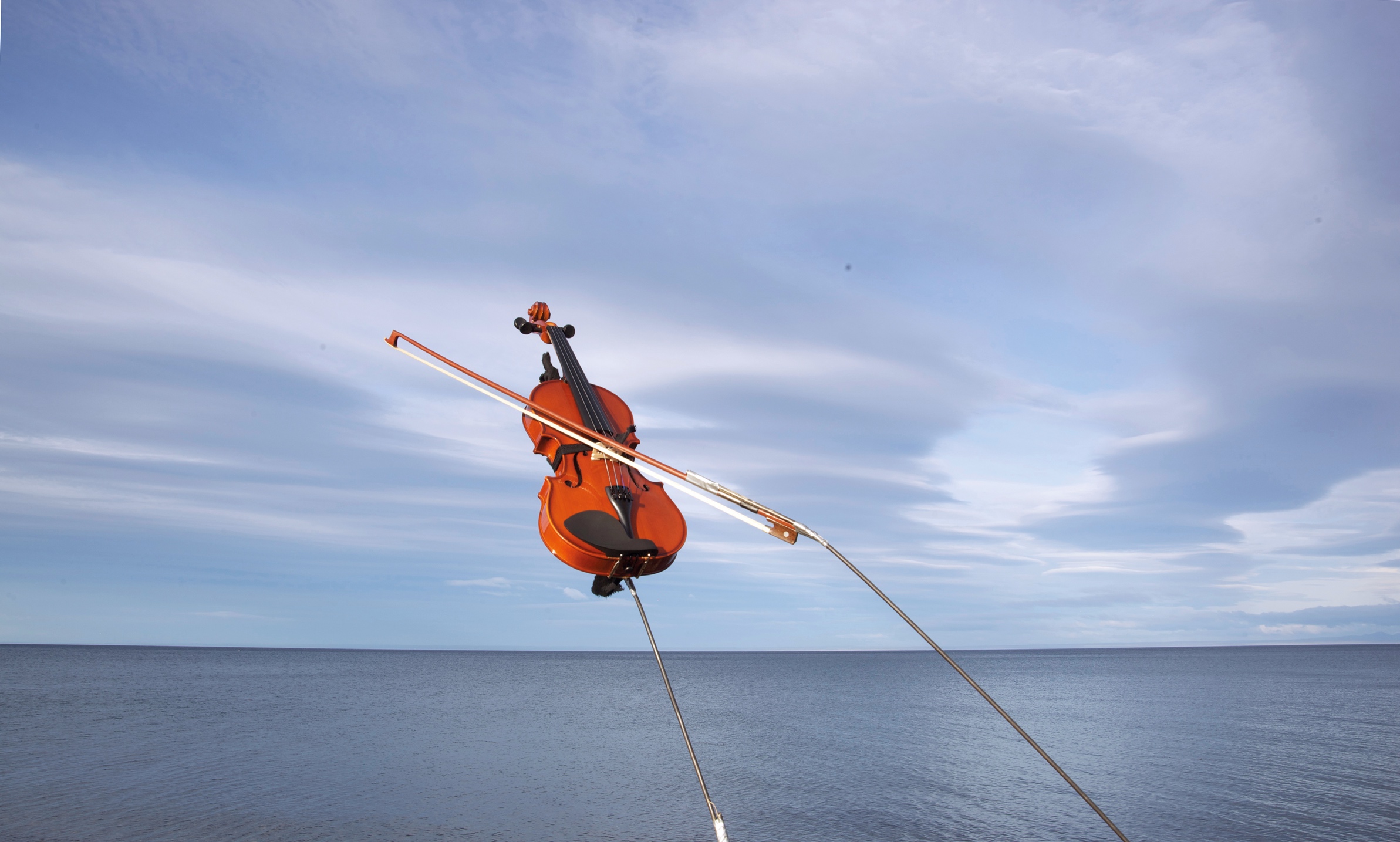
Figures 8 to 10. Violin Solo (2010). Video performance hoisting a violin and a bow while there is a southern wind at Bahía Inútil in Patagonia.


Among other time-related considerations, I am interested in practices with temporary languages, such as audio-visuals, performances, and installations, which, even with an accentuated speciality, enjoy close-to-life temporality—today it is there and tomorrow it is not.
From the thick forest, I remember: / a clearing of light / the bird's stupor / the distance between the leaves / the root / ancient and powerful / the ants’ dynasty / the suicidal drops / and the fungi empire / it is a / reminiscence of the future / a memory, / the new light reveals the ground / and so it happened. / Beyond, in the deep end / in the mineral layer / after clay: / iron, calcium, coal / were pierced by life. / Penetrated by the torrent / of underground water. / Down there, there is a past that is / deep and not past, / ancient underground, / genetics of rhythm / origin of forms. / It is a reminiscence of the future / a / memory, / a wound that seeks a body. / The unknown light rains / floods the earth under the foliage / which moves away and gives space / to time / stage for serenity / stupefied opening / astonishment / stupor / concern / actively knowing / commemoration / it is a memory of the future / a memory / that oblivion covers and protects. / The forest clearing / reveals the traces / reveals the / sprout, the seed / it lets it germinate / let it! / It is light that waters / an instant, a life / a step, a planet / a drop, a star / the breath of a hurricane, / that happens in the forest / and everything in strict silence.
Figure 11. Churi-illapa / Son of Lightning (2021). Totemic sculpture in the shape of a winged jaguar, made by carving and assembling wood from a tree struck by lightning in the archaeological region of San Agustín-Colombia.

Figure 12. Churi-Inti / Son of the Sun (2021). Gold assembly in a branch of caspe (magical tree) collected in the archaeological zone of San Agustín-Colombia.

Figure 13. Wawa-Yawar / Son of the Blood (2021). Red wax vein assemblage on a branch of caspe (magical tree) collected in the archaeological zone of San Agustín-Colombia.

Time also opens its ontological dimension within my work: the being given to the time and the time given to the being. That time is a room from childhood, a stage or enclosure allowing the transformation of the spirit and the creative act.
In the upper part of the house, not in my grandfather's room nor hers, I discovered the sunroom.
It was a space completely structured and cladded with wood, every inch of it was patinated with dust accumulated over the years, which turned it into a misty, fugitive, and untouchable place. In the afternoons, the sun setting on the horizon dyed the boards and the dust, red in summer and blue in winter. The sunroom had a window long as a railway and generous as the pockets of my grandmother's apron. There, in the apron, micro worlds were assembled with garlic, coins, matches, some marbles and the occasional chocolate, as well as the pills that she took from time to time. In my view, this universe of surprises that hung from her waist—simulating a flowery-fabric belly or a curtain that sometimes revealed, when she walked, her seventy-year experience of coming and going through landscapes—was the closest thing to a treasure. What I saw through this window accompanied me forever. Neither before nor after there was a window so brief, so clear, and close to the landscape. Through it you could see the tides and winds; you would go around the world riding in fishing boats or spying on the seagulls.
That time is perceived as a dark and silent environment, overlapped by a halo of light that reveals the floating dust, which the ancient pre-Socratics called clinamen.[2]
The silence that speaks will come / when the word is insufficient. / Silence will say it all at once / without wanting to say something, but everything. / While it will say it / si_lent_ly / the word will give space to air, / to light, to time, to the image, / silence is your blood and mine.
The word helps us when there is something to say, / silence saves us when there is everything to say.
The persistence of the child
My special interest in memory—as a power or force that promotes transformation and change—brings with it what I call the persistence of the child, which internally directs my artistic practice.
Today, in the mirror, I saw a child who seemed familiar to me, like the breadcrumbs on the table, the mountains on the bed, the underwater soap, and the barking of Goliath (my first dog). As common as a tomato or an onion. He looked at me, scared. As if he did not know me.
Figure 14. Tablets of the Future (2019). Ceramic series recording the imprint of toys’ pieces and fragments in low relief.

This determination challenges and constantly renews actions and values. It brings with it and updates the driving forces of the past; forces captured in three founding autobiographical events. Thanks to memory, they have updated as apices or traces of my sensitivity.
I cannot believe I trusted these same fingers to count vowels and numbers from one to ten. They have always been there, quiet as my grandfather's coat.
The boy who explores shop windows, secret rooms, and the pocket of my grandmother's apron trains in looking without seeing or indirectly looking.
Among the things that one forgets under other things / there are other very small ones that in turn hide things. / All this happens involuntarily. / And there are layers and layers of things, some transparent, others blurred. / And we are among so many things while forgetting them. / Among other things, / we are only in those that emerge when they have been forgotten. / And that is where we are, / within what arises.
The travelling child, who cultivates his view from a distance, from the outside, as a stranger, is the child of initiation and rituals, an ethnographer child who observes diverse cultures and nature.
Every time the window opens / a breeze comes in from afar, / since I was five years old when dad / took me to the woods and read aloud / it comes from there / for many years: / light years / tree years / book years / chestnuts years / (they come to play). / He read Marx and Mao Tse Tung / to the wind / and I hunted lizards between the flagstones / in the sun. / His voice made the forest an auditorium / the trees were attentive to the / revolution. / Every time the window is opened / the air underneath is red, / like party flags / like southern apples / like hand wounds / it stains the tool / and it hurts. / The year 73 is at the window / old man, libertarian, survivor / with him comes the storm / strong, / irrefutable, brave. / When the window opens / my child comes in, the one that I was / and sits next to me / with short pants / scratched knees and snot hanging out, / that child with glasses / clumsy and thoughtful / who / cried while swallowing with pain / a piece of old bread.
Finally, the adult resulting from that stubborn child, among other things, is an adult who aspires to rewrite his childhood.
Figure 15. Protoneobots Findings (2019). Installation with music-graphic compositions that exhibit pieces alluding to pre-Columbian deities in ceramics and contemporary toys.

By often coming and going from the house to the beach, I learned the way and I come back every time I smell the sea, every time I cry, and my eyes burn, every time the pebbles get into my shoes. Because of the frequent trips from the house to the beach, I can no longer leave that path, even though new houses are blocking the way, as well as gardens with arid, hard, and stony surfaces and new bodies of water. Even so, I cannot get away from the path that I made as a child with my small footprints size 24, when coming and going lightly but insistently, as if I knew that life was going to distance me from the beach. From the constant coming and going, I have condemned my legs to that unique route in my childhood. I am still what I was then, although today the sea is like a soul conflicting with oblivion and my grandfather's house has just a few stones that hold my memory. [3]
Figure 16. Homecoming (2015). Plastic installation including a Volkswagen Beetle car, three hundred (300) worn tires marked with the writing "return home" and a video projection.

Figure 17. Secret (2010). Experimental video that shows the author auscultating one of the "end of the world" lighthouses in Tierra del Fuego-Patagonia.

Figure 18. Runaway (2018). Experimental video that shows the author running through different conflict and post-conflict zones in the world. The race takes place over two years.

Run. Nothing but run until you are lost in the woods.
That “sacred yes”, as a practice of innocence, open to discovering new forms and orders and embracing the new, intensified within my creative actions during the pandemic confinement. When the isolation became harsh, there was a baffling distance and inexpressible affections, and bodies and materiality were absent. Then, the enthusiasm for wandering through imaginary worlds appealing to the child’s state of the spirit was accentuated in my practice.
Until now, I had not been a stranger in the struggles of this trip "in the outskirts, (...) always attracted first by the name and by the nameless, which the poet wants to name or, at least look at, feel and, above all, accompany; the unnamed or the unnameable should not remain alone” (translation from Zambrano 2007, 70).
That is the origin of the woke man, the insomniac who has been wandering for centuries, of Xon, who climbed layers of earth and rock, the foreigner coming from memory. Poetry is born from there, where the word is announced in different ways and images, before being said. That is why, there nothing is called a river, sea, mountain, sky, earth, bat, or spider. Instead, everything names itself with its power and performance and propagation and change. Everything is expressed as it is, and thus, things in that world are crossed and stitched by a torrent. Nothing separates them from one another, and everything makes up a vast family. Rhythm is blood; it ties everything together in a gregarious existence. In that place are the unnameable things that are said in infinite ways, each one different, singular, never to be repeated or mean anything. The singular direction is its destiny, unfolding in a poetic direction, one way, toward which the locals head, accompanying their world with unrepeatable and unsaid things. Those men who accompany nameless things, booting their rhythm, and loving them, were called poets; Xon was one of them.
No, I am not saying that since my childhood I have not travelled through the dust that floats or across the flies’ journeys in clinical paths. It is not that the forests have not questioned my human childhood, filling it with pre-scientific questions and games, or that I have not moved away from my library to deeply singular latitudes made of paper. No, I did not lack training in intuition or indirect interpretation. On the contrary, at that moment, I already had the skill of the lion, installed solid and vigilant, but with restricted power and domain.
Close your eyes to see that feature: the image. He knows that this is how it works—it was always that way—since he was a child in the sunroom; he imagined it that way. He spent summer afternoons opening and closing his eyes. He opened them to see the sea in front of his grandfather's house, behind a blanket of dust that fell from the roof made from boards tossed by the wind. He closed them to sail away, as he navigated in a fishing boat in the morning to return in the afternoon with the boat full of crabs.
… just now, secluded, and together with my family, restrained by new living conditions, the isolation practices affected my expressive and factual resources. They sharpened sensitivity, and freed singularity, as subjectivity concentrated towards a “sacred yes”. This practice of innocence brought with it playing with my children and using school techniques, representation processes, and rhythm as the primary language.
Figures 19 and 20. Delirium (2021). Paper and cardboard assemblage using psychiatric medicine packaging.


The lizards in my pocket were alive as every Sunday I hunted with rubber bands and autumn spikes (green and flexible branches to mercilessly catch reptiles and mice). Those were days of childish hunting, with snot hanging, the shirt outside my trousers and receiving an infinite scolding at the end of the day. A piece of stale bread was the only thing I had since breakfast, the last memory of my mother, a piece of bread and butter forgotten in the bag. Sunday chores! I would like to return to hunting lizards and recover the skills, not from hunting but from walking without fear of losing myself or forgetting the way from home to life.
Creativity saves us from the most terrible things. It borders on exile, isolation, and ostracism. It brings loneliness and silence with it, but it is the same loneliness and silence of the nests and shelters. The oldest and original house appears between sections of childhood. It comes with the child who governs the homeland of creation.
Tender thought must be the new quality of willpower.
Joseph Beuys
Bibliography
1. Nietzsche, Friedrich. 20191885. Así habló Zaratustra. Originally written in 1885. Madrid: Ed. Gredos.
2. Zambrano, María. 2007. Algunos lugares de la poesía. Madrid: Ed. Trotta, 1st edition.