
How to Cite: Trujillo-Torres, Sebastián. "Learning from (In)Constant Infrastructures". Dearq no. 38 (2024): 24-41. DOI: https://doi.org/10.18389/dearq38.2024.03
How to Cite: Trujillo-Torres, Sebastián. "Learning from (In)Constant Infrastructures". Dearq no. 38 (2024): 24-41. DOI: https://doi.org/10.18389/dearq38.2024.03
Sebastián Trujillo-Torres
sebastian.trujillo.torres@gmail.com
Universidad Nacional de Colombia
CEPT University
Received: April 15, 2023 | Accepted: October 12, 2023
As part of a larger research endeavour, this article operates in the context of current conditions and potentialities of street vending in India, as a city-making constant. It begins by examining frequent, yet, questionable tropes utilised to justify their exclusion from urban planning and design narratives as a main issue to debate: tropes that are then debunked and disproven, after methodically mapping and unpacking the design and infrastructural features of selected case studies. Street vending is therefore explored as a distinct type of infrastructural system in itself, one which is simultaneously a constant factor, and an inconstant array of procedures and processes. It possesses distinct temporal and spatial features seemingly incompatible with conventional planning and design understandings. This article is therefore intended to attempt not only to legitimize the spatial-systemic practices of these infrastructures as a developmental asset, but to outline clues for designers to reimagine urban futures that can lead to more equitable city-making practices.
Keywords: Infrastructure, India, urbanism, design, street vending, futures, (in)constant.
When it comes to street vending in India, it is veritably difficult to gauge its scale.
While official estimates set the numbers to an approximate of 10 million people currently engaging with street vending in the country (Sanzgiri), one could argue that this seems less than accurate. As of 2023, India possesses a sixth of the world's population: with 1.4 billion citizens (United Nations), it has become the most populous country in the world —overtaking China— with its soaring fertility rates. An even more astonishing figure, if we consider that its top 1% holds about 40% of the country's total wealth, while the bottom 50% (about 700 million people) own 3% (OXFAM).
This may seem like a cheap shot and it is perhaps a bit of a stretch to equate poverty with street vending, or even to say that extreme inequality causes it. Correlation is not causation. Yet, we know now that street vending tends to be an easy-entry (at times last resort) economic resource for low-income groups (the bottom 50%), simultaneously linked with formal unemployment, processes of intense urbanisation, marginalisation, and a lack of state presence. The works. We also know that given its volatile nature and that the statistics are made up mostly of licensed vendors (hence a sheer impossibility to account for them all), we can speculate that the number of street vendors in India is significantly larger than the population of, say, Portugal1.
In fact, according to estimates by vendor rights organisations, the actual number of street vendors could be approximately 130 million (National Hawkers Federation) which, is we also consider their families, can add up to about 230 million. This means that they compose not only about 17% of the worlds most populated country but also a population equivalent to that of Nigeria2, which occupies the sixth position.
Fair to say then, following this line of reasoning, that street vendors in India are no menial topic: there are a lot of them, and they will be around for a while.

Figure 1_ Bhadra Plaza in Ahmedabad, Gujarat (India), 2015. The revitalisation of this symbolic open space completed in 2014 by Vastu Shilpa Consultants (led then by Pritzker laureate Balkrishna Doshi), was heavily criticised for not appropriately incorporating street vendors in the planning of the precinct and therefore resulting in a contentious space of friction between the formal and the informal. However, despite drawbacks in the planning process, the congestion and increased density of the site were also caused by a series of external economic and social factors that are symptomatic of Southern Urbanisms; processes that point to the need for more malleable infrastructural systems that can absorb and adapt to these changes. The image shows the stark contrast between the complex accommodation of vendors in the open market, and Premabhai Hall on the right, one of the most representative pieces of Indian modernism designed by Balkrishna Doshi in 1976. Source: Photograph by the author.
And this is particularly the case if we take into account how polarised and, at points, controversial this topic is ―as has been documented by scholars throughout the country3. A common focal point of dispute that is intrinsically and fundamentally, a spatial problem; a problem of public space. A problem of contesting expectations, capacities, and resources. At the core of which, we have a series of tropes that disallow in-depth and thorough understandings that can produce much more than the draconian planning principles that characterize Indian institutionalism (Schindler).
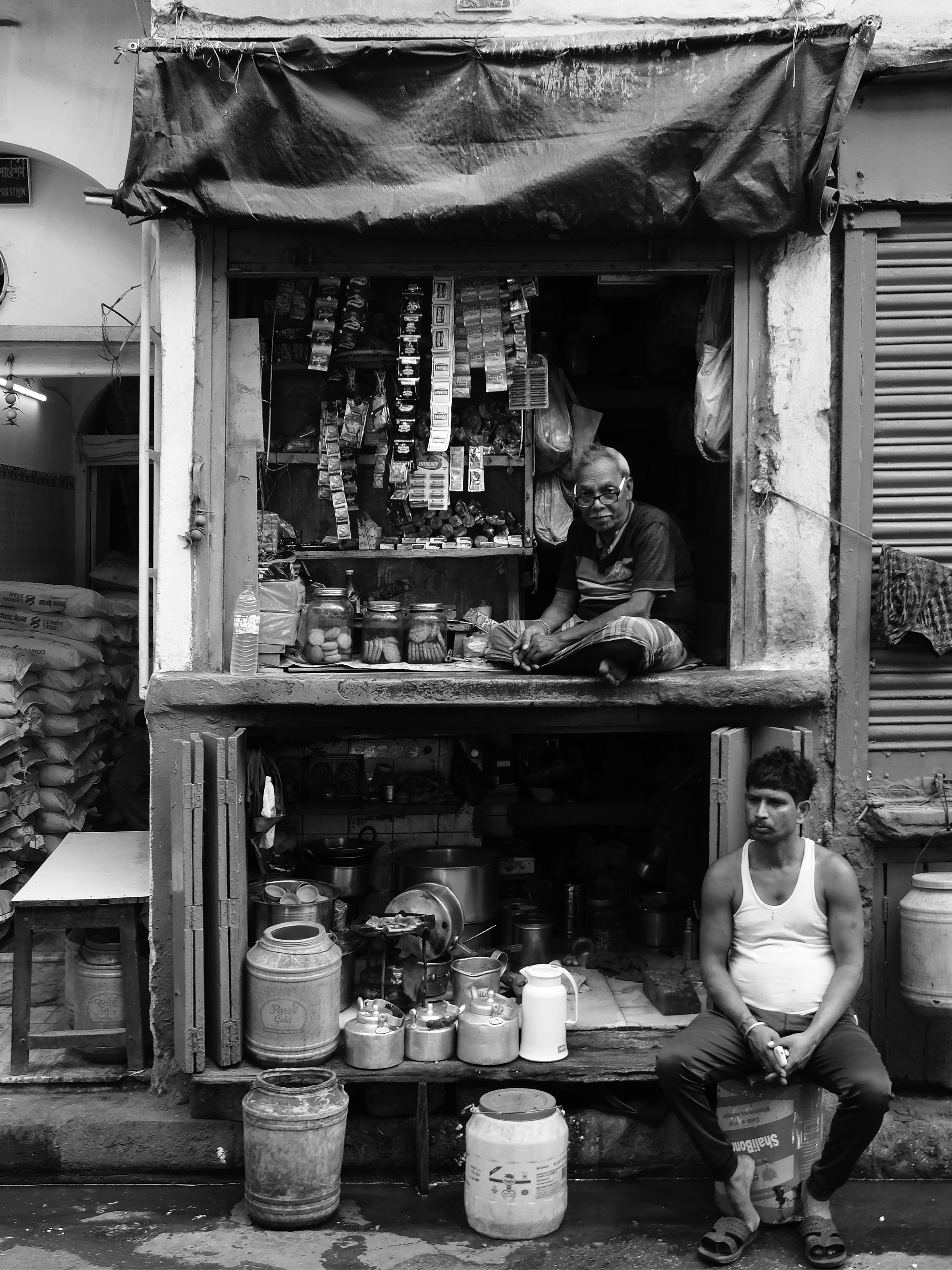
Figure 2_ Double-levelled shop in the streets of North Kolkata (India), 2022. This typology of miniature stores common to highly densified cities as Kolkata, illustrate frequent processes of progressive property partition which lie in-between the formal and informal. This example, albeit architectural, reflects the disputed nature of public space in India and the resourcefulness through which this is navigated. Also, cases like this function in collaboration and co-dependence with more mobile and transient forms of exchange. Source: Photography by the author.
These tropes begin with the assumption that street vending is an informal activity that does not belong in formal planning processes. It is regularly ignored or considered a nuisance rather than a valuable economic activity or a potential asset for the city. Street vendors can be portrayed as invaders of public space4, causing congestion and hindering pedestrian movement: a perception that leads to displacement and eviction from their traditional places of work, while the activity itself is often viewed as "chaotic" or "organic". It is thought to lack a visible order, regulations, and control, and leads to concerns about safety, hygiene, and environmental degradation. And let us not forget the aesthetic argument which establishes that street vending can be unsightly and far from the popularly desired aesthetics for the urban environment, and, therefore, prompts calls for removal. This supposed lack of aesthetic quality is also connected to the idea that street vendors are resistant to change and innovation, allegedly making it difficult to incorporate them into urban design developments.
In other words, they are seemingly incompatible with progress. Hence, off with their heads.
The most erroneous trope of all however, is that street vendors are illegal: it is quite common to assume they operate completely outside of the margins of the law and the state, and hence are a hindrance to the appropriate conformation of a 'lawful nation'. This is perhaps the most harmful idea, and yet the easiest to disprove.
Now, it might seem easy to counterargument these assumptions from the vantage point of a disciplinary, knowledge-oriented inquiry (far from the tribulations of real-world decisions). Nevertheless, is important to challenge these misconceptions as a way to manufacture renewed "bottom-up urbanisms" (Arefi and Kickert) that depart from reengineering existing systems (not just fashioning objects ex-nihilo), while understanding the relevance this entails not only for the near futures of Global South urbanisms (which India characterises perhaps in a radical way) but the urbanisation processes resulting from current and upcoming crises.
Street vending is often seen as an informal activity that does not seem to fit into formal planning processes.
This perception is grounded in a belief that street vending is a temporary or transitional occupation that will eventually be replaced by more formal economic activities; a view that ignores how it is often a long-term or even permanent occupation for many people, particularly those from marginalised communities5.
Most importantly however, this assumption sits on a misguided understanding of informality as a category that denotes activities and conditions categorically outside of the purview of the state. Nothing could be further from the truth. Not only is the 'informal' usually in constant exchange with the 'formal' (keeping close relations with official agencies, utilising infrastructure, etc.), but the 'formal' also retributes this dependency by continuously utilising 'informal' methods (bypassing official systems or procedures, arbitrarily prioritising certain guidelines/projects over others, etc.), to the extent that in many contexts it is difficult to differentiate where one begins and the other ends (Schindler).
It is easy to portray street vending as an unruly activity unfit for inclusion. It is easy because that's how it appears. Yet by observing it carefully, one can understand the complex relationships with the state that are at times antagonistic, sometimes cooperative, or sometimes even oblivious of one another. Therefore, recognising street vending as a legitimate economic activity (from the purview of this undeniable relativity) and even as an infrastructural system itself, is not far-fetched: it only requires understanding its complexity beyond a reductionist view of the city.

Figure 3_ Street cart embeded within a compound wall, Lucknow (India), 2022. This seemingly movable device has been incrusted as part of an architectural edge, wherein it simultaneously conducts 'informal' economic activities and provides a 'formal' property limit. Source: Photography by the author.
Street vendors can also be seen as public-space invaders.
In fact, the term "hawker" is a colonial derogative term crafted as a top-down classification by British officials, who perceived vendors as disruptors of civil order preying on unsuspecting passersby. Enter, the hawker myth.
A narrative that despite persisting today largely across contexts and social groups, it has also been consistently challenged. The best example is the National Hawkers Federation, one of the biggest street vendor organisations in India striving for vendor rights and advocating for structural change, who reappropriated the term "hawker" to re-signify it.
Now, the perception of the hawker as an invader of public space is also based on the assumption that public space is (or should be) inherently neutral and empty, and that it should be free from any obstructions. Or at least any 'unsightly' obstructions. However, we know that public space is actually filled and shaped by a multiplicity of contested power relations (AlSayyad and Roy) —social, political, and economic processes— wherein street vending contributes with a great degree of vitality and diversity by allowing any citizen to have a stake in the construction of the street. This does not mean that vending in itself is inherently virtuous, but it does mean that it is not axiomatically objectionable.
This is precisely because street vending renders the street productive; not only in economic terms, but in terms of culture, relationships, wayfinding, and even safety (eyes on the street6). Comparatively speaking, street vending assumes significantly more productive potential than, for instance, parked vehicles on the street, which nevertheless are not met with the same hostility from authorities or even the public itself (Butani). Evidently, a person who owns a street cart vis-á-vis one who owns a car, do not seem to have equal entitlements. Not to say that street vending should be given absolute leeway in the city, nor that private vehicles should be banned, but to recognise the contested nature of public space as locus of negotiation and corresponding intervention, rather than arbitrary injunction.

Figure 4_ Ram Kumar, chai vendor in College Street, Kolkata (India), 2022. Ram has been working as a street vendor in this particular site for over a decade, where he has been able to not only construct meaningful relationships with the book shop owners that characterize this part of the city, but also concisely demonstrates how the street is activated with barely any material interventions. Source: Photography by the author.
When it comes to street vending, popular rhetoric tends to point out that only chaos prevails in its presence.
This 'chaos' trope, is a bit of a soundbite denoting urban activities without an apparent order, regulation, or control; specifically, an order from higher authorities. A perception based on two intertwined, dubious assumptions.
The first assumption is that the only way to ensure the quality and safety of goods, services, and spaces is through the construction and imposition of formal protocols and guidelines. The guidance of institutions and corporations will illuminate and support this path. However, it is well known by now that these protocols and guidelines at times ascertain structural biases and exclusions; policies that even if well-crafted certainly face great difficulties in their implementation and promotion. It would be unfair to say that this approach is redundant, yet considering that it is straightforwardly successful and that it is self-sufficient is arguable (Brenman and Sanchez).
The second assumption is the typecasting of street vending as inherently devoid of order and organisation; something that is equally debatable. This is because street vendors are known to develop their own systems of regulation and self-organisation that ensure the quality and safety of their products, relying on complex social networks of provision, exchange, and maintenance. Their infrastructural arrangements depend on a multiplicity of constantly changing factors, which they usually navigate in frugal yet dexterous ways. There is order in street vending. Planned; recurrent; and, to a certain extent, predictable orders. Yet these are not necessarily top-down forms of organisation, but perhaps more decentralised and at times circumstantial.
There is (complex) order in street vending.


Figures 5 and 6_ Unpacking the design and infrastructural conditions of Ram Kumar, 2022. What these drawings reflect on, is the underlying decision-making processes that reflect order and patterns of movement and exchange despite a seemingly cluttered appearance. Source: Drawings by the author and Kruti Shah.
Unsightly, intrusive, messy; plain ugly.
Street vending is often perceived as unattractive or, rather, detached from the aspirational aesthetics that seem to characterise a 21st century urban environment7. Something that leads to calls for the removal of street vendors and their architectures as they fail to conform to aesthetic ideals; whatever those might be.
Nevertheless, this particular rationale evidently falls short of objectivity: whose aesthetic ideals? Where do these come from? Whose aspirations and values do they represent? Whose welfare do these guarantee? And, most importantly, how is this 'lack of aesthetics' produced?
Suffice it to say that vendors do employ certain aesthetic strategies to attract customers and differentiate themselves (aesthetics serve a very practical purpose), yet if we focus on those that somewhat reflect a sense of neglect and carelessness, we need to examine the economic and social contexts where they operate. If we approach aesthetics not as a matter of individual or subjective judgement, but as a form of measuring a sense of care towards the environment, we could argue that this entails investment of resources and time which many vendors either do not have the incentive to invest, or do not have altogether. This correlates to conditions of scarcity and pedagogical development, which surely is at the root.
'Aesthetics in absentia' are reflective of specific means and structural difficulties.

Figure 7_ Street cart in the streets of Lalbagh in Lucknow (India), 2022. This case study demonstrates not only certain aesthetic strategies utilised in the graphic design of the device, but also the frugal nature of construction of some of these minimal mobile shops. Source: Photography by the author.
There is a perception that street vendors are resistant to change and innovation, which makes it seemingly impossible to incorporate them into urban design developments.
Now, even if they were, the fact is that resistance will always appear in matters of urban development.
Sure, some are more than others, and this is always a case-by-case issue. The fact remains however, that urban and planning developments require, if not consensus, a concerted effort to incorporate the multiplicity of stakeholders that make-up Indian urbanity, even if that entails tiresome processes of negotiation; especially with a group as substantial as street vendors.
Now, street vendor organisations are usually receptive to the positive transformation of urban conditions, at least that is their general disposition (of course, exceptions considered). The caveat here, is that since planning developments are likely to depart from conditions of exclusion, removal, and prohibition of street vendors, resistance is perceived as a regressive attitude against development. When top-down development encounters grass-roots opposition, it is usually tagged as reactionary and boorish; therefore illegitimate.

Figure 8_ National Hawkers Federation Conference and Leadership Training, Ratnagiri (India), 2023. This conference bringing together diverse figures of leadership from all over India, focused on the implementation challenges and strategies of the Street Vendors Act of 2014, the role of street vendors in the context of global warming and environmental degradation, and dialogues on inclusive forms of urban planning. Source: Photography by the author.
As mentioned earlier, the most damaging of tropes is the misconception of street vending as an illegal and unlawful act. However, according to the Street Vendors Act of 2014, street vendors have the right to carry on their businesses as long as they comply to the conditions of their license (which they are entitled to, of course). Vendors cannot be evicted from any zone unless they are properly surveyed, licensed, and then provided with a new place for vending; a process that needs requires appropriate time frames that allow the vendor to adjust and plan to new circumstances.
It might be perceived as illegal, but street vending in India is pretty much legal.
Now, while it is unnecessary to unpack the Act itself here, what might be relevant is the main challenge it faces: its implementation. This is because, even though the Act was formulated at national level, its execution is dependent on state governments. Therein lies the problem: state agencies typically overlook the Act, either due to negligence or ignorance, as they may be unaware of its existence or deliberately choose to operate informally, outside its scope.
Vendors throughout India have extremely varied statuses in terms of licensing and certification, yet the generalised problematic relates to the denial of their rights (by oversight or malice), and the everyday happenstance of bribes, threats, and violence which is of significant concern8.

Figure 9_ Ima Market in Imphal, Manipur (India), 2022. As one of the largest women-run markets in Asia, and within a cultural setting wherein the vast majority of street vendors are women, the Ima market demonstrates how fixed infrastructures can respond positively to the legality of street vending and the informal economies that sustain a great majority in the Indian subcontinent. Source: Photography by the author.
Now, the purpose of refuting the prior array of misconceptions serves a double-bind agenda.
On the one hand, it is of utmost importance to outlay the operating properties of a phenomenon such as this, not only on account of its sheer scale and inevitable prevalence, but because the inarguable role it plays in subcontinental processes of urbanisation. Understanding the dynamics of street vending therefore allows for appropriate planning processes to take place. Furthermore, this insight can foster more democratic and sensitive forms of development beyond the Strongman paradigm (Rachman). On the other hand, untangling these tropes can open a ground of theorisation capable of constructing a renewed common sense beyond ideological alliances, into a potential win-win scenario of horizontalised prosperity: the purpose of this argumentation is to understand what possibilities we possess to rethink our cities, taking into account the resources and assets (in their extended definition) we have, and can therefore cultivate.
It is also important to clarify this process of debunking within the context of a broader research project9. This project is rooted in an extensive documentation process designed to gain insight into current real-world conditions, alongside comprehensive examinations of economic, sociological, and environmental aspects. This research thus began through an iterative-creative process of data collection in the selected cities, involving a network of collaborators. Simultaneously, we engaged in a process of drawing immediate conclusions that not only allowed a holistic understanding of the system, but also enabled us to explore potential future scenarios. In this manner, the insights we gathered eventually consolidated into an evaluation of street vending as an infrastructural system, or more aptly, one we have termed '(in)constant'.


Figures 10 and 11_ Excerpts from the Atlas of (in)constant Infrastructures funded by the DXD-Sanskriti Foundation and developed along with Kruti Shah. The first image outlines the cities selected for the investigation along with the relative position of all the case studies, while the second maps out the methodological framework utilised in the research process.
Within this overarching framework of ideas, infrastructures are defined as processes of exchange and management of resources or services, which allow settlements to function without necessarily being visible. It is therefore not inconceivable to categorize street vendors as part of a larger infrastructural system. This classification is justified by their role in providing goods and services to a large number of people in public and private spaces, requiring a complex set of varied architectures such as stalls, carts, vehicles, and storage facilities. Additionally, street vending encompasses social and economic infrastructures such as social networks, credit systems, and markets. These infrastructures play a pivotal role in granting street vendors access to resources and information necessary for sustaining their livelihoods and the livelihoods of many others. The provision of these infrastructures is often carried out through collective action and self-organisation, shaping the social and political context in which they operate.
These infrastructural systems, however, have an interesting particularity that sets them apart.


Figures 12 and 13_ Unpacking the design and infrastructural conditions of Raju, a tabaco and gutka vendor in Lucknow (India), 2022. What these drawings attempt to illustrate is that despite the fact that Raju's device seems isolated and detached as an object, it is absolutely embedded in the flow circuits of the street and demonstrates clear cooperation and exchange with the adjoining vendors, who complement and support each other. Source: Drawings by the author and Kruti Shah.
While in many cases street vendors can indeed appear stationary, it is in their nature to occupy the city in intermittent and, at times, mobile ways. In fact, it could be argued that more than merely occupying physical space, they occupy time, as this temporal dimension is a defining parameter in their everyday activities. These are somewhat inconstant from a spatial perspective. At the same time, given their comprehensive and unavoidable presence in the dynamics of Indian urbanity, they are certainly a constant: a consistently defining pattern of urbanisation throughout the subcontinent. Systems and subsystems that emerge almost inevitably. Thus, infrastructures that are both inconstant and constant: (in)constant.
The recognition of street vending as an infrastructural, (in)constant system, has important implications for how we understand and approach street vending in India and other parts of the Global South. It challenges the preconceptions and assumptions that often hinder the incorporation of street vending and movable infrastructures into planning agendas and urban design developments, and highlights the importance of creating more inclusive and malleable urban environments that can accommodate a wider range of activities and dynamics.


Figures 14 and 15_ Unpacking the design and infrastructural conditions of Praveen, an onion farmer and vendor on the outskirts of Delhi (India), 2022. As a straightforward strategy to directly sell his produce without intermediaries, Praveen utilises his tractor. Although he tends to be found at particular days of the week, specific hours of the day, and along a specific route, he rarely pauses in one place for too long to minimize the risk of attracting unwanted attention and potential harassment from the police. Source: Drawings by the author and Kruti Shah.
One of the most evident preconceptions in urban design and planning is the fact that infrastructural systems seem fixed, determined, and unchangeable. However, what is easily observable in (in)constant infrastructures is how they are predominantly prone to movement and temporariness. By defying fixed, permanent, and formal forms of being, and embracing peripatetic, reversible, and even improvised spatial practices as essential features, (in)constant infrastructures create a dynamic and ever-changing relationship with the city. A relationship that needs to be thought of not in terms of opposition -a binary-, but rather within a diagram of continuity: the ecology of the built environment is made up of a gradient of components that attenuate from more rigid to looser rhythms, materialities, and permanencies. (In)constant infrastructures only occupy a specific bracket within this.


Figures 16 and 17_ Unpacking the design and infrastructural conditions of Indira, a pan and gutka vendor in the Ima Market of Imphal, Manipur (India), 2022. These drawings demonstrate the complex and nuanced construction of small-scale devices by Manipuri women, which negotiate their spaces within their fixed state-sponsored infrastructures. Manipuri vendors are known not only for their remarkable grassroot associations, but their success in demanding infrastructural conditions from the local governments. Source: Drawings by the author and Kruti Shah.
Now, our research has shed light on the fundamental role these conditions play. From makeshift sidewalk-architectures to deployable artifacts, these constitute the irredeemable vitality of Indian urbanity. Rather than being seen as a blight on the urban landscape, these structures can be understood as a necessary response to the unique challenges faced by India's cities, including high density, scarcity, and low institutional presence.
Aside from the way these infrastructures occupy space-time, we have the question of the rationale behind their diverse architectural languages: these devices tend to be comparatively small, easy to move or disassemble, constructed with easily available and relatively cheap materials. They are constructed incrementally in response to changing needs and varying capacities offered by the contexts in which they are set, while constructing long-term associations and relationships within their cultural and social backgrounds. What is interesting about this, is that although they might seem ad-hoc and unplanned, (in)constant infrastructures are carefully constructed and tend to be quite long-lasting, which points to a counter-intuitive design process in which highly durable materials are merged in contingent ways to evolve design features as and when the environment dictates it. This means that although the inception phase of these devices might resemble conventional manufacture processes, their development is consistently contingent and context sensitive.
What we know from this, is that while the demand for design is self-managed and vendors tend to be quite self-sufficient in this regard, there is still a gap for architectural and spatial design to ensure more comprehensive and cohesive urban design standards.
However, there are a series of space-making patterns worth considering; one of them is the recurrent use of 'anchoring' strategies. We call anchoring a process of adhesion and material negotiation with more fixed infrastructures, as a fundamental principle of interdependence that tends to be more productive than destructive (as is usually presupposed). In other words, the fact that (in)constant infrastructures consistently tend to attach and associate themselves to urban elements such as trees, electric boxes, streetlights, and the sorts. Within this ecology, there are certain systems of care in place: spatial processes of useful reliance, wherein (in)constant infrastructures tend to assure the welfare and maintenance of other infrastructural systems. In other words, (in)constant infrastructures exist in co-dependence with fixed infrastructural elements since they tend to anchor and often protect them in the process. These processes of acquired responsibility that thrive in continuous dialogue, lead us to question whether we can think of infrastructural design from this presupposition, by projecting urban elements keeping in mind systems of care.


Figures 18 and 19_ Unpacking the design and infrastructural conditions of Shiv Mangal, a pan and gutka vendor in Lalbagh, Lucknow (India), 2022. As the drawings demonstrate, Shiv's device is nothing more than a bicycle, a wooden box, and an assortment of complementary objects, which create and ad-hoc shop between two electric boxes. What otherwise would be a leftover site becomes a place for gathering. Source: Drawings by the author and Kruti Shah.
It is important to highlight however, that while spatial conditions and responses vary widely—reflecting cultural and regional tendencies as well as individual ingenuity—, the economics of the people behind them are usually quite challenging, with many vendors operating in precarious settings with limited or virtually inexistent legal protections or access to basic services. Moreover, vendor organisations tend to express the increasing invisibility and lack of representation of vendors in urban development narratives. The dominant narrative of 'progress' in the country closely resembles the developmental agendas of the 20th-century, which have been deemed obsolete in many other parts of the world. This has resulted in vendors being framed in opposition to soundbites such as Smart City, Internet of Things, High-rise architecture, and so on.
The sensible approach to transform public space in India, tends to begin by recognising the fundamental role of underrepresented majorities10 —in this case street vendors—, as components of vital urban systems that contribute to the city's social and economic vibrancy. This entails acknowledging the complex spatial relationships between vendors, their infrastructure, and the broader urban environment, and recognising that these systems are inherently temporary, dynamic, and adaptive, requiring a new approach to urban design vocabularies that embrace movement, flexibility, and improvisation.
If we take these learnings as a point of departure to redefine urbanism as a projective practice, not only are we compelled to include components of mobility and temporariness as guiding and organisational factors in city-making guidelines, but we are confronted with a myriad of legal responsibilities that need to be addressed. Similarly, these also open a promising ground for exploration from a spatial and even experiential perspective: a potential form of urbanism beyond the hegemony of the illiberal smart urbanism (Dürr). (In)constant infrastructures then, serve as a pathway for reinventing future capacities.
As point of departure, it is undeniable that we need to adopt a participatory approach to urban planning that engages vendors, urban residents, and local authorities. This requires addressing the spatial and infrastructural challenges that vendors face, such as access to basic services, but also enforcing the legal frameworks that protect their rights and livelihoods while regulating their public space-making practices in a way that is compatible with renewed expectations and changing aspirations. It is important, however, to understand this as a way to reinvent the future by recognising present potentialities, rather than extending ostensibly obsolete pasts. It offers a method for integrating current urban systems into the methodologies of city-making.
It is here that designers play a crucial role, not only in reconciling global demands with local potentialities, but also in contributing to the construction of urban co-design standards. The challenge then, is not how to impose generic models of development, but how to reimagine, for instance, the perks of a Smart City through a system that already works in a decentralised, yet interconnected manner. This is possible by considering (in)constant infrastructures as an asset that not only maintains but also enriches the functioning of an equitable-futurist city. For example, vendor organisations are already working against climate change by formulating and implementing basic strategies for reducing single-use plastics, utilising alternate sources of energy production, and commercialising local and seasonal products, etc.
Developing and renewing appropriate vocabularies to turn (in)constant logics into design logics, also implies working at the local level. It entails developing inventive approaches for managing public space that accommodate the needs of movable and temporary structures of exchange, while addressing broader challenges of urbanisation (i.e., climate change, extreme social inequality, environmental degradation, political crises, etc.). It is clear that we cannot keep planning like we did in the 20th century, as if we had infinite resources and infinite time. Thus, capitalising on the properties of the larger system beyond ideological connotations of benefits versus flaws becomes imperative. This entails recognising properties such as frugality and malleability as critical in contemporary infrastructural design. This recognition will allow for appropriate responses on foreseeable irregular patterns of investment, environmental unpredictability, and urban growth logics that surpass the capacity of the state.
This implies a radical shift in the way we think about urban design and planning. It entails acknowledging the fundamental role of (in)constant infrastructures in its inherent complexity and diversity. It necessitates the development of new tools and methodologies that enable us to understand and design in collaboration with these infrastructures, rather than in spite of their existence. A shift that despite partially relying on structural and institutional developments, can only begin with the mobilisation of citizens along with the urgent need for the radical inclusion of (in)constant infrastructures in planning agendas. Given that the underlying causes and circumstances for current forms of urbanisation in India are unlikely to entirely change within the next decade or so, this approach becomes even more imperative.
There can be a myriad of approaches to tackle the manifold challenges and opportunities inherent in this. One avenue worth exploring involves the establishment of a broader organisational network capable of efficiently managing and coordinating vendors on a large scale; an App that could sidestep the regular complications associated with current forms of governance, and that could be designed for the progressive betterment of the urban landscape. Thus, leveraging forms of information technology could offer a means to precisely allocate vendors specific spaces and timings ensuring their safety and adherence to legal regulations. At the same time, it would release institutions and local governments from the titanic task of on-ground implementation (which often yields counter-productive results). Tools that could be designed and overseen by third-party organisations, acting as intermediaries between the top-down establishment and grassroots organisations, thereby reconciling disparate logics of governance while manufacturing provisions for those that cannot access this technology.
The integration of these technological services could present an opportunity to safeguard the rights and responsibilities of vendors, the integration of citizens into participatory forms of zoning, as well as the demands of existing institutions and authorities. Indeed, this is already happening in India within the realm of women's safety11 and could be easily transferred to this context. This development would simultaneously imply the inclusion of (in)constant infrastructures into city guidelines, to optimize the appropriate distribution between the different forms of movement and occupation that consolidate Indian urbanity, incorporating (in)constant infrastructures as a more complex array of urban furniture in public space. This would entail moving beyond the vending and non-vending zone dyad, into a more nuanced form of regulating the street in view of fluctuating circulations, densities, and demands, and a significant necessary step to negotiate the hurdles of informality.
The Street Vendors Act of 2014 warrants an urgent review to accommodate the legal, design, urban, architectural, and spatial diversities of these systems comprehensively. Reductive regulations must be replaced with nuanced approaches that address existing multiplicities adequately. A step forward in this direction involves the development of a comprehensive taxonomy of (in)constant infrastructures, outlining distinct spatial typologies in correlation to temporal occupations. Creating a matrix of this kind can foster greater adaptability and resilience, and it can be integrated with the necessary information technology to serve as both an empowering tool for vendors and a bridge between them and institutional agencies.

Figure 20_ Excerpt from the Atlas of (in)constant Infrastructures funded by the DXD-Sanskriti Foundation and developed along with Kruti Shah. Proposed taxonomy map based on the infrastructural performance of the case studies investigated.
* This essay is a collection of reflections stemming from the research project "Atlas of (In)Constant Infrastructures" which was developed as part of the 2022 DXD-Sanskriti Fellowship in collaboration with Kruti Shah. The fellowship financed and supported the year-long venture, allowing for a process of documentation, mapping, research and speculation around seventy-eight public-space devices with a high potential for movement and temporariness found in twelve Indian cities, and resulting in a comprehensive document outlining the current conditions and future possibilities of these infrastructural systems.
1 According to the UN's Population Data Portal, the population of Portugal as of 2022 is approximately 10 million people.
2 According to the UN's Population Data Portal, the population of Nigeria as of 2022 is approximately 222 million people.
3 Jayanta Bourah and Sarthak Aryan have explored how the contentious issue of street food vendors has intensified amid the pandemic, highlighting the conflict between recognising the Right to Livelihood as a Fundamental Right and the challenges in its practical implementation (Boruah y Aryan). Their research examines India's complex legal framework for street vendors and compares it to more effective approaches in other countries, emphasising the pressing need for precise reforms to regulate this growing sector. Similarly, Vikas Kumar has also documented how street vending in India is increasingly becoming a polarised and controversial issue, with promises of change often unfulfilled despite the pivotal role of hawkers in the economy. Evictions persist and policies like the 2014 Street Vendors Act face implementation challenges. He argues that The Smart City Mission exacerbates this, which raises concerns about the government's commitment to the urban poor.
4 According to The Centre for Civil Society ―a Delhi-based organisation committed to social change through public policy―, many street vendors are consistently stigmatised by official authorities, which reflects in a certain resistance to registering them and even encouraging processes of harassment, extortion, and evictions by police and government officials (Narang y Sabharwal). Their research has revealed that its implementation has been significantly slow and inconsistent on account of overarching biases against them. Their documentation has also revealed that court decisions often favour government actions (including impromptu evictions) despite legal protections. The CCS has similarly studied how in Delhi ―a pioneer in implementing the Act―, challenges persist, with insufficient vendor representation in Vendor Committees and arbitrary eviction practices; something that has been further accentuated with The Smart Cities Mission.
5 Arvind Rajagopal analyses this through the evolving dynamics of citizenship, inclusion, and politics in the context of Mumbai's street vendors, challenging the assumption that street vending is destined to yield to more structured economic endeavours. In "The Violence of Commodity Aesthetics" (Rajagopal), he explores how trends such as the shift towards targeting individuals over masses in businesses and politics, blur traditional distinctions between public and private spheres; in this context, the paper examines the implications for the rights of street vendors, highlighting the potential for marginalised individuals to gain political agency and recognition through their involvement in new communication circuits and the sharing of intellectual property across social classes.
6 The idea of "eyes on the street," as championed by Jane Jacobs, emphasises the importance of community and social interactions in urban planning and city life (Kanigel). Jacobs believed that vibrant and safe neighbourhoods are created when there are numerous people actively engaged in public spaces, observing and interacting with one another; these "eyes on the street" serve as a form of informal surveillance and contribute to the security and vitality of a neighbourhood. Jacobs' theories challenged traditional urban planning practices and emphasised the value of preserving existing communities and their organic social dynamics.
7 The perception of street vending as unattractive in modern urban settings is a common stereotype, often disconnected from the aspirational aesthetics of 21st-century cities: Jonathan Shapiro Anjaria in "Street Hawkers and Public Space in Mumbai" documents this phenomenon while seeking to challenge it. The article highlights that street hawkers are an essential part of the urban fabric, offering a critical perspective on public space dynamics while revealing how hawkers in Mumbai and across India grapple not with a regulatory state, but a predatory one, navigating constant demands for bribes and the threat of demolition, where a license serves as their only security (Shapiro Anjaria).
8 Sharit K. Bhowmik has shed some light this regard: his report Hawkers And The Urban Informal Sector: A Study Of Street Vending In Seven Cities, underscores that challenges such as governmental corruption or institutional intimidation constitute frequent illegal procedures ―via specific case studies―, while highlighting the urgency of addressing its structural causes. The report also recognising the essential role that street vendors play in urban economies and how it constitutes a fundamental livelihood for marginalised social groups, therefore advocating for their proper legalisation and regulation (Bhowmik, Hawkers and the Urban Informal Sector: A Study of Street Vending in Seven Cities). Similarly, separate studies in Sonipat (Panwar and Garg) and Visakhapatnam (Kiran and Babu) have documented not only the frequency by which bribes are exerted on street vendors, but also the significant proportion and toll on their overall income.
9 "Atlas of (in)constant Infrastructures", funded by the DXD-Sanskriti Foundation and developed along with Kruti Shah between early 2022 and mid-2023.
10 In this regard, India has an ample trajectory of practices engaged in participatory planning and urban design. From a more sober approach like that of Prasana Desai in Pune, to the direct action of Urban Design Collective in Chennai, or Sponge Collaborative between southern India and Boston, one can easily map a vigorous effort to open design alternatives.
11 This refers particularly to Safetypin, a social impact organisation working towards building responsive, inclusive, safe, and equitable urban systems, particularly for women and other excluded groups. They collaborate with both governmental and non-governmental stakeholders by using big data to improve urban elements and services in cities, through an app that provides information about safety factors in relation to physical and social infrastructure.