In Search of Gender Perspectives in Indexed Publications on Architecture and Urbanism: A Systematic Bibliographic Review Focused on Teaching
Lucía Martín López
lucia.martin.lopez@urjc.es
Universidad Rey Juan Carlos, España
Rodrigo Durán López
rodrigo.duranlo@anahuac.mx
Universidad Anáhuac México
Received: December 14, 2023 | Accepted: June 12, 2024
By systematically reviewing indexed literature in the Scopus database, this study aims to identify the status of publications on the teaching of architecture and urbanism from a gender perspective. The PRISMA statement is used, and the analysis is conducted from a descriptive viewpoint, examining trends in production, geographic location, networks of coexistence of significant terms, high-impact documents, and funding organizations. The review shows that scientific production on gender topics is feminized and underrepresented in Latin America, and it provides parallel reflections to establish a debate on the state of the art.
Keywords: PRISMA methodology, bibliometric analysis, thematic networks, feminism, teaching, pedagogy.
introduction
Thousands of resources can be found in bibliographic reviews of concepts of architecture, urbanism, teaching, gender, and feminism. For example, a search for "architecture, gender, teaching," using Google Scholar, a search engine specialized in scientific and academic content and bibliography, produces almost a million results. An examination of these resources shows that many belong strictly to the areas of knowledge on which this research focuses, with few results associated with other disciplines such as computational or political sciences. On the other hand, it should be noted that the analysis shows that a large number fail to meet the quality indicators of prestigious scientific publications (impact indices, citations, inclusion in databases, H index, editorial prestige, etc.). This is because the platform includes everything from citations and links to books, scientific journal articles, conference communications, and technical-scientific reports to theses, dissertations, and files deposited in repositories.
However, a search for "architecture, gender, teaching" using Scopus—a bibliographic database of abstracts and citations of scientific journal articles for global research in different disciplines (sciences, technology, medicine, social sciences, arts, and humanities) that gives prestige value to serial publications that access its list (journals, conferences, and research book series)—produces a significantly lower number of results (about 500) than obtained using Google Scholar.
A question arises from these two searches: where is the gender perspective in indexed architecture and urbanism journals? This is a double-edged question pointing, on the one hand, to the deficit of resources within prestigious bibliographic search platforms and, on the other, to the type of material included in these platforms (theme, source, year of publication, location, authorship, funding, etc.).
methodology
By conducting a systematic literature review on the concepts of "architecture", "urbanism", "teaching", "gender", and "feminism", this article aims to identify the state of the art of indexed publications on the teaching of architecture and urbanism from a gender perspective, using a descriptive approach. Thus, it is possible to explore discrimination and inequality based on biological differences between genders. Feminism is understood as a collective movement that seeks to transform power structures to achieve equal rights between men and women.
The PRISMA statement (Preferred Reporting Items for Systematic Reviews and Meta-Analyses) (Page et al. 2021) was used to select the bibliography (fig. 1). Its guidelines improve the transparency, quality, and consistency of methodological information (Hutton, Catalá-López, and Moher 2016).
Figure 1_ Literature review diagram. Source: the authors, based on PRISMA 2023.
According to PRISMA, all results from the Scopus database focused on the following keywords were initially collected: "architecture AND teaching AND gender" (69 results), "architecture AND teaching AND feminism" (4 results), "architecture AND teaching AND feminist" (15 results), "architecture AND education AND gender" (305 results), "architecture AND education AND feminism" (13 results), "architecture AND education AND feminist" (27 results). The same queries were made substituting the term "architecture" for "urbanism" and respectively obtained 5, 3, 3, 19, 3, and 2 results, as shown in figure 1. The data were last extracted on November 14, 2023, with 468 records obtained. As the main exclusion criterion, thematic area restriction was applied, leaving out all results not belonging to the areas of Social Sciences, Arts and Humanities, or Environmental Sciences (171 records excluded). Duplicates were then removed (81). Finally, after reading the full texts, 80 results whose themes were not related to architecture or urbanism were discarded. Thus, 136 studies were synthesized for analysis.
The metadata provided by Scopus for these 136 documents were initially analyzed, using spreadsheets and subsequently with VOSviewer, a software tool used to construct and visualize bibliometric networks, which allowed the review to visualize the scientific landscape concerning the presence of the gender perspective in the teaching of architecture and urbanism in the context of indexed research journals.
Five principal research questions were formulated for the study, from which various tangential topics were subsequently extrapolated: (1) What are the trends in scientific production on the topic over time based on the number of annual publications? (2) Where is research being produced geographically and in terms of publication venues? (3) How is the network of coexistence of important terms extracted from specific literature, and how does this vary annually? (4) What are the most impactful documents? (5) Which funders are providing economic resources for research on the topic?
The review includes a visualization of all these aspects, using diagrams to help the reader construct their reflections and to establish a debate on the state of the art of the topic.
state of the art
A gap around the topic was identified in the process of locating similar research to that presented in this text. It is true that there is a potent corpus of research around feminisms in urbanism and architecture, and providing just a few examples would be reductionist, as would also be the case in relation to the numerous analyses of architecture and urbanism from a gender perspective. Therefore, only articles that link bibliographic analyses with feminisms or a gender perspective were selected. In this selection, among others, feminist analyses of architectural historiography (Arias Laurino 2018) were located, as was research on the evolution of female-authored publications in Spain (Sánchez Hernández 2009) without a specific focus on architecture, and international reviews of gendered studies focused on the construction industry (Navarro-Astor, Román-Onsalo, & Infante-Perea 2016).
None of these works linking bibliographic analysis and feminisms or a gender perspective intersect their research with the third important vector in this investigation, which is teaching. The only work that analyzes the production of architecture texts used to teach history from an intersectional point of view is "The Canon and the Void: Gender, Race, and Architectural History Texts" by Meltem Ö. Gürel and Kathryn H. Anthony (2006). However, this text leaves out all other subjects linked to architecture teaching, a phenomenon that has been explored in this investigation.
discussion and results
The oldest resource that appears in the Scopus bibliographic database and is linked to the concepts of architecture, urbanism, teaching, gender, and feminism is the article "A Guided Tour of the Kitchen: Seven Japanese Domestic Tales" published in 1996 in the journal Environment and Planning D: Society and Space by Sandra Buckley of Griffith University (Australia). This is a text where the kitchen, more than a functional place in the home, becomes a multifaceted concept that challenges material boundaries, transforming into a space where official discourses on gender, family, motherhood, education, and employment are reviewed (Buckley 1996).
Many of the resources located specifically discuss pedagogical experiences and techniques with a gender perspective focused on architecture or urbanism, such as Elizabeth Ervin's essay (2006), which examines the textual practices of the Situationist International and reflects on their application in the classroom with an explicit activist orientation; Carla Jackson Bell's edited book Space Unveiled (2014), where the historical, theoretical, and practical training of architecture students based on the Bauhaus model is questioned, and a culturally inclusive perspective is proposed from the architecture workshop; the text by Natalia Czytajlo and María Paula Llomparte Frenzel (2023), which delves into social cartographies as articulators of teaching and research that make new modes of representation and records of the territory visible to collectively generate new transversal and situated information; or Socorro Pérez Rincón's contribution (2023), which presents two teaching innovation experiences that invite students to investigate territorial conflicts, identifying marginalized voices and incorporating the gender perspective to deconstruct neoliberal planning discourses.
A further significant number of the texts analyzed is made up of statistical studies or surveys to understand certain aspects of architecture teaching and how it impacts men and women. Most of these pieces do not incorporate a feminist positioning or perspective, and their analyses address aspects ranging from access to architecture studies and dropout rates (González-Rogado, Nieto-Isidro, and García-Holgado 2023) to the regret of graduates who have completed their study programs but suffered from the education-employment mismatch (Rodríguez-Esteban and Vidal 2022).
Only a few texts explain architectural or urbanistic experiences outside the classroom that impact students from a gender perspective, such as the design of gender-neutral spaces like bathrooms and locker rooms (Harwood-Jones, Airton, and Martin 2023) or campus housing (Patchcoski and Harris 2023). In contrast, only text comes to light in which authors propose a different approach in the classroom, which discusses the work of Lyda Caldas at the Universidad del Valle in Colombia (Hernández 2023).
These are some of the most notable resources obtained in the search. The general trends identified this inquiry are shown below.
trends in scientific production on the topic, based on the number of annual publications
The first work that appears in Scopus related to the topics of interest explored in this review dates from 1996. It was a further six years before any new writings were recorded, in 2002. For the next seven years, only one to two works were produced a year or every two years until 2010, when there was a significant increase, with four records, twice the annual maximum during the previous fourteen years. Over the next couple of years, production returned to the standard of one to two publications annually, while between 2013 and 2017 there was a significant increase, with six works recorded in 2013 and a stabilization to between six and eight works annually during these years. From 2018 to 2021, there was a new sustained increase in production to between ten and fourteen works a year. In 2022, the historical maximum of texts in the database was established, with twenty-one works available in Scopus. These numbers suggest both a late start and very low numbers of texts on the topics addressed in this review. There has been a significant increase during the last ten years, suggesting a trend that could establish a stable production of more than twenty texts annually for the present decade.
An analysis of the ten most impactful texts in terms of citations according to authorial gender shows that 80 percent are authored by women, with the most cited authors being Inés Sánchez de Madariaga and Marion Roberts, Mary Lou Rasmussen, and Ji Young Cho. The remaining 20 percent have mixed authorship (Milagros Sáinz and Jörg Müller) or are co-authored by several men (Diego Vergara, Álvaro Antón-Sancho, Jamil Extremera, and Pablo Fernández-Arias). Additionally, when a list of the most prolific authors was extracted from the bibliography, 84 percent were women, including Ji Young Cho, Inés Sánchez de Madariaga, Lucía C. Pérez-Moreno, Carolina Quiroga, Raheleh Saifiabolhassan, and Daniela Sandler. The only man on this list is the educator and philosopher Jan Jagodzinski. These numbers highlight that scientific production on gender topics is clearly feminized.
Figure 2_ Evolution over time of the analyzed research production. Source: the authors, 2023.
geographical location of production and publication venues
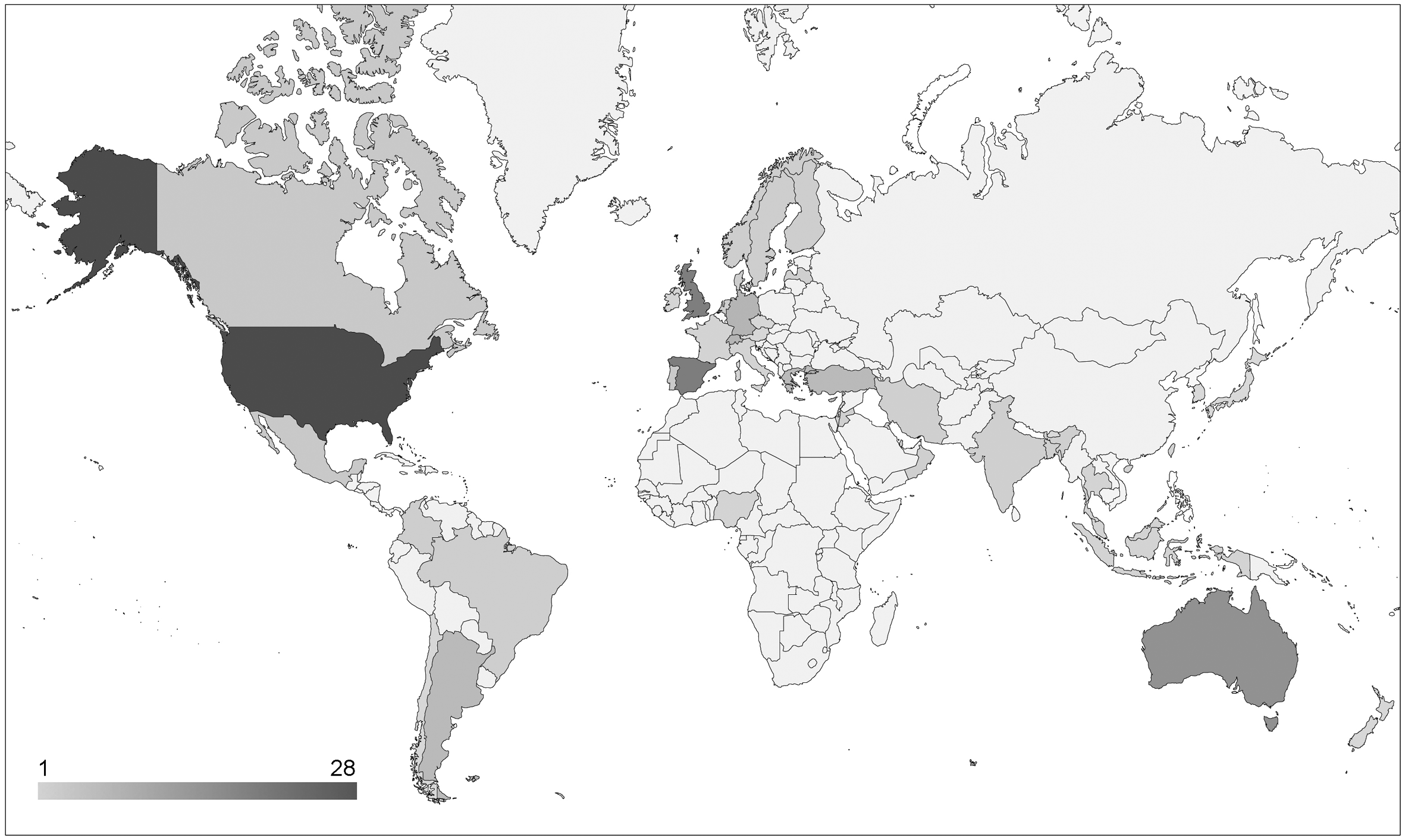
The origin of the works considered for this text is relevant to obtaining a general view of the areas and countries where there is greater interest in the topic. Figure 3 shows the country of origin of the institution to which each author is affiliated; in some cases, an author may appear in more than one work. Four countries concentrate 50 percent of the researchers analyzed: the United States is the country with the highest representation, with twenty-eight researchers affiliated with local institutions. Second place is shared by Spain and the United Kingdom, with eighteen each, followed by Australia with fourteen. The rest of the countries accumulate single-digit figures, with the most important being Germany with seven, Argentina and Turkey with six each, and Portugal with five. From a regional perspective, Europe, with seventy-four authors, concentrates almost 50 percent of those affiliated, while the Americas register forty-five, about a third of the total. The rest are distributed among a few authors from Africa and Asia.
Figure 3_ Map of the geographical location of the analyzed research production. Source: the authors, 2023.
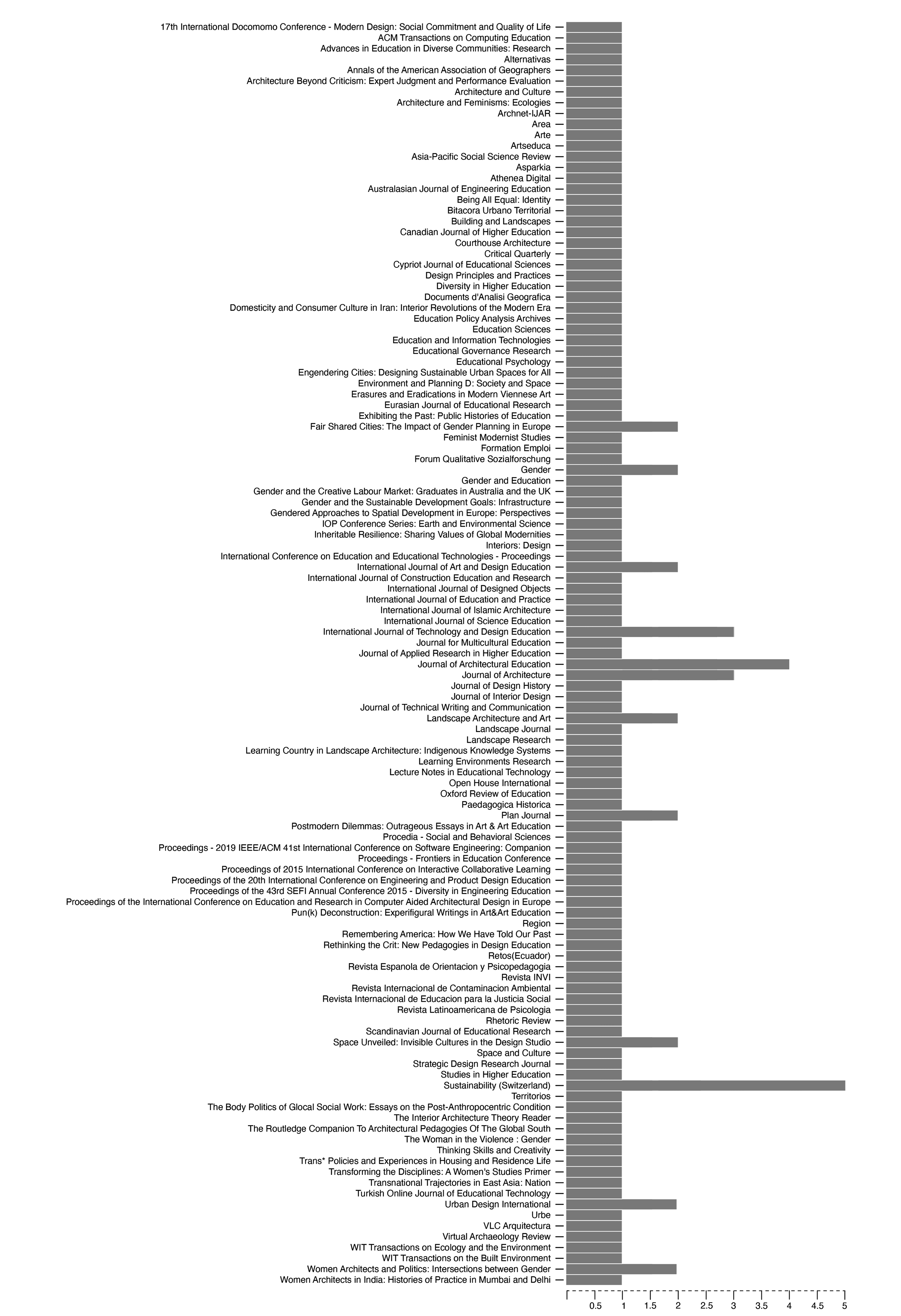
Several journals and books have included studies related to these topics, though with relatively low frequency over the period under review. Among these, the Swiss journal Sustainability stands out, with five articles. The American Journal of Architectural Education follows with four texts. Two journals published three works each: the International Journal of Technology and Design Education from the German publisher Springer and the UK's The Journal of Architecture. Lastly, with two contributions, we find Fair Shared Cities: The Impact of Gender Planning in Europe (UK), Gender (Germany), the International Journal of Art and Design Education (UK), Landscape Architecture and Art (Latvia), Plan Journal (Italy), Space Unveiled: Invisible Cultures in the Design Studio (UK), Urban Design International (Germany), and Women Architects and Politics: Intersections Between Gender Power Structures and Architecture in the Long 20th Century (Germany).
Figure 4_ List of the main journals where the analyzed scientific reflections are published. Source: the authors, 2023.
network of coexistence of terms extracted from the literature
In order to visualize a term co-occurrence network, we used the titles and abstracts of articles retrieved from the Scopus bibliographic database. These articles were identified using the search criteria described in the methodology section of this paper.
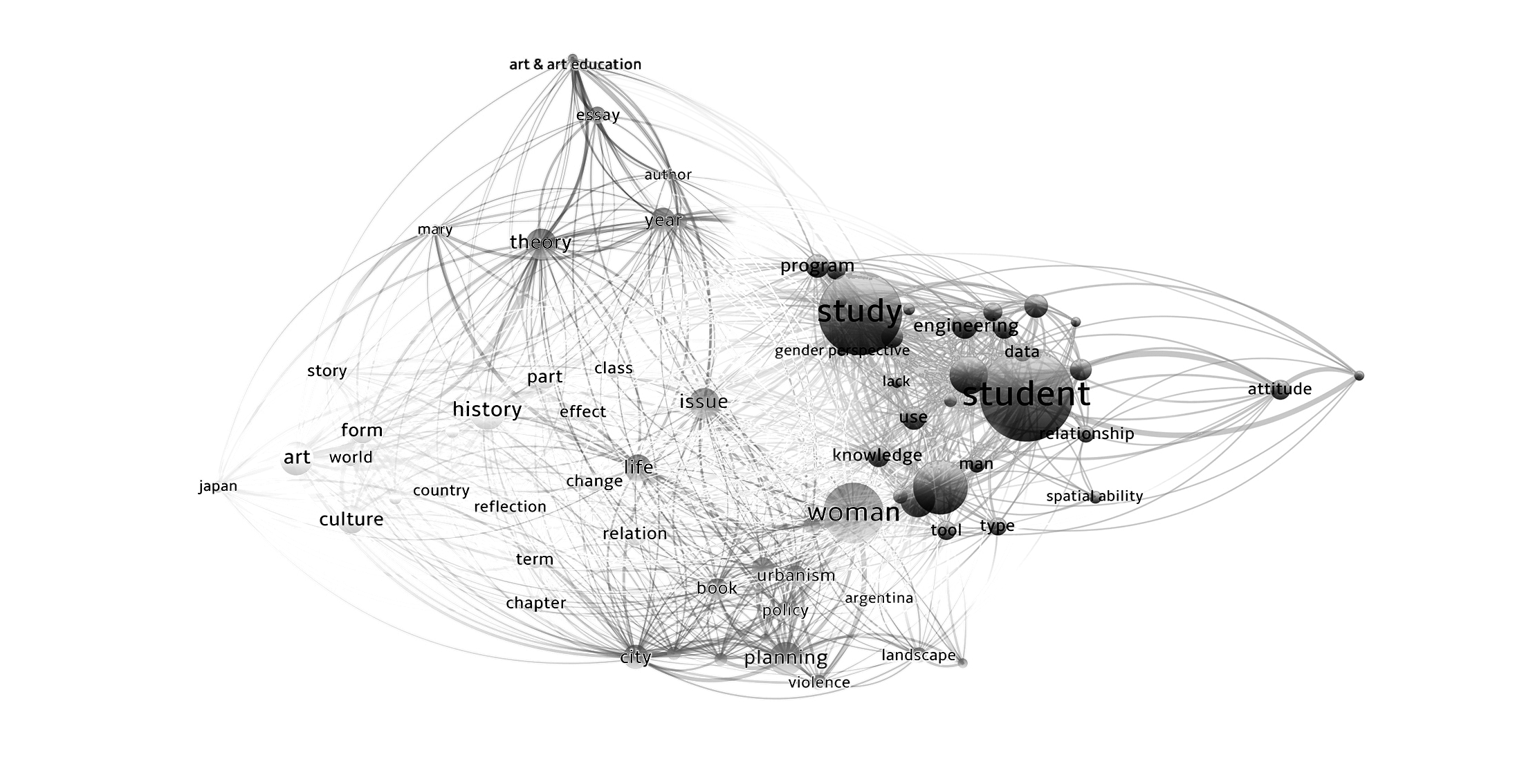
In constructing the map, the full counting method was used, ignoring the labels that structure the abstracts and copyright statements. From this, 4,414 terms were identified, and a minimum of ten appearances per term was imposed, with 121 reaching the threshold. A relevance score was calculated for each of the 121 terms, which was used as a basis for selecting the most relevant terms, of which 60 percent were graphed (fig. 5).
Figure 5_ Co-occurrence map of terms. Source: the authors, 2023.
The term co-occurrence map (fig. 5) is divided into four clusters (fig. 6): The first and most relevant cluster focuses on the terms "student" and "woman" and includes words such as "age", "area", "attitude", "data", "engineering", "factor", "gender perspective", "graduate", "higher education", "implication", "lack", "learning", "man", "program", "relationship", "research", "course", "significant difference", "Spain", "spatial ability", "survey", "tool", and "type". The second cluster, centered around the words "history", "culture", and "art", also includes aspects such as "change", "chapter", "country", "effect", "example", "form", "history", "Japan", "part", "reflection", "relation", "term", "view", and "world". The third cluster, centered on planning, addresses words like "issue", "book", "gender mainstreaming", "landscape", "landscape architecture", "policy", "urbanism", "variety", and "violence". Finally, the fourth cluster highlights the word "theory", accompanied by concepts like "art & education", "art education", "author", "case", "essay", "story", and "year".
Figure 6_ Details of the four clusters of the term co-occurrence map. Source: the authors, 2023.
In this analysis, it can be observed that the most relevant terms are linked to subjects (student, woman, engineer, graduate, etc.). The remaining clusters are related to the theme or discipline. First, they focus on history, culture, and art as ways of seeing the world and producing change. They are followed by ideas related to planning and public policies more focused on decision-making and impact, for example, in terms of violence. Finally, aspects related to history, case studies, or the study of specific authors appear (fig. 6).
Figure 7_ Map of the most used concepts by year. Source: the authors, 2023.
The relevance of the above terms has fluctuated in various ways over time. In an analysis of term usage over the past eight years, an evolution of interests can be observed, starting with the subject "woman" in 2016 and terms such as "implication", "violence", "survey", "spatial ability", "relation", "culture", "form", "story", and "Japan", to the emphasis on educational programs from 2020 with terms like "research", "course", "Spain", "gender perspective", "area", "Argentina", "higher education", "change", and "landscape". This change includes the term "history" in 2017 and terms like "example", "view", "effect", and "landscape architecture"; in 2018, the key term "student" appeared, alongside words like "theory", "author", "issue", "book", "planning", "learning", "type", "relationship", "lack", "term", and "art". Finally, in 2019, terms like "engineering" and "gender mainstreaming", "chapter", "data", "factor", "country", "age", "tool", "case", "essay", and "art & education" emerged.
most impactful documents and funding institutions
A key reason for understanding which bibliographic resources are most relevant to the topics of architecture, gender, and teaching is the impact evaluated by the number of citations each publication registers. Figure 8 shows the ten most cited publications. In the first place, with 54 mentions, is the book Fair Shared Cities: The Impact of Gender Planning in Europe (Sánchez de Madariaga and Roberts 2016), followed by the article "Beyond gender identity?" (Rasmussen 2009) with 50 mentions. In third place is the text "An investigation of design studio performance in relation to creativity, spatial ability, and visual cognitive style" (Cho 2017), with 47 citations, and in fourth place, the article "Gender and family influences on Spanish students' aspirations and values in STEM fields" (Sáinz and Müller 2018) with 43 citations. The article "Attitudes of design students toward computer usage in design" (Pektaş and Erkip 2006) has 34 citations to date, while "Universal Design: Implications for Computing Education" (Burgstahler 2011) has 30 citations. Completing the list with 29, 23, 23, and 21 mentions respectively, are the books The Woman in the Violence: Gender, Poverty, and Resistance in Peru (Alcalde 2010); and Domesticity and Consumer Culture in Iran: Interior revolutions of the modern era (Karimi 2013); the article "Assessment of Virtual Reality as a Didactic Resource in Higher Education" (Vergara et al. 2021); and finally the oldest text among the located resources, "A Guided Tour of the Kitchen: Seven Japanese Domestic Tales" (Buckley 1996).
Overall, the impact in terms of citations of these texts recorded in Scopus is small, since the text with the highest number of mentions has 54 citations, and the ten most cited texts collectively reach only 354 mentions, placing them in the lowest positions of their respective quartiles.
Figure 8_ List of the most cited documents. Source: the authors, 2023.
Regarding the different organizations and institutions that have provided the necessary support for the research registered since 1996, it is noteworthy that no organization appears in more than one work. However, it is important to note that of the 27 registered institutions, 10 are US institutes or universities. The remaining 17 are distributed across different countries in Europe, Asia, and Oceania. This suggests that there are still no institutions dedicated to funding specialized research on the topics discussed here. However, three works of European origin benefited from the Horizon 2020 funding program which benefitted their institutions.
Figure 9_ List of funding institutions. Source: the authors, 2023.
final reflections
This research confirms the significant gap in the Scopus-indexed literature on gender, architecture, urbanism, and teaching. The gap is accentuated in the Latin American region, with very little international presence, which is surprising given the great interest in these topics in countries like Argentina, Spain, and Mexico. This is mainly because the theme is marginally developed, primarily disseminated in conferences and congresses and in publications considered of lesser impact. The underrepresentation of gender in the aforementioned literature could be explained by several factors. First, the persistence of traditional sex roles in society could have influenced the lesser presence of women in research over previous years. Additionally, geography also plays an important role: the low levels of scientific production in Latin America could affect gender representation in publications. Similarly, this underrepresentation could be understood as a result of the lack of specific organizations in the region that support specialized research in gender and architecture and urbanism.
This tendency is also observed in the journals that have consistently published the topics addressed here, and is reinforced by identifying that the country with the most funding options for these investigations is the United States.
Among the limitations detected in the study, it is clear that the use of chosen search terms limits the results, leaving out many texts related to the topic. However, it has been verified that more precise searches also do not imply a significant variation in quantitative terms. This is the case for the search for the terms "housing AND gender AND teaching" restricted to the areas of social sciences, arts and humanities, and environmental sciences, which yielded fourteen documents, not all of which fit the study theme. The case of the search for the terms "housing AND gender AND pedagogy" is similar, as it yielded only three documents.
bibliography
- Alcalde, M. C. (2010). The Woman in the Violence: Gender, Poverty, and Resistance in Peru. Nashville: Vanderbilt University Press.
- Arias Laurino, D. B. (2018). "La construcción del relato arquitectónico y las arquitectas de la modernidad: un análisis feminista de la historiografía." Doctoral thesis, Universitat Politècnica de Catalunya. DOI: https://doi.org/10.5821/dissertation-2117-123109.
- Bell, C. J. (Ed.). (2014). Space Unveiled: Invisible Cultures in the Design Studio. London: Routledge. DOI: https://doi.org/10.4324/9781315765990.
- Buckley, S. (1996). "A Guided Tour of the Kitchen: Seven Japanese Domestic Tales." Environment and Planning D: Society and Space, 14(4), 441-461. DOI: https://doi.org/10.1068/d140441.
- Burgstahler, S. (2011). "Universal Design: Implications for Computing Education." ACM Transactions on Computing Education, 11(3), 19. DOI: https://doi.org/10.1145/2037276.2037283.
- Cho, J. Y. (2017). "An investigation of design studio performance in relation to creativity, spatial ability, and visual cognitive style." Thinking Skills and Creativity, 23, 67-78. DOI: https://doi.org/10.1016/j.tsc.2016.11.006.
- Czytajlo, N., & Llomparte Frenzel, M. P. (2023). "Género y paisaje: perspectivas emergentes y cartografías sociales. Experiencias desde laboratorios temáticos en Tucumán, Argentina." Revista INVI, 38(107), 122-150. DOI: https://doi.org/10.5354/0718-8358.2023.68877.
- Ervin, E. (2006). "Rhetorical Situations and the Straits of Inappropriateness: Teaching Feminist Activism." Rhetoric Review, 25(3), 316-33. DOI: https://doi.org/10.1207/s15327981rr2503_5.
- González-Rogado, A. B., Nieto-Isidro, S., & García-Holgado, A. (2023). "Access and Dropout in Engineering and Architecture Studies. A Preliminary Study with a Gender Perspective." In Proceedings TEEM 2022: Tenth International Conference on Technological Ecosystems for Enhancing Multiculturality Lecture Notes in Educational Technology, edited by F. García-Peñalvo & A. García-Holgado, 431-439. Singapore: Springer. DOI: https://doi.org/10.1007/978-981-99-0942-1_44.
- Gürel, M. Ö., & Anthony, K. H. (2006). "The Canon and the Void: Gender, Race, and Architectural History Texts." Journal of Architectural Education, 59(3), 66-76. DOI: https://doi.org/10.1111/j.1531-314X.2006.00036.x.
- Harwood-Jones, M., Airton, L., & Martin, K. (2023). "Reimagined and redesigned: Recommendations for gender-neutral washrooms and changerooms on campus." Canadian Journal of Higher Education, 53(1), 65-79. https://www.scopus.com/record/display.uri?eid=2-s2.0-85171661101&origin=inward&txGid=3d841502311bbd042f7e29c522b96379.
- Hernández, F. (2023). "Lyda Caldas and women architects in Colombia: the landscape of Universidad del Valle in Meléndez." Journal of Architecture, 28(3), 383-401. DOI: https://doi.org/10.1080/13602365.2023.2206408.
- Hutton, B., Catalá-López, F., & Moher, D. (2016). "La extensión de la declaración PRISMA para revisiones sistemáticas que incorporan metaanálisis en red: PRISMA-NMA." Medicina Clínica, 147(6), 262-266.
- Karimi, P. (2013). Domesticity and Consumer Culture in Iran: Interior revolutions of the modern era. Abingdon: Routledge. DOI: https://doi.org/10.4324/9780203072905.
- Navarro-Astor, E., Román-Onsalo, M., & Infante-Perea, M. (2016). "Revisión internacional de estudios de barreras de carrera bajo la perspectiva de género en la industria de la construcción." Innovar, 26(61), 103-118. DOI: https://doi.org/10.15446/innovar.v26n61.57169.
- Page, M. J., McKenzie, J. E., Bossuyt, P. M., Boutron, I., Hoffmann, T. C., Mulrow, C. D., Shamseer, L., Tetzlaff, J. M., Akl, E. A., Brennan, S. E., Chou, R., Glanville, J., Grimshaw, J. M., Hróbjartsson, A., Lalu, M. M., Li, T., Loder, E. W., Mayo-Wilson, E., McDonald, S., McGuinness, L. A., Stewart, L. A., Thomas, J., Tricco, A. C., Welch, V. A., Whiting, P., & Moher, D. (2021). "The PRISMA 2020 statement: an updated guideline for reporting systematic reviews." BMJ (71). DOI: https://doi.org/10.1136/bmj.n71.
- Patchcoski, B. J., & Harris, A. M. (2023). "Redefining Community Through Collaboration: Defining Gender-Neutral Housing for a Four-Year Residential Liberal Arts College." In Trans* Policies & Experiences in Housing & Residence Life, edited by J. C. Garvey, S. H. Chang, Z. Nicolazzo, & R. Jackson, 81-89. New York: Routledge. DOI: https://doi.org/10.4324/9781003448266.
- Pektaş, Ş. T., & Erkip, F. (2006). "Attitudes of Design Students Toward Computer Usage in Design." International Journal of Technology and Design Education, 16(1), 79-95. DOI: https://doi.org/10.1007/s10798-005-3175-0.
- Pérez-Rincón, S. (2023). "Enseñanza del urbanismo desde una perspectiva social y feminista. Experiencias docentes y conflictos comparados." Revista Bitacora Urbano Territorial, 33(1), 197-210. DOI: https://doi.org/10.15446/bitacora.v33n1.104529.
- Rasmussen, M. L. (2009). "Beyond gender identity?" Gender and Education, 21(4), 431-447. DOI: https://doi.org/10.1080/09540250802473958.
- Rodríguez-Esteban, A., & Vidal, J. (2022). "Spanish graduates' regret about program of study from the perspective of education-job mismatch." Education Policy Analysis Archives, 30(79). DOI: https://doi.org/10.14507/epaa.30.6683.
- Sáinz, M., & Müller, J. (2018). "Gender and family influences on Spanish students' aspirations and values in STEM fields." International Journal of Science Education, 40(2), 188-203. DOI: https://doi.org/10.1080/09500693.2017.1405464.
- Sánchez de Madariaga, I., & Roberts, M. (Eds.). (2016). Fair Shared Cities: The Impact of Gender Planning in Europe. New York: Routledge.
- Sánchez Hernández, M. F. (2009). "Evolución de las publicaciones femeninas en España. Localización y análisis." Documentación de las Ciencias de la Información, (32), 217-244.
- Vergara, D., Antón-Sancho, Á., Extremera, J., & Fernández-Arias, P. (2021). "Assessment of Virtual Reality as a Didactic Resource in Higher Education." Sustainability, 13(22), 12730. DOI: https://doi.org/10.3390/su132212730.