
How to Cite: Barberá Pastor, Carlos. "The New Town for the New Orthodox Project based on John Hejduk's Ephemeral approach to Architecture". Dearq no. 39 (2024): 4-13. DOI: https://doi.org/10.18389/dearq39.2024.01
How to Cite: Barberá Pastor, Carlos. "The New Town for the New Orthodox Project based on John Hejduk's Ephemeral approach to Architecture". Dearq no. 39 (2024): 4-13. DOI: https://doi.org/10.18389/dearq39.2024.01
Carlos Barberá Pastor
Universidad de Alicante, Spain
In 1979, John Hejduk conceived a town of eighteen thousand inhabitants on the outskirts of Venice. Located on a lagoon, a series of canals built between buildings connect it to the Italian city. The municipality is made up of buildings such as the customs office, the wharf, houses, the market, and public cemetery, together with the public park and public hotel. This city is called New Town for the New Orthodox (fig. 1), and lying at its heart is a hospital, also public. As John Hejduk explained in an interview with Peter Eisenman (1985, 84), curiously enough, the city's days are numbered. We could describe the project as ephemeral urbanism, that is, a very short-lived town compared to millennia-spanning western cities with buildings steeped in endless historical layers.

Figure 1_ John Hejduk, New Town for the New Orthodox: Perspective (1974-1979). Ink and watercolor drawing on paper, 21 x 28cm. Source: John Hejduk fonds — Canadian Centre for Architecture (CCA).
New Town for the New Orthodox forms a trilogy with Cemetery for the Ashes of Thought, and The Silent Witnesses, in which the prominence given to small houses expresses fabulous dualities. During that time, John Hejduk designed various residences. His conceptual proposals are characterised by solid vs vacuum contrasts, elevated floors, and the play of blinds or shutters to compress or expand night and day (Hejduk 1985, 84) (fig. 2).

Figure 2_ John Hejduk, Plans and elevations for The Silent Witnesses (1974-1979). Graphite on paper, 76.3 x 101.7cm. Source: John Hejduk fonds — CCA.
New Town for the New Orthodox alludes to the passage of time in accordance with the inhabitants' lives. The residents' lives and deaths would define the town's periods of occupation or non-occupation. "The cemetery fills in and it contains 18,000 coffins and when they put the last coffin in the town is abandoned. That's the New Town for The New Orthodox" (Hejduk 1985, 84).
This town has as many coffins as homes and such a condition constitutes the essence, the identity of an urban space whose end is foreseeable. Not only the inhabitants' lifespan but also the town's own expiry forces us to pause and reflect. Why? Why a town destined to be abandoned once its graveyard is full?
The question of ephemeral city constitutes a hypothesis. Projects such as Berlin Masque or Victims were developed years after the New Town for the New Orthodox and they create a sense of fleeting time through the role they give to occurrences. European cities were still marked by the suffering of World War II and trapped within their idiosyncrasy remained a vision of time that continued to be linear. For example, in the structure entitled Reading Theatre, which is buried underground, actors enter one side of the building using an elevator and recite poems at the end of a hallway. Their image is projected on a screen and their voices fill the theatre. This work considers the fragmented spatiality of the sound of voice (fig. 3). The architectural condition is shaped by the events taking place in the space. Image and sound propagate towards the interior limits through the volatile nature of the event and aesthetic expression. Here, the ephemeral is defined more by the interest in the readings and sound than by the space or the building itself, though this peculiar underground visit is somewhat captivating as well.

Figure 3_ The Reading Theatre. Source: Hejduk (1985, 418).
We shall proceed to demonstrate here that the specific ephemeral nature of architecture does not rest on construction elements or mobility features—e.g., when a piece appears and disappears from a square or a street, shifting location. Rather, the circumstantial nature of architecture lies in the value attributed to the event, to the activities developed by occupants and the particular transcendence given to action in that space. Throughout his extensive work from the 1970s and early 80s (fig. 4), until the end of the twentieth century, John Hejduk's artistic expression is driven by this ephemeralness. The architect's distinctive use of connections and artistic proposals mark the perishable condition of actions, which many artists before him expressed in sound performances, installations, and happenings. They convey the notion of transience in architecture, based on the artistic and provocative character of an event. Tearing down theatrical conventions, the performers offer glimpses (or more) of 'themselves' as living beings, standing literally or figuratively naked before us. They show themselves to themselves, at least that is how it seems" (Bleeker 2019).

Figure 4_ John Hejduk, Victims: Sketches of structures (1984). Pen and ink on lined yellow paper, 27.7 x 21.4cm. Source: John Hejduk fonds — CCA.
In New Town for the New Orthodox, there is one inhabitant per dwelling. Citizens pass away and when the cemetery is full, the city is abandoned. The equal number of inhabitants and coffins—eighteen thousand small homes and as many coffins—highlights the importance of events in architecture. A dwelling's emptiness is premeditated in order to perpetuate what occurred within it. The transient nature of the house and the perpetuity of its events give the city a new meaning. The living spaces once abandoned—like the city itself—will carry the lives of its inhabitants. The house becomes a residence of memory, a place where events undergo characterisation within the space. Occurrences are given relevance. And owing to the building's possible twists — determined by the actions and transitory condition perpetuated by the content of the space—the architecture becomes captivating.
The origin is constituted by the nature of time, as projected by the town, and its short lifespan. Life in the home space becomes the architectural source. Here, origin does not refer to the beginning, but rather to what we can identify as the state of things as collected by experience unfolding within a space, filling it with occurrences. The value of a place—loaded with air as a condition for life, and therefore action—rests on the occurrences that take place within it. They form the original question that allows moving them on to perpetuity. Emanuele Coccia is very clear on the origin of things.
Our world did not begin with a single event, infinitely distant in space and time, millions of light years away from us; we cannot encounter it in a space that has left no trace. The beginning of the world is seasonal, rhythmic, it expires as does everything else that exists. Neither substance nor foundation, it can be found neither in the ground nor in the sky, but rather halfway between the two. Our beginning is not within us—in interiore homine—, it is outside, in the open. It is not stable, nor ancestral, a star beyond measurable dimensions, a god, a titan. It is not unique (Coccia 2017, 37).
In what allows us to breathe, lies the extraordinary. "Our world begins with the leaves: fragile, vulnerable and, therefore, capable of coming back and living again after surviving the rough season" (Coccia 2017, 37). The beginning resides in what provides us with oxygen, which, in turn, constitutes a space. And that space is where occurrences unfold.
The perishable nature of leaves in a forest, that grow and die year after year, is what allows the oldest trunk to remain part of a cycle that gives life to trees, valleys, mountains, and mountain ranges. The beginning of plants, as a leaf sprouts on a stem of grass, a bush, a tree. Life commences in this way, and thus people give life to cities. The meanings of spatial interiors are conveyed by these very inhabitants depending on the activities that unravel in the city. An example in John Hejduk's architecture is the "Chapel of the Dead Angel" (fig. 5), where two states meet in a single space: the first, that of looking for the cause of the angel's death; and the second, that of the violence of having lost its spirit.

Figure 5_ John Hejduk, Bovisa: "Chapel of the Dead Angel" (1986). Ink painting on paper, 100 x 65cm. Source: John Hejduk fonds — CCA / Estate of John Hejduk.
In a conversation that arose with John Hejduk, after alluding to the poetics of New Town for the New Orthodox, Peter Eisenmann explores the exceptional nature of a house that will not be occupied by another person. He mentions the traces and memory present in a house left empty after its occupant's passing.
In these conditions two things happen to life; one is the exhalation of life because your house, your place, your time can never be used or repeated again. It is the mark of that existence, so it becomes its own monument. In a certain way it is one's own gravestone while one is living. The other thing is that it is also marking you for death; your life is merely marking time, because once you leave your house it be comes your tombstone. So, you're living in your own tombstone in a sense. What is striking about the project is the relationship of the house as a marker of life and death (Hejduk 1985, 85).

Figure 6_ Performance by Connie Beckey. Source: Hejduk (1989, 34).
These conditions lead us to discern occurrences once they have ceased taking place. Traces of life are a means to remember what took place before. As John Hejduk once said, "The rains of eternity / cannot wash away the bood" (Hejduk 1993, 132).
These conditions are rarely approached in architectural discourse. Through his proposal, John Hejduk conveys the utmost ephemeralness of occurrences, seeking to perpetuate them and give them meaning (fig. 6).

Figure 7_ John Hejduk, Bovisa: The Judges (1986). Ink painting on paper, 100 x 65 cm. Source: John Hejduk fonds — CCA / Estate of John Hejduk.
In Soundings, (Hejduk 1993, 50), three people sustain three geometric figures, thus showing how they are connected to the architecture through a personal bond, forming part of it. In the Bovisa illustration (fig, 7), they hold the figures in their hands with little effort, and all stands erect in a state of equilibrium. Yet such a balance depends on numerous variables or judgement calls, illustrating the dualistic nature of the heterogeneity we live in.
The passage of time is not linear in nature, despite a certain insistence on representing it as such. Artistic expression is capable of transforming an instant in time and of giving it an eternal quality.1 Regarding Hejduk's proposal, Peter Eisenmann says "your life is no more than discerning time, because once you leave your house it becomes your tomb". Samuel Beckett had previously expressed this in Waiting for Godot, where birth takes place in recently excavated graves, an allegory of giving birth at the very moment a tomb is unearthed.
Have you not done tormenting me with your accursed time! It's abominable! When! When! One day, is that not enough for you, one day he went dumb, one day I went blind, one day we'll go deaf, one day we were born, one day we shall die, the same day, the same second, is that not enough for you? They give birth astride of a grave, the light gleams an instant, then it's night once more (Beckett 2007, 120).
And that is how we live and die, in time and space. At the theatre it is but an instant. It thus becomes viable based on the importance of the occurrence, of an unnoticed event, yet one that is necessary to alter repeated occurrences over time.
The young maid enters the kitchen in the morning, performs a series of dreary, routine gestures, does some cleaning, scares away the ants with a splash of water, grabs the coffee grinder, and shuts the door with her foot. As her eyes roam over her pregnant belly, it seems as if she is breeding all the misery in the world (Deleuze 1986, 12).
This scene fragment, cited by Deleuze in reference to the film Umberto D—in which "De Sica depicts the famous sequence that Bazin set as an example" (Deleuze 1986, 12)—could remain unnoticed in countless European homes of the first half of the twentieth century. However, realities such as this, repeated in the kitchens of many bourgeois households across Europe and the world, are spotlighted thanks to Italian neorealism and great cinema directors such as Roberto Rossellini, Vittorio De Sica, Luchino Visconti, Pier Paolo Pasolini and Michelangelo Antonioni. Actors such as Giulietta Masina, Ingrid Bergman, Anna Magnani, Sophia Loren, Jean-Paul Belmondo, Eduardo De Filippo, Paolo Stoppa, Vittorio Gassman and Mario Vitale played leading roles written by mid-century screenwriters such as Cesare Zavattini.
However, many actors who took on and fleshed out these roles were the same people who were suffering the consequences of fascism in both in their public and private daily lives. Many portrayed their own realities and experiences in the same urban and domestic spaces. Places of misery and the humblest domestic daily conditions were represented. These social conditions raised interest and had huge repercussions in the European artistic and intellectual world. "With neorealism, Italian cinema now turned its attention to ordinary people that had been overlooked for so long. The young and ambitious directors wanted to depict what they saw every day on the streets, and hence form a different perspective on the way we look at cinema" (Kartal 2013, 146).
As commented by Víctor Erice in the documentary Un lugar en el cine, the way realities are depicted in neorealist films illustrates the support that European intellectuals wished to give in the light of social problems. Directors, concerned with popular, daily experiences, showed the realities of humble people on the big screen. A context in which only the progressive political left influenced and worked towards ending the deceit. Rural communities, the unemployed, the working class and workers' unions—who lived in the very buildings depicted in the films—occasionally appeared as the protagonists of cinematographic culture. The European working class remained linked to the intellectual bourgeois who were behind the film industry. In a way, they laboured hand in hand towards social and cultural transformation adopting a specific approach to the situation.
By providing an understanding of these ways of life, many who were being exploited by fascism found some sort of hope. Misery somehow became a form of expression. The tone constitutes a discourse that still applies today. It is a legacy of European history transmitted through neorealist cinema.
Interestingly, the cinematographic sequences seem to have remained engrained in the walls, via the sounds that still flow through them. That is how director Víctor Erice described it in Alberto Morais' film Un lugar en el cine. In 2007, Erice recreated a scene from Roberto Rossellini's 1945 film Roma cittá aperta (fig. 8). The director, from Vizcaya (Spain,) re-filmed a scene using colour film, on the sites originally used by Rossellini in 1945. Filming empty streets in 2007, a modern car occasionally passing by, Erice adds the soundscape of the famous, original scene in which pregnant Pina runs after Francesco, the father of her child, who has been arrested by the Nazis. As if the urban space could retain the horrific sounds of the atrocities of World War II in its walls, the twenty-first century scene takes us back to those events, without showing what happened.

Figure 8_ Photogram from Roma Cittá Aperta by Roberto Rossellini and photogram of footage by Víctor Erice. Source: Un lugar en el cine by Alberto Morais.
John Hejduk's work in the last two decades of the twentieth century shows how walls can rescue the sounds of past events. Years after New Town for the New Orthodox, Hejduk proposed Masques, a prime example of an architectural project that uses an artistic approach in order to reclaim events and occurrences and to thus create popular expression. It resembles the transmitting of neorealist film sequences while making them last over time. And in a way, it is visible in the new town proposal, which abounds in time-related content and recovers events that occurred within the architectural space. Few examples are capable of generating such a considered and extensive discourse through artistic and architectural means of expression.
By using neorealist Italian cinema to study John Hejduk's work, we can characterise occurrences, especially given that this type of cinema was designed to show the realities of people according to their various circumstances.
The so-called masterpieces of neorealism were insufficiently neorealist because they still relied on fiction to communicate the large or small facts of everyday life. Life cannot be captured through scenarios. Cinema's business is not to tell stories, Zavattini exhorts. Neorealist directors were aware of this and had explored strategies to allow life to expose itself, unmediated, to the camera. Unfortunately, no one had yet fully succeeded in such an enterprise. Rossellini, De Sica, and Visconti had started the battle to conquer reality. And now, behind them there was an army of directors ready to go on the attack and win the neorealist war. The victory would, however, also coincide with the death of cinema. / For Zavattini, the birth of neorealism would imply the elimination of the whole technical-professional apparatus of cinema, screenwriters, directors, and actors. Thus, to have neorealism, to translate neorealism from manifestos to reels, one would have to renounce cinema (Fabbri 2015, 191).
This renunciation of cinema obliges us to turn towards architecture. It is amidst architectural spaces that things occur, vicissitudes unravel there, and they do not need to be represented elsewhere. John Hejduk provides an artistic medium to comprehend the importance of daily life occurrences. Through a fusion of architecture, artistic expression, and daily life, Masques makes it unnecessary to represent each act, but rather to commit to the process.
Gilles Deleuze's references to neorealist cinema and cinema in general help us to recognise the importance of John Hejduk's work. As in the case of theatre or performance, we approach architecture adopting a Deleuzian time-image perspective. This means viewing architecture according to temporary realities that shed light on the central role of occurrence in architecture, as represented in Hejduk's Masques or the New Town for the New Orthodox itself.
Gilles Deleuze makes us perceive temporality based on "the idea of Bergson's theory of memory" (Harraser 2019, 98).2 He presents "the time of the conscience" to us "as an enigma in progress, an ever changing, Dynamic funnel" (Harraser 2019, 98). We can propose a conception of time that is little discussed in architecture: moments of experience influenced by aesthetic principles and the resulting past, present, and future changes. Lived experiences rest not only on concrete events, but also on the infinite perspectives that lead us to characterise architecture with caution. Indeed, we identify occurrences and sensitivities according to memories in the present: a temporary state we use to build our perceptions and to settle in the past, to ensure that the story is not told by those in a position of power. The new conception of time is the characterisation of everything that leaves a trace and which can be used to identify a space according to its contents. It is the New Orthodox. "This multiplicity is developed using the concept of phenomenal transparency, which seeks to comprehend architectural experiences as a sequence, where one sees and analyses space through a series of occurrences" (Pérez Fernández 2021). This reveals a piece of hitherto scarcely explored history of architecture, an architecture that struggles with valuing the experiences unfolding within a space. Today it is approached only tentatively despite its essential role in architectural conceptualisation. "It is the same mechanism as the process of perception: just as we perceive things right where they are in space, we remember them as they were in time. And in both cases, we step out of ourselves" (Deleuze 1986, 135, author's translation). Thus, by directing our thoughts to concrete events, we can trigger a ripple in the present stemming from all past occurrences.
John Hejduk attempts to value the responsibility of leaving behind the fleetingness of countless, sensitivity-loaded occurrences with respect to social and political transformation. This leads us to reflect on our personal responsibility according to our various identities. Such legacies allow bringing back lived experiences and to define the new orthodox. And they can be used to transform artistic architectural processes. We question our own existence, "what has passed, what is present, what is yet to come" (Quetglas 2021, 21).
We must therefore identify the vicissitudes, memories, journeys, and feelings capable of evoking "a layer or continuum that survives the passage of time" (Deleuze 1986, 167), which can then contribute to building a present undergoing constant reconfiguration. Referring to artistic expression, Deleuze alludes to how "a work of art can create paradoxical, hypnotic, hallucinatory layers, characterised by having passed while also being forthcoming" (Deleuze 1986, 168). And here we find the time-image fusion which allows committing to the identification of the interest of things, as suggested by Deleuze when discussing cinema as an artistic expression.
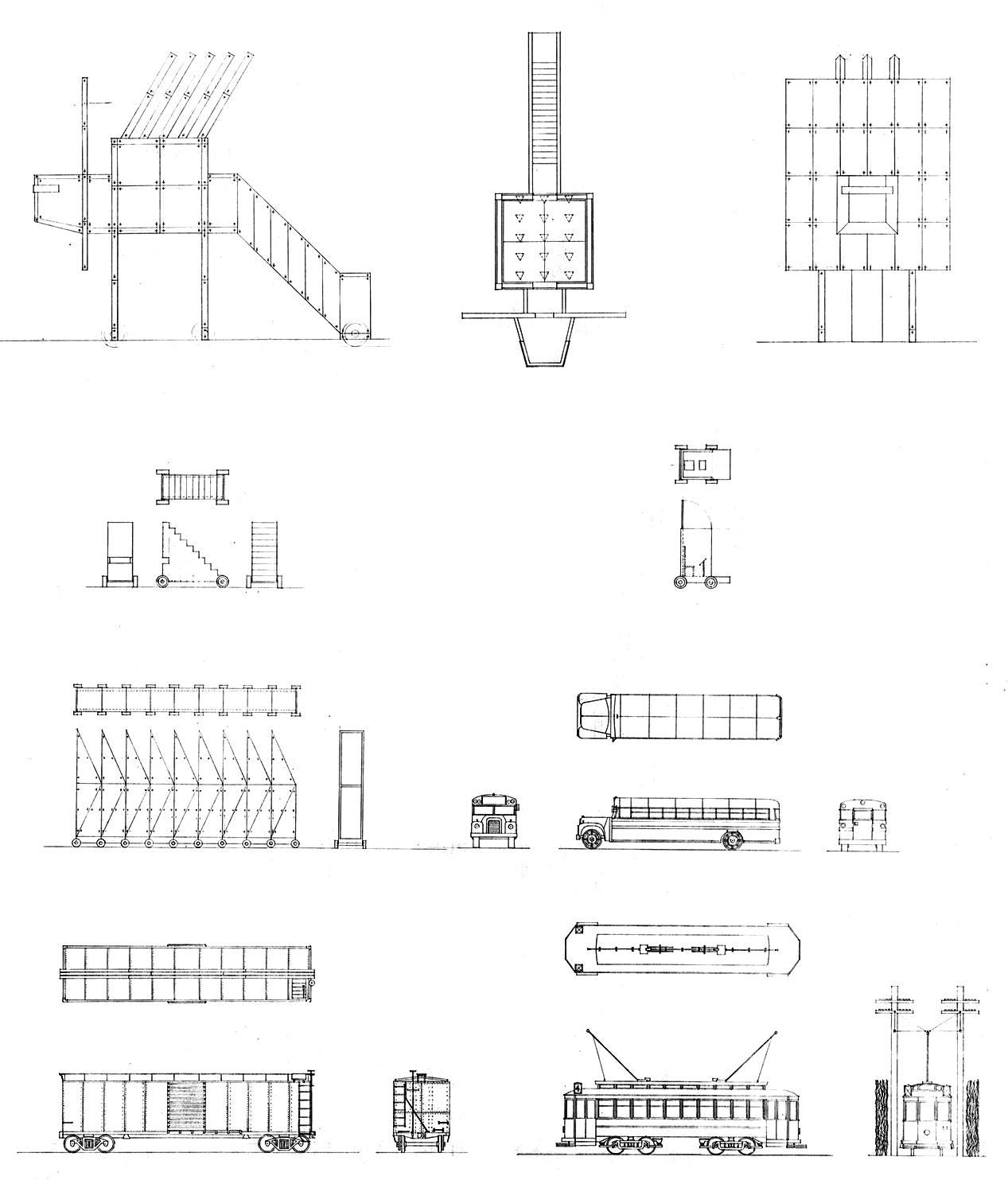
Figure 9_ John Hejduk, Victims: Plans and elevations (1984). Reprographic copy, 92.5 x 46cm. Source: John Hejduk fonds — CCA.
"Deleuze isolates a few scenes from each film—he samples them, so to speak—and then re-assembles them into his own personal version of world cinema history. Deleuze's cinema volumes are extraordinary works of montage. (…) By detaching sequences from stories and reconfiguring them in a new narrative assemblage, Deleuze…" (Fabbri 2015, 189) looks at the concrete occurrences which had been used to recover the aesthetic principle of the occurrence in cinema. This tension leads us to discuss commitment to the activity set out in Hejduk's series of structures and pieces (fig. 9) which transform the sense of architectural history because attention is given to what is seemingly insignificant.
Exploring what is insignificant constituted a point of departure for research into Pina Bausch's dance. An insignificant occurrence linked to everyday life at the root of dancing that could be made up of any movement, such as walking, sitting, throwing oneself to the ground, self-caressing. An insignificant occurrence detected through the repetition of a gesture, attitude, or behaviour. Repetitions varying ever so slightly at each iteration. And if, according to Barthes, "repetition opens access to a different temporality", the insignificant can be seen here as the difference and singularity of each repetition in each new dimension of time. A repetitive occurrence full of inherent, hypnotic qualities, where only unveiled insignificancies can indicate possible options of exit or distance (Ferrando 2012).
Masques embraces a social, cultural, and political commitment. Yet this approach is somewhat broken by the construction itself. Indeed, it is made of pieces that are spread across the world in different cities, as the relationship between them is not experienced from the perspective of their temporal value. Because these pieces are built merely as object representations, the occurrences designed to change the meaning of space and time do not culminate in this understanding. If each object is to remain intimately connected to time and space through the relationships that inhabitants have with them, or through the placement of the objects themselves in a particular street or square, the concept of structure breaks any time-image relationship that could be used to generate a new way of writing the history of architecture — by not being inhabited. Pieces in the Christiania square in Oslo (Hejduk 1995, 19), Bedford Square in London (Hejduk 1987), the house of the painter and house of the musician in the Martin-Gropius-Bau in Berlin (Hejduk 1985, 328) fail to meet the architectural conditions established in cinema through movement-image. "It is as if cinema said to us: with me, a thinker awakes within all of you. A subjective and collective robot for an automatic movement: art of the 'masses'" (Deleuze 1986, 210). The opportunity to establish an artform that creates relationships with objects not only through occurrences but also through the other relationships they have, as we witness in the use of theatre, cinema, performance, and sound art within architecture. This is the missing link, lost in the space-time of our recent history.
1 This is expressed by Josep Quetglas (2021, 21): "Eneas—the Citerean hero, son of Venus—escapes the city and death. He carries his elderly father, Anquiases, on his shoulders, and the sacred images that protected the city in his arms. He takes his son, Ascanio, by the hand. He takes with him that which has passed, is present, and is yet to come. He takes with him his personal memories, the essence of the tribe, and a future that will no longer be his." (author's own translation).
"Carrying this triple load also belongs perhaps to the nature of any artwork, or indeed of any human work. Any new piece does not only begin with promise, but also conserves the custodial presence of everything else that has been done" (author's own translation).
2 "There, all those who stutter should also limp: Interrupt time, wear out bodies, build worlds" (Harraser 2019, 98). Own translation.