Calabash Gourds in the Work of Roberto Evangelista: Amazonian Agencies and Trajectories
Las calabazas en la obra de Roberto Evangelista. Agencias y trayectorias amazónicas
Cuieiras na obra de Roberto Evangelista: agências e trajetórias amazônicas
Fecha de recepción: 1 de agosto de 2025. Fecha de aceptación: 17 de febrero de 2026. Fecha de modificaciones: 4 de marzo de 2026
DOI: https://doi.org/10.25025/hart.11794
Gabriela Paiva de Toledo
Holds a Ph.D. in Art History from Southern Methodist University, Dallas. Her dissertation, "Contested Conquest: Art and The Amazon under Brazilian Dictatorship (1964-1985)," investigates how artists critically responded to the expansion of agribusiness, mining, infrastructure development, and industrialization in the Brazilian Amazon, supported by the military regime’s propaganda of the Rainforest as a 'green desert' undergoing occupation. She received her Bachelor of Arts from the University of Campinas in History with an Art History minor in 2013 and her Master of Arts degree in Art History from the same institution in 2017. She was a fellow at the Kunsthistorisches Institut in Florenz in 2016 through the Research Abroad Program, the State of Sao Paulo’s endowment for the humanities and sciences (BEPE/FAPESP fellowship). She was a research fellow for the project “The Amazon Basin as Connecting Borderland” (2023-2024) − The Getty Foundation, Universidad San Francisco de Quito (USFQ), Universidade do Estado do Rio de Janeiro (UERJ), and Universidad de los Andes (Uniandes, Bogotá). She was a research fellow for the project “Bridging the Sacred: Spiritual Streams in Twentieth-Century Latin American and Caribbean Art, 1920-1970,” hosted by MoMA’s Cisneros Institute (2023-2024).
Abstract:
This paper addresses the use of calabash gourds by Brazilian artist Roberto Evangelista (1946–2019). I argue that an assessment of Evangelista’s work can lay the groundwork for reconceptualizing the Amazon basin as a historical landscape shaped by the trajectories and associations of human and more-than-human actors across temporal-geographical distances. This paper’s contribution is threefold: first, it delineates the Amazon’s insertion into global networks and its long-term participation in historical processes. Secondly, it emphasizes the relevance of Amazonian contemporary art for rethinking the Amazon beyond fixed geographical frontiers and modern ideas of pristine nature. Lastly, by adopting an object-based methodology and focusing on trajectories, this paper also makes an ecocritical contribution to the field of art history.
Keywords:
Amazonian contemporary art, Crescentia cujete, early modern Amazonia, ecology, global art history, Roberto Evangelista.
Resumen:
Este artículo aborda el uso de calabazas por parte del artista brasileño Roberto Evangelista (1946-2019). Sostengo que la evaluación de la obra de Evangelista permite sentar las bases para reconceptualizar la cuenca amazónica como un paisaje histórico, moldeado por las trayectorias y asociaciones de actores humanos y más que humanos a través de distancias temporales y geográficas. La contribución de este artículo es triple; primero, delinea la inserción de la Amazonía en redes globales y su participación a largo plazo en procesos históricos. Segundo, enfatiza la relevancia del arte contemporáneo amazónico a la hora de repensar la Amazonía más allá de las fronteras geográficas fijas y las ideas modernas de naturaleza prístina. Por último, al adoptar una metodología basada en objetos y enfocarse en las trayectorias, este artículo también hace una contribución ecocrítica al campo de la historia del arte.
Palabras clave:
Arte contemporáneo amazónico, Crescentia cujete, Amazonía en la modernidad temprana, ecología, historia del arte global, Roberto Evangelista.
Resumo:
Este artigo aborda o uso de cuieiras por Roberto Evangelista (1946-2019). Defendo que a análise da obra de Evangelista estabelece as bases para reconceituar a bacia amazônica como uma paisagem histórica, moldada pelas trajetórias e associações de atores humanos e não humanos ao longo de distâncias temporais e geográficas. A contribuição deste artigo é tripla; em primeiro lugar, delineia a inserção da Amazônia em redes globais e sua participação de longo prazo em processos históricos. Em segundo lugar, enfatiza a relevância da arte contemporânea amazônica para repensar a Amazônia além das fronteiras geográficas fixas e das ideias modernas de natureza intocada. Por fim, ao adotar uma metodologia baseada em objetos e focar em trajetórias, este artigo também faz uma contribuição ecocrítica para o campo da história da arte.
Palavras-chave:
A Amazônia na Época Antiga; Arte Contemporânea Amazônica; Crescentia Cujete; Ecologia, História da Arte Global; Roberto Evangelista
Introduction
This paper addresses the use of calabash gourds by Brazilian artist Roberto Evangelista (1946-2019). Evangelista’s work provides an understanding of the cultural inscriptions of calabash gourds and their participation in far-reaching social networks across the centuries. My argument is that an assessment of Evangelista’s work can lay the groundwork for reconceptualizing the Amazon basin as a historical landscape with fluid borders, shaped by the trajectories and associations of human and more-than-human actors across temporal-geographical distances. Thus, this paper’s contribution is threefold: first, it delineates the Amazon’s insertion into global networks and its long-term participation in historical processes. Secondly, it emphasizes the relevance of Amazonian contemporary art (through its negotiations of local-global identities) for rethinking the Amazon beyond fixed geographical frontiers and modern ideas of wilderness and pristine nature. Lastly, by adopting an object-based methodology and focusing on trajectories, this paper also makes an ecocritical contribution to the field of art history by highlighting the agency of gourds in historical processes.
Calabash gourds are containers used in everyday activities in the Amazon and hold cultural connections with Amazonian Indigenous and riverine communities. The round calabash gourds are crafted from the fruit of the calabash tree (Crescentiacujete), which is cut in half and cleaned, forming a hollow vessel used to hold liquids, to cook, bathe, and wash (Img. 1); nowadays they are commonly used in the consumption of local traditional dishes such as tacacá.1 The calabash tree produces fruit year-round, growing in the annually inundated areas of the Amazon basin (known as várzeas) as well as in the backyards of riverine communities.2
In the first part of this paper I examine Evangelista’s deployment of Amazonian gourds in his installation Resgate (Rescue) at the 1992 exhibition America: Bride of the Sun, held at the Royal Museum of Fine Arts of Antwerp, Belgium. My primary focus is to outline the work’s institutional critique through site-specificity and materiality, unveiling the connections between Enlightenment-affiliated institutions (such as the museum of fine arts) and the historical process of colonization of the Americas. The displacement and relocation of Amazonian gourds to the museum are key critical operations. I then proceed to reevaluate the artwork’s historical depth by considering the global transits of calabash gourds in the colonial period. I examine one of these transits through the writings of Bahian-born naturalist Alexandre Rodrigues Ferreira (1756-1815), the leader of an expedition whose primary goal was to investigate new avenues for economic exploitation for the Portuguese Crown. The expedition also had a scientific goal: to describe, catalog, and illustrate the three kingdoms of nature (mineral, animal, and plant).
Image 1. Paiva de Toledo, Gabriela. Sarayaku women manufacturing gourds, Sarayaku, Ecuador, October 2023. Photographed during the research trip for the project The Amazon Basin as Connecting Borderland.
Evangelista’s work prompts us to reconsider those histories of colonial encounters and shift our attention to the agency of Amazonian artifacts. The paper’s third section examines the incorporation of calabash gourds into the cultural life of the peoples that inhabit the upper Rio Negro, which informed the artist’s production. The examination of social trajectories neutralizes narratives of the Amazon basin as an inert natural landscape, a passive subject of colonial domination, and opens to a historical landscape of multiple social actors (humans and more-than-humans). The last section examines another version of Resgate, concurrently performed in Manaus, in the Brazilian Amazon, in response to the Rio de Janeiro Earth Summit taking place that same year. This variation was a happening and involved local people from Manaus. By connecting the two events, Evangelista advanced a political-ecological approach of global historical significance, correlating the twentieth-century ecological crisis with the Amazon’s long colonial history. Evangelista shifted attention to the Amazon’s materiality and cultural practices as a powerful site for the re-elaboration of the two fundamental and interrelated questions of colonial trauma and environmental collapse.
I conclude this paper by arguing for an expansion of the field of art history, opening a dialogue between Evangelista’s work and historical ecology, which provides tools for examining human-plant associations in the Amazon basin over long spans of time, and reframing the Amazonian landscape as historically and collectively generated. Evangelista’s work was informed by his experiences and knowledge of Amazonian social life and captured the temporal dimension of human-plant long-term associations through his focus on a significant artifact in local cultural practices: gourds.
Global Art History, Circulations, Agency
This paper addresses discussions raised during the project The Amazon Basin as Connecting Borderland: Examining Cultural and Artistic Fluidities in the Early Modern Period—a partnership between the Getty Foundation, the Universidad San Francisco de Quito (USFQ), the Universidade do Estado do Rio de Janeiro (UERJ), and the Universidad de Los Andes—in 2023. This project was part of the Getty Foundation’s broader initiative Connecting Art Histories, which seeks to foster the production of global art histories. The Amazon Basin project adopted a supranational geohistoriographical approach that examines historical processes transculturally to avoid ahistorical accounts of fixed cultural entities. The notion of “connected borders” comprehends cultural differences negotiated through porosity and mobility, and suggests that natural, cultural, and political borders are historically constructed.
Participants were asked to reflect on possible methodological paths for a global art-historiographical approach to the Amazon basin in the early modern period, countering modern narratives of the Amazon basin as a realm of pristine nature. This would mean adopting a polycentric perspective and expanding the scope to encompass artifacts that are not traditionally regarded as art, moving away from the historical art canon, national art narratives, and the diffusionist center-periphery framework that have shaped the metanarrative of modernity.3
Following those guidelines, this paper outlines a methodology that proceeds from an assessment of Amazonian contemporary art (the area of this author’s expertise) and its critical operations towards borders, cultural essentialisms, and institutional critique (all elements proper to contemporary art), also considering its specific historical reexamination of colonization and Amazonian identities within local-global negotiations. In this way, I reassert the key critical role of contemporary art in pushing the frontiers of the discipline since at least the 1980s (a point previously argued by art historians committed to the global turn, such as Hans Belting and Claudia Mattos).4 Evangelista’s engagement with Amazonian gourds affords a dynamic reading of them as they move across networks and negotiate meanings (in his case, the global networks of art institutions and the spatial politics of site-specificity). Reading Evangelista’s work as an instance of institutional critique allows us to reframe its historical depth and draw its connections with early-modern circulations.
This prompts us to turn to theoretical discussions that highlight artifactual agency in social transactions, rather than attempting to pin down cultural origins and re-create diffusionist schemes. If we take note of the intense circulation of gourds in time and space, we must discard any assumption of a specific cultural identity and fixed borders. As such, this study draws on art-historiographical research that focuses on transits or circulations.5 In conversation with geohistory and historical materialism, circulatory approaches draw on the study of the biography of things, the most famous compendium of which is The Social Life of Things, edited by Arjun Appadurai.6 This line of work analyzes the different ways in which objects of economic value circulate in social life, focusing on the trajectories of objects in their specific cultural and historical contexts and the conditions of their circulation within different value regimes, aiming at understanding social interactions.7 As Appadurai points out, human actors encode meanings in things; therefore, studying the biography of things allows us to examine the human transactions and calculations that permeate the lives of objects.8
The recent ecological turn in the field of art history has pushed the circulatory approach further, seeking to overcome the culture-nature dualism preserved in the anthropocentric perspective of “encoding meanings in things.” Drawing on the new materialist and posthumanist frameworks advanced by theorists like Jannet Bennet and Donna Haraway, and on the work of anthropologists like Tim Ingold, Bruno Latour, Anna Tsing, Philippe Descola, and Eduardo Viveiros de Castro, art historians have emphasized the agency of things.9 New materialism and posthumanism establish that meanings are not “encoded by humans in things” (as if discourse and matter were two separate realms) but are contingently generated by embodied interactions between human and more-than-human actors over time. This paper contributes to the theoretical expansion of art history towards ecology by examining the agency of gourds.
It is also important to highlight our debt to Fernando Ortiz’s Cuban Counterpoint: Tobacco and Sugar.10 Published in 1940, this work not only introduced the notion of “transculturation,” crucial to later developments in global art history and circulatory approaches, but also, and most importantly, it developed an analysis of Cuban culture based on plant species and commodities: sugar and tobacco. Sugar and tobacco developed a symbiotic relationship with the Cuban territory throughout the colonial period, shaping material practices and negotiating the new colonial identities within transculturation processes between Indigenous Taino people, enslaved people from the Western African Coast, and European colonizers. They also moved across global networks, fostering cultural changes in the Atlantic world from the 16th century onwards. As such, Ortiz’s study set a precedent for my own focus on the circulations of the fruit of the calabash tree in the Amazon basin.
This paper’s delimitation of early modernity follows Sanjay Subrah- manyam’s definition. Subrahmanyam has located early modernity in the first interfaces between the micro (local and regional) and macro (supraregional and global) levels of interactions, temporally varying according to the specificities of the networks under scrutiny.11 For Subrahmanyam, early modernity also carries a fundamental cognitive aspect: the rise of a new conception of the limits of the inhabited world based on new transoceanic and transcontinental displacements. This is not limited to transformations in cartographic and spatial notions, or to European ethnographic descriptions. There are diverse and divergent perspectives that can be taken as starting points for historiographical inquiry into the early modern period. I consider the new baroque decorative patterns on the calabash gourds, observed by Rodrigues Ferreira in 1785-86 and preserved in the samples in his collections, as a historical record of awareness, on the part of their producers (Indigenous women from Tapajós), of the geographical distances to be traversed by those objects (Img. 2).
Lastly, this paper examines Evangelista’s work in order to foreground a view of Amazonian history through the transits of calabash gourds that evidence the interconnections between colonial capitalism, globalization, and the planet’s ecological crisis. It does so in order to critically engage with the project of a global art history. Global art history has sought to disentangle itself from linear, stage-specific histories that culminate in the emergence of the ‘West’ as a hegemonic order assumed to have reshaped the rest of the globe. Attention to supraregional networks, combined with a historical-materialist approach to examining global transits, must do more that avoid the teleology of modernity; it must also undertake a critical assessment of the workings of global capitalism in terms of how colonialism produced and continues to produce social and environmental inequalities. Otherwise, it runs the risk of remaining a positive narrative, although transnational.
Image 2. Gourd collected by A. Rodrigues Ferreira in Monte Alegre, 1785-6. Museu da Academia de Ciências de Lisboa.
Moving Gourds and Institutional Critique: Resgate by Roberto Evangelista (1992)
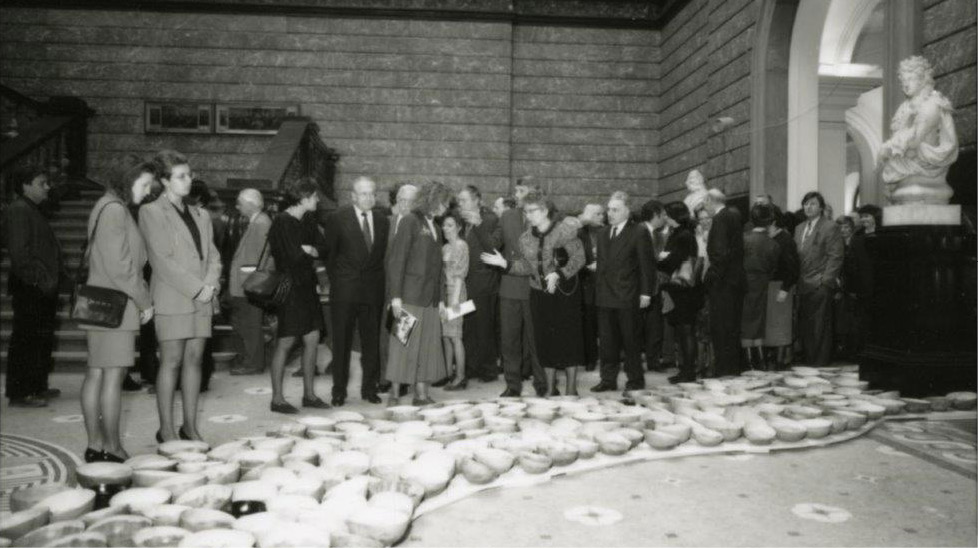
In 1992, at the quincentenary of Columbus’s arrival on the Taino island of Guanahaní (now known as the Bahamas), a particular kind of Amazonian vessel landed in Antwerp, a former Iberian shipping base and nerve center of the early capitalist colonial economy in the 16th century. Blocking their way, visitors encountered hundreds of calabash gourds in the entryway to Antwerp’s Royal Museum of Fine Arts (Img. 3). Made of a fruit commonly found in the Amazon, those vessels contaminated the building’s neoclassical asepsis. They belonged to Brazilian artist Roberto Evangelista’s installation Resgate, presented at the mega-exhibition America: Bride of the Sun, curated by Paul Vandenbroeck and Catherine de Zegher. Evangelista arranged approximately one thousand gourds in the museum’s foyer.12
Image 3. Evangelista, Roberto. Resgate. Installation for the exhibition America Bride of the Sun. Gourds, water, candle. 1992. Archive KMSKA – Photo archive – Opening exhibition America, Bride of the Sun – 1992
America: Bride of the Sun was part of a series of events sponsored byUNESCO, conceived as a reflection on the European colonial enterprise in the Americas, which started with Genoese navigator Cristoforo Colombo sailing west across the Atlantic in the late 15th century and was followed by the colonization of the Caribbean under the Spanish Crown.13 The exhibition focused on the economic, political, and cultural relations between Flanders and the Americas and the Caribbean during the colonial period. The curators and contributors to the catalog shifted attention to the historical and sociopolitical contexts that shaped the objects and their meanings, engaging in postcolonial theory and the emerging discussions on cultural cross-fertilization and transnational world history (or, as we now call it, global history), questioning modernization theory and the center-periphery framework of the previous years.
Hans Belting identified the 1980s as a period marked by new exhibition trends that combined what were classified as high and popular arts. According to Belting, the 1989 Magiciens de la Terre marked the emergence of global art. This and other exhibitions, he noted, demonstrated a new interest in the history of globalization that was in sync with the expansion of global history, which gained ground in academia with the end of the Cold War and the new polycentric geopolitical configuration of the world.14 Following this trend, America: Bride of the Sun’s curators proposed a framework that moved away from a Eurocentric view of Latin America, privileging analyses focusing on how bothcolonizing and colonized cultures mutually transformed each other through colonialism, while highlighting colonialism’s enduring impact on contemporary world politics and the formation of global culture. To this end, they mapped a complex and multisided cartography of the early modern period’s international dynamics and cultural conflicts through objects and documents, avoiding conventional chronology in favor of a thematic approach.
The exhibition showcased four hundred works on the museum’s ground floor, organized around two central axes: Flemish and post-contact art, objects of religious and scientific purpose, maps, travelogues, and Catholic missionary documentation. The first axis was named “Europe’s Gaze” and discussed the colonial process in terms of religion, science, economy, and culture.15 The rooms in this section displayed Catholic paintings as well as objects and documents connected with sea voyages. Representations of Latin-American nature appeared in natural history books and 18th-century still lives. The display also called attention to Flemish art’s pivotal role in producing and disseminating a “universal” Baroque across the Atlantic. The second axis was named “Labyrinthus americanus” and analyzed Latin American responses to colonization and modes of self-representation within the formation of new colonial identities.16 Objects in this section highlighted the syncretism of European art and faith with various local beliefs and social practices.
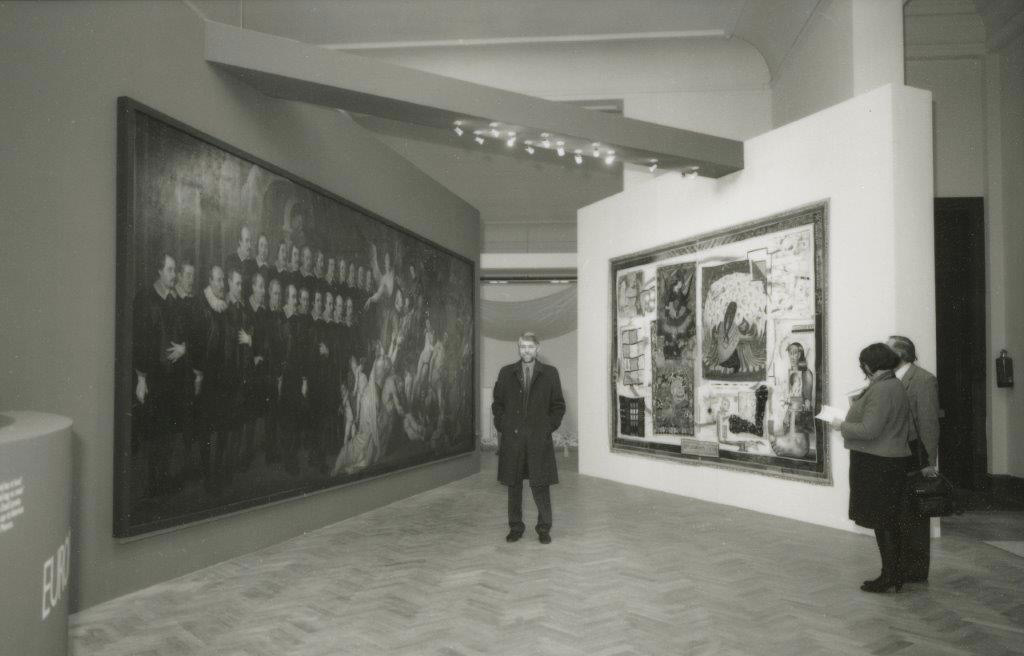
Historical objects and documents were juxtaposed with modern artworks, which examined the construction of post-independence Latin American identities and elaborations on the trauma of colonialism (Img. 4). The curators also commissioned new works from twenty-four contemporary artists from Latin America, among them Ana Mendieta, Victor Grippo, Eugenio Dittborn, Oscar Muñoz, Cildo Meireles, Waltércio Caldas, Roberto Evangelista, Cecilia Vicuña, José Bedia Valdés, Regina Vater, and David Lamelas. Their works were strategically exhibited in the galleries beneath early modern European paintings, opening new avenues for examining colonialism’s long history and the European art canon (with the exception of Lamelas’s When the Sky is Low and Heavy, which was built outside the museum).
Compared to previous large-scale exhibitions that incorporated the same global framework by expanding their geographic scope and including objects produced by the so-called “others,” America: Bride of the Sun was more successful at incorporating a postcolonial critique. Exhibitions such as Jean-Hubert Martin’s 1989 Magiciens de la terre, at the Centre Georges Pompidou, and MoMA’s 1984 Primitivismin 20thCentury Art failed at the attempt to rethink Western aesthetic parameters, since they retained a unilateral historical framework that ended up reinforcing ideas of cultural superiority. Nonetheless, America: Bride of the Sun did not escape criticism. In an interview with De Zegher published in the exhibition catalog, the critic Benjamin Buchloh called attention to the consonance between the exhibition and the neoliberal agenda that supported UNESCO’s initiative to further multiculturalism.17 He suggested that the exhibition ran the risk of contributing to the consolidation of a trend in investments and consumption in the art world that sought to expand to encompass contemporary art from Latin America. In response, De Zegher argued that the exhibition critically addressed Western propaganda systems to examine their role in the expansion of capitalism; in this, the juxtaposition of contemporary and old works played a key role.
Image 4. Installation view showing Huybrecht Sporckmans’s painting “The City of Antwerp Implores Emperor Ferdinand to Reopen the Scheldt (1677)” and Juan Davila’s “Mexicanism” (1990), at the exhibition America Bride of the Sun, Royal Museum of Fine Arts Antwerp, 1992. Archive KMSKA – Photo archive – Opening exhibition America, Bride of the Sun – 1992.
The curators’ response shifted attention to the critical operations resulting from the exhibition’s thematic framework while dismissing concerns about the site itself, produced by the museum’s own geographic location and institutional framework, which were at the core of Buchloh’s critique. Evangelista’s installation played with this inherent tension between institutional space, place, and postcolonial curatorial discourse. By employing gourds as a fundamental element and transporting them into the museum, Evangelista provocatively aroused an image of the exotic linked to Indigenous America. A feeling of otherness was produced by the very framing of these objects within the museum space, an institution based on Enlightenment ideology and founded in the 19th century to house art objects from Northern Europe, outlining the teleology of modernity. Thus, by incorporating the museum space into his work, Evangelista highlighted the material and ideological intertwining of that particular institution with the history of colonialism.
From Indigenous Women’s Workshops to Alexandre Rodrigues Ferreira’s Collection: The Social Trajectories of Gourds in the Late 18th Century
Evangelista’s critical operations framed the displacement of gourds, from the Americas to European institutions committed to the Enlightenment cultural project, within a broader history. One famous early modern episode was the inclusion of gourds in the collection of Amazonian artifacts, fauna, and flora assembled in the late 18th century by the Bahia-born naturalist Alexandre Rodrigues Ferreira and sent to the Real Gabinete de História Natural in Lisbon. Rodrigues Ferreira was a student of the Italian naturalist Domenico Vandelli, who led the project of Luso-Brazilian Enlightenment and educational reform at the University of Coimbra during the rule of the Marquis of Pombal in 1772.18
Between 1783 and 1792, Rodrigues Ferreira carried out a scientific expedition in the Amazon basin with the goal of investigating, describing, cataloging, and producing illustrations of the three kingdoms of nature (mineral, animal, and plant), in addition to writing observations on local social life. As Adelino Brandão has pointed out, the primary purpose of the expedition was to provide the Portuguese Crown with an “inventory of economic, commercial, and colonization possibilities” in the Amazon.19 Queen Maria I of Portugal supported the expedition during a period of economic hardship following the so-called Pombal Era (1750-1777).20 With Napoleon’s invasion of Portugal in 1807, Rodrigues Ferreira’s writings and collections were plundered and dispersed; a significant part of the botanical, animal, and mineral collections were incorporated into the Natural History Museum in Paris.21 Upon the transfer of the Portuguese Crown to Rio de Janeiro, Brazil, another significant part of the collections and documents were moved to the new Imperial capital; the gourd collection, however, remained in Lisbon and was transferred to the Academia Real das Ciências in 1836.22 Today, part of the gourd collection is held by the Academia de Ciências in Lisbon and another part by the University of Coimbra.
On February 4, 1786, during his stay in the town of Barcelos on the Rio Negro’s right bank, Rodrigues Ferreira wrote an account of the making of gourds by Indigenous women in the villages of Monte Alegre and Santarém (former Jesuit villages of Gurupatuba and Tapajós, respectively), at the confluence of the Tapajós and Amazon rivers.23 This account was produced as the expedition traversed the Portuguese territories of Grão-Pará and Rio Negro (1783–1788). The team included the Portuguese draftsmen Joaquim José Codina and José Joaquim Freire, and the botanist Agostinho José do Cabo, as well as numerous Indigenous guides and informants (who frequently abandoned the group, according to Rodrigues Ferreira’s correspondence).24
Rodrigues Ferreira’s expedition was one of several strategic ventures sponsored by the Portuguese Crown to delimit the boundaries of Portuguese colonial possessions in the Amazon, following the Treaty of Madrid (1750) and the Treaty of San Ildefonso (1777), amid a drastic process of political and administrative territorial reconfiguration. The signing of the Treaty of Madrid spurred efforts to demarcate the frontiers between Portuguese and Spanish possessions based on new geographic and legal parameters.25 The Treaty of San Ildefonso later revised and renegotiated these parameters.26 Rodrigues Ferreira delimited the cultural-social and biological space of the Amazon claimed by the Portuguese so as to assign that biocultural diversity a political unity under the authority of the Portuguese Crown. This must be understood against the background of the diverse, fluid, and immense mosaic of ecosystems, with its corresponding cultural and historical diversity, that form the entire Amazon basin and goes beyond the political limits established by the Treaty of Madrid in 1750. While the hydrographic reality escaped homogenization, an Amazonian space was constructed as a unified political concept in the practices of 18th-century administrators and explorers to fulfill colonization projects.
Concurrently, the Portuguese began to urbanize the Amazon during the government of Francisco Xavier de Mendonça Furtado, who was in charge of delimiting the northern border of Portuguese colonial possessions along the Amazon river, and of promoting the abolition of old missions and missionary settlements to make way for towns and fortresses under secular authority. Renata Malcher de Araujo has analyzed the ideological foundations of this first urbanization period, which conceived occupied space through the Enlightenment opposition of the urban versus the wild.27 The dialectic between the urban (as a civilized place) and the bush (as a wild, empty space susceptible to enemy occupation) performed a discursive operation in which the latter gradually gave way to the former, resulting in the unification of all occupied space. Geographical maps, urban layouts, and architectural plans, such as those produced during Rodrigues Ferreira’s expedition, were instrumental to this process of material and symbolic spatial production, certifying to the Portuguese Crown the accomplishment of the colonial territory’s political, administrative, and military reorganization.
The spatial transformation of the Amazon basin from 1750 onwards was accompanied by a series of changes in legislation concerning Indigenous peoples, triggered by disputes between administrators and Jesuits over the control of Indigenous labor.28 In 1757 the Diretório dos Índios was implemented; this colonization instrument, likewise based on actions described as “civilizatory,” established the removal of the missionaries’ guardianship over Indigenous peoples and centralized the Portuguese administration’s control over Indigenous social practices (such as marriage, education, housing, and daily relationships within Indigenous communities).29 In 1759 the Jesuits were cast out of the Portuguese colonial possessions.
Rodrigues Ferreira’s “Memória sobre as cuias” (Report on Gourds) offers a firsthand account of that process decades after the Diretório dos Índios was implemented. The naturalist had visited the workshops of Indigenous women who produced hand-painted gourds in Monte Alegre and Santarém in 1785. He wrote similar accounts during the same period in Barcelos, all based on observations and information gathered during the first phase of the trip (1783-1788), and intended to accompany the shipments of objects to Lisbon. Examples include “Memória sobre as salvas de palhinha” (Report on Straw Plates) and “Memória sobre a louça que fazem as índias do estado” (Report on Ceramics made by the Province’s Indian Women), dated February 5, 1786. In his reports on straw plates and gourds, in addition to providing detailed accounts of their market prices, Rodrigues Ferreira discussed the exploitation of the Indigenous women’s labor by the village directors and commanders. In this way, he was a witness to the Diretório dos Índios’s impact on Indigenous lives.
The documents attest that Rodrigues Ferreira spoke with informants (probably the artisans themselves) to obtain information about the raw materials, techniques, and consumer market of the artifacts they produced, revealing his efforts to track the entire production chain and create a clear economic scheme for their manufacture. He collected samples of the referred objects on site to be sent to the Real Gabinete de História Natural in Lisbon, and the reports were intended to accompany boxes containing the samples. All of these accounts emphasize the fact that Indigenous women drove manufacturing economies in the Amazon basin, being the leading producers and traders of such artifacts. Rodrigues Ferreira meticulously described the collected objects, raw materials, techniques, and local uses to facilitate an understanding of their significance by recipients in Lisbon. Along with these written accounts, drawings and watercolors by Freire and Codina were sent with the objects. A watercolor signed by Freire (Img. 5) depicts the workshop used by the Indigenous women of Monte Alegre to produce the gourds, and the various stages of their making, which are also described in detail by Rodrigues Ferreira. Thus, we can imagine a multimedia presentation of these artifacts, circulating from the Amazon river to Lisbon in the form of written and visual explanations.
Image 5. Freire, José Joaquim, “Prospecto das Casas das Índias de Monte Alegre, onde faziam as cuyas” (Prospectus of the Casas das Índias of Monte Alegre, where the gourds were made), 1785-6. Acervo da Fundação Biblioteca Nacional - Brasil
Besides providing a context for interpreting the objects, facilitating their cataloging and recontextualization within the collection in Portugal, Rodrigues Ferreira’s reports, along with the drawings and watercolors by Freire and Codina, also served to diagnose the colony’s economic and social dynamics. According to Rodrigues Ferreira, between five and six thousand calabash gourds were produced for sale in 1785; Portuguese merchants, he observed, would purchase and resell them across the region, transport them to other regions to trade, and export them to Europe.30
Image 6. Gourd collected by A. Rodrigues Ferreira in Monte Alegre, 1785-6. Museu da Academia de Ciências de Lisboa.
Studies by Renata Maria de Almeida Martins have pointed to a series of cultural exchanges that occurred through the production and consumption of these objects. De Almeida Martins notes that the gourds collected by Rodrigues Ferreira were produced using traditional techniques, that is, by applying black varnish (cumaty) and colorful decoration with vegetable dyes;31 however, instead of geometric motifs, as was the Indigenous tradition, they are decorated with patterns drawn from the European Baroque repertoire, often strongly inspired by Eastern decorative art (Img. 6).32 De Almeida Martins notes the substantial similarity between these decorations and those found in objects produced in Asia for the European market (such as boxes, cups, and lacquer pots), and in Japanese and Indo-Portuguese furniture (such as porcelain and textiles). This reinforces the idea that the gourds collected by Rodrigues Ferreira were participants in a broader cultural exchange network, inserting Amazonian products and producers in global transits.33
In this way, it is interesting to observe how gourds were involved in the forging of cosmopolitan identities. Those extensive trade networks impacted their production, as Indigenous women recognized a commercial interest in them from the Portuguese settlers and overseas and began to produce them according to their tastes. Thekla Hartmann identified this trade network in 18th-century censuses that classify the decorated gourds produced by Indigenous women as a socially established craft.34 Rodrigues Ferreira also remarked on the emergence of new uses for them caused by the broadening of exchange networks, such as a tea set made of calabash gourds bearing new decorative patterns that signaled geographic distance and exoticism, such as oriental motifs, which granted users cosmopolitan status and identity.35
Hartmann points out that gourds are listed as products of intertribal trade across the Amazon basin in reports dating back to the 16th century, such as those by the Dominican Gaspar de Carvajal in 1543, the Jesuit Samuel Fritz and bishop João de São José, written between 1762 and 1763, and the Jesuit missionary João Daniel.36 They also found a place in the colony’s economic life and entered transatlantic trade with the metropolis. Since the 18th century, they have played an important role in the economy of the lower Amazon, massively produced in Indigenous women’s workshops. When they entered Rodrigues Ferreira’s collection they acquired a new status as examples of the Amazon basin’s colonial habits and a potentially lucrative economic activity that the metropolis could exploit.37 Their trajectories from the lower Amazon to the natural history collection in Lisbon in the late 18th century were symptomatic of an exploitative logic over Indigenous labor and the incorporation of Amazonian material culture into the metropolitan process of capital accumulation.
Gourds in the Fluxes of Life: Everyday, Ritual, and Symbolic Objects
Examining historical narratives of the Amazon basin, Ana Pizarro argues that “in a universe where transport is fundamentally river-based, travel is, above all, a permanent structure.”38 Pizarro draws attention to a fluvial emphasis in the historical accounts of the Amazon in relation to other Latin American regions, a specific trait verified in historical sources that date back to the 16th century.39 The fluvial discourses that have historically constructed the Amazon concern navigation, waters fluxes, scientific explorers, Indigenous aquatic nations, and the central role of waters to modern Amazonian states. The narratives of Rodrigues Ferreira’s expeditions within and beyond the continent are also permeated by that fluvial discursive element. Often, the fluvial element brings narrative obstacles, danger, diseases, and isolation. In his writings, the gourds appear as participating in trade through aquatic routes.
Evangelista re-created water routes to tell other neglected histories involving gourds. Sâmara Evangelista, the artist’s daughter, explained that he was interested in the ritual and functional values of gourds as everyday objects in the Amazon basin.40 Gourds forge Indigenous and caboclo identities in the Amazon.41 They are ubiquitous in daily activities like eating, drinking water, and bathing; and play a role in sacred practices among Amazonian Indigenous peoples. They are thus present in all circumstances of life.
In the 1970s calabash gourds became the fundamental formal and conceptual element of Evangelista’s work. In his first installations they are often employed in association with other local Amazonian materials such as urucum (Bixa orellana) and manioc flour, weaving discourses on Amazonian identities. The agency of gourds in his work is also connected to their potential as symbolic objects, being bearers of the circular shape, "a primordial rational structure of Amazonian nature".42 In his views, this circular shape represented the element of Amazonian cultural resilience that survived countless invasions throughout history and was rooted in the deeper histories of Indigenous cultures.
In his first experimental video, Mater dolorosa, in memoriam II. Da criação e sobrevivência das formas (Mater dolorosa, in memoriam II: On the Creation and Survival of Forms), filmed in 1978 at the Lago do Arara, in the Rio Negro (Img. 7), Evangelista employed gourds in dialogue with the Tukano pajé (shaman) Bibiano Costa, incorporating the Tukano conceptualization and social practices in relation to gourds.43 Among Tukano and Maku communities in the upper Rio Negro gourds are employed in ipaducircles,events for the collective consumption of coca (Erythroxylum coca) and caxiri (manioc-based alcoholic beverage), and knowledge socialization.44 Gourdsfunction here as transitional objects, passed around circle participants. Their names change according to their ritual function.45 They also feature in mythical narratives of the creation of the universe and humankind.46 Together with cigars, they are employed in enchantment rites as vessels to hold healing substances while prayers are chanted.47
In Tukano myths, they are fundamental objects in transformative, creational, and reproductive episodes. In his film, Evangelista weaves a cosmological narrative where gourds are associated with life-giving sources such as the sun, the human head, the stomach, and the navel, thus linking them to basic life processes such as procreation, nourishment, and cognitive functions. The various shifts in their framing and meanings in the film echo their quality as symbolic objects, connected with local practices, memories, and identity formation among inhabitants of the upper Rio Negro.
Image 7. Evangelista, Roberto. Scene from “Mater Dolorosa in Memoriam II (On the Creation and Survival of Forms)”, film, 16mm, 12min, 1978. Courtesy of Evangelista Family Collection.
In the film, the artist moved his work with gourds out of traditional exhibition spaces, a gesture that can be regarded as a precedent for Resgate. In a new context and situation, drifting and dancing in groups on the waters, he multiplies the significance of the gourds and incorporates the Lago do Arara into the artwork as their support and spatial context. In Resgate the artist expands this gesture to include the circulation of Amazonian objects along transatlantic networks.
Evangelista’s work in the 1970s responded critically to the rapid advance of Brazil’s military regime into the region and the increasing industrialization and urbanization that brought about drastic demographic, cultural, and ecological transformations. The Brazilian military seized power through a coup d’état in April 1964 and, in 1970, launched the Programa de Integração Nacional (PIN, National Integration Program), a series of infrastructure projects that included extensive road systems, industrialization, the expansion of agribusiness, cattle ranching, and mining in the rainforest. In 1967 industrial expansion took shape with the establishment of the Zona Franca de Manaus (Manaus Free Trade Zone), in the artist’s hometown, which enabled the region’s exploitation by multinationals and financial capital.
In the meantime, according to Márcio Souza, artists in the city of Manaus (mainly related to the avant-garde group Clube da Madrugada) began to aesthetically organize the collective perception of Amazonian cultural and environmental transformations, elaborating on its peripheric position in relation to the Brazilian Southeast and moving away from the modernist Southeastern avant-garde whose proposals were in alignment with developmentalism.48 As Souza explains, despite the existence of urban centers in the Amazon since the 17th century, representations of the Amazon as a primitive realm of pristine nature and wilderness proliferated in the 20th century to better market the region nationally and internationally, furthering the unapologetic exploitation of its natural and human resources.49 The exploitation of the Amazon and its socioeconomically peripheral position reflected Brazil’s modernity project. Evangelista was part of the younger generation in the 1970s who envisioned critical responses to that peripheral condition and the exoticization of the Amazon, which were part of the same colonial logic.
A Political Ecology of Ritual Cleansing
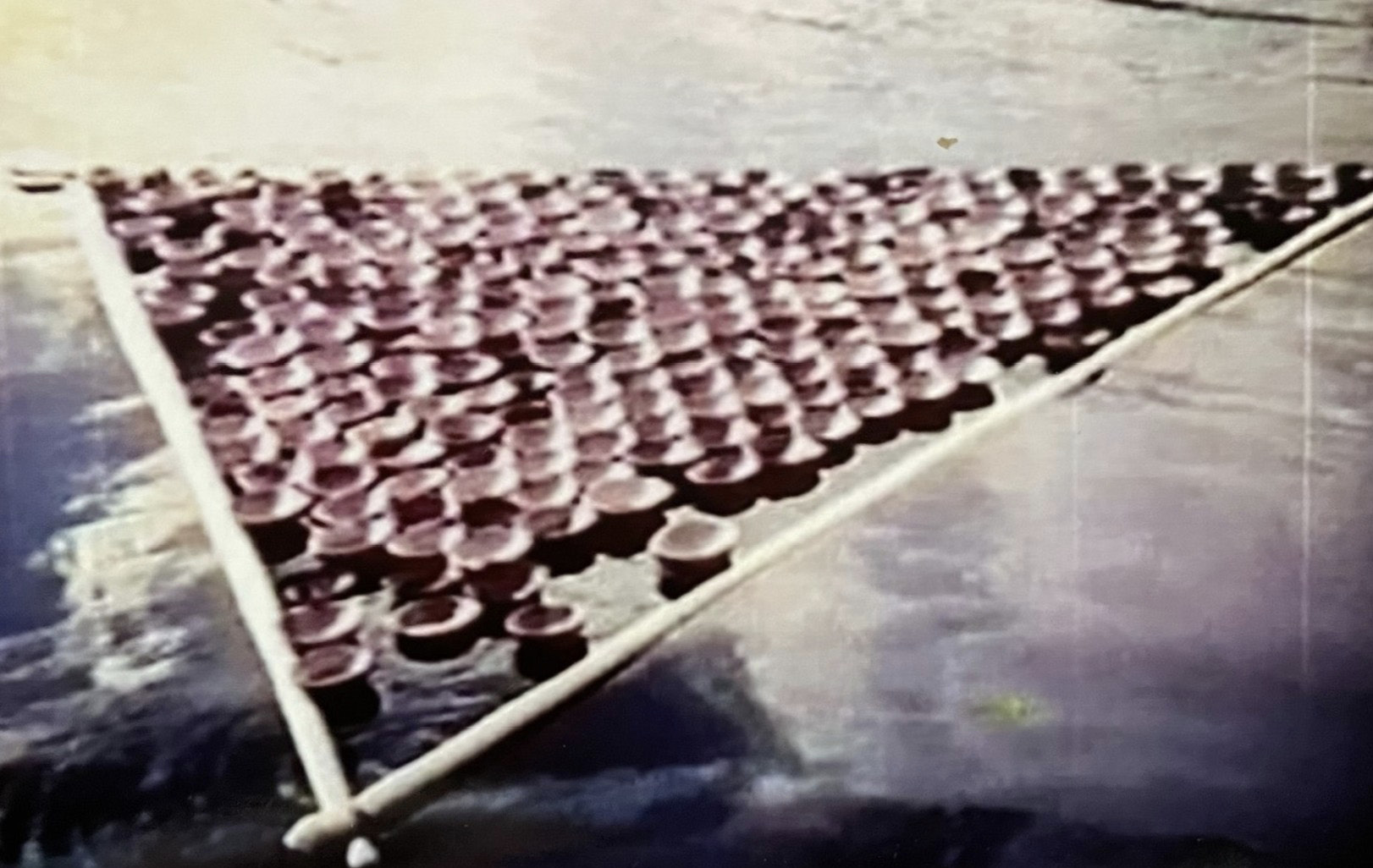
The undulating arrangement of the gourds in Resgate suggests movement in an aqueous medium, reminiscent of the vessels floating on the Rio Negro in Mater dolorosa, in memoriam II. This element also connects the installation with a homonymous work, produced by the artist at the same time in another location. Evangelista summoned the people of Manaus through a variety of media outlets (such as newspapers and television) to participate in a collective performance that would take place at the Ponta Negra beach, along the Rio Negro, on February 21,1992.50 The work was part of the Goethe-Institut’s project Arté Amazonas, which gathered artists of different nationalities fora three-week artistic residency taking place in three cities in the Brazilian Amazon, Manaus, Belém, and Porto Velho. Their work was shown in the Modern Art Museum in Rio de Janeiro later that year. The initiative was conceived as an artistic response to the Rio Summit taking place that year.51
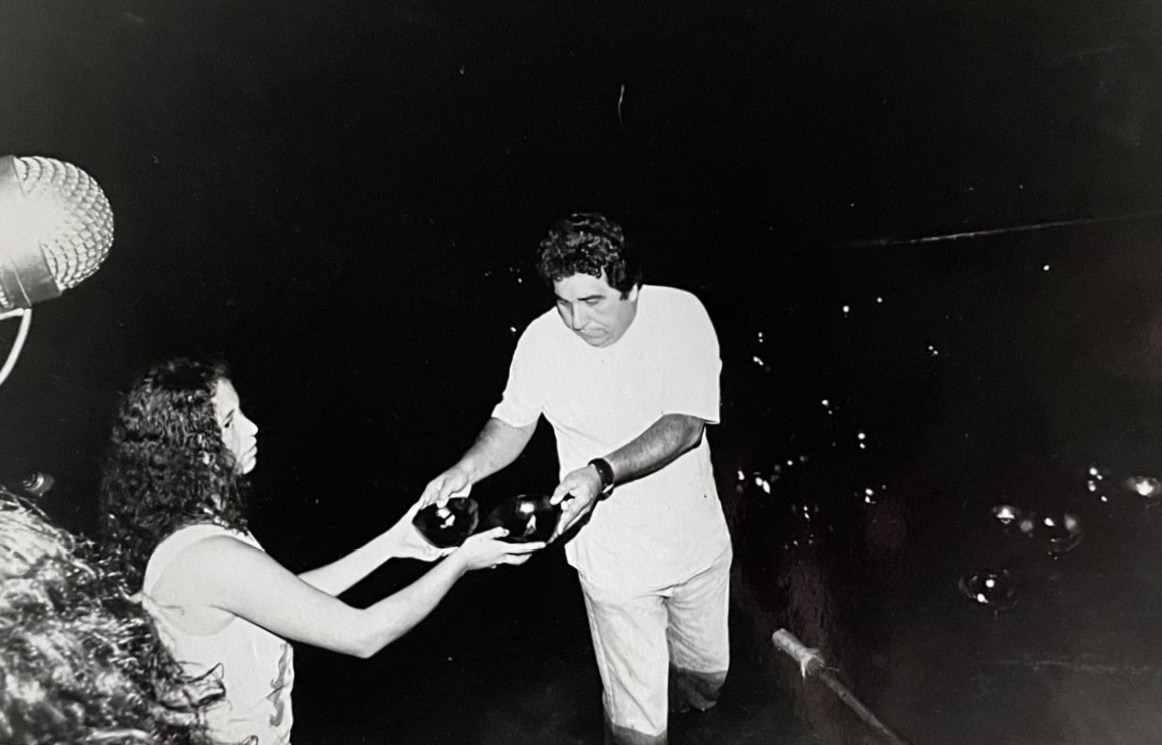
On the video and photographs documenting the performance one can see a crowd (almost 500 people) gathering on the beach at night, holding gourds containing lit candles. The crowd sang a song composed by Evangelista in partnership with Celdo Braga while handing the gourds to the artist (Img. 8). He then released them into the Rio Negro, where they were contained by a large triangular structure made of miriti branches knotted together. Sâmara Evangelista compares the performance with a sort of collective ritual to rescue local memories and knowledge. Among riverine and Indigenous communities, when someone drowns and the body cannot be found, gourds containing lit candles are cast into the river at night to reveal the location of the body. Finding the body means the person will not be forgotten.
Image 8. Evangelista, Roberto, “Resgate”, happening at Ponta Negra Beach, Manaus, February 21, 1992. Courtesy of the Evangelista Family Collection.
According to Renato Athias, gourds filled with water are employed in healing processes that use enchanted words referring to a mythological time (Pa’miri-masa), shared among various Indigenous groups along the Negro, Apaporis, and Caquetá rivers.52 Athias states that water is the vital principle among the Indigenous peoples of the Rio Negro; in the shaman’s hands, it is invested with the power to cleanse.53 Evangelista’s work built on this magical repertoire to show alternative ways of tackling the problems unleashed by industrial capitalism on Earth, evoking Indigenous Amazonian regenerative practices. In John Arden’s film Artists to the Amazon (1992) Evangelista explains that Resgate is a work that not only mourns the dead (those murdered over the five hundred years of colonization of the Amazon basin) but also seeks to restore the identity of those who are alive.54
As pointed out by critic Jean Fisher, in Antwerp Evangelista initially intended to light the candles, place them inside the gourds, and fill them with water and oil. However, the museum’s director Lydia Schoonbaert requested alterations to the project due to concerns surrounding the conservation of the permanent collection.55 The risk of burning the building to the ground added another powerful gesture to Evangelista’s work: one of purification by fire. Evangelista agreed to keep only one lit candle placed inside the darkest gourd, filled with water, next to a floor tile featuring the hand that symbolizes Antwerp’s history of free trade on the waterways. Waters that had connected the globe, that had provoked encounters on a global scale, that took part in colonial enterprises and the spread of capitalism across Earth. The water and lit candle inside the gourd activated water’s power to heal colonial trauma by keeping Amazonian practices and knowledges alive.
Conclusion
As we approach the end, and before the concluding paragraphs, I want to point out another avenue for expanding the field of art history and reassessing the significance of Evangelista’s work in reconceptualizing the Amazon basin as a historical landscape: the dialogue with historical ecology, which undermines previously prevalent notions of pristine nature. We grasp the environmental implications of Evangelista’s deployment of calabash gourds when we consider social interactions in the Amazon basin over a longer span of time. These implications can be elucidated in conversation with historical ecology, combined with archeological data and ethnobotany.
Recent studies have shown that species of the genus Crescentia have taken part in social interactions with humans for millennia in the Americas; humans were the main agents of their dispersal.56 The oldest records of human associations with Crescentia in South America date to five thousand years ago in Peru and one thousand years ago in Ecuador.57Studies by Xitlali Aguirre-Dugua and Alejandro Casas have shown that, in Mesoamerica, the use of fruits of the genus Crescentia to manufacture bowls can be dated to 2,400 years BP, at the latest.58 According to Aguirre-Dugua et al., the Maya valued these round fruits (similar to those employed by Evangelista in his work) over long ones for producing drinking vessels used both in everyday and ritual activities; this was a strong selection factor in the history of adaptation and dispersal of that plant in the Americas.59 According to Priscila Ambrósio, the elongated species migrated from the Orinoco basin to Mexico and to the Negro, Solimões, and Madeira rivers, while the genetic profile of round fruits found in the medium and lower Amazon suggests a dispersal coming from the Caribbean through the Guianas.60 In the colonial period, the round species spread up to the Rio Negro.61 For the people in the upper stretch of the river, those round gourds were reminders of the forced Indigenous migrations coming from the lower Amazon areas in colonial times.62
Ambrósio has identified the historical effects of centuries of use and circulation in the morphological and genetic profiles of gourds in the Amazon basin. According to the author, gourds narrate a history of “coevolution with the dynamics of rivers, extinct dispersers, pollinators, social and economic arrangements over time and space in the Amazon.”63 It is important to note Ambrósio’s use of the term “coevolution;” although humans played a role in the evolution and dispersal of that species, the calabash tree also shaped human gestures, knowledge, cultural practices, and identities. They became temporal-ritual markers of crucial moments in the lives of riverine communities, devices for delimiting territories, companions in ritual and healing practices, and agents in reproductive processes.64 Both their presence and absence in a certain area and space are signs of social relations. They populate the sacred realm for many Indigenous cultures in the Amazon river basin as participants in spiritual rites.
The tree has been ubiquitous in every moment of daily life in the Amazon basin among various communities, both rural and urban, from bathing, sailing, and cooking to storing things. It combines the history of the rainforest with human practices, intertwining the biological and cultural spheres. All these socioenvironmental qualities of gourds are activated in Evangelista’s work, as he arranges them in different circumstances—either floating on the Rio Negro or blocking access to an art institution.
Installation art engages in artistic operations of appropriation, juxtaposition, and institutional critique. Resgate pointed out the Royal Museum of Fine Arts’s material and ideological entanglement with the history of colonialism. Upon entering exhibition spaces that are connected with the global market, calabash gourds expose the long history of the circulation of Amazonian products, people, fauna, flora, and images during the formative stages of global capitalism. In this way, the installation fostered connections with the early modern circulation of gourds from the Amazon basin to European collections like the one assembled by Rodrigues Ferreira, where gourds functioned as exotica, scientific samples, and prospects of capitalist commodification. Rodrigues Ferreira’s collecting and accounts were part of a colonial project based on the exploitation of Indigenous labor in the Amazon basin and conceptions of Amazonian nature as an economic resource in the metropolitan process of capital accumulation.
Through Rodrigues Ferreira’s accounts and gourd collection it is also possible to observe their agency in the forging of new social identities in the colonial period. We are informed that Indigenous women drove those manufacturing economies while facing new economic pressures from colonial administrators. Their use of Baroque decorative patterns attests to their awareness of the geographical distances to be crossed by those objects and their participation in long-distance networks. Moreover, it is reasonable to think that cosmopolitan identities were forged on the side of the consumers; among these, the combination with Eastern fashion and cultural practices signaled geographic distance and exoticism.
In Evangelista’s installation gourds purposely walked the fine line between exotica and commodity (as suggested in Buchloh’s criticism), seeking to expose the exhibition’s bias through their juxtaposition with the architectural space. Resgate forced visitors to confront the objects that blocked the normal flow of the building’s entrance hall, since the gourds were not safely enclosed behind glass windows (Img. 9). They thus produce another subjective position, moving away from both Enlightenment examination and contemplation to produce strangeness and confrontation. That effect is increased by the gourds’ discursive power, which is based on intensities—of quantity, placing, and disposition.
Image 9. Evangelista, Roberto. Resgate. Installation for the exhibition America Bride of the Sun. Gourds, water, candle (1992). Archive KMSKA – Photo archive – Opening exhibition America, Bride of the Sun – 1992.
By shifting attention to the Amazon’s materiality and cultural practices, Evangelista introduced powerful means for the re-elaboration of the two fundamental and interrelated questions of colonial trauma and environmental collapse. The performance version of Resgate on the Rio Negro reenacted Amazonian ritual cleansing and reframed the installation in Antwerp as another healing gesture, founded on the preservation of the memories and trajectories of silenced actors. Evangelista’s work prompts us to reconsider histories of colonial encounters and shift attention to the agency of objects like gourds. As such, it provides a counterpoint to modern rationality grounded in the separation between nature and culture; in this work, the Amazon basin emerges as a historical landscape, shaped by the trajectories and associations of human and more-than-human actors.
Bibliography
Aguirre-Dugua, Xitlali and Alejandro Casas. “Mesoamerica in a Bowl: The Botanical and Cultural Heritage of Crescentia L. Vessels.” Current Anthropology 64, n.o 5 (2023): 528-549.
Aguirre-Dugua, Xitlali et al. “Round and Large: Morphological and Genetic Consequences of Artificial Selection on the Gourd Tree Crescentia cujete by the Maya of the Yucatán Peninsula, Mexico.” Annals of Botany 109, n.o 7 (2012): 1297-1306.
Altic, Mirela. “Missionary Cartography of the Amazon after the Treaty of Madrid (1750): The Jesuit Contribution to the Demarcation of Imperial Frontiers.” Terrae incognitae 46, n.o 2 (2014): 69-85.
Ambrósio Moreira, Priscila. “Memórias sobre as cuias. O que contam os quintais e florestas alagáveis na Amazônia brasileira?”. In Vozes vegetais. Diversidade, resistências e histórias da floresta,edited by Joana Cabral de Oliveira et al., 154-166. Ubu / IRD, 2020.
—. “História evolutiva das árvores de cuia (Crescentia cujete). Uma integração entre genótipo, ambiente e cultura.” PhD dissertation, Instituto Nacional de Pesquisas da Amazônia, 2017.
Appadurai, Arjun. The Social Life of Things: Commodities in Cultural Perspective. Cambridge University Press, 1986.
Athias, Renato. “Kumuá, baiároá e yaís. Os especialistas da cura entre os índios do rio Uaupés-Am.” Somanlu 7, n.o 1 (2007): 87-105.
—. “Medicina indígena no Rio Negro. Experiências de um projeto.” In Medicina tradicional indígena em contextos, edited by Louciane Ourique and P. S. Osório, 101-109. Funasa, 2007.
Belting, Hans. “From World Art to Global Art: View on a New Panorama.” In Global Contemporary and the Rise of New Art Worlds, edited by Hans Belting, Andrea Buddensieg, and Peter Weibel, 178-185. ZKM, 2013.
Beksta, Casimiro J. “Mito da origem dos índios tukano, dessano e maku. Relato do pe. Casimiro Beksta sobre desenhos de um índio tukano,” https://acervo.socioambiental.org/acervo/documentos/mito-da-origem-do-mundotukano-dessano-maku.
DaCosta Kaufmann, Thomas, Catherine Dossin, and Béatrice Joyeux-Prunel. Circulations in the Global History of Art. Routledge, 2016.
De Almeida Martins, Renata Maria. “Cuias, cachimbos, muiraquitãs. A arqueologia amazônica e as artes do período colonial ao modernismo.” Boletim do Museu Paraense Emílio Goeldi. Ciências humanas 12, n.o2 (2017): 403-426.
Fernandes, Estevão Rafael. “Normalizando povos indígenas. Um olhar sobre o Diretório Indígena(1757).” RIDH 7, n.o 2 (2019): 39-59.
Ferrão, Cristina and José Paulo Monteiro Soares. Viagem ao Brasil de Alexandre Rodrigues Ferreira. A expedição philosophica pelas Capitanias do Pará, Rio Negro, Mato Grosso e Cuyabá. Kapa, 2005.
Gonçalves de Carvalho, Luciana et al. O artesanato de cuias em perspectiva. Santarém. IPHAN / CNFCP, 2011.
Hartmann, Thekla. “Evidência interna em cultura material. O caso das cuias pintadas no século XVIII.” Revista do Museu Paulista 33 (1988): 291-302.
Hug, Alfons and Nikolaus A. Nessler. Arte Amazonas. Uma contribuição artística para a Conferência das Nações Unidas sobre o Meio Ambiente e Desenvolvimento “Rio 92.” Goethe-Institut Brasília, 1992.
Ishihara Brito, Adilson Junior. “Domar as águas e os sertões da fronteira intra-americana. A centralidade dos caminhos fluviais nas disputas luso-espanholas do Tratado de Santo Ildefonso.” Revista brasileira de história 39, n.o 82 (2019).
Malcher de Araujo, Renata. “A urbanização da Amazónia e do Mato Grosso no século XVIII. Povoações civis, decorosas e úteis para o bem comum da Coroa e dos povos.” Anais do Museu Paulista 20, n.o 1 (2012): 41-76.
Mattos, Claudia. “Geography, Art Theory, and New Perspectives for an Inclusive Art History.” The Art Bulletin 96, n.o 3 (2014): 259-264.
Mazadiego, Elize and Stefaan Vervoort. “When the Sky Is Low and Heavy: David Lamelas and Transnational Heritage in Flanders.” Arts 11, n.o 24 (2022): 1-17.
Ortiz, Fernando. Contrapunteo cubano del tabaco y el azúcar. Ayacucho, 1987.
Pádua, José Augusto. Um sopro de destruição. Pensamento político e crítica ambiental no Brasil escravista, 1786-1888. Zahar, 2002.
Paiva Ramos, Danilo. “Círculos de coca. Encontros noturnos e caminhos vividos pelos hupd’äh (maku).” PhD dissertation, University of São Paulo, 2013.
Pãrõkumu, Umusi (Firmiano Arantes Lana) and Tõrãmü Kehíri (Luiz Gomes Lana). Antes o mundo não existia. Mitólogia dos antigos desana-kêhíripõrã. UNIRT / FOIRN, 1995.
Pizarro, Ana. Amazônia.As vozes do rio. UFMG, 2012.
Ribeiro Chaves, Otávio. “América portuguesa: do Tratado de Madri ao Tratado de Santo Ildefonso.” Territórios e Fronteiras 7, n.o 2 (2014).
Riello, Giorgio and Anne Gerritsen. Global Lives of Things. Routledge, 2015.
Rodrigues Ferreira, Alexandre. Viagem filosófica pelas capitanias do Grão-Pará, Rio Negro, Mato Grosso e Cuiabá. Valer, 2008.
—. Viagem filosófica pelas capitanias do Grão-Pará, Rio Negro, Mato Grosso e Cuiabá. Conselho Federal de Cultura, 1972-1974.
—. “Memória sobre as cuias que fazem as índias de Monte Alegre e Santarém.” Revista nacional de educação 6 (1933): 58-63.
Souza, Márcio. A expressão amazonense. Valer, 2010.
Rocha da Costa, Dóris Karoline, Josiane Lima do E. Santo, and Sávio Stoco. “Artists to the Amazon. A descoberta da fonte videográfica da instalação/performance Resgate (1992) de Roberto Evangelista.” XXXI CONFAEB, 2022.
Subrahmanyam, Sanjay. “Connected Histories: Notes towards a Reconfiguration of Early Modern Eurasia.” Modern Asian Studies 31, n.o 3 (1997): 736-737.
Vandenbroek, Paul and Catherine de Zegher. America. Bruid van de zon. Imschoot, 1992.
Vincent, William Murray. “Daxsea Mahsa: Cosmology and Material Culture among the Tukano Indians of Brazil.” PhD Dissertation, University of Illinois, 1985.
Cómo citar:
Paiva de Toledo, Gabriela. “Calabash Gourds in the Work of Roberto Evangelista: Amazonian Agencies and Trajectories”. H-ART. Revista de historia, teoría y crítica de arte, n.o 23 (2026): 153-180. https://doi.org/10.25025/hart.11794.
1. Luciana Gonçalves de Carvalho et al., O artesanato de cuias em perspectiva. Santarém (IPHAN, CNFCP, 2011).
2. Priscila Ambrósio Moreira, “Memórias sobre as cuias. O que contam os quintais e florestas alagáveis na Amazônia brasileira?,” in Vozes vegetais. Diversidade, resistências e histórias da floresta, edited by Joana Cabral de Oliveira et al. (Ubu / IRD, 2020), 163.
3. Hans Belting, “From World Art to Global Art: View on a New Panorama,” in Global Contemporary and the Rise of New Art Worlds, edited by Hans Belting, Andrea Buddensieg, and Peter Weibel (ZKM, 2013), 178-185.
4. Belting, “From World Art to Global Art;” Claudia Mattos, “Geography, Art Theory, and New Perspectives for an Inclusive Art History,” The Art Bulletin 96, n.o 3 (2014): 259-264.
5. Thomas DaCosta Kaufmann, Catherine Dossin, and Béatrice Joyeux-Prunel, Circulations in the Global History of Art (Routledge, 2016); Giorgio Riello and Anne Gerritsen, Global Lives of Things (Routledge, 2015).
6 Arjun Appadurai, The Social Life of Things: Commodities in Cultural Perspective (Cambridge University Press, 1986).
9. Christy Anderson, Anne Dunlop, and Pamela H. Smith, The Matter of Art: Materials, Practices, Cultural Logics, c. 1250-1750 (Manchester University Press, 2015); Riello and Gerritsen, Global Lives of Things.
10. Fernando Ortiz, Contrapunteo cubano del tabaco y el azúcar (Ayacucho, 1987).
11. Sanjay Subrahmanyam, “Connected His- tories: Notes towards a Reconfiguration of Early Modern Eurasia,” Modern Asian Studies 31, n.o 3 (1997): 737.
12. Evangelista mentioned the number of gourds years later in a letter to a cultural organization in Manaus requesting funding to produce a similar work in the exhibition Brasil + 500. Mostra do redescobrimento (São Paulo, 2000). The letter is kept in Evangelista’s personal archive.
13. Elize Mazadiego and Stefaan Vervoort, “When the Sky Is Low and Heavy: David Lamelas and Transnational Heritage in Flanders,” Arts 11, n.o 24 (2022): 8.
15. Mazadiego and Vervoort, “When the Sky Is Low and Heavy,” 8-9; Paul Vandenbroek and Catherine de Zegher, America. Bruid van de zon (Imschoot, 1992), 251-428.
16. Mazadiego and Vervoort, “When the Sky Is Low and Heavy,” 8-9;America. Bruid van de zon, 429-527.
18. José Augusto Pádua, Um sopro de destruição. Pensamento político e crítica ambiental no Brasil escravista, 1786-1888 (Zahar, 2002), 13-15.
19. Adelino Brandão, Introduction, in Alexander Rodrigues Ferreira, Viagem filosófica pelas capitanias do Grão-Pará, Rio Negro, Mato Grosso e Cuiabá (Conselho Federal de Cultura, 1972-1974), 45.
20. Eduardo Galvão and Carlos A. Moreira Neto, Introduction, Viagem filosófica.
21. Cristina Ferrão and José Paulo M. Soares, Viagem ao Brasil de Alexandre Rodrigues Ferreira, vol. 1 (Kapa, 2005), 64.
23. Alexandre Rodrigues Ferreira, “Memoria sobre as cuyas,” Revista nacional de educação 6 (1933): 58-63.
24. Rodrigues Ferreira, Viagem filosófica, 7; Ferrão and Soares, Viagem ao Brasil.
25. Mirela Altic, “Missionary Cartography of the Amazon after the Treaty of Madrid (1750): The Jesuit Contribution to the Demarcation of Imperial Frontiers,” Terrae incognitae 46, n.o 2 (2014): 73-74. On the fundamental role played by rivers in territorial demarcations during the 18th century, see Adilson Junior Ishihara Brito, “Domar as águas e os sertões da fronteira intra-americana. A centralidade dos caminhos fluviais nas disputas luso-espanholas do Tratado de Santo Ildefonso,” Revista brasileira de história 39, n.o 82 (2019).
27. Renata Malcher de Araujo, “A urbanização da Amazonia e do Mato Grosso no século XVIII. Povoações civis, decorosas e úteis para o bem comum da Coroa e dos povos,” Anais do Museu Paulista 20, n.o 1 (2012): 48; see also Altic, “Missionary Cartography,” 75.
28. Otávio Ribeiro Chaves, “América portuguesa: do Tratado de Madri ao Tratado de Santo Ildefonso,” Territórios e fronteiras 7, n.o 2 (2014): 223.
29. Until the mid-18th century, measures to disrupt the modes of social organization and spatial occupation of the various Indigenous populations were more dispersed and relied on the notions of “just war (guerra justa)” and “rescue (resgate)” (when imprisonment and compulsory labor were permitted) and the so-called “descents (descimentos).” See Estevão Rafael Fernandes, “Normalizando povos indígenas. Um olhar sobre o Diretório Indígena(1757),” RIDH 7, n.o 2 (2019): 39-59.
30. Rodrigues Ferreira, “Memória sobre as cuias,” 62-63.
31. Renata Maria de Almeida Martins, “Cuias, cachimbos, muiraquitãs. A arqueologia amazônica e as artes do período colonial ao modernismo,” Boletim do Museu Paraense Emílio Goeldi. Ciências humanas 12, n.o 2 (2017): 413.
32. De Almeida Martins, “Cuias, cachimbos, muiraquitãs,” 404.
33. De Almeida Martins, “Cuias, cachimbos, muiraquitãs,” 414-415. De Almeida Martins explains the central role of the Jesuits in the exchange networks of objects and knowledge from Asia to Europe and the Portuguese and Spanish colonies in the Americas.
34. Thekla Hartmann, “Evidência interna em cultura material. O caso das cuias pintadas no século XVIII,” Revista do Museu Paulista 33 (1988): 295.
35. Rodrigues Ferreira, “Memória sobre as cuias,” 63.
36. Hartmann, “Evidência interna em cultura material,” 291-302; De Almeida Martins, “Cuias, cachimbos, muiraquitãs,” 410.
44. William Murray Vincent, “Daxsea Mahsa: Cosmology and Material Culture among the Tukano Indians of Brazil” (PhD dissertation, University of Illinois, 1985); Danilo Paiva Ramos, “Círculos de coca. Encontros noturnos e caminhos vividos pelos hupd’äh (maku)” (PhD dissertation, University of São Paulo, 2013).
46. Casimiro J. Beksta, “Mito da origem dos indios tukano, dessano e maku. Relato do pe. Casimiro Beksta sobre desenhos de um índio tukano,” https://acervo.socioambiental.org/acervo/documentos/mito-da-origem-do-mundotukano-dessano-maku; Umusi Pãrõkumu (Firmiano Arantes Lana) and Tõrãmü Kehíri (Luiz Gomes Lana), Antes o mundo não existia. Mitólogia dos antigos desana-kêhíripõrã (UNIRT / FOIRN, 1995).
50. The happening is mentioned in the variety section of the Jornal do Commercio on February 21, 1992, page 12; Dóris Karoline Rocha da Costa, Josiane Lima do E. Santo, and Sávio Luís Stoco report finding a newspaper article about the event titled “Ritual poético na Ponta Negra” and published on July 19, 1992 in the newspaper A Crítica. Dóris Karoline Rocha da Costa, Josiane Lima do E. Santo, and Sávio Luís Stoco, “Artists to the Amazon: A descoberta da fonte videográfica da instalação/performance Resgate (1992) de Roberto Evangelista,” XXXI CONFAEB, 2022. On July 22 of the same year, notes in social columns and the cover story of A Crítica’s culture section reported on the work.
51. Alfons Hug and Nikolaus A. Nessler, Arte Amazonas. Uma contribuição artística para a Con- ferência das Nações Unidas sobre o Meio Ambiente e Desenvolvimento “Rio 92” (Goethe-Institut Bra- sília, 1992).
52. Renato Athias, “Kumuá, baiároá e yaís. Os especialistas da cura entre os índios do rio Uaupés-Am,” Somanlu 7, n.o 1 (2007): 90.
53. Renato Athias, “Medicina indígena no Rio Negro. Experiências de um projeto,” in Medicina tradicional indígena em contextos, edited by Louciane Ourique and P. S. Osório (Funasa, 2007), 101-109.
54. Rocha da Costa, Lima do E. Santo, and Stoco, “Artists to the Amazon.”
55. Mazadiego and Vervoort, “When the Sky Is Low and Heavy,” 10.
56. Priscila Ambrósio Moreira, “Memórias sobre as cuias. O que contam os quintais e florestas alagáveis na Amazônia brasileira?,” in Vozes vegetais, 154-166; and “História evolutiva das árvores de cuia (Crescentia cujete). Uma integração entre genótipo, ambiente e cultura” (PhD dissertation, Instituto Nacional de Pesquisas da Amazônia, 2017).
57. Ambrósio Moreira, “Memórias sobre as cuias,” 154.
58. Xitlali Aguirre-Dugua and Alejandro Casas, “Mesoamerica in a Bowl: The Botanical and Cul- tural Heritage of Crescentia L. Vessels,” Current Anthropology 64, n.o 5 (2023): 528-9.
59. Xitlali Aguirre-Dugua et al., “Round and Large: Morphological and Genetic Consequences of Artificial Selection on the Gourd Tree Cres- centia cujete by the Maya of the Yucatán Peninsula, Mexico,” Annals of Botany 109, n.o 7 (2012): 1297-1306.
60. Ambrósio Moreira, “Memórias sobre as cuias,” 162.
61. Ambrósio Moreira, “Memórias sobre as cuias,” 163.
62. Ambrósio Moreira, “Memórias sobre as cuias,” 156.
63. Ambrósio Moreira, “Memórias sobre as cuias,” 165.
64. Ambrósio Moreira, “Memórias sobre as cuias,” 165.