Black Amazonia in Art History: Pan-Amazonian Dialogues at the Amazon Biennial, 2023–2025
La Amazonía negra en la historia del arte. Diálogos panamazónicos en la Bienal de la Amazonía, 2023-2025
Amazônia Negra na História da Arte: Diálogos pan-amazônicos na Bienal das Amazônias, 2023-2025
Fecha de recepción: 9 de agosto de 2025. Fecha de aceptación: 20 de febrero de 2025. Fecha de modificaciones: 5 de marzo de 2025
DOI: https://doi.org/10.25025/hart.11860
Brenda de Oliveira
Holds a PhD in Art History from the University of São Paulo, specializing in Contemporary Art and Amazonian Visualities. She is a researcher for the project “The Amazon Basin as Connecting Borderland: Examining Cultural and Artistic Fluidities in the Early Modern Period,” funded by the Getty Foundation. She is also a member of the LABYA-YALA decolonial studies lab at the School of Architecture and Urbanism of USP (FAU-USP), linked to the FAPESP/FAU-USP Young Researcher Project Phase 2: Barroco-Açu: Portuguese America in the Artistic Geography of the Global South.
Abstract:
This article proposes a “Black Amazonia” approach to art history, investigating the presence and contributions of Afro-descendant communities in the pan-Amazonian region. Drawing on Oscar de la Torre’s theoretical framework of “environmental creolization,” the study seeks evidence of a transnational Black Amazonia. Within the art world, the first two editions of the Amazon Biennial are analyzed as a strategic platform to articulate maroon resistance and diaspora, thus contributing to the remapping of cultural geographies. To this end, the article examines the works of Joelington Rios (Brazil), from the first edition (2023), as well as those of Astrid González (Colombia) and Simon Speiser (Ecuador), from the second edition (2025).
Keywords:
Black Amazonia, Pan-Amazonia, mocambo epistemologies, contemporary art, Amazon Biennial.
Resumen:
Este artículo propone un enfoque historiográfico basado en la noción de “Amazonía negra” con el objetivo de investigar la presencia y las contribuciones de las comunidades afrodescendientes en la región panamazónica. A partir del marco teórico de la “criollización ambiental”, propuesto por Oscar de la Torre, el estudio busca evidencias de una Amazonía negra transnacional. En el campo de los sistemas del arte, se analizan las dos primeras ediciones de la Bienal de la Amazonía en tanto plataforma estratégica para conectar la resistencia y la diáspora cimarrona, y contribuir a la redefinición de las geografías culturales. Para ello, se examinan las obras de Joelington Rios (Brasil), de la primera edición (2023), y las de Astrid González (Colombia) y Simon Speiser (Ecuador), de la segunda edición (2025).
Palabras clave:
Amazonía negra, Panamazonía, epistemologías cimarrona, arte contemporáneo, Bienal de la Amazonía.
Resumo:
Este artigo propõe uma abordagem de “Amazônia Negra” para a história da arte, investigando a presença e as contribuições de comunidades afrodescendentes na região pan-amazônica. A partir do arcabouço teórico de “crioulização ambiental” de Oscar de la Torre, o estudo busca evidências de uma Amazônia Negra transnacional. No mundo da arte, as duas primeiras edições da Bienal das Amazônias são analisadas como uma plataforma estratégica para articular a resistência quilombola e a diáspora, contribuindo, assim, para o remapeamento de geografias culturais. Para tanto, o artigo examina as obras de Joelington Rios (Brasil), participante da primeira edição (2023), bem como as de Astrid González (Colômbia) e Simon Speiser (Equador), da segunda edição (2025).
Palavras-chave:
Amazônia negra; Pan-amazônia; Epistemologias do mocambo; Arte contemporânea; Bienal das Amazônias.
Introduction
In recent years, growing efforts by scholars and cultural institutions have sought to rethink art historiographies by placing historically marginalized regions at the center of critical inquiry. Within this process, art history emerges as a particularly fertile field for questioning and redefining traditional notions of center and periphery, and for addressing broader issues related to visuality, memory, territory, cultural practices, and modes of knowledge production. From this perspective, the Amazon region stands as a compelling intercultural nexus whose diverse and vibrant material and visual heritage continues to inspire critical investigation. Therefore, the Amazon region can and should be understood as an active and complex center: a place from which new epistemologies may emerge and resonate globally.
While the Amazon region is far from undocumented, conventional academic approaches still face challenges in producing or integrating records that reflect local perspectives, especially by Indigenous, maroon and riverine populations from areas such as the borderlands or lesser-known tributaries. Yet we are witnessing a promising shift: this gap is now being actively acknowledged and addressed through new methodologies, interdisciplinary collaborations, and a renewed interest in the region’s dynamic cultural exchanges. This article finds its locus in this vital and emerging field, a field whose relevance is defined by the significant body of work that still needs to be done.
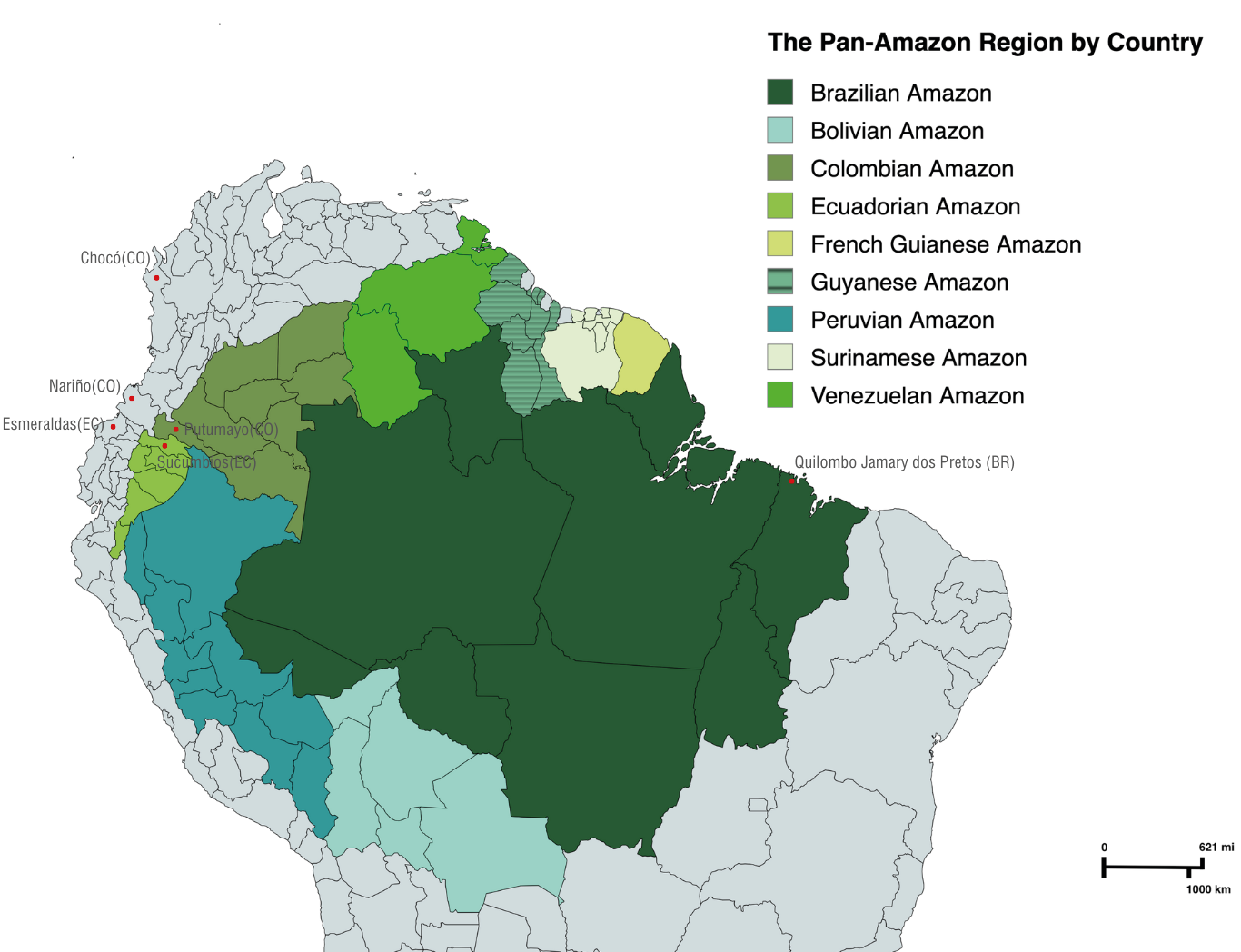
This study argues for the importance of an analysis of Black Amazonian realities and visual imageries. Such an approach offers a perspective that aims to challenge the historical effacement of Afro-descendant contributions within the Amazon’s artistic and cultural landscape, while simultaneously emphasizing the transnational relevance of these contributions across the broader pan-Amazonian context—which encompasses parts of Brazil, Colombia, Ecuador, Peru, Venezuela, Bolivia, Guyana, Suriname, and French Guiana (Img. 1).
The map in Image 1 serves as a visual resource for this discussion, demarcating the specific localities that will function as geographical axes for the analysis. The map represents the Pan-Amazon by coloring states and provinces that contain Amazonian biomes. This analysis will follow the six sampling locations marked on the map, with a focus on specific points like the quilombo Jamary dos Pretos1 in Brazil and the regions of Putumayo and Sucumbíos in Colombia and Ecuador. The inclusion of locations like Chocó and Nariño (in Colombia) and Esmeraldas (in Ecuador), which are situated outside the Amazon, further highlights the connections of the Black diaspora and the historical interactions between the Amazonian biome and the Pacific coast, connections that have long been underrepresented in scholarly portrayals of Amazonian history.
Image 1. Mapping the Pan-Amazon Region and its Regional Connections. Prepared by Brenda de Oliveira using the “Amazon Biome” dataset (WWF Living Amazon Initiative, 2012), accessed via the Data Basin platform (Conservation Biology Institute), 2025.
For too long, scholarly portrayals of Amazonian history have predominantly foregrounded Indigenous experiences and European colonial encounters, frequently underrepresenting the profound influences and enduring legacies of its Afro-descendant communities. Against this backdrop of historical marginalization, contemporary art provides a vital and dynamic arena for rearticulating and circulating histories, identities, and epistemologies of Afro-descendant communities throughout the Amazon basin. Through its diverse forms, critical engagements, and inherent capacity for dialogue, contemporary art has been challenging conventional national and historical boundaries, offering means to reclaim narratives, and bringing to prominence Afro-descendant material and visual heritage in the pan-Amazon region.
This study will bridge different temporalities and territorialities with contemporary art expressions that articulate Afro-descendant presence and their relationships with the diverse Amazonian landscapes. It will first establish the conceptual framework of Black Amazonia, examining the theoretical contributions of Oscar de la Torre; subsequently, the focus will pivot to an in-depth analysis of contemporary artistic interventions that articulate Black Amazonian realities and visual imageries.
A striking example of this dynamic field is the Amazon Biennial, which stands out as a crucial contemporary stage due to its rapid expansion since the inaugural 2023 edition, its extension across Brazilian Amazonian cities, the launch of an initial international tour, and the second edition held in November 2025. This essay will examine key works by artists from various Amazonian and diasporic contexts, including Joelington Rios (Brazil), Astrid González (Colombia), and Simon Speiser (Ecuador), explaining how their practices challenge historical erasures and forge new visual epistemologies.2
Historical and Cultural Foundations of Black Amazonia
The People of the River: Nature and Identity in Black Amazonia, 1835-1945, a seminal work by Oscar de la Torre, provides a conceptual framework for understanding the Amazon region’s formation through the lens of marronage—the resistance and creation of communities and settlements by runaway enslaved people who established autonomous ways of life as acts of insurgency against the colonial-slavery regime.3 Although De la Torre focuses on the trajectory of maroon descendants in the Brazilian Amazon, more precisely the frontier state of Pará, he offers essential analytical tools to investigate Black Amazonia as a broader conceptual, cultural, and historical domain across the transnational Pan-Amazon region.
Building upon a well-established historiography on the legacies of slavery among rural Afro-Brazilians—a field that, over the past few decades, has achieved significant analytical depth and conceptual sophistication—De la Torre’s study identifies a critical gap: an absence of research embracing the diverse themes of Afro-descendant life within a dedicated framework for the Amazon. Pioneers such as Florestan Fernandes,4 along with more recent scholars,5 have examined Black communities and their histories, and others have emphasized the role of natural landscapes in the lives of enslaved Africans in the New World;6 early foreign observers such as the French couple Henri and Marie Octavie Coudreau also provided reports on Black and maroon populations through their expeditions along Amazonian rivers like the Curuá, Cuminá, and Trombetas; nonetheless, these contributions lacked a comprehensive conceptual framework capable of articulating its diverse realities and interconnected histories. De la Torre’s research, engaging with the scholarship of Rosa Acevedo Marin and Edna Castro,7 initiates a historical investigation of the Afro-descendant experience in the Amazon, providing the conceptual tools necessary to understand the region as a part of the African diaspora. His work thus lays the essential groundwork for a broader transnational analysis of Black Amazonia.
A key dimension of De la Torre’s groundbreaking framework lies in its environmental perspective on the history of marronage, which the author describes as “environmental creolization.” Central to his work, environmental creolization is defined as the “process of acquaintance with the opportunities and constraints of local environments.”8 Going beyond cultural and demographic adaptation, it encompasses enslaved Africans’ and maroons’ engagement with Amazonian landscapes and their understanding of seasonal rhythms, marketable products, and possibilities for agriculture to sustain families and communities. By adding this perspective, the author highlights how maroon communities developed strategies for autonomy and freedom, and how they adapted and transformed their natural surroundings, creating cultural landscapes as spaces of personal and social identity. The author also emphasizes that environmental creolization enabled sustainable relationships with the forest that actively challenged extractivist logic.
For example, cassava cultivation and processing—including the widespread use of cassava ovens for flour production—exemplify fundamental practices learned and adapted by African and Afro-descendant communities within the roça system, playing a central role in local economic structures, just like other diverse skills in agriculture, foraging, hunting, fishing, and trading in forest products. Reflecting on the conditions that enabled such adaptation, De la Torre argues:
[M]astery over local environments was more rewarding in Amazonia than in other Brazilian regions. Specializing in forest resource management, canoe navigation, exploration, tourist guiding, or accounting in a trade store, for example, frequently represented viable paths to new sources of income and even to stable jobs. Finally, the tropical forest of Amazonia had numerous similarities to its counterpart in the Congo-Angola region, which facilitated transfers of knowledge and technology between both shores of the equatorial Atlantic.9
Beyond its practical and economic dimensions, environmental creolization also manifests profoundly in the symbolic and cultural interaction of Afro-descendant communities. As De la Torre explains, the broader concept of creolization generally refers to “the cultural and demographic adaptation of enslaved Africans to life in the Americas, involving processes of cultural mixture and change, occasional re-Africanizations, and the flexible maintenance of numerous African cultural referents.”10 The cultural mixture and change, as described by De la Torre and other scholars who investigate creolization,11 were profoundly shaped by the interaction of these communities with diverse Indigenous groups. Such intermingling had a profound impact on Afro-descendant epistemologies in the Amazon, particularly in shaping their unique relationships with the natural world.
The interplay between African and Indigenous cultures is vividly apparent in material culture and intangible traditions. For instance, basket-making is a key craft that demonstrates these profound interethnic exchanges in the Amazon. De la Torre mentions a moment of cultural observation captured by the American diplomat John Esaias Warren in 1851, who described a scene of intermingling: “in the corner of the hut were a couple of negro women, seated on the ground engaged in basket-making; while a boy was cutting long strips from a species of cane used for this purpose.”12 The artifact described by Warren, while gene- rically termed as a “basket,” was likely a tipiti—the long, braided cylinder used to squeeze boiled cassava pulp—an omnipresent artifact in Amazonian farms (Img. 2). As De la Torre notes, this scene speaks of a rich process of knowledge sharing about “what could be grown, collected, processed, built, conserved, fabricated, hunted, fished, distilled, bought, and sold,”13 thus forming a complex cultural landscape of shared survival and identity.
Image 2. Tipiti (squeezer), woven fiber, 2020. Photograph by Nino Andrés. From the project Objects of the Forest, curated by Andrea Bandoni. Digital montage by the author.
Countless evidence of blurring ethnic lines and forging new forms of identity and belonging can be found in other accounts from the era. In 1846, the entomologist William Edwards manifested no surprise when he saw “two free negroes who had been admitted to the rights of tribeship”14 in an Indigenous community.
Oral traditions and intangible heritage—such as mythology, music, and dance—are crucial repositories of memory and identity that constitute a Black Amazonia. De la Torre mentions carimbó, with its distinct rhythms and musical instruments, as a patrimony that narrates experiences of labor, daily life, and ancestral connections. Similarly, he analyzes narrative forms like the mythology of the Cobra Grande (Big Snake), from the Trombetas river, to demonstrate how deeply intertwined African Bantu myths became with Indigenous cosmologies, symbolizing spiritual resistance against oppressive forces and the cultural reclamation of territory.
Additionally, the author emphasizes a crucial fourth dimension of this framework: the critical importance of the maroons’ active negotiation with broader society, involving missionaries, merchants, and political actors. Through these interactions, maroons could secure access to trade and peace, thereby forging complex networks for their autonomy and transition from slavery to freedom.
This body of strategies and practices—encompassing (1) economic autonomy, (2) cultural and environmental knowledge, (3) interethnic relations, and (4) political negotiation—collectively forms the conceptual domain of Black Amazonia that this study will use as its analytical lens.
Black Amazonia in Art History
Black Amazonia as a methodological lens for art-historical inquiry embraces the fluidity and interconnectedness of African and Afro-descendant cultural flows and realities in the Pan-Amazon. This approach allows the field of art history itself to transcend conventional borders and rethink its own boundaries.
The artists to be presented below develop their work precisely by putting pressure on these boundaries. That is, they (a) propose ruptures with Eurocentric narratives; (b) seek a cultural-geographic expansion by thinking not only of the Amazon, but of the Global South as a center where powerful artistic practices take place; (c) blend practices and knowledge systems by working with functional objects, rituals, oralities, and cosmologies that challenge the ontological boundaries of the discipline; and (d) pursue interdisciplinarity, engaging in dialogue with fields such as anthropology, decolonial studies, and oral history, among others, thus expanding the ways of reading images, objects, performances, and materialities.
It is specifically this methodology that will guide the subsequent analysis of selected contemporary artists who, through their works, materialize the concept of Black Amazonia. Such a process finds its most potent contemporary expression through influential platforms like the Amazon Biennial. The very name of that event, with its plural original form in Portuguese—Bienal das Amazônias—embodies its premise: the diversity and plurality of Amazonian realities. The organizers seek to shift the debate on the arts away from dominant art market axes and center the Amazon as a protagonist, as seen through the perspective of the region’s own artists and communities. Founded by Livia Conduru and launched in 2023 with the theme Bubuia: Waters as a Source of Imagination and Desires, curated by the Brazilians Vânia Leal, Sandra Benites, Flavya Mutran, and Keyna Eleison, its inaugural edition brought together 123 artists and collectives from the Pan-Amazon region.15 The transnational focus was further amplified by its itinerant program, which has taken exhibitions and educational programs to multiple cities in the Brazilian Amazon, as well as to Medellín and Bogotá in Colombia.
With its second edition planned for the end of 2025 on the theme of “distance-green”16 and a new curatorial team led by Manuela Moscoso (Ecuador) and Sara Garzón (Colombia), the Biennial reaffirms its interest in being a space for encounters and listening between Amazonian territories, demonstrating a commitment to the decentralization of artistic practices and the amplification of new narratives. The second edition turns to the deep ties between pan-Amazonian territories and the Caribbean, imagining them as a network of flows—of waters, landscapes, and bodies—connecting forests and urban zones, Caribbean rhythms to Andean glaciers, geological time to collective life.
Joelington Rios and the Mocambo Epistemology
Joelington Rios, an emerging visual artist in the Brazilian art scene, hails from the quilombo Jamary dos Pretos, a maroon settlement in the Brazilian Amazon, within the state of Maranhão. At the age of nineteen he migrated to Rio de Janeiro to further his artistic training, embarking on a career that bridges local roots with cosmopolitan experiences. Now twenty-eight years old, Rios has returned to live in his maroon territory, the community that forms his identity and artistic inspiration.
Despite his rural base, he maintains a strong presence in the contemporary art world through commercial representation by two Brazilian art galleries. His ascent to national prominence was established in 2022 when he was named a finalist for the PIPA Prize, a highly prestigious award in contemporary Brazilian art. This recognition solidified Rios as a vital voice in the national artistic landscape.
Rios’s artistic practice operates as a critical cartography of Black Amazonian realities. His work articulates a decolonial aesthetic through a masterful synthesis of diverse media—from photography and video art to installation and sculpture. The core of his work lies in revealing corporeal realities that challenge dominant narratives, re-signifying memories, and elaborating alternative forms of existence. He frequently mentions in interviews and lectures that his artistic methodology is also a political project that positions conviviality and listening as fundamental tools for his creative process.
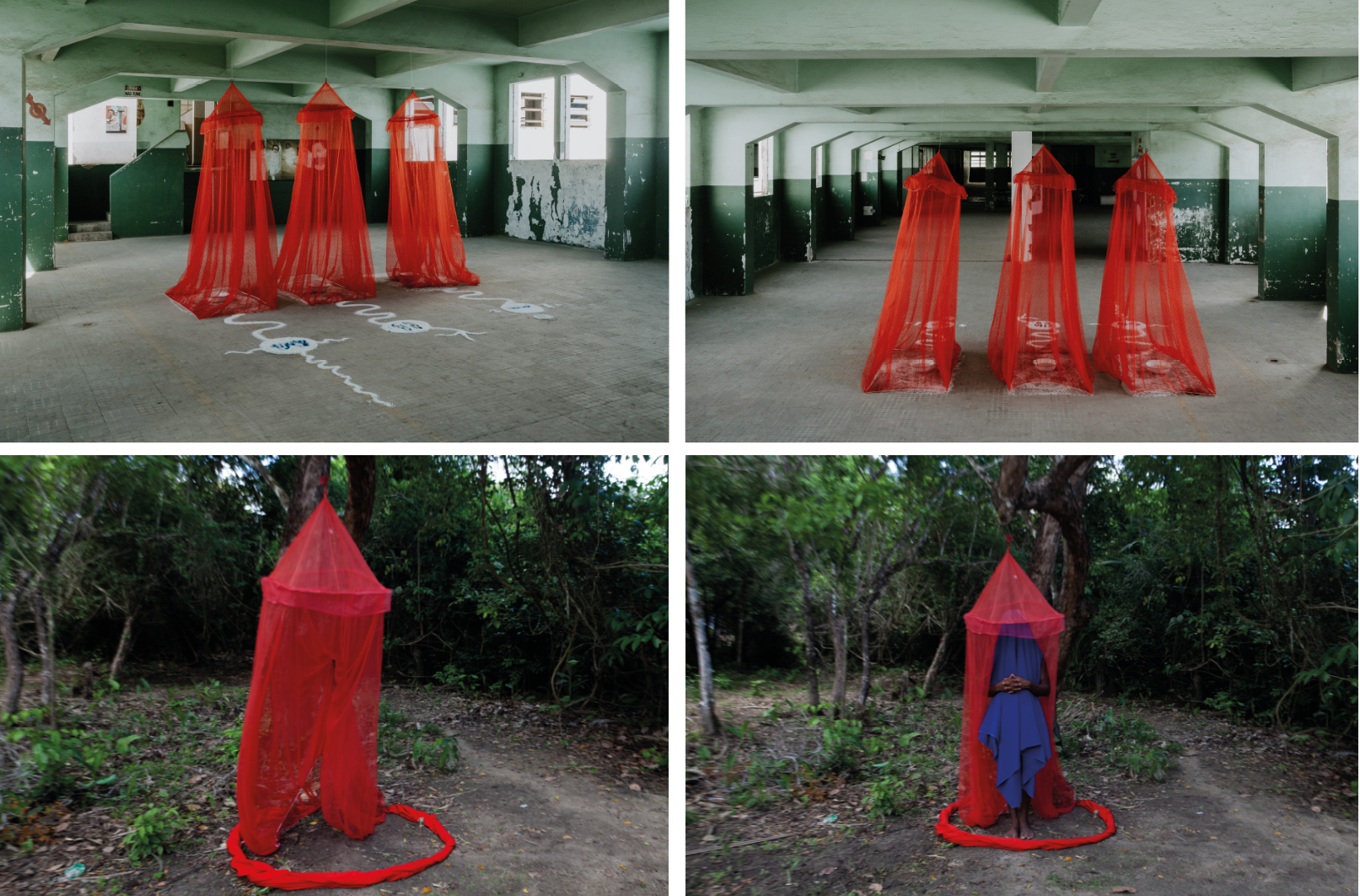
Cruzeiro do Sul 2 (Southern Cross 2, 2023) exemplifies Rios’s approach. The piece was commissioned for the inaugural edition of the Amazon Biennial and builds upon an earlier iteration, Cruzeiro do Sul 1 (Southern Cross 1, Img. 3), also created in 2023, which comprised an installation and a series of performances situated between his maroon territory and an urban environment in Rio de Janeiro.
Image 3. Joelington Rios, Cruzeiro do Sul 1 (2023). Installation and performance with mosquito netting, salt, and water. Photographs by Tayná Uràz (above) and Joelington Rios (below). Digital montage by the author.
While both works share a conceptual and material lineage—particularly through the use of mosquito netting as a central element—they differ in composition and context. In Cruzeiro do Sul 1 the artist employed mosquito netting, salt, and water to activate a dialogue around protection, territory, and the body, weaving together ancestral knowledge and environmental precarity. This ephemeral intervention, being a temporary installation and performance, establishes a tension between the natural and the constructed, the ancestral and the contemporary—mobilizing space and memory through fragile yet potent materials.
The composition of the site-specific installation Cruzeiro do Sul 1 features three distinct, conical forms of red mosquito netting arranged in a triangular pattern and spatially engaged with the architecture of an old factory. The piece, showcased at the collective exhibition Catavento 23 in the industrial neighborhood of São Cristóvão, Rio de Janeiro (May 20-21, 2023), immediately establishes a tension between the natural and the constructed, the ancestral and the contemporary. While the mosquito nets and salt were placed in the urban space as a way to engage with the former factory, the photo-performance in a forested area near the artist’s home was created beforehand. In the latter, we see only a single red structure that now houses a blue-draped figure. The sequencing of these two parts is not made explicit, but the work suggests a layered temporality: do three mosquito nets become one, or does one unfold into three? Do they coexist simultaneously within the symbolic space of the work?
Such shifting structure invites reflection on presence, multiplicity, and transformation. The vivid red netting, whether standing alone or encasing a human figure, creates a strong chromatic tension against both the decaying greens and grays of the urban space and the lush verdant tone of forest vegetation. The emergence of the blue-cloaked body adds yet another layer, activating the piece as both material and performative site.
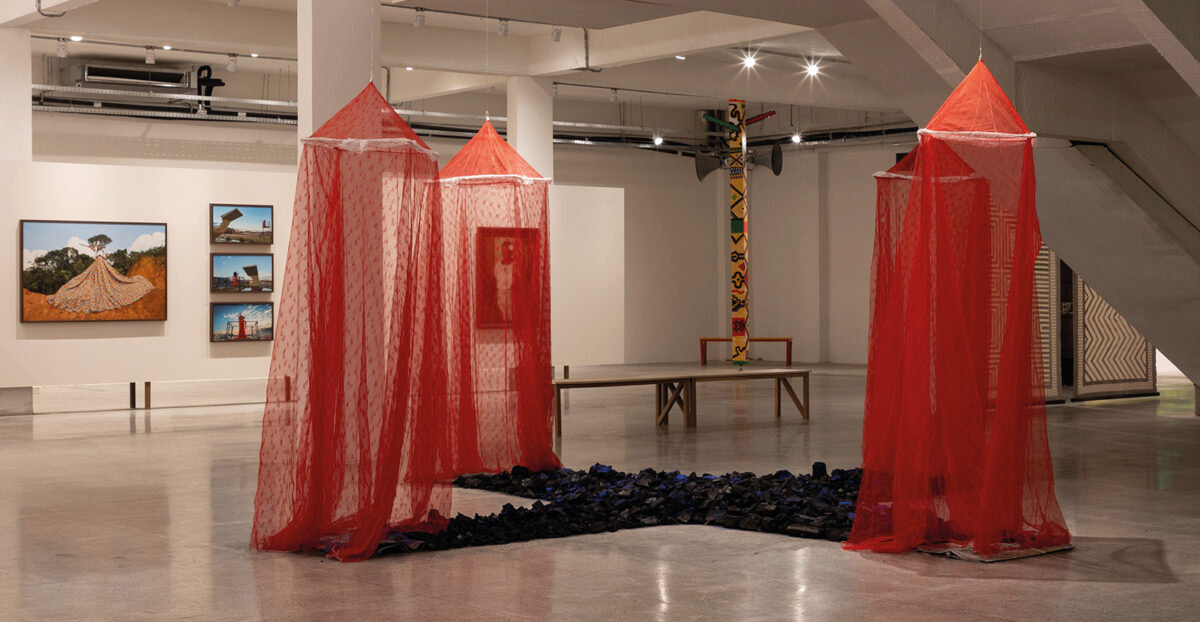
On the ground, faint, fluid tracings of white (salt-and-water mixture) delineate abstract shapes or map-like contours, suggesting an invisible geography or a re-inscription of territory, symbolizing both the ocean that separates Africa and Brazil and the life-giving rivers of the Amazon. The inclusion of salt and water speaks to elemental forces: the preservative qualities of salt, the cleansing or destructive power of water, and the historical pathways of transatlantic slave trade and forced migration. In contrast, Cruzeiro do Sul 2 (Img. 4), created specifically for the Biennial, substitutes salt and water for charcoal and waji (a plant-derived blue pigment), to form a cross.
Image 4. Joelington Rios, Cruzeiro do Sul 2 (2023). Installation with mosquito netting, charcoal, and waji. Photograph by Danilo José Rocha.
Image 5. Joelington Rios, Cruzeiro do Sul 2, details. Photographs by Joelington Rios. From the artist’s online portfolio. Digital montage by the author.
The charcoal, a remnant of burnt wood, speaks directly to the extractive violence of deforestation and the socio-economic history of the Amazon. However, it is also a symbol of the land, the earth, and the resilience of Black communities. The inclusion of waji—deep blue powder composed of minerals such as sodium, aluminum, and silicate—further expands this dialogue. Often referred to as African anil or “black blood,” waji is traditionally used in Afro-Brazilian religions such as Candomblé and Umbanda for spiritual cleansing and protection (Img. 5).
Although waji today is typically imported and industrially manufactured—as indicated on commercial packaging produced in places like Nigeria—its ritual function in Brazil is the result of a historical adaptation. In the Yoruba cosmology that informs many Afro-diasporic spiritual systems, three sacred pigments structure the metaphysical order: efun (white), osun (red), and arokin (blue). In Brazil, however, due to the unavailability of arokin, waji became its symbolic and ritual substitute. This substitution exemplifies a broader process of “environmental creolization” in the Afro-Atlantic world, as De la Torre elaborated, wherein spiritual practices were reconfigured using locally and commercially accessible materials without relinquishing their cosmological foundations.
A comparable process unfolded with the red pigment osun; originally extracted from African sandalwood, this powder in Brazil came to be produced from urucum (annatto), extremely widespread among Indigenous peoples who use it in their body paintings along with genipap (which yields the color black). In this regard, the environmental creolization explained by De la Torre also embodies the crucial aspect of ethnic hybridization, drawing upon Indigenous knowledge in Brazil.
It is no coincidence that the colors blue and red feature so prominently in Cruzeiro do Sul 1 and 2 as well as in several other works by Rios. These chromatic elements form a consistent thread throughout his artistic production, both visual and textual. In particular, Rios has been developing a rich poetic exploration of the corporeality of blue, often referring to his own body as a “blue body.” Alongside this, another recurring motif in his oeuvre is the image of the snake—sometimes appearing as a blue ouroboros, or else evoked more abstractly through serpentine forms, such as the winding patterns traced in salt in Cruzeiro do Sul 1. These material shifts intensify the work’s engagement with ideas of resistance, cosmopolitics, and symbolic healing, aligning it more directly with the Biennial’s curatorial framework and the transregional dialogues it sought to foster.
Such symbolic layering resonates with broader mythological frameworks, notably the myth of the Cobra Grande. According to De la Torre, maroon communities in the Lower Amazon reconfigured fragments of West African and Indigenous cosmologies to construct narratives of resistance, relocation, and liberation, often centering the image of a powerful snake. The Cobra Grande is used as a symbol of autonomy and mastery over the environment and also an embodiment of the threatening force of slavery and the resilience of those who resisted it. De la Torre argues that the symbolic snake appears across a wide range of Afro-Atlantic traditions—from Bantu-speaking peoples of Congo and Angola to Haitian Vodun and Yoruba cosmologies—where it is often associated with spiritual power, protection, and transformation. Within this expansive cultural tapestry, Rios’s use of the snake and the color blue invokes a diasporic poetics of memory, resistance, and myth.
Cruzeiro do Sul1 and 2 also resemble a celestial code—once used by European colonizers as a navigational reference upon their arrival in the Americas—shedding light on the broader histories of violence and colonization that have shaped the region. The installations take their name from the Southern Cross constellation, which, in this context, signals a dual meaning: for European colonizers it was a tool for direction and navigation, but for the Indigenous and Afro-descendant populations it came to symbolize displacement and the violence of colonization. Both works are part of a larger, ongoing artistic series titled Mocambaiou, which draws from the oral histories and ancestral memory of the artist’s mocambo in the Amazon region.17
The series specifically evokes the history of the mocambeiros—runaway enslaved individuals who would clandestinely visit slave farms at night to gather supplies (including salt, tools, and other items they didn’t produce themselves) and liberate others. Rios reclaims the phrase “olhou-oiou-mucumbaiou; zoio-olhou-boca-calou” from a testimonial given by Estanislau Mafra, a late member of his community, during an anthropological study conducted in the 1990s.18 The phrase is a play on sound and semantics, characteristic of oral-based Afro-diasporic traditions, meaning: “The eye saw, it became a mocambo; the eye saw, the mouth fell silent,” functioning as a code of secrecy and survival, underscoring the vital need for discreet passage and silent witness during those perilous journeys. This ancestral strategy of movement and covert communication is materialized in the formal and conceptual structure of the installation, transforming the historical routes between the plantation and the Amazonian forest into an exploration of rhythm and flow.
Lastly, considering the analysis of Rios’s works and the poetics that permeate his artistic practices, it can be argued that he articulates a mocambo epistemology that recognizes the importance of maroon narratives and knowledges as a legitimate way of understanding the world.19 This epistemology is not a fragmented or abstracted form of knowledge; rather, it is oral, bodily, ritualistic, and communal, with its sources deeply rooted in the territory, the body, ancestry, and collectivity. Such a framework proposes a conception of knowledge that differs from classical Western frameworks, positioning the maroon experience as a distinct and complete epistemology.
Mocambo epistemology fundamentally departs from Cartesian binary logic or the pursuit of universal scientific truth. Instead, it is a living paradigm grounded in forms of knowledge that: (a) preserve collectivity and honor ancestry; (b) maintain a deep balance with the territory; and (c) are intrinsically linked to survival, resistance, autonomy, and worldmaking. There is a recognition of the mysteries and the sacred that do not need to be fully controlled or explained, as wisdom also lies in embracing the limits of human knowledge. Structurally, it is characterized by horizontality, circularity, and performance, with a collective subject of knowledge—where the community, the elder, the Black female body, and the child are all valid knowers.
Rios’s artistic practice, therefore, serves as a powerful means of materializing and articulating this epistemology. Through his work, he represents these oral and spiritual traditions and also valorizes the beauty and dignity inherent in this worldmaking project, putting it into dialogue with the contemporary art world.
Astrid González and the Cartography of Affection
Astrid González is an Afro-descendant multidisciplinary artist from Medellín, Colombia, whose work revisits universal history in order to critically examine the lived realities of Afro-descendant communities in colonial contexts—particularly during the emergence and consolidation of maroon communities in Colombia’s Pacific region—and the later processes of whitening, which were promoted as paradigms of progress and race mixture throughout the Americas.
Working across photography, video, and sculpture, González explores the aesthetic and political dimensions of Black embodiment, reflecting on how the Afro-descendant body has been represented from the 16th century to the present. For her, the body is a field of symbolic struggle where discourses of racism, invisibility, cultural exchange, and political resistance unfold. Through her practice, she asserts Afro-diasporic identity as a source of ancestral pride and as a strategy of epistemic and cultural resistance.
At the heart of González’s practice is a form of autoethnography that uses personal memory, family stories, and ancestral knowledge to construct a counter-history. In an autoethnographic text that accompanies her 2021 video work Hablar a plantas (Talking to Plants), she introduces herself by saying: “My name is Astrid González. I am an Afro-Colombian woman born in a city with a deep-seated colonial history. I was born and raised in Medellín, the city of eternal spring and the mythos of hired assassins. Yet, symbolically, my ma- roon navel was buried in the Colombian Pacific, where my most recent ancestors were born. So I grew up steeped in dark coffee, in a territory where, little by little, we, the descendants of enslaved Africans, have been loudly establishing ourselves.”20
Her narrative interweaves experiences of displacement and return, of urban and rural life, of healing rituals and spiritual knowledge passed down through generations. She recounts memories of her grandfather, Luis Quintero, a community healer who treated neighbors using candles, coins, glasses, and prayers—embodying a syncretic spiritual knowledge system that resists Western medical rationalism. In her words, such rituals were “a secret, a syncretic prayer that heals people when they have spiritual illnesses manifested in the body and mind.”21
González’s work functions as a “cartography of affection,” a practice that challenges the “racialization of space” and “moral topography”22 that have historically marginalized Black populations in Colombia. This concept of affection refers to a form of mapping that is rooted in personal, embodied memory and relational ties rather than objective, geographical data. Her inclusion in the second edition of the Amazon Biennial demonstrates the larger argument that contemporary art can articulate diaspora, displacement, and identity in a pan-Amazonian and transnational sense, even when the artist’s primary focus is not geographically situated within the Amazon. Her presence at the Biennial serves as a testament to how the exhibition goes beyond a univocal, geographical definition of the Amazon, embracing it instead as a fluid, transnational cultural nexus.
To fully grasp González’s artistic project it is important to contextualize the historical invisibility of Afro-descendant communities in the Colombian Amazon. It is important to understand that in Colombia there is a long-standing association between race and territory. In Blackness and Race Mixture: The Dynamics Of Racial Identity In Colombia, the British sociologist Peter Wade discusses the spatial constitution of society that has shaped national identity, affecting how different groups are perceived.23
Drawing on long-term fieldwork in Afro-Colombian communities since the late 1980s, Wade argues that Colombian society is defined by the coexistence of two dynamic processes: mestizaje (the physical and cultural mixture of races) and racial discrimination. The book explores how this interaction shapes the position of Black people and the very essence of the Colombian nation. The author maintains that the perception of racial differences in Colombia are both a matter of appearance and geography.
The idea of how regions are associated with specific racial groups and its impacts on people’s identities and opportunities were later discussed by other scholars such as the Colombian anthropologist Eduardo Restrepo, who wrote about the Afro-descendent presence in the Colombian Amazon—more precisely in Putumayo (see Img. 1), a department located in the southwestern part of the country, bordering the Amazon region. He later elaborated on these ideas by framing them as part of a broader process of “racialization of space”—or even “spatialization of race”—in Colombia. According to Restrepo, there is a widespread assumption that Afro-descendant populations are only present in the Pacific region and, to a lesser extent, in the Caribbean and the inter-Andean valleys. As a result, regions like Putumayo are imagined as racially homogeneous and exclusively Indigenous. In contrast, the interior of the country tends to be associated with whiteness, with only some mestizo and Indigenous presence acknowledged in rural or southern areas.
As a counter-narrative, the history of the Colombian Black Amazon is one of long duration and continuity, built upon migratory flows, resource exploitation, and social and political agency. Historically, national governments sought to settle the Amazon region, often perceived as an “empty area,” by encouraging the migration of landless peasants, a classic model of “migration of conquest.” The migration of Afro-Colombian communities from the South Pacific region of Nariño to the Amazonian piedmont of Putumayo is a crucial example of this historical trajectory. The communities settled in key locations, such as the corregimiento of Cofania Jardines de Sucumbíos, and along the San Miguel River, forming a direct transnational connection with settlements like Lago Agrio in Ecuador. Studies reveal that, although migration to the region intensified from the 1960s onward due to the oil boom and the trans-Andean pipeline, the Black presence can be traced back to the 16th and 18th centuries, linked to gold extraction, and to the 19th century, with rubber production.24
According to Restrepo, mobility is in fact an intrinsic characteristic of Black communities, who view it as a “family strategy” to expand their living space and activate solidarity networks. Although early maroon communities were situated in the Pacific and Caribbean regions, rivers such as the Putumayo and Caquetá served as corridors for the movement and settlement of these populations, who established themselves in forested areas either as runaways or as part of extractive labor in rubber and mining. The mention of settlements like Puerto Limón, Tesalia, Burdines, and Puerto Colón (on the border with Ecuador by the San Miguel River) establishes a direct transnational connection between countries in the Amazon region such as Colombia and Ecuador.
Reflecting De la Torre’s debate on interethnic exchanges, the history of Afro-descendent communities in Colombia is likewise characterized by profound cultural interaction. Afro-Colombian migrants developed practices and knowledge of forest management (extractive activities, agriculture) that resemble the ancestral knowledge of Brazilian mocambeiros, demonstrating that a Black Amazonian epistemology was manifested in analogous ways in the region. The relationship with Indigenous communities, such as the Cofán people, was crucial; they donated land to the newcomers, integrating them into the local economy and fostering a symbiotic relationship. “The Cofán would point out the trees and we would work them”25 is a direct testimony of this exchange of knowledge.
Collaboration is also evident in the material culture and labor practices of the community. The extraction of timber, particularly cedar, was a central economic activity and a source of great pride. The tools used for this work, as described by the Colombian anthropologist Juan Carlos Rubiano Carvajal, were and continue to be displayed on the façades of homes, as artifacts of memory and markers of earned territory and self-sufficiency. However, the shift from this traditional economy to other forms of labor, such as coca cultivation in the 1980s, highlights the dynamic nature of these communities’ engagement with the environment and regional economic forces.
Despite these challenges, Afro-Colombian communities have demonstrated remarkable political agency. The consolidation of the migratory process in the Amazon region and the quest for sociopolitical visibility led to the formation of community councils, such as Nueva Esperanza, Nuevo Renacer, and Liberación y Futuro, which then formed the cross-border organization ASOCCAFRAIN,26 an example of a cross-border articulation and defense of rights. Such a move towards political visibility and collective land titles marked a significant shift, as these communities, once marginalized as outsiders and invaders, became participants and guides in the region’s planning.
Another conceptual tool introduced by Restrepo for understanding the racialization of space is Michael Taussig’s notion of “moral topography.” He argues that this concept, rooted in the historical division between civilization and barbarism, has been central to Colombian governance. The binary, he shows, can be traced back to the intellectual foundations of Colombia’s consolidation as a Republic laid by leading figures like “El Sabio” Caldas (the scientist Francisco José de Caldas) and the governing elites of Bogotá. In this framework, the “civilized” subjects are positioned in the Andean interior, while the “barbaric” and “savage” are relegated to the coasts and jungle regions.
The moral topography strongly associates Afro-descendants with backwardness and places them geographically on the Pacific coast and its rivers. As Retrepo puts it, “not a few Colombians find it hard to understand that the majority of Afro-descendants do not live in this region nor are they rural subjects (fishermen and miners), but rather they are found in the urban centers of Cali, Cartagena, Bogotá, Pereira, and Medellín. In these stereotypical logics, many associate the concept of Black with fishing, the beach, the marimba, and the Colombian Pacific.”27
It is precisely this historical narrative of migration and agency that forms the basis for González’s “cartography of affection.” While the dominant discourse overlooks the historical flows of Afro-descendant communities from the Pacific region of Nariño and Barbacoas to the Amazonian piedmont of Putumayo, González’s work brings these experiences to the forefront and sheds light on the silenced histories and identities of Afro-Amazonian peoples. Her artistic methodology is articulated in her two-part photographic series Cultura negra (Black Culture, Img. 6) and Continuación cultura negra (Black Culture Continued, both from 2016). Much like Rios’s Cruzeiro do Sul 1 and 2,this series engages with the notion of art as a repository of historical memory, transforming ancestral practices and utilitarian objects into highly symbolic contemporary artifacts.
Image 6. Astrid González, Cultura negra (2016); citing Pelucas porteadoras (Porter Wigs, 1997–2001) by Liliana Angulo. Digital photography on smooth cotton rag paper, three pieces, 81 × 54 cm each. Installation view at Museo de Arte Moderno de Medellín and Pivô Pesquisa. From the artist’s website.
Composed of a triptych of digital photographs, the series focuses on a set of core elements that articulate an Afro-diasporic memory. Two of the photographic pieces center on the joto, a clothing bundle made from sheets and carried on the heads of women for washing clothes in the rivers of the Chocó region (see Img. 1)—the only department in Colombia bordered by both the Pacific and Atlantic Oceans.
According to the artist’s description on her website, the joto acquires the status of a testament to the collective life of women on the riverbanks, as the practice of washing clothes becomes a social gathering and a space for speech and trust among Black women. By placing it as a core element of her art, González highlights the joto as an archive of lived experience and riverine culture forged through labor, solidarity, and the transmission of oral tradition.
A second element in the triptych features a translucent container with corn kernels, referencing a crucial strategy of cimarrón (maroon) women (Img. 7).
In these communities (known as palenques)28 women would braid seeds and grains into their hair, camouflaging their future sustenance and creating a mobile archive of agricultural knowledge. This was a vital act of defiance against a system that stripped them of their autonomy and their future. The secrecy was necessary because these seeds were their means of survival, meant to be planted in new, liberated settlements. This practice was both a symbolic and practical gesture of rebellion, turning their bodies into a vessel of hope for a new society outside the logic of plantations.
Image 7. Astrid González, Cultura negra (detail).
A crucial formal detail of the triptych is a cord that links the three images, creating a visual flow between the two jotos and the translucent container of corn kernels at the center. In her autoethnographic narrative González states that, in a symbolic sense, her “maroon navel was buried” in the palenques of the Pacific. For those unfamiliar with this cultural practice, particularly in South America, burying the umbilical cord stump is a ritual of belonging. It serves as a spiritual anchor, a way of declaring a person’s unbreakable connection to the land where they were born.
From this perspective, the cord that weaves the photographic series together can be interpreted as a metaphorical umbilical cord, a life-giving thread that connects a network of “maternal wombs” that symbolically give birth to a new and fertile future, one forged in the resistance against historical violence. This symbolic layering transforms the installation into a visual meditation on connection, origin, and the act of creating a new sense of belonging in a territory that was, and remains, a place of historical struggle.
Image 8.Astrid González, Continuación cultura negra (2016). Digital photography on smooth cotton rag paper, three pieces, 81 × 54 cm each. Installation view at Museo de Arte Moderno de Medellín. From the artist’s website.
The subsequent series, Continuación cultura negra (Img. 8), deepens this reflection, using the same photographic language to expand on the concepts of resistance and resilience. Also composed of a triptych, the work revisits the metaphor of corn seeds but with a particular focus on representation and invisibility.
In this series, the artist uses the image of a translucent container holding seeds, placed on the head of the same female figure depicted in other works, a visual strategy that reframes the Black body as a central site of memory and identity. As a critique of the colonial gaze—which often reduced Afro-descendant bodies to exoticized still lives or mere symbols of labor, as when they are shown carrying a bodegón of fruit on their heads—this aesthetic choice proposes the use of the human figure to frame the body as a field of symbolic struggle, re-signifying its presence and agency in the face of historical erasure.
Instead of a visible burden, the seeds are wrapped in a translucent veil, making them semi-invisible. This visual strategy invites the observer to question the representation of the palenquero subject. The artist subverts the logic of imposed visibility, in which Black communities were only seen in stereotypical roles (peasants, fisherwomen, etc.). The veil, while concealing, also reveals the question: what is actually being carried? The seeds become an archive of hope and knowledge, camouflaged from the oppressive gaze, but present and ready to germinate in “safe land.”
From an anthropological perspective, González’s work addresses the construction of culture not as something static but as a dynamic process of adapting to and transforming the environment. The seeds, which were carefully hidden and transported, could represent the capacity to create new, free societies and cultures—the palenques—by recognizing and managing the natural surroundings, in opposition to colonial logic. Such approach directly connects to De la Torre’s concept of “environmental creolization,” as it demonstrates how an intimate knowledge of the environment—embodied by the seeds—became the very foundation for liberation and the creation of new societies (the palenques).
Ultimately, González’s two series function as a conceptual diptych. Taken together, they can be read as a cohesive and compelling decolonial project on cimarrón epistemology and Afro-diasporic female agency. If Cultura negra establishes the ancestral connection through the symbolic umbilical cord, Continuación cultura negra projects this heritage into the future, questioning how this history is told and seen. Both works reaffirm the agency of the Black people’s epistemic and cultural resistance, and strengthen the argument that the artist’s “cartography of affection” is a powerful tool for remapping history and giving visibility to Afro-descendent communities and their migration cycles and agency in Colombia.
This is where her art makes an invaluable contribution to the conceptual framework of Black Amazonia as envisioned by De la Torre. While her pieces are not geographically situated in the Amazonian biomes, they are intellectually and affectively intertwined with a history of Afro-descendant migration and survival that extends from the Pacific to the Amazon. Her participation in the Amazon Biennial is thus a powerful validation of the idea that these narratives, once confined to a “racialized space,” are now recognized as a fundamental part of the transregional and transnational narrative of the Amazon.
Simon Speiser and the Metaphysics of Freedom
The presence of Afro-descendant populations in the Ecuadorian Amazon is concentrated mainly in the province of Sucumbíos (see Img. 1), in the country’s northeast, a region bordering Colombia to the north and Peru to the east. This area is marked by a dense hydrographic network, where the San Miguel, Putumayo, and Napo rivers play fundamental roles in both territorial organization and the history of migrations. The San Miguel river forms a natural section of the border between Ecuador and Colombia and has historically been a route of escape and displacement for Afro-descendant populations coming from conflict zones in southern Colombia. The Putumayo river, a tributary of the Amazon river, has an even broader importance as it connects various border communities and serves as a transport, trade, and, in some cases, refuge route. The Napo river, which originates in the Ecuadorian Andes and flows towards the Amazon, besides its ecological importance, was historically explored by missionaries, traders, and colonizers, influencing the establishment of multi-ethnic riverside settlements. Thus, these rivers are important for the physical conformation of these territories while they serve as fundamental cultural markers for understanding the trajectories of resistance, adaptation, and belonging of Afro-descendant communities in the Amazon region.
According to data from the 8th Population and 7th Housing Census, conducted in 2022, the percentage of the Ecuadorian population that identifies as Afro-Ecuadorian or Afro-descendant, Black, and Mulatto is approximately 5%. Guayas, Esmeraldas (Pacific region), and Pichincha (sharing an internal border with Esmeraldas) are the provinces with the highest Afro-Ecuadorian populations. Sucumbíos, in the Amazon region, accounts for a total of 5,652 individuals, based on self-identification according to their culture and customs. Although this is a small number compared to other regions, it represents a significant presence, far from the coast, particularly in Lago Agrio, where there is a strong cimarrón presence.
As documented in the collective volume Memorias y tradición oral afroecuatoriana de Nueva Loja, the Afro-Ecuadorian presence in the northern Amazonian provinces of Sucumbíos, Orellana, and Napo is a long-standing reality.29 This presence is a result of distinct migratory flows from the country’s Pacific coast—primarily the provinces of Esmeraldas, Guayas, Los Ríos, and Imbabura—as well as from the Pacific coast of neighboring Colombia, such as the department of Nariño (see Img. 1). This migration intensified from 1967 onward, largely driven by the region’s oil boom. Today, the majority of Afro-Ecuadorians in Sucumbíos are concentrated in the urban areas of cantón Lago Agrio and cantón Shushufindi.30
The founding myth of a shipwreck in Esmeraldas contrasts the origins of the coastal cimarrón society with the Afro-descendant presence in Sucumbíos, which is the result of much more recent displacements. This myth is rooted in a historical event that took place in 1553, when a merchant vessel carrying enslaved Africans ran aground off the coast of what is now Ecuador. A group of the captives, including Alonso de Illescas, who would become a key figure in the region, managed to escape and established an autonomous settlement in the area now known as Esmeraldas.
It is well known that, at that time, the Spanish conquest of the Inca Empire was very advanced, and Lima had become the capital of the Viceroyalty of Peru—the political, commercial, and administrative center of the Spanish Empire in South America. The city was also the main hub for the distribution of silver extracted from mines such as Potosí, in present-day Bolivia.
The ship that was wrecked had been sailing from Panama to Lima, along a vital trade route that carried goods, people, and, most importantly, enslaved labor to the new cities, haciendas, and mining operations. Faced with the demographic collapse of Indigenous populations caused by disease and forced labor, the Spanish Crown was accelerating the importation of enslaved Africans to sustain the colonial economy. It was in this context that the 1553 shipwreck brought African communities to Ecuador’s coastal region.
To deepen the understanding of the complex trajectories of Afro-Ecuadorian identity, this section is dedicated to analyze the work of the German-Ecuadorian artist Simon Speiser, whose artwork Naufragio liberador (Liberating Shipwreck, 2024)reveals layered narratives of freedom and liberation.
Speiser is known for his interdisciplinary approach that merges nature and technology through various media—ranging from writing, sculpture, and printing to video and VR installations. He delves into themes of the interplay between human and technological worlds, using modern media to investigate an oral archive of memories from his father’s family. In doing so, he draws from the cultural heritage of the maroon societies in Ecuador’s Esmeraldas rainforest, bringing these historical narratives to life through a contemporary lens.
Naufragio liberador (Img. 9), presented within the EMAP x Seoul Frieze Film Program, is a film that traverses multiple fields—from colonial history and maroon resistance to speculative physics and metaphysics. Considering art criticism and historiography, the film engages with entanglement, temporality, and liberation, eschewing linear narratives in favor of a layered, “creolized” perspective on history and identity.
Image 9. Simon Speiser, Naufragio liberador (2024). Single-channel video, stereo sound, color, 18 m 52 s. From the artist’s website. Digital montage of film stills by the author.
Speiser’s film crosses the history of Esmeraldas’s cimarrón community with physics and metaphysics. The narrative, which blends interviews, digital landscapes, and rituals, treats the shipwreck not as an accident but as a “singularity”—a point of radical rupture that opens up new possibilities and a metaphor for creation emerging from a catastrophe.
The film’s narrator—the artist’s father, Remigio Tapia—captures this idea by suggesting that “enchanted strings” oscillate between death and freedom, simultaneously closing gateways for some and opening them for others. This poetic framing aligns with the testimony of a physics professor, Marino Guarín, who describes black holes as “stellar corpses” and white holes as points of origin, drawing a profound parallel between cosmic phenomena and the human experience of survival and emergence from historical cataclysms.
The notion of a divine mandate, articulated in the film by Don Simi (Arquímedes Simisterra Hurtado) (seen in Img. 9), further elevates the historical shipwreck to a moment of cosmological and spiritual significance, underscoring the foundation of Esmeraldas as a fated act of divine intervention that ordained freedom and liberation. Don Simi’s narrative focuses on the history of central figures like De Illescas and another black leader named Antón. He describes their escape from the sinking ship in 1553 and subsequent rise as leaders of a maroon community and powerful examples of agency and resistance. De Illescas, who lived in Seville, Spain, as a personal servant to the Illescas family—a prominent household of merchants—and never labored in plantations, leveraged his fluency in Spanish language and culture to forge strategic alliances with indigenous populations, for instance. This act of cultural and social adaptation exemplifies what De la Torre calls “environmental creolization,” which is key to understanding how Afro-Ecuadorian identity emerged as a dynamic, hybrid process shaped by cultural exchange and adaptation. Their assertion, stated during the film, of “never having been enslaved” is more than a historical claim: it is an act of self-definition—a deliberate rejection of the colonial narrative of subjugation.
While the mythical and historical origin of Esmeraldas is rooted in an act of freedom for this specific community, it is crucial to note that this narra- tive coexists with a more complex history of slavery in the region. That is to say, while this particular group asserts that they were never enslaved, the system of enslavement operated officially in Ecuador until around 1851, and over time numerous escaped enslaved people sought refuge in the maroon settlements that had been established.
Over the centuries the Black population of Esmeraldas grew through various channels. In the sixteenth century, it was initially composed of indi- viduals from the Antilles—where slavery was first consolidated—and others brought from North Africa, Guinea, Senegal, the Gold Coast, Sierra Leone, Cameroon, the Congo, Angola, and the East Coast of Africa, both with royal permission and through contraband.31 The seventeenth century saw a significant increase in the Black population, largely due to slaves who fled the gold mines of Barbacoas and sought sanctuary in Esmeraldas. Towards the end of the century, slaves from Colombia and the Caribbean were also introduced to the Santiago river to intensify the search for gold. Such a pattern continued into the late nineteenth century, when the Alfaro government brought 4,000 Black people from Jamaica to work on the southern railway, many of whom subsequently settled in the region. This historical record demonstrates that while freedom was a founding principle, the history of Esmeraldas is inextricably linked to the complexities of slavery and forced migration. Yet, the very existence of these established maroon communities provided a vital support network and a path to liberty for those who escaped enslavement.
The film’s title, Naufragio liberador, is an intentional paradox that en- capsulates the work’s central thesis. The shipwreck, typically a symbol of destruction and loss, is recontextualized as a catalyst for liberation. It is the very collapse of the colonial vessel that allows for the emergence of a new social and cultural order. Such a reinterpretation finds resonance in the work of the Martinican political philosopher Malcom Ferdinand. In a way that echoes Paul Gilroy’s notion of the Black Atlantic—where the ship emerges as an emblem of great potency, a “living, microcultural, and micropolitical system in motion”32—Ferdinand presents escape as a gesture of inventing another way of existing, an “otherwise.” This perspective highlights how the ship, while an instrument of oppression, carried within it the possibility of generating future maroon settlements, a potential that re-emerges even in the face of violence and alienation—as he poetically phrases it: “the strong conviction that, behind the arrogance of the plantations, the possibility of an autrement, the traces of Mother Earth and the horizon of a world, persist.”33
In conclusion, Speiser’s Naufragio liberador is a multi-layered artwork that uses the language of contemporary art to forge a new understanding of history. By weaving the speculative frameworks of physics with the oral histories and maroon traditions of Esmeraldas, the film constructs a powerful counter-narrative to colonial discourse. It asserts that freedom and identity can emerge from the most unlikely, and even traumatic, places: a shipwreck, a black hole, a moment of profound and transformative rupture.
Much like Gonzáles’s, Speiser’s work does not originate from within the Amazon, yet it is part of a cartography that traces how the agency and self-determination of Ecuador’s Black population forged a network of migratory flows that extends into the Amazon basin. Such a connection is particularly pertinent as the artist is slated to exhibit at the second edition of the Amazon Biennial, though the specific work remains to be announced. Beyond Naufragio liberador, other works by Speiser, such as La visión del monte (The View of the Forest, 2023) also delve into the Afro-descendent issue in Ecuador, connecting with a broader dialogue on biocultural diversity and cimarrón knowledge that transcends national borders.
Conclusion
The narrative of a transnational Black Amazonia goes beyond a historiographical exercise. It constitutes an epistemic resistance that challenges centuries of effacement. The ongoing work of scholars such as the Brazilian historian Manoel Rendeiro Neto, whose research exposes imperial cartography as a tool of violence that “painted a false picture of emptiness,”34 provides a central metaphor for this study. The challenge, therefore, lies in rectifying this historical omission and remapping Black Amazonia through a recognition of Afro-descendant territorial practices, forms of autonomy, and historically marginalized claims to land and belonging.
Contemporary art emerges as a crucial tool in this pursuit for historical reparation and counter-narrative. As demonstrated by the artists in this study, Black Amazonia reveals the constitution of an epistemology rooted in autonomy, dignity, pride, sophisticated strategies of resistance, and a profound sense of coexistence and community. Such epistemology appears increasingly relevant in today’s world, offering insights into current systemic crises—ranging from geopolitical and economic to social, environmental, and civilizational.
While the present study has focused on Rios, González, and Speiser, the full scope of the Black Amazonia scene articulated at the Amazon Biennial extends far beyond. A significant number of other artists could be examined through the same methodological lens, revealing new facets of Black Amazonian realities. The list includes artists from Brazil (Rafael Bqueer, Keila Sankofa, Ge Viana, Silvana Mendes, Hal Wildson, Manauara Clandestina, Antonieta Feio); Suriname (Miguel Keerveld, Marcel Pinas, Kenneth Flijders, Remy Jungerman, Rinaldo Klas); French Guiana (Roseman Robinot, Nathalie Leroy Fiévée); Ecuador (Sofia Salazar Rosales); and Venezuela (Alvaro Barrington). In addition, the inclusion of artists from the broader diaspora, such as Sandra Brewster (Canada), Christie Neptune and Keisha Scarville (United States, Guyana), and Marie-Claire Messouma (France, Guadeloupe), further underscores the transnational and diasporic character of this emerging field.
Bibliography
Acevedo Marin, Rosa Elizabeth, and Edna Castro. No caminho das pedras de Abacatal. Experiência social de grupos negros no Pará. UFPA / NAEA, 2004.
—. Negros do Trombetas. Guardiães de matas e rios. CEJUP / UFPA, 1998.
Almeida, Mariléa de. Devir quilombola. Antirracismo, afeto e política nas práticas de mulheres quilombolas. Patuá, 2022.
Benítez, Lilyan and Alicia Garcés. Culturas ecuatorianas: ayer y hoy. Abya-Yala, 1990.
Brown, Ras Michael. African-Atlantic Cultures and the South Carolina Lowcountry. Cambridge University Press, 2012.
Burbano, Nelci et al. Memorias y tradición oral afroecuatoriana de Nueva Loja. Abya-Yala / Universidad Politécnica Salesiana, 2013.
Carney, Judith. Black Rice: The African Origins of Rice Cultivation in the Americas. Harvard University Press, 2001.
—. “Landscapes of Technology Transfer: Rice Cultivation and African Continuities.” Technology and Culture 37, n.o 1 (1996): 5-35.
De la Torre, Oscar. The People of the River: Nature and Identity in Black Amazonia, 1835-1945. University of North Carolina Press, 2018.
Dos Santos, Antônio Bispo. A terra dá, a terra quer. Ubu Editora, 2023.
Edwards, William H. A Voyage up the River Amazon, Including a Residence at Pará. D. Appleton & Company, 1847.
Ferdinand, Malcom. Uma ecologia decolonial. Pensar o mundo a partir do mundo caribenho. Ubu Editora, 2022.
Fernandes, Florestan. The Negro in Brazilian Society. Columbia University Press, 1969.
García, Paola et al. Diversidad cultural del sur de la Amazonía colombiana. Instituto Humboldt / Corpoamazonia, 2012.
Freire de Carvalho, José Paulo. “Jamary dos Pretos, terra de mocambeiros: estudo antropológico.” Research Report, 1994.
Gilroy, Paul. The Black Atlantic: Modernity and Double Consciousness. Harvard University Press, 1993.
Hutchinson, Harry William. Village and Plantation Life in Northeastern Brazil. University of Washington Press, 1957.
McNeill, John R. Mosquito Empires: Ecology and War in the Greater Caribbean, 1620-1914. Cambridge University Press, 2010.
Monteiro, Benedicto. Verde vagomundo. Cultural Cejup, 1991.
Parés, Luis Nicolau. “O processo de crioulização no Recôncavo Baiano, 1750-1800.” Afro-Ásia 33 (2005): 87-97.
Rendeiro Neto, Manoel Domingos Farias. “Denying Sovereignties: Empires, Maps, and Runaway Indigenous People and Maroons in Amazonian Borderlands, 1777-1800”. Master’s thesis, University of California Davis, 2021.
Restrepo, Eduardo. Afrodescendientes en el Putumayo. Trayectorias y presencias negras en la Amazonía colombiana. Fundación Universitaria Uniclaretiana / Institución Universitaria ITM, 2025.
Röhrig Assunção, Matthias. Capoeira: The History of an Afro-Brazilian Martial Art. Routledge, 2005.
Rubiano Carvajal, Juan Carlos. “Del Pacífico a la Amazonía. La migración de las comunidades negras al piedemonte amazónico.” Jangwa pana 23, n.o 1 (2024): 1-15.
Vogt, Carlos and Peter Fry. Cafundó. A África no Brasil. Linguagem e sociedade. Editora da Unicamp, 1996.
Wade, Peter. Blackness and Race Mixture: The Dynamics of Racial Identity in Colombia. Johns Hopkins University Press, 1993.
Warren, John Esaias. Para, or, Scenes and Adventures on the Banks of the Amazon. G. P. Putnam, 1851.
Cómo citar:
De Oliveira, Brenda. “Black Amazonia in Art History: Pan-Amazonian Dialogues at the Amazon Biennial, 2023–2025”. H-ART. Revista de historia, teoría y crítica de arte, n.o 23 (2026): 53-82. https://doi.org/10.25025/hart.11860.
1. The term “quilombo” refers to communities historically formed by Africans who escaped slavery in colonial Brazil and established autonomous settlements in remote or marginal territories as a form of resistance to the slave system. Today, the term also designates the descendants of these communities (quilombolas), who maintain collective territorial ties, cultural traditions, and political struggles for land rights and historical recognition. Similar formations existed across the Americas and the Caribbean—known, for example, as palenques in Spanish America and cumbes in parts of the Caribbean—reflecting a broader transnational history of Black resistance and maroon societies.
2. When this article was originally submitted in October 2025, the second edition of the Amazon Biennial had not yet opened. The event took place during the review process and featured contributions from both Astrid González and Simon Speiser. Speiser presented Naufragio liberador (Liberating Shipwreck, 2024), the work discussed in this article, while González exhibited Zángano (2024-2025), a two-channel video installation (15 m 5 s, 4K), which stages the mythical Afro-Colombian healer known as the “zángano” in a liminal state of transformation. Rooted in oral traditions from the predominantly Black region of Chocó in Colombia, the work speculates on a figure historically protected through cimarrón strategies of concealment, foregrounding absence, opacity, and speculative reconstruction as forms of resistance.
3. Published in 2018 by the University of North Carolina Press, the book established Oscar de la Torre as a key scholar in Afro-Amazonian studies and environmental history. An associate professor of Africana studies at the University of North Carolina in Charlotte, De la Torre advances a socio-environmental approach to slavery and the post-emancipation period in the Americas, examining the intersections of environment, labor, and identity. The book received the Outstanding First Book Prize from the Association for the Study of the Worldwide African Diaspora (ASWAD) in 2019 and the Best Book in Amazonian Studies Award from the Latin American Studies Association (LASA) in 2020, and has become a foundational reference for understanding the historical formation of Black Amazonia through the lens of marronage and Black peasant communities.
4. Florestan Fernandes, The Negro in Brazilian Society (Columbia University Press, 1969).
5. Harry William Hutchinson, Village and Plantation Life in Northeastern Brazil (University of Washington Press, 1957); Carlos Vogt and Peter Fry, Cafundó. A África no Brasil. Linguagem e sociedade, edited by Peter Fry (Editora da Unicamp, 1996).
6. Judith Carney, “Landscapes of Technology Transfer: Rice Cultivation and African Conti- nuities,” Technology and Culture 37, n.o 1 (1996): 5-35; and Black Rice: The African Origins of Rice Cultivation in the Americas (Harvard University Press, 2001); Ras Michael Brown, African-Atlantic Cultures and the South Carolina Lowcountry (Cambridge University Press, 2012); John R. McNeill, Mosquito Empires: Ecology and War in the Greater Caribbean, 1620-1914 (Cambridge University Press, 2010).
7. When placed in dialogue with the work of Brazilian scholars Rosa Elizabeth Acevedo Marin and Edna Maria Ramos de Castro—both senior researchers affiliated with the Federal University of Pará (UFPA) and the Núcleo de Altos Estudos Amazônicos (NAEA)—De la Torre’s research can be perceived as part of a longer intellectual trajectory grounded in Amazonian historiography and social science. Since the 1990s, Acevedo Marin and Castro have developed foundational studies on slavery, maroon communities, territorial rights, and collective memory in Pará, particularly through works such as Negros do Trombetas. Guardiães de matas e rios (CEJUP / UPFA, 1998) and No caminho das pedras de Abacatal (UPFA / NAEA, 2004). These studies, extensively cited throughout The People of the River, provide the empirical and conceptual basis for understanding Afro-Amazonian territorial formation, marronage, and socio-environmental strategies of resistance. De la Torre’s intervention builds upon this Brazilian scholarship while extending it into a broader transnational and diasporic analytical framework, thereby situating Black Amazonia within African diaspora studies and environmental history.
8. Oscar de la Torre, The People of the River: Nature and Identity in Black Amazonia, 183-1945 (University of North Carolina Press, 2018), 7.
11. Matthias Röhrig Assunção, Capoeira: The History of an Afro-Brazilian Martial Art (Routled- ge, 2005), 32-46; Luis Nicolau Parés, “O processo de crioulização no Recôncavo Baiano, 1750-1800,” Afro-Ásia 33 (2005): 87-97.
12. John Esaias Warren, Para, or, Scenes and Adventures on the Banks of the Amazon (G. P. Putnam, 1851), 222.
14. William H. Edwards, A Voyage up the River Amazon, Including a Residence at Pará (D. Apple- ton & Company, 1847), 169.
15. According to the exhibition catalogue, in the Amazonian region of the state of Pará the term “bubuia” refers to the act of floating on the surface of a flowing river without sinking, while attentively observing one’s surroundings. The expression is common in riverine communities located outside major urban centers, where everyday activities are closely tied to the rivers, whether for fishing, bathing, or transportation.
16. “Distance-green” is a poetic inflection inspired by Verde vagomundo (1972), a novel by the Amazonian writer Benedicto Monteiro (1924-2008), from Pará, Brazil. The expression appears in the line “Thousands of green shades… distance-green,” evoking an Amazonia composed of infinite tones and suspended affects. The novel follows the return of Major Antonio, a military officer who arrives in the region to resolve the sale of land he owns. Equipped with a tape recorder, he attempts to document the speech and stories of local inhabitants as though he had never belonged to the place himself. “Distance-green” condenses this tension between presence and displacement, familiarity and estrangement, nature and fiction. See: Benedicto Monteiro, Verde vagomundo (Cultural Cejup, 1991).
17. While these communities are broadly known as “quilombos” in Brazil—analogous to maroon settlement in the wider African diaspora—in the Amazon region the term “mocambo” was more commonly used. Accordingly, individuals who belonged to or descended from these communities are often referred to as “mocambeiros,” with a meaning analogous to that of “quilombola” in other parts of the country—both terms functioning as adjectival forms derived from “mocambo” and “quilombo,” respectively.
18. José Paulo Freire de Carvalho, “Jamary dos Pretos, terra de mocambeiros. Estudo antropológico” (Research Report 3, 1994), 42; Socio-Environmental Archive [AS], São Luís-MA.
19. For a broader discussion, see: Antônio Bispo dos Santos, A terra dá, a terra quer (Ubu Editora, 2023); and Mariléa de Almeida, Devir quilombola. Antirracismo, afeto e política nas práticas de mulheres quilombolas (Patuá, 2022).
20. Astrid González, “Hablar a plantas,” https://astridgonzalezartista.weebly.com/hablar-a-plantas.html. The original Spanish text reads: “Yo me llamo Astrid González, soy una mujer afrocolombiana que nació en una ciudad con una consolidación histórico-cultural con profundas bases coloniales. Medellín, la ciudad de la eterna primavera y el imaginario del sicariato, me vio nacer y crecer. Sin embargo, simbólicamente mi ombligo cimarrón se enterró en el Pacífico colombiano en donde nacieron mis ancestros más recientes. Así que he crecido bañada de café oscuro en un territorio en el que poco a poco los descendientes de africanos esclavizados nos hemos ido situando bullosamente” (my translation).
22. Eduardo Restrepo, Afrodescendientes en el Pu- tumayo. Trayectorias y presencias negras en la Ama- zonía colombiana (Fundación Universitaria Uni- claretiana / Institución Universitaria ITM, 2025), 13; quoting Michael Taussig, Shamanism, Colo- nialism, and the Wild Man: A Study in Terror and Healing (University of Chicago Press, 1987), 287.
23. Peter Wade, Blackness and Race Mixture: The Dynamics of Racial Identity in Colombia (Johns Hopkins University Press, 1993), 3-50.
24. For a broader discussion, see: Paola García et al., Diversidad cultural del sur de la Amazonia colombiana (Instituto Humboldt / Corpoamazonía, 2012), 264.
25. Juan Carlos Rubiano Carvajal, “Del Pacífico a la Amazonía. La migración de las comunidades negras al piedemonte amazónico,” Jangwa pana 23, n.o 1 (2024): 7.
26. Asociación de Consejos Comunitarios de la Frontera Arauca e Independencia.
27. Restrepo, Afrodescendientes en el Putumayo, 13.
28. A famous example is San Basilio de Palenque, a historic palenque located near Cartagena. It is widely considered the first free territory for formerly enslaved people in the Americas and remains a pivotal reference point for cimarrón culture in Colombia, having preserved African traditions, language, and music.
29. Memorias y tradición oral afroecuatoriana de Nueva Loja, edited by Nelcy Burbano et al.(Abya-Yala / Universidad Politécnica Salesiana, 2013).
30. Nelci Burbano et al., “Memorias y tradición oral afroecuatoriana de Nueva Loja,” in Educación cimarrona: memorias, reflexiones y metodologías, edited by Antonio d’Agostino and Nelci Burbano Preciado (Abya-Yala, 2013), 25.
31. For a broader discussion, see Lilyan Benítez and Alicia Garcés, Culturas ecuatorianas: ayer y hoy (Abya-Yala, 1990).
32. Paul Gilroy, The Black Atlantic: Modernity and Double Consciousness (Harvard University Press, 1993), 4.
33. Malcom Ferdinand, Uma ecologia decolonial. Pensar o mundo a partir do mundo caribenho (Ubu, 2022), 166.
34. Manoel Rendeiro Neto, “Denying Sove- reignties: Empires, Maps, and Runaway Indigenous People and Maroons in Amazonian Borderlands, 1777-1800” (master’s thesis, University of Cali- fornia Davis, 2021), 26.