Books That Were Also Exhibitions
Reception date: March 14, 2023. Acceptance date: August 22, 2023. Date of modifications: August 24, 2023
DOI: https://doi.org/10.25025/hart15.2023.09
Michael Andrés Forero Parra
completed a Bachelor of Architecture with a Minor in Fine Arts (Universidad de los Andes, Colombia) and an MA in Art Museum and Gallery Studies with Merit (University of Leicester, UK). He is currently finalizing the Curatorial Research Collective PhD program (TU/e, the Netherlands). At the intersection of these disciplines, his interests encompass the history of museums and exhibitions, the museological practices in relationship with architecture, the research and dissemination of cultural heritage, and the relationships between gender and artistic creation. Michael teaches history of architecture, art, and design at the Faculty of Creative Studies at the Universidad del Rosario in Bogotá. He previously worked with the Museo de la Memoria in Bogotá, the Museo Itinerante de la Memoria y la Identidad de los Montes de María, and the queer initiative Museo Q which he co-founded. Michael’s work has been recently published in PIN-UP Magazine (2023), Journal of the Society of Architectural Historians (2023), and Queer Spaces: An Atlas of LGBTQIA+ Places and Stories (2022). He has received scholarships by the Nieuwe Instituut, the Culture Agency of Bogotá, and the Colombian Ministry of Science, among many others.
Abstract:
Many of the books that have recorded the history of architecture in Colombia were also exhibitions. Between 1977 and 1992, when the study of the history of Colombian architecture reached great growth, architecture exhibitions and their accompanying publications were decisive actors in shaping Colombian architectural culture. In addition to documenting these ephemeral events, the publications fostered criticism, academic research, and heritage conservation. Although the enduring nature of books has secured their significance, the history of architecture exhibitions has been forgotten. Through archival research and interviews, this article recovers the history of two architecture exhibitions from 1980 and 1985, a history that reveals the entanglement of architecture exhibitions and their editorial dissemination.
Keywords: architecture exhibitions, exhibition catalogues, architectural culture, architecture in Colombia, curating architecture, cultural diplomacy.
Libros que también fueron exposiciones
Resumen:
Muchos de los libros que han registrado la historia de la arquitectura en Colombia también fueron exposiciones. Entre 1977 y 1992, cuando el estudio de la historia de la arquitectura colombiana alcanzó gran auge, las exposiciones de arquitectura y sus publicaciones acompañantes fueron actores decisivos en la configuración de la cultura arquitectónica colombiana. Además de documentar estos eventos efímeros, las publicaciones fomentaron la crítica, la investigación académica y la conservación del patrimonio. Aunque la perdurabilidad de los libros ha asegurado su trascendencia, la historia de las exposiciones ha sido olvidada. Mediante investigación de archivo y entrevistas, este artículo recupera la historia de dos exposiciones de arquitectura de 1980 y 1985, una historia que permite entrever el entrelazamiento de las exposiciones de arquitectura y su difusión editorial.
Palabras clave: exposiciones de arquitectura, catálogos de exposiciones, cultura arquitectónica, arquitectura en Colombia, curaduría de arquitectura, diplomacia cultural.
Livros que também foram exposições
Resumo:
Muitos dos livros que registraram a história da arquitetura na Colômbia também foram exposições. Entre 1977 e 1992, quando o estudo da história da arquitetura colombiana atingiu seu auge, as exposições de arquitetura e suas publicações foram atores decisivos na configuração da cultura arquitetônica colombiana. Além de documentar esses eventos efêmeros, as publicações incentivavam a crítica, a pesquisa acadêmica e a conservação do patrimônio. Embora a durabilidade dos livros tenha garantido sua transcendência, a história das exposições foi esquecida. Por meio de pesquisa em arquivos e entrevistas, este artigo recupera a história de duas exposições arquitetônicas de 1980 e 1985, uma história que nos permite vislumbrar o entrelaçamento da exposição arquitetônica e sua disseminação editorial.
Palavras-chave: Exposições de arquitetura, catálogos de exposições, cultura arquitetônica, arquitetura na Colômbia, curadoria de arquitetura, diplomacia cultural
The 240-page book The International Style: Architecture Since 1922, written by Henry-Russell Hitchcock and Philip Johnson, was published by W. W. Norton in conjunction with the groundbreaking exhibition Modern Architecture: International Exhibition, which opened at the Museum of Modern Art in New York in February 1932. According to the architectural historian Beatriz Colomina, the book and the exhibition, inextricably linked, were the medium that brought the international style into existence.[1] Similarly, the book and the exhibition encouraged the creation of MoMA’s Department of Architecture in the summer of 1932, the first curatorial division dedicated to architecture in an art museum. In this way, the book and the exhibition were not only platforms for the dissemination of something previously existing, but they were also acts of interpretation and meaning, articulating discourses and shaping institutions.
Although Hitchcock and Johnson emphasized the permanent value of the book over the ephemeral nature of the exhibition, Alfred H. Barr Jr., the first director of the Museum of Modern Art, would state in the 200-page exhibition catalogue titled Modern Architecture that “[e]xpositions and exhibitions have perhaps changed the character of American architecture of the last forty years more than any other factor.”[2] Anticipating “[the] multiplier effect” that exhibitions and publications could have on architectural practice, Barr, Hitchcock, and Johnson (who was the first head of the Department of Architecture) engaged in a complex network of imagery, publicity, spectacle, diplomacy, and debate, a network that has largely defined architecture in the twentieth century.[3]
While several authors have examined architectural publications or exhibitions separately, few have attempted to explore the production of publications in direct relation to architecture exhibitions, as in the case of catalogues, brochures, or comprehensive books.[4] With the aim of contributing to the examination of this overlooked relation, and by focusing on exhibitions about Colombian architecture, this article examines the history of two exhibitions along with the publications that accompanied them. First, an exhibition inaugurated in 1980 at the Centre Pompidou in Paris and a book that became the only tangible and accessible trace of this event for Colombian architects and historians. Second, a traveling exhibition that opened in several cities simultaneously in 1985, and two publications based on it that laid the foundations for the history of architecture in Colombia. In both cases, the exhibitions and their publications, embedded in academic projects and cultural policies, stimulated architectural discussions and lasting engagements. Understanding such exhibitions as productive spaces and acknowledging that beyond the content of books and displays there are networks worth unraveling, the article proposes another site for architectural history in Colombia, approaching architecture from another direction, one that challenges built objects as its primary outcome.
1. Architectures colombiennes. Alternatives aux modèles internationaux
On December 17, 1980, at the Grand Foyer of the Centre Pompidou in Paris, the exhibition Architectures colombiennes. Alternatives aux modèles internationaux opened to the public.[5] In 180 m2 the exhibition displayed photographs, architectural plans, text panels, books, and magazines presenting contemporary architecture from Colombia, that is, built projects from 1960 to 1980.[6] The exhibition highlighted “the profound originality of architectural creativity in Colombia and the way in which various conceptual or stylistic alternatives have developed in opposition to international models, and in particular to models from the USA.”[7] In this way, the exhibition in Paris confronted Colombian architecture with the paradigm that had been established in 1932 in New York. Although Colombian architecture had been exhibited internationally in the past, it was the first time that a world-renowned art museum dedicated an exhibition exclusively to architecture in Colombia.[8]
The exhibition was the result of a research trip in the late 1970s by French architecture curator Anne Berty. During her stay in Colombia, Berty contacted influential architects, such as Rogelio Salmona, who at the time was supervising the construction of the Museo de Arte Moderno de Bogotá, Silvia Arango, an architectural historian who lectured at the School of Architecture at the Universidad Nacional de Colombia, and Carlos Morales, who in 1980 would be appointed as dean of the School of Architecture at the Universidad de los Andes.[9] Architectural designs by both Salmona and Morales would be included in the exhibition. Although the exhibition at the Pompidou closed on February 9, 1981, its accompanying publication, an eponymous book of 239 pages with a colorful and playful cover inspired by a painting by architect Myriam Rojas and printed by Éditions du Moniteur, traveled worldwide and eventually reached Colombian audiences. The content and structure of the book are both derived from the exhibition, although its texts provided greater detail and cultivated a broader audience. Unlike the exhibition, which was visited only by Salmona, the book, although in French and never translated into Spanish, was read by many Colombian architects and critics and gave rise to a heated debate.

Arango, for example, claimed that “[b]y emphasizing the valuable, by pointing out the essential, by omitting the entire mass of bulky and bland architectural production, Anne Berty performed the clearest, most vigorous, and most courageous act of criticism ever produced in Colombia.”[10] According to Arango, “the eyes of an unsuspecting foreigner” allowed Berty to be surprised and moved by the Colombian architecture she selected.[11] In addition to becoming an enduring testament to this moment of visibility for Colombian architecture in Paris, Arango argued that the book was “destined to impact” Colombian architectural culture as well, as in fact it did after a series of round tables organized by the School of Architecture at the Universidad de los Andes.[12] Alberto Saldarriaga, a historian of architecture, was less generous. From reading the book as the primary source, he concluded that the exhibition did not contribute to deepening the historical study of architecture in Colombia and was merely an effort to create a “publicity image” abroad, a diplomatic attempt to counteract the country’s negative reputation.[13] Surprisingly, Saldarriaga seemed to have changed his mind when, two years later, he agreed to collaborate with Colombia’s Ministry of Foreign Affairs in the exhibition Art de l’atelier, art de la rue en Colombie, an exhibition with an accompanying catalogue that included a section on Colombian vernacular architecture, presented in November 1983 at the École Nationale Supérieure des Beaux-Arts in Paris.[14] Like Arango, Saldarriaga noted the fact that an outsider like Berty had managed to create a sudden interest and to garner collaboration from Colombian architects who, according to him, would have been reluctant to do the same locally.[15] Architect Patricia Gómez was less generous than Arango and less critical than Saldarriaga. For her, the exhibition “was without a doubt the most significant event in Colombian architecture in recent times,”[16] but complained about a few generalizations and criticized Berty’s presentation of architecture from Bogotá as a national standard. Art critic Álvaro Medina expressed a similar opinion, claiming that “now that the exhibition is over, the book remains” and agreeing with Gómez that the exhibition “was not a presentation of architecture in Colombia but of architecture in Bogotá.”[17] Although various critics valued Berty’s foreign perspective, they all agreed on the arbitrary selection of materials for both the exhibition and the book.
While the exhibition and the book motivated considerable debate in Colombia and discussions about architecture in connection to national and regional identity, following discussions about center/periphery relations in Latin America, the conversation in France revolved around architectural alternatives to the international style.[18] In fact, Berty came to Colombia while working on a larger project for the École Spéciale d’Architecture in Paris, where she collaborated with French architecture professors Franck Renevier and Gilles Mathiot. Since the 1960s, in the midst of the Cold War, the École had promoted cultural exchanges, especially with the Americas. Architectural historian Caroline Maniaque claims that “[f]rom 1963 to 1968, the École Spéciale d’Architecture in Paris organized a series of small shows on Frank Lloyd Wright, Bruce Goff, and Paolo Soleri,” exhibitions that were significant in the dissemination of “alternative architectural cultures” in France.[19] Meanwhile, the English version of the catalogue of the famous exhibition Architecture without Architects, originally shown at the Museum of Modern Art in New York in November 1964, became available in France in January 1969 when the exhibit traveled to the Musée des Arts Décoratifs (a French translation was eventually published in 1977). The interest in alternative architectural cultures was still alive in October 1979 when the École hosted the traveling exhibition Architectes de Buenos Aires, produced in collaboration with the Buenos Aires-based Centro de Arte y Comunicación. With exhibitions and publications devoted to Argentine and Colombian architecture in 1979 and 1980, the École continued and expanded its interest in alternative architectural cultures from North America to South America.
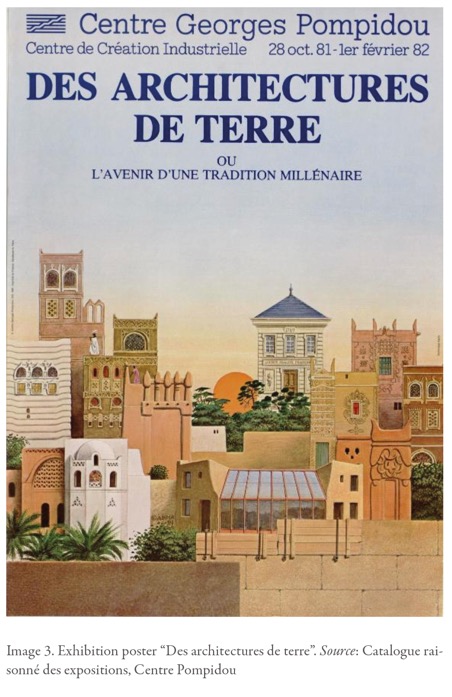
This interest in alternative architectural cultures found resonance with Jean Dethier, architectural curator at the Centre de Création Industrielle, a department dedicated to architecture and design at the Centre Pompidou. Dethier had curated the exhibition Architectures marginales aux Etats-Unis that opened at the American Center for Art and Culture in Paris in November 1975, an exhibition that traveled throughout Europe and provoked a diplomatic incident between France and the United States.[20] Even after Architectures colombiennes, in October 1981, Dethier continued to explore alternative architectural cultures with the memorable exhibition Des architectures de terre ou l’avenir d’une tradition millénaire, an exhibition accompanied by a 192-page book that presented earthen architecture from thirty countries on five continents. It was through this convergence of interests connecting the École Spéciale d’Architecture in Paris and the Centre de Création Industrielle that Berty’s curatorial project on Colombian architecture found space at the Centre Pompidou.

Along with the social networks that Berty cultivated in Colombia and the professional relations that supported her in France, Architectures colombiennes drew the attention of the Colombian ambassador to France at the time, Enrique Gómez Hurtado. Gómez Hurtado’s involvement was most likely a reflection of Colombia’s foreign policy during the presidency of Julio César Turbay Ayala (1978-1982). Turbay’s overall diplomatic strategy “was driven by a strong desire to improve the country’s international image,” since by the early 1980s “Colombia had become virtually synonymous with drug-related violence and corruption.”[21] In line with this policy, Gómez Hurtado persuaded other actors to sponsor the exhibition, such as the airline Avianca, public cultural institutions like Colcultura, or business organizations like the Colombian Coffee Growers Federation.[22] Diplomatically, however, the exhibition’s success was limited. As the Colombian Consul in Marseille stated a few years later: “we make a cultural event, it raises interest and good press, but it is a one-time affair and is forgotten, and so the negative reputation remains.”[23] The Consul regarded such diplomatic efforts as inconsistent and claimed that continuous investment was the sine qua non condition for cultural diplomacy, a condition that the Colombian government could hardly afford to fulfill in the early 1980s.[24]
Curatorially, the impact was more significant. According to Berty, in the early 1980s, when “Western architecture was seeking the renewal of its inspiration beyond its traditional borders and its own historical and cultural references,” Latin America in general and Colombia in particular provided new models.[25] Renevier highlighted that beyond a specific school of architecture or the academic ambition to elaborate new theories, there was a “tacit agreement” among young architects to reject “Western models” like the international style and, in exchange, find a local specificity embodied both in construction materials and in the collective ways of life fostered by Colombian architecture.[26] According to Dethier, the exhibition opened new perspectives as alternatives to a “Western ethnocentric perspective” and presented Colombian architecture as a legitimate challenge to the international style, understood as a project of “cultural and technological imperialism.”[27] Strikingly, these French curators framed Colombian architecture as a critique of North-American influences while ignoring European cultural domination only a few decades earlier. Perhaps a decolonial proto-critique or an attempt to build other intellectual genealogies? In any case, Berty, Renevier, and Dethier projected a confrontation between international models and marginal solutions, reinforcing and celebrating the existence of alternative architectural cultures.
Recently, confirming the enduring significance of the book and the impact of the exhibition, Architectures colombiennes has once again attracted the attention of some authors who have highlighted its role in the construction of a canon of Colombian architecture by focusing on certain names (e.g., Rogelio Salmona), construction materials (e.g., brick), architectural languages (e.g., integration with the landscape), and lineages (e.g., Alvar Aalto).[28] On the other hand, the bibliography that closes the catalogue for Architectures colombiennes also reveals the consolidation of another canon, that of the historical study of Colombian architecture shaped by Carlos Martínez and Germán Téllez, in addition to the magazines Proa and Escala. However, by the late 1970s the historiography of Colombian architecture had become a focus of renewed interest for a new generation of historians who not only focused exclusively on masterworks but increasingly included everyday spaces and vernacular architecture.
For example, in November 1977, the architects Lorenzo Fonseca and Alberto Saldarriaga inaugurated the exhibition Aspectos de la arquitectura contemporánea en Colombia at the Centro Colombo Americano in Bogotá, an exhibition developed over several years and accompanied by a lengthy book.[29] The book, coordinated by architect and graphic designer Eric P. Witzler but authored by Fonseca and Saldarriaga, recovered and extended the historical analysis of Colombian architecture, starting from Pre-Columbian times, addressing vernacular constructions, and concluding with a few remarks on the awards, competitions, publications, and magazines that dynamized the field. In this sense, this book elaborated a more extensive history of Colombian architecture and included other types of intellectual production, thereby differentiating itself from earlier studies.[30] The interest in studying the history of architecture in Colombia had another vital episode at the Museo de Arte Moderno de Bogotá after the inauguration of its new building on April 25, 1979.[31] Riding the wave of excitement around the new building, the museum’s Department of Education, directed by artist and critic Beatriz González, organized several lectures on Colombian architecture.[32] These included talks on colonial architecture in August 1979, architecture from the 1960s in September 1979, and a seminar on modern architecture in April 1980. Although these lectures did not generate publications, they functioned as alternative spaces outside architectural academia or professional associations to discuss and revalue the history of Colombian architecture. In this sense, some of the repercussions of the Pompidou book and exhibition in the Colombian context were: enabling the emergence of discourses that challenged international paradigms, suggesting a space for further discussions and elaborations around the history of architecture in Colombia, and, additionally and perhaps more importantly, raising awareness as to the relevance of presenting and disseminating such new views publicly in museums.

2. Historia de la arquitectura en Colombia
If the exhibition Architectures colombiennes at the Pompidou can be framed within a specific French academic and curatorial project, the exhibition Historia de la arquitectura en Colombia, which traveled extensively during 1985 and 1986, was the pinnacle of a series of (re)actions by Colombian architects and historians who were now writing their own history. Between 1981 and 1985—that is, in the span between the two exhibitions—the appetite for consuming and disseminating architecture was fed from different fronts. New texts on Colombian architecture were published through editorial projects like the Cuadernos Proa collection, and academic events were regularly organized, including a series of International Forums at the Universidad de los Andes, with national and international guests.[33] Both Cuadernos Proa and the International Forums adopted a situated perspective, delving into topics such as the history of brick architecture in Colombia, architectural heritage since colonial times, and housing in Latin America.
According to Carlos Morales, the idea for the exhibition Historia de la arquitectura en Colombia originally came from architect Rogelio Salmona, perhaps motivated by his visit to the Pompidou exhibition.[34] Salmona would also be part of the group that originally established a Department of Architecture at the Museo de Arte Moderno de Bogotá in 1983, a curatorial unit that would dedicate some of its exhibitions to presenting Colombian architecture.[35] However, it was Morales who, from his position as dean, promoted an agreement between the architecture schools of the Universidad Nacional de Colombia and the Universidad de los Andes, thus creating the conditions for the ambitious project. By February 1983 a group of researchers led by Silvia Arango had already been formed. Unlike Architectures colombiennes, the research for this exhibition, which lasted about two years (1983-1984), covered different periods, from the indigenous to the colonial to the modern. In this way, Arango solved two issues noted by several critics of Berty’s exhibition and book: the reductive privileging of architecture produced in Bogotá and the need to survey many other types of architecture, from different regions and with a wider historical arc. While Arango directed the research, Morales coordinated the exhibition.
Morales claims that instead of developing an exhibition and then moving it from one place to another, the team decided to print several copies of the 120 panels that made up the display (designed by the architect Rafael Gutiérrez Patiño), a decision that the Colombian Ministry of Foreign Affairs agreed to fund.[36] Thanks to this funding the exhibition was on view at multiple sites, including the International Architecture Biennale of Buenos Aires in May 1985, the exhibition hall of the government building in Caracas in June 1985, and the Museo de Arquitectura in Mexico in July 1985. The exhibition opened in Colombia at the Museo Nacional on June 24, 1985, and was in view until July 17, 1985. It opened later at the Museo de Arte Moderno de Medellín and at the Art Museum of the Universidad Nacional de Colombia in Bogotá in August 1985; it also ran simultaneously at different exhibition spaces in the Colombian cities of Manizales (July 1985), Cartagena (July 1985), Pereira (August 1985), Cali (August 1985), and Armenia (October 1985).
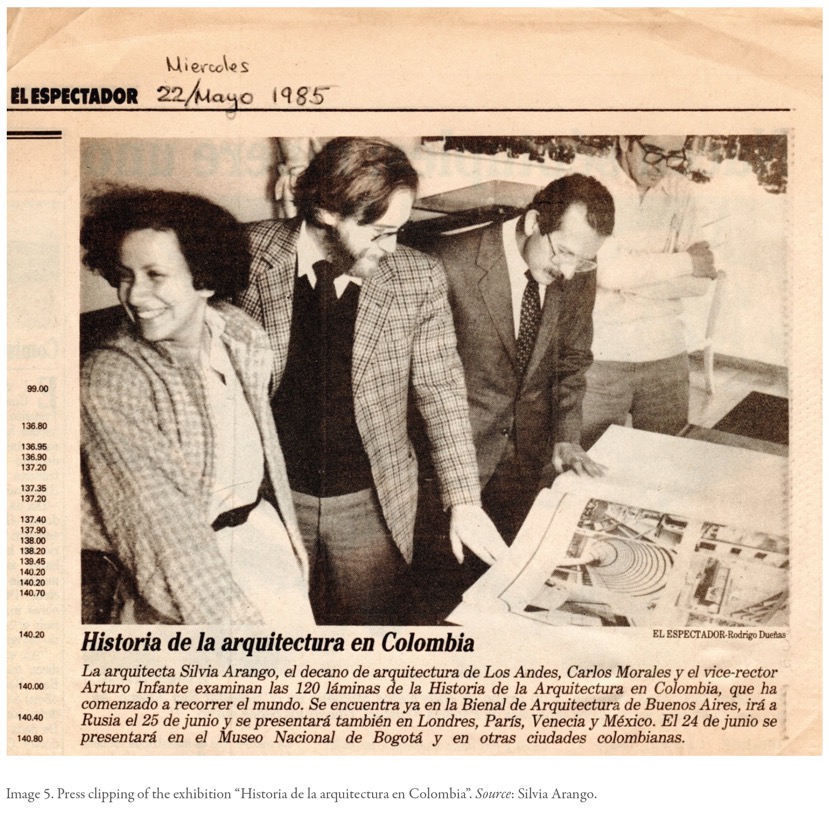
The inauguration of the exhibition at the Museo Nacional de Colombia is not a minor detail; the first edition of the Colombian Architecture Biennial in July 1962 was also held there, and previously the Museo Nacional had regularly welcomed architecture as an object of exhibition. From 1949 to 1974, in addition to events like the XII Pan-American Congress of Architecture in 1968, the Museo Nacional hosted at least ten architecture exhibitions (some of which were also competitions), presented a monograph on landscape architect Roberto Burle Marx, and organized an exhibition based on the book 4000 años de arquitectura mexicana, published in 1956 by the Mexican Society of Architects.[37] While the 1962 Biennial was “sparsely attended,” the Museum reported 70,000 visitors for the month of March, 1959.[38] Unlike other platforms like the Biennial, the Museum employed a diversified approach to architecture as the subject of exhibitions, attracting different and many viewers. The exhibition in 1985 was, in a sense, a renewal of the Museum’s interest in exhibiting architecture. After Historia de la arquitectura en Colombia, the museum exhibited watercolors by Colombian architect Gabriel Largacha in December 1987, architectural drawings by Scottish architect and designer Charles Rennie Mackintosh in October 1991, and hand-drawn perspectives by Swiss architect Victor Schmid in December 1991, the last two with the support of the British Council and Pro Helvetia, respectively.
As with various exhibitions throughout the twentieth century (e.g., the American National Exhibition, held in 1959 at the Sokolniki Park in Moscow), Historia de la arquitectura en Colombia was also a vital tool for nation branding. However, according to Morales, the involvement of the Colombian Ministry of Foreign Affairs in the project came after the organizers opted to reject sponsorship offers from private companies looking for their projects to be included in the exhibition, thus maintaining the curatorial independence of the team.[39] Rather, by taking advantage of the social and political networks available between diplomats and architects, the team managed to pique the interest of the Ministry through the workings of the architect Diana Barco. Barco had worked with Salmona and was the sister of Carolina Barco, a former urban planning consultant working with the Bogotá City Administration, and the daughter of Virgilio Barco Vargas, a former Mayor of Bogotá (1966-1969), director of the World Bank (1969-1974), ambassador to the United States (1977-1980), and President of Colombia (1986-1990). These social and political relations between architects and diplomats led to the inclusion of the exhibition Historia de la arquitectura en Colombia in “Colombia 85,” an ambitious cultural program intended to promote the country abroad. The program was first communicated to several diplomatic missions as early as August 1984,[40] and comprised a varied cultural repertoire, including displays of Colombian colonial art, archaeological pieces from the Museo del Oro, a selection of Colombian films, folk dance groups, choral music recitals, and lectures on Colombian literature. Unlike the isolated involvement of Colombia’s ambassador to France during the Pompidou exhibition in 1980, on this occasion the diplomatic involvement was utterly deliberate, planned months in advance, and collectively arranged to serve national interests. Consequently, the exhibition Historia de la arquitectura en Colombia was shown throughout Latin America and in other cities such as Moscow, London, Edinburgh, Paris, Venice, Berlin, Tokyo, and New York, in some cases accompanied by unique printed and translated material and public programming for each location.
With such an enormous undertaking, the exhibition generated various publications including brochures, a massive catalogue, and an influential book. As mentioned before, specific ephemera were produced for certain locations.[41] For example, in Caracas, a black-and-white legal-size brochure was printed with four photographs and a text written by architect William Niño Araque. In his text, Niño Araque celebrated the exhibition as an opportunity for all audiences, and not just specialists, to take an interest in architecture. In New York, an English-language brochure summarized each of the seven chapters that divided the exhibition, with twenty-one black-and-white photographs and short descriptive texts. Other brochures were also made in Spanish. For example, the brochure distributed at the Art Museum of the Universidad Nacional de Colombia replicated information from the exhibition, but unlike the New York brochure it suppressed three curatorial chapters. Perhaps the 22-page booklet with a colorful cover—using the same image as the official postcard—was the most complete publication in terms of content among this type of ephemera, although it featured only seven black-and-white images.

On the other hand, the exhibition catalogue, of which 3,000 copies were printed by the publishing company Escala, was a massive publication in size and weight. Larger than A3 in format, with 259 pages and a cloth-bound hardcover, it was an expensive instrument of soft power. Appealing by its size and tactile sensousness at first, the book also rewards readers with a treasure trove of graphic material: 425 images including 4 maps, 302 black-and-white photographs, 34 color images, 60 architectural plans, and 25 illustrations. Ready for distribution on the opening day, many copies of the catalogue ended up in university libraries or private collections. Intended also to function as a surrogate, the catalogue reproduced the same material as the exhibition, changing only its title: La arquitectura en Colombia. In that sense, it was the exhibition translated to print, no longer on panels for a wider audience but on sheets of paper for a secluded reader. The texts were short and easy to read, similar to those in the brochures. Although in the 1980s it may have circulated as a coffee-table book, now in the 2020s it is a unique and irreplaceable treasure.
Unlike the ephemera or the exhibition catalogue, a second, 292-page book, also based on the exhibition, was published four years after the show. Conceived as a second stage of the same research project, this book was now aimed at a “specialized audience,” including architects, students, and researchers.[42] If the first moment was a collective effort, the second stage was a solo exercise by Silvia Arango. According to her, “[a]lthough the main basis was the collective research carried out during the years 1983 and 1984, the final writing of the text implied theoretical revisions, an expansion of the initial documentation, and even a re-elaboration of certain judgments and general criteria.”[43] Despite the revisions, the book maintained the seven curatorial chapters of the exhibition and basically the same graphic material. However, instead of reproducing information from the exhibition, as the catalogue did, the book offered Arango the space to produce an additional layer of meaning and to impact architectural knowledge. While the exhibitions allowed curators working on architecture like Berty, Saldarriaga, and Arango to create more general and accessible frameworks for different audiences, the resulting books consolidated much denser narratives for specialized readers. Moreover, even though the book did not include exhibition views captured during its various iterations or documentation regarding its reception, the book nonetheless continues to function as a pill against memory loss, enabling an afterlife for the exhibition up to this day.
Since
its first edition in 1989, Arango’s book has been reprinted three times (1990,
1993, 2019) and has become an inescapable and indispensable source for those
who teach the history of architecture in Colombia. Furthermore, on August 28,
1992, at the thirteenth edition of the Colombian Architecture Biennial, the
jury awarded the National Architecture Award—the highest award—to this book.
This was the first time since 1962, when the Colombian Society of Architects
established the Biennial, that a publication was selected over buildings.
Although the book managed to prolong the life span of the exhibition and live
on in its own right, the most enduring impact of the exhibition and its
publications was the establishment of the Museo de Arquitectura at the
Universidad Nacional de Colombia in 1986. This museum, directed by Arango from
October 1986 to August 1990, was created to commemorate the fiftieth
anniversary of the School of Architecture, and its first exhibition was Historia
de la arquitectura en Colombia, whose 120 panels are now part of its
collection.[44]
As in 1980, the exhibition and its editorial production not only had an impact
on how Colombian architecture was understood, but also sowed museological seeds
that continue to flourish today.
3. Conclusion
This article examined the entanglement of architecture exhibitions and their editorial output. It recovered the history of two exhibitions on Colombian architecture and their accompanying publications, an exhibition from 1980 at the Centre Pompidou and another from 1985 at the Museo Nacional de Colombia, a book in French that generated debates about architecture and identity in Colombia and a series of publications of various kinds that fueled cultural consumption and interest in the history of Colombian architecture. Undoubtedly, these books and exhibitions have significantly shaped Colombian architectural culture in the twentieth century.
The article reveals the complex network woven in the dissemination of architecture by recovering the history of these exhibitions and focusing on the inextricable relation between exhibitions and books. This network emerges through links that connect academic institutions, museums, international relations, cultural financing, curatorial agendas, local contexts, and publishing companies, among other actors. By approaching architecture in this tentacular way, we can stop perceiving buildings and constructions as isolated elements and immovable products. On the contrary, through the study of exhibitions and books, we are able to notice the multiple connections of architecture with the economy, diplomacy, politics, and culture.
This ability to show architecture’s entanglements with various fields is one of the most valuable aspects of studying architecture exhibitions. Although this article examined the role played by some diplomats and government agencies in developing exhibitions, there is still much to explore in Colombia’s architectural diplomacy. Similarly, the 1980s witnessed an exponential increase in architecture exhibitions worldwide and in Colombia. However, we know little about the early years of the Museo de Arquitectura or other institutions that developed architecture exhibitions, such as the Banco de la República. Just as there is a need to explore various exhibition spaces, it is also necessary to review other editorial platforms where architecture was discussed. Art and cultural magazines were productive sites where many architects collaborated and strengthened their careers as critics and historians. Finally, and as I emphasized at the beginning, books often survive in time, but many of the records of the exhibitions are lost. Perhaps, therefore, it is worth questioning the architectural archive as a place to preserve these types of traces, which are significant for understanding the complex cultural processes of architecture.
Bibliography
Arango, Silvia. “Libro: Arquitecturas colombianas.” Arte en Colombia 15 (1981): 51.
—————. La arquitectura en Colombia. Bogotá: Escala, 1985.
—————. Historia de la arquitectura en Colombia. Bogotá: UNAL, 1989.
Bagley, Bruce Michael and Juan Gabriel Tokatlian. “La política exterior de Colombia durante la década de los ochenta. Los límites de un poder regional.” In Relaciones internacionales y política exterior de Colombia, edited by Sandra Borda and Arlene B. Tickner, 79-146. Bogotá: Uniandes, 2011.
Barr Jr., Alfred H. “Foreword.” In Modern Architecture, 12-17. New York: Museum of Modern Art, 1932.
Bergdoll, Barry. “Curating History.” Journal of the Society of Architectural Historians 57, no. 3 (1998): 257, 366.
—————. “Preface.” In Mediated Messages: Periodicals, Exhibitions, and the Shaping of Postmodern Architecture, edited by Véronique Patteeuw and Léa-Catherine Szacka, xi-xiv. London: Bloomsbury, 2018.
Berty, Anne. Architectures colombiennes. Paris: Editions du Moniteur, 1981.
Colomina, Beatriz. “Museum.” In Privacy and Publicity: Modern Architecture as Mass Media, 201-230. Cambridge and London: The MIT Press, 1996.
—————. “Enclosed by Images: The Eameses’ Multimedia Architecture.” Grey Room 2 (2001): 6-29.
Del Real, Patricio. Constructing Latin America: Architecture, Politics, and Race at the Museum of Modern Art. New Haven: Yale University Press, 2022.
Dethier, Jean. “Architectures de Colombie?.” BIP 100 ‘Spécial Colombie’ (1981).
École Spéciale d'Architecture de Paris. Architectes de Buenos Aires. Buenos Aires: École Spéciale d'Architecture de Paris & Centre d'Art et de Communication, 1979.
Ettinger, Catherine R. “Theorizing from the South: The Seminar of Latin American Architecture.” In Architecture Thinking Across Boundaries: Knowledge Transfers since the 1960s, edited by Rajesh Heynickx, Ricardo Costa Agarez, and Elke Couchez, 180-191. London: Bloomsbury, 2021.
Forero Parra, Michael Andrés. “Learning Space: The Leopoldo Rother Museum of Architecture in Colombia.” OASE Journal 99 (2017): 13-21.
Gómez, Patricia. “Arquitectura Colombiana en el Centro Pompidou.” Revista del arte y la arquitectura en América Latina 6, no. 2 (1981): 12-13.
Gordon Kantor, Sybil. Alfred H. Barr, Jr. and the Intellectual Origins of the Museum of Modern Art. Cambridge and London: The MIT Press, 2002.
Hines, Thomas S. Architecture and Design at the Museum of Modern Art: The Arthur Drexler Years, 1951-1986. Los Angeles: Getty Publications, 2019.
Ickx, Wonne. “Empty Catalogues.” In Exposed Architecture: Exhibitions, Interludes, and Essays, edited by Isabel Abascal and Mario Ballesteros, 235-237. Mexico City and Zürich: LIGA and Park Books, 2017.
Maniaque, Caroline. “The American Travels of European Architects, 1958-1973.” In Travel, Space, Architecture, edited by Jilly Traganou and Miodrag Mitrašinović, 189-209. Surrey: Ashgate, 2009.
—————. “Exhibiting Vernacular Structures and Marginal Architecture in France.” In French Encounters with the American Counterculture, 1960-1980, 73-92. London and New York: Routledge, 2011.
Medina, Álvaro. “Una exposición y un libro: Architectures colombiennes.” Arte en Colombia 15 (1981): 52-57.
Miller, Wallis. “Points of View: Herbert Bayer’s Exhibition Catalogue for the 1930 Section Allemande.” Architectural Histories 5, no. 1 (2017): 1-22.
Mondragón, Hugo and Manola Ogalde. “Consagrar y excluir. El canon en disputa de la arquitectura colombiana, 1951-1981.” Dearq 29 'Colombia desde afuera' (2021): 68-79.
Namer, Claude. “Arquitectura colombiana presente en París.” Arte en Colombia 15 (1981): 49.
Renevier, Franck. “L’Occident sombre dans la nostalgie. Un entretien avec Rogelio Salmona.” Le nouvel observateur, January 1981.
Riley, Terence. The International Style: Exhibition 15 and the Museum of Modern Art. New York: Columbia Books of Architecture, 1992.
Saldarriaga, Alberto. “Arquitecturas colombianas. Alternativas a los modelos internacionales.” Proa 296 (1981): 11-13.
Téllez Castañeda, Germán. “Notas para una historia informal de las Bienales Colombianas de Arquitectura.” In Veinte Bienales Colombianas de Arquitectura, 1962-2006, 15-58. Bogotá: Sociedad Colombiana de Arquitectos, 2006.
Tickner, Arlene B and Sandra Borda. “Introducción. Las relaciones internacionales en Colombia.” In Relaciones internacionales y política exterior de Colombia, edited by Sandra Borda and Arlene B. Tickner, 21-46. Bogotá: Uniandes, 2011.
Ursprung, Philip. “The Indispensable Catalogue.” Log 20 ‘Curating Architecture,’ edited by Cynthia Davidson (2010): 99-103.