Set up to fail: The politics, mechanisms, and effects of mass incarceration


Abstract

The rise of the citizen security paradigm has complemented, rather than curtailed, authoritarian legacies in Latin America and the Caribbean. Notably, criminal justice and law enforcement policies continue to feed a wave of mass incarceration, evidenced in a dataset on incarceration in 21 countries for 1995–2020. El Salvador stands out as a unique case study, with the second-highest incarceration rate in the world. We analyze four key mechanisms driving mass incarceration in the country—increasing discretionary arrests, diluting due process guarantees, escalating criminalization, and harshening of sentences—, and unpack its uses and effects. Mass incarceration has criminalized transgressive identities and the poor, strengthened gangs organizationally, made gangs’ criminal activity more complex, and turned them into significant actors in Salvadoran political life. These effects are hallmarks of El Salvador’s notoriously failed “mano dura” strategy and pose major obstacles for desistance from crime and violence, as well as reentry after incarceration.


El ascenso del paradigma de seguridad ciudadana ha venido a complementar, en vez de sustituir, los legados autoritarios en América Latina y el Caribe. En particular, las políticas de justicia criminal y seguridad pública siguen alimentando una ola de encarcelamiento masivo, evidenciado en un conjunto de datos sobre encarcelamiento en veinte países para 1995–2020. El Salvador se distingue como un estudio de caso único, con la segunda tasa de encarcelamiento más alta del mundo. Analizamos cuatro mecanismos clave que fomentan el encarcelamiento masivo en el país —incremento de detenciones arbitrarias, dilución de garantías del debido proceso, criminalización escalada y endurecimiento de penas—, e indagamos sus usos y efectos. El encarcelamiento masivo ha criminalizado identidades transgresoras y la población pobre, fortalecido las pandillas como organizaciones, vuelto más compleja la actividad criminal de las pandillas, e impulsado su transformación en actores determinantes en la vida política salvadoreña. Estos efectos son distintivos del notorio fracaso de la “mano dura” en El Salvador y supone graves obstáculos a la desistencia del crimen y la violencia, así como la reinserción después del encarcelamiento.


INTRODUCTION

Across Latin America and the Caribbean, law enforcement and criminal justice systems are being charged with solving social problems. The failure of politicians to deliver meaningful solutions to some of society’s most urgent challenges leads to a reliance upon repression, with legislation passed that obliges police, armed forces, courts, and prisons to keep society in check.1 This has prompted widespread criticism over human rights abuses, the perpetuation of crime and violence, and the undermining of democracy and the rule of law.2 In the early twenty-first century, the citizen security paradigm swept across the Americas, framed as a break with authoritarian legacies and urging a broader understanding of what is needed to achieve sustainable reductions in crime and violence. Crucially, it called for a shift from a state-centric focus to an emphasis on citizens’ fears and experiences and recognition of the need for institutional and social transformations.3 However, the ascendancy of a citizen security discourse did not spell the end of the reliance upon repression, as evidenced in policing practices,4 as well as a wave of incarceration across the continent, the scale and implications of which demand scholarly attention.

Figure 1 shows the evolution of incarceration rates in the 21 countries in Latin America and the Caribbean with more than one million inhabitants where data is available. Between 1995 and 2020, the median for this group of countries grew from 98 to 219 incarcerated persons per 100,000 inhabitants. While the countries started off on a similar, relatively low level, they have diverged sharply over time, as seen within the Central American subregion: In 2020, Honduras was just at the regional median and Guatemala at 141, while El Salvador soared from 132 at the turn of the century to above 600 in recent years—far ahead of the runner up, Panama, and second in the world only to the United States of America (USA).

Figure 1.

Incarcerated persons per 100,000 inhabitants in Latin America and the Caribbean, 1995–2020

fig1.jpg

To recognize this situation as one of mass incarceration involves coming to terms with a set of challenges that is distinct to incarceration at lower levels.5 Amid the high drama of armed violence that tends to capture much of the attention and imagination around El Salvador of late, incarceration has received scant scholarly attention, despite its uniquely high rate and the centrality of prisons in the Salvadoran landscape of crime and violence.

To address this knowledge gap, we firstly analyze the politics that drive mass incarceration in El Salvador; secondly, identify and unpack four key mechanisms of mass incarceration— increasing discretionary arrests, diluting due process guarantees, escalating criminalization, and harshening of sentences—; and, thirdly, discuss its uses. Finally, we lay out the principal effects of mass incarceration for the country, including strengthening gangs organizationally, stimulating greater complexity and sophistication in their criminal activities, and gangs’ growing role in Salvadoran political life, as well as the major implications of mass incarceration for desistance from crime and violence, and reentry after incarceration. Furthermore, by sharing novel empirical and analytical work, we seek to lay the groundwork for further research and policy development.

1. THE POLITICS OF MASS INCARCERATION

In the aftermath of the 1980–1992 war, forging democracy and the rule of law was at the center of the public agenda in El Salvador, and the postwar framework for public security pushed up against the country’s authoritarian legacies.6 Over the decade leading up to 2009, the opposition leftist guerrilla organization-turned-political party Farabundo Martí National Liberation Front (FMLN) resisted the repressive law enforcement and criminal justice policies of the governing rightist National Republican Alliance (ARENA), and, after winning the 2009 presidential elections, the FMLN adopted an explicit citizen security approach to dress up its policies over the following decade.7 This paradigm lent itself to link up crime and violence with social and economic development,8 as well as a democratic civil order,9 making it a comfortable fit with an ostensibly leftist political project.

Once in office, however, the FMLN increasingly came to draw upon its citizen security credentials to implement the kinds of policies that it denounced while in opposition, including widespread discretionary arrests and extensive use of lethal force by law enforcement officers. At the center of this story are gangs—both as bearers of great responsibility, depositaries of myths, and devices for political mobilization—, and law enforcement and criminal justice policy in postwar El Salvador has largely been geared at gang repression, driven by well-documented moral panics that cast gang members as folk devils.10

As with leftist governments in much of the region, the FMLN failed to offer a compelling and effective alternative to “mano dura,” and instead compensated for the shortcomings of policies and resources by recurring to militarization and engaging in the kinds of “performance of security” that the party believed could translate into electoral gains.11 Alisha C. Holland offers a compelling analysis of how the political left and right have converged on security policy—as much in El Salvador as in Costa Rica, Guatemala, and Honduras—, with the left seeking to “challenge the right’s advantage on security through an emphasis on the socioeconomic determinants of crime and a willingness to take a hard-line approach”.12

Looking back at the decade from 2009 until its electoral defeat in 2019, it is difficult to imagine that the FMLN would have tolerated a number of the policies that it implemented had it still been in opposition. A prime example is the prominent role of the armed forces in public security provision, which the FMLN resisted and decried as a violation of the 1992 peace accord throughout the 1990s and 2000s. However, “citizen security” proved to be a sufficiently porous vessel that it could fit not only claims for social justice, but practices drawn from a long history of authoritarian rule. That is, rather than displace and substitute the punitive populism that it would appear to contradict, the FMLN’s citizen security policies were grafted onto the framework of militarized repression.

2. THE MECHANISMS OF MASS INCARCERATION

There is academic consensus that decades of repressive criminal justice and public security policies have failed to sustainably reduce crime and violence, promote the rule of law, or effectively guarantee citizens’ rights in El Salvador.13 However, the resulting mass incarceration and the mechanisms that drive it are under-researched, never mind the pathways to rolling them back and substituting them for a new generation of policies.

In the USA, where the issue is most widely debated and researched, mass incarceration grew out of systemic racism, the war on drugs, “mandatory sentencing” that requires a predefined prison sentence for certain crimes, and the proliferation of private prisons.14 However, in El Salvador, not only the politics outlined above but also the mechanisms were distinct. We identify four key mechanisms as drivers of mass incarceration in the country, namely: increasing discretionary arrests, diluting due process guarantees, escalating criminalization, and harshening of sentences.

First, successive Salvadoran governments have granted law enforcement officers a great deal of discretion in conducting searches and arrests. The exact official figures diverge slightly, but in this country of 6.4 million people, around half a million arrests were carried out between January 2010 and December 2019.15 The number of arrests has been seen as an indicator of effective law enforcement, with quotas regularly placed on jurisdictions to boost detentions, and about three in four arrests are in flagrante delicto—that is, at the law enforcement officer’s discretion when a person is allegedly caught in the act of committing a crime, rather than on the orders of a prosecutor or judge. A clear expression of the scale of unnecessary and oftentimes unlawful arrests is that, out of around three thousand monthly arrests, three in four people are released from custody without charge within 72 hours.16

While each wrongful arrest in isolation might be brushed off as inconsequential, the accumulated harm of half a million arrests is likely to have significant criminogenic outcomes, driving a process of “deviance amplification” whereby the frequency and/or severity of crime and violence is fomented by society’s reaction to it.17 Even a few days in detention can lead to income loss, if not job loss, while any future search for employment may be frustrated by having a police record. Moreover, these practices foster police illegitimacy, indignation, and outrage and may indeed undermine support for the ostensibly democratic political regime that law enforcement officers represent.18

Second, the weakening of due process guarantees affects those who are charged with a crime. Most egregiously, under the April 2016 legislative package of temporary “extraordinary measures”,19 made permanent in August 2018,20 was decried by the United Nations High Commissioner for Human Rights for having “placed thousands of people in prolonged and isolated detention under truly inhumane conditions, and with prolonged suspension of family visits”.21 The measures included a temporary suspension of judicial processing terms, a suspension of transfers of incarcerated persons not only between prisons but even to appear in court. Effective access to legal counsel and a fair trial was restricted by introducing trials conducted by videoconference, where defendants are unable to communicate directly, confidentially, or expediently with neither attorney nor judge. Other threats to due process predate the extraordinary measures, such as the penchant for trials with numerous defendants, routinely running into the dozens and exceptionally hundreds of defendants, usually alleged gang members.

Third, the past twenty years have seen the criminalization of previously tolerated behaviors. In April 1998, a new Criminal Code and Criminal Procedure Code went into effect, marking El Salvador’s transition from an inquisitorial toward a more adversarial legal system,22 and we have systematized and analyzed all subsequent reforms of the Criminal Code.23 While 58 new crimes have been added, not a single crime has been repealed, and as legislators have broadened the scopes of existing crimes 92 times, they have narrowed them only twice. Furthermore, twelve whole new criminal laws have been created for specific areas, including drugs and violence against women, with the overall effect of subjecting a whole new range of behaviors to criminal sanction. Overwhelmingly, the sometimes implicit but oftentimes explicit motivation for reforms has been to persecute gangs.24

Fourth, our review also shows that prison sentences for different crimes have been increased 92 times and reduced only eight times since 1998. Topping the list, the penalty for “illicit association” (in effect, gang membership) has been reformed five times, from an initial 1–5 to the current 3–26 ⅔ years, while the maximum sentence for aggravated homicide has been extended three times, from thirty years in 1998 to sixty in 2020. Meanwhile, virtually all crimes previously punishable by fines are today subject only to incarceration.

Even with these developments, though, a vast disparity remains between the numbers of arrests and convictions. An important part of the explanation for this lies in the dismal performance of the Prosecutor General of the Republic (FGR), which suffers from chronic underinvestment, understaffing, and an enormous workload. Between 2013 and 2018, the FGR opened 582,976 cases and proceeded to take 175,149 (30.0 percent) of them to trial but landed a mere 24,285 (4.2 percent) guilty verdicts.25 That is, were it not for the gross ineffectiveness of the criminal justice system, the scale of mass incarceration in El Salvador would have been greater still.

3. USES OF MASS INCARCERATION

Excluding a marginal number of foreigners from the analysis, per January 1, 2020, there were 37,570 incarcerated adults in El Salvador—92.4 percent men and 7.6 percent women; 73.4 percent had been sentenced, while 26.6 percent were awaiting trial. Prison data shows that, overwhelmingly, incarceration is used to tackle the politically central issues of twenty-first-century El Salvador, namely homicides, extortion, gang membership, and, to a lesser extent, drugs. At the other extreme, incarceration for crimes such as corruption or environmental harm is exceedingly rare, as reflected in Figure 2, which shows the crimes for which those 37,570 people were convicted or charged.
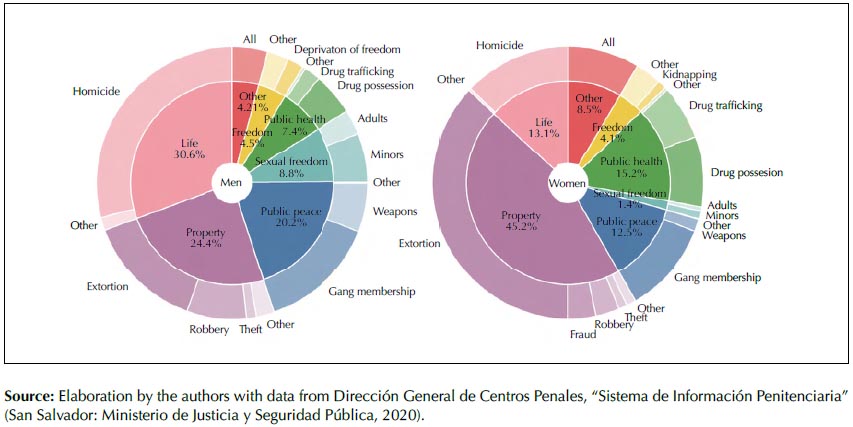
Figure 2.

Categories and crimes for which incarcerated men and women are convicted or charged, 2020

fig2.jpg

Also evident in Figure 2 is the disparity between incarcerated men and women, with property crimes constituting just over 45 percent of crimes for which incarcerated women were charged or convicted—the vast majority linked to extortion—against 24 percent for men. Such gaps ought to be further interrogated in future research, especially as it is plausible that a large proportion of crimes that women are incarcerated for are directly linked to the relationships with men in their lives, who oblige them to collect extortion payments or smuggle drugs into prisons during visits.

Arguably, a large proportion of people in Salvadoran prisons should not have been incarcerated in the first place. This is partly reflected in Figure 3, which shows that, from 2011 to 2019, only 18.8 percent were released from prison after serving out their sentences, while 46.6 percent were released due to a verdict of innocence, dismissal of charges, or end of remand. The reasons for the apparent overuse of prisons by judges have not as yet been systematically researched.

Figure 3.

Reasons for release from prison per month (smoothed), July 2011–December 2019

fig3.jpg

Finally, since 2018, the rise in incarceration has been stemmed through the conditional suspension of prison sentences of up to three years, the expansion of opportunities for incarcerated persons to serve two days of their sentence for every day of community service and prison work, and the strengthening of the capacity of the prison criminological councils to allow for more efficient processing of those who qualify for substitution of imprisonment or parole. Still, these measures have been insufficient to roll back mass incarceration and its effects.

4. EFFECTS OF MASS INCARCERATION

Following David Garland, the defining features of mass incarceration are, firstly, the sheer numbers and, secondly, “the social concentration of imprisonment’s effects.” That is, “Imprisonment becomes mass imprisonment when it ceases to be the incarceration of individual offenders and becomes the systematic imprisonment of whole groups of the population”.26 In El Salvador, it is true that the drive for mass incarceration has been fed by a fixation on gangs, but any notion that they are the only ones affected is a myth.

At any given time, about half the incarcerated population is gang-affiliated. Nevertheless, while gang members tend to get longer sentences, the turnaround of non-gang members is higher. Thus, as reflected in Figure 4, of the 75,211 people who entered the Salvadoran prison system between July 2011 and December 2019, 31.5 percent were current and 4.0 percent former gang members, but 64.5 percent—two in three—had no gang affiliation. At this massive scale, imprisonment seems to be rather a blunt instrument—punishing criminal behaviors, yes, but also criminalizing transgressive identities and the poor, starting with poor, young men.27

Figure 4.

Entries and releases of incarcerated persons by gang affiliation, July 2011– December 2019

fig4.jpg

Furthermore, mass incarceration has contributed immensely to transforming the criminal ecosystem in El Salvador. As discussed by Benjamin Lessing, while policy and scholarly debates tend to revolve around the desired and undesired individual-level effects of incarceration, “such work largely overlooks the collective effects of incarceration,” which, he argues, “can strengthen prison-based criminal organizations at the expense of the state”.28 El Salvador is a radical case in this regard, for

mass incarceration has played a central role in strengthening Salvadoran gangs organizationally. As the prison population swelled, prison authorities started to separate inmates by gang affiliation as of September 2, 2004,29 and while this helped reduce inter-gang fighting within prisons,30 it also brought members of the same gang together from across the country in a way that had never happened before and that the gangs would have been unable to do on their own.31

This bringing together of gang members in prison is significant for several reasons. First and foremost, gangs are social organizations that provide members with meaning and belonging. In this vein, David C. Brotherton and Luis Barrios have argued that gangs may be understood as “street organizations,” which they define as

A group formed largely by youth and adults of a marginalized social class which aims to provide its members with a resistant identity, an opportunity to be individually and collectively empowered, a voice to speak back to and challenge the dominant culture, a refuge from the stresses and strains of barrio or ghetto life, and a spiritual enclave within which its own sacred rituals can be generated and practiced.32

Accordingly, over the past twenty years, the collective experience of thousands of gang members of persecution and incarceration fomented their cohesion.

Secondly, as the organizations grew more complex, the gangs’ capacity for more sophisticated criminal activity was also enhanced,33 not least extortion of businesses and individuals.34 Paradoxically, a key driver of extortion in El Salvador has been mass incarceration, as a significant part of extortion income is used to cover the basic needs of gang members in prison and care for their families on the outside.

Thirdly, mass incarceration is integral to the story of gangs gradually becoming de facto political actors, with gang leaders gaining consciousness of their political agency and ability to set the public agenda, oftentimes through shocking acts of violence. Throughout, wrongful incarceration and appalling and abusive prison conditions have remained the gangs’ chief grievance, from protests and hunger strikes in prisons in the wake of repressive campaigns starting in 2003,35 to a major strike by incarcerated people across most prisons in 2009,36 and several large marches by gang members and their relatives.37

During the 2012–2013 gang truce, the gangs released a series of public statements where improved prison conditions ranked as their top demand to the government, effectively in exchange for maintaining the sharp reduction in homicides.38 Ever since, the number of homicides has remained a currency of power in the relationship between Salvadoran gangs and governments, intricately entwined with the persistence of mass incarceration and the politicized agenda for reform to which it gives root. Today, that agenda is topped by prison reform and support for reentry, the end and investigation into extrajudicial executions, and the reversal of chronic underinvestment in stigmatized communities. Since the gangs’ ability to either unleash or rein in their organizational capacity for homicides remains their main form of applying pressure and brokering deals with politicians, the governments’ ability to safeguard its citizens now relies heavily on negotiations with the gangs. A genealogy of the processes leads back to the advent of mass incarceration.

Finally, this brief overview of the politics, mechanisms, uses, and effects of mass incarceration in El Salvador leads up to a crucial issue for the country’s future, namely the implications for the prospects of reentry of incarcerated persons upon release from prison. In Figure 5, we forecast the number of incarcerated persons released from Salvadoran prisons,39 and our best estimate is that, on average, around 750 people will leave Salvadoran prisons every month from January 2020 to December 2024. Over five years, that makes for some 40–50,000 people, out of a total population of 6.4 million. At this point, it becomes evident that El Salvador has set itself up to fail: While staving off collapse, no state or prison administration can cope well with incarceration or reentry at this scale.

Figure 5.

Forecast of incarcerated persons released from prison per month, 2020–2024

fig5.jpg

CONCLUSION

The Salvadoran crisis of mass incarceration, and the ensuing crisis of reentry of incarcerated persons, result from the failure to deal with crucial social problems through politics and two decades of public policies that have incentivized mass arrests, diluted due process guarantees, created new crimes, and harshened sentences. Yet incarceration is not an effective or efficient means to foster desistance from crime and violence.40 Rather, as a rule, incarceration is harmful to incarcerated people, their families and societies.41 From this juxtaposition of realities follows big questions for policy and scholarship moving forward, not least: What should be the role of prisons in citizen security policy and how to go about the large-scale reentry of incarcerated persons?

We argue that the path forward passes through rolling back each of the four mechanisms we have discussed to reduce the size of the incarcerated and reentry populations. Lest the mechanisms of mass incarceration are better understood and reversed, the influx of incarcerated people into prisons is bound to carry on at unsustainable—never mind unacceptable—levels.

Two points stand out in the struggle for peace and security in El Salvador. Firstly, to stop mass arrests—a shift that must be envisioned within a larger framework of law enforcement reform and an end to the marginalization of stigmatized youth. Secondly, to stop and reverse mass incarceration through decriminalization (dealing with social problems by means other than criminal justice), excarceration (diverting people away from prison), and decarceration (getting people out of prison). Together, these shifts call for investment in alternatives to incarceration and strengthening constructive mechanisms for dealing with conflicts from the interpersonal to the societal.

All the while, it is imperative to address the effects of mass incarceration that are already being felt, employing strategies that are commensurate with the scale of the challenges. Crucially, these will include investing in communities impacted by mass incarceration, so that they can successfully absorb a burgeoning reentry population, and developing economic frameworks capable of sustaining large-scale reentry. However, further research is urgently needed to help develop actionable policies and programs.

Finally, to effect and sustain a shift away from the politics of punishment that have gotten us to where we are today, it is incumbent upon us to reimagine ways of responding to crime and violence as well as to transgressive identities and collectives.42 This task is too important to be left solely to politicians, law enforcement and criminal justice authorities, and requires mobilizing behind socially transformative approaches if our collective notions of justice are to evolve.

REFERENCES

1. 

Asamblea Legislativa. “Disposiciones especiales transitorias y extraordinarias en los centros penitenciarios, granjas penitenciarias, centros intermedios y centros temporales de reclusión.” Diario Oficial 411, no. 59 (April 1, 2016): 4–8.

2. 

Asamblea Legislativa. “Reformas a la Ley Penitenciaria.” Diario Oficial 420, no. 161 (August 31, 2018): 3–8.

3. 

Auyero, Javier, Philippe Bourgois, and Nancy Scheper-Hughes, eds. Violence at the Urban Margins. New York: Oxford University Press, 2015. https://doi.org/10.1093/acprof:oso/9780190221447.001.0001.

4. 

Beckett, Katherine, and Megan Ming Francis. “The Origins of Mass Incarceration: The Racial Politics of Crime and Punishment in the Post–Civil Rights Era.” Annual Review of Law and Social Science 16, no. 1 (2020): 433–452. https://doi.org/10.1146/annurev-lawsocsci-110819-100304.

5. 

Bergmann, Adrian. “Glass Half Full? The Peril and Potential of Highly Organized Violence.” Revista de Estudios Sociales, no. 73 (2020): 31–43. https://doi.org/10.7440/res73.2020.03.

6. 

Bergmann, Adrian. “Violence, Migration, and the Perverse Effects of Gang Repression in Central America.” In Media, Central American Refugees, and the U.S. Border Crisis: Security Discourses, Immigrant Demonization, and the Perpetuation of Violence, by Robin Andersen and Adrian Bergmann, 36–58. New York: Routledge, 2019. https://doi.org/10.4324/9780429199592-3.

7. 

Borgh, Chris van der. “Government Responses to Gang Power: From Truce to War on Gangs in El Salvador.” European Review of Latin American and Caribbean Studies, no. 107 (2019): 1–25. https://doi.org/10.32992/erlacs.10433.

8. 

Borgh, Chris van der, and Wim Savenije. “De-Securitising and Re-Securitising Gang Policies: The Funes Government and Gangs in El Salvador.” Journal of Latin American Studies 47, no. 1 (2015): 149–176. https://doi.org/10.1017/S0022216X14000741.

9. 

Brotherton, David C., and Luis Barrios. The Almighty Latin King and Queen Nation: Street Politics and the Transformation of a New York City Gang. New York: Columbia University Press, 2004.

10. 

Call, Charles T. “Democratisation, War and State-Building: Constructing the Rule of Law in El Salvador.” Journal of Latin American Studies 35, no. 4 (2003): 827–862. https://doi.org/10.1017/S0022216X03007004.

11. 

Chinchilla, Laura, and Doreen Vorndran. “Citizen Security in Latin America and the Caribbean: Challenges and Innovation in Management and Public Policies Over the Last 10 Years.” Washington: Inter-American Development Bank, 2018. https://doi.org/10.18235/0001426.

12. 

Cohen, Stanley. Folk Devils and Moral Panics: The Creation of the Mods and Rockers. London: MacGibbon and Kee, 1972.

13. 

Cruz, José Miguel. “Government Responses and the Dark Side of Gang Suppression in Central America.” In Maras: Gang Violence and Security in Central America, edited by Thomas C. Bruneau, Lucía Dammert, and Elizabeth Skinner, 137–157. Austin: University of Texas Press, 2011. https://doi.org/10.7560/728608.11.

14. 

Cruz, José Miguel. “Police Misconduct and Political Legitimacy in Central America.” Journal of Latin American Studies 47, no. 2 (2015): 251–283. https://doi.org/10.1017/S0022216X15000085.

15. 

Dalton, Juan José. “Presos de cinco cárceles salvadoreñas, en huelga de hambre.” El País. September 28, 2005. https://elpais.com/internacional/2005/09/28/actualidad/1127858414_850215.html.

16. 

EFE. “Piden mejores condiciones carcelarias.” El Diario. March 4, 2010.

17. 

Frühling, Hugo, Joseph S. Tulchin, and Heather A. Golding, eds. Crime and Violence in Latin America: Citizen Security, Democracy, and the State. Washington and Baltimore: Woodrow Wilson Center Press and Johns Hopkins University Press, 2003.

18. 

Fuentes, Elizabeth. “Legislación antipandillas y planes mano dura: ¿un derecho penal del enemigo?” In Violencia en tiempos de paz: conflictividad y criminalización en El Salvador, edited by Óscar Meléndez and Adrian Bergmann, 115–146. San Salvador: Secretaría de Cultura de la Presidencia, 2015.

19. 

García Pinzón, Viviana, and Erika J. Rojas Ospina. “La política de seguridad en El Salvador: la construcción del enemigo y sus efectos en la violencia y el orden social.” Revista de Estudios Sociales, no. 73 (2020): 96–108. https://doi.org/10.7440/res73.2020.08.

20. 

Garland, David. “Introduction: The Meaning of Mass Imprisonment.” Punishment & Society 3, no. 1 (2001): 5–7. https://doi.org/10.1177/14624740122228203.

21. 

González, Yanilda María. Authoritarian Police in Democracy: Contested Security in Latin America. Cambridge: Cambridge University Press, 2020. https://doi.org/10.1017/9781108907330.

22. 

Gottschalk, Marie. Caught: The Prison State and the Lockdown of American Politics. Princeton: Princeton University Press, 2015. https://doi.org/10.1515/9781400852147.

23. 

Hinton, Elizabeth. From the War on Poverty to the War on Crime: The Making of Mass Incarceration in America. Cambridge: Harvard University Press, 2016. https://doi.org/10.4159/9780674969223.

24. 

Holland, Alisha C. “Right on Crime? Conservative Party Politics and Mano Dura Policies in El Salvador.” Latin American Research Review 48, no. 1 (2013): 44–67. https://doi.org/10.1353/lar.2013.0009.

25. 

Hoppert-Flämig, Susan. “A Salvadoran Turnaround? The FMLN’s Response to Citizen Security Needs.” In Nuevo pensamiento sobre seguridad en América Latina: hacia la seguridad como un valor democrático, edited by Alexandra Abello Colak and Pablo Emilio Angarita Cañas, 71–85. Buenos Aires: Consejo Latinoamericano de Ciencias Sociales, 2013.

26. 

International Crisis Group. “Mafia of the Poor: Gang Violence and Extortion in Central America.” Brussels: International Crisis Group, 2017. https://www.crisisgroup.org/latin-america-caribbean/central-america/62-mafia-poor-gang-violence-and-extortion-central-america.

27. 

“Las maras hicieron tregua para protestar.” El Diario de Hoy. October 25, 2009.

28. 

Lerman, Amy E. The Modern Prison Paradox: Politics, Punishment, and Social Community. Cambridge: Cambridge University Press, 2013. https://doi.org/10.1017/CBO9781139649681.

29. 

Lessing, Benjamin. “Counterproductive Punishment: How Prison Gangs Undermine State Authority.” Rationality and Society 29, no. 3 (2017): 257–297. https://doi.org/10.1177/1043463117701132.

30. 

Liebling, Alison, and Shadd Maruna, eds. The Effects of Imprisonment. 2nd ed. 2005. Reprint, London: Routledge, 2013. https://doi.org/10.4324/9781843926030.

31. 

Maruna, Shadd, and Hans Toch. “The Impact of Imprisonment on the Desistance Process.” In Prisoner Reentry and Crime in America, edited by Jeremy Travis and Christy Visher, 139–178. Cambridge: Cambridge University Press, 2005. https://doi.org/10.1017/CBO9780511813580.006.

32. 

Moncada, Eduardo. “Resisting Protection: Rackets, Resistance, and State Building.” Comparative Politics 51, no. 3 (2019): 321–339. https://doi.org/10.5129/001041519X15647434969948.

33. 

Montes, Carlos. “Se extiende la rebelión en los centros penales.” La Prensa Gráfica. February 16, 2009.

34. 

Montoya, Ainhoa. The Violence of Democracy: Political Life in Postwar El Salvador. Cham: Palgrave Macmillan, 2018. https://doi.org/10.1007/978-3-319-76330-9.

35. 

Moodie, Ellen. El Salvador in the Aftermath of Peace: Crime, Uncertainty, and the Transition to Democracy. Philadelphia: University of Pennsylvania Press, 2010. https://doi.org/10.9783/9780812205978.

36. 

Muggah, Robert. “The Rise of Citizen Security in Latin America and the Caribbean.” International Development Policy, no. 9 (2017): 291–322. https://doi.org/10.4000/poldev.2377.

37. 

Müller, Markus-Michael. “The Rise of the Penal State in Latin America.” Contemporary Justice Review 15, no. 1 (2012): 57–76. https://doi.org/10.1080/10282580.2011.590282.

38. 

Murakawa, Naomi. The First Civil Right: How Liberals Built Prison America. Oxford: Oxford University Press, 2014.

39. 

National Research Council. The Growth of Incarceration in the United States: Exploring Causes and Consequences. Edited by Steve Redburn, Jeremy Travis, and Bruce Western. Washington: The National Academies Press, 2014. https://doi.org/10.17226/18613.

40. 

Observatorio para el Fortalecimiento Institucional. “Operatividad y eficacia de la Fiscalía General de la República: período 2013-2018.” San Salvador: Acción Ciudadana, 2020. https://accion-ciudadana.org/wp-content/uploads/2020/07/Informe.-Operatividad-y-eficacia-de-la-FGR.-Periodo-2013-2018.-Accion-Ciudadana.-2020.pdf.

41. 

Pearce, Jenny. “Perverse State Formation and Securitized Democracy in Latin America.” Democratization 17, no. 2 (2010): 286–306. https://doi.org/10.1080/13510341003588716.

42. 

Peirce, Jennifer, and Gustavo Fondevila. “Concentrated Violence: The Influence of Criminal Activity and Governance on Prison Violence in Latin America.” International Criminal Justice Review 30, no. 1 (2020): 99–130. https://doi.org/10.1177/1057567719850235.

43. 

Policzer, Pablo, ed. The Politics of Violence in Latin America. Calgary: University of Calgary Press, 2019. https://doi.org/10.2307/j.ctvkwnpz9.

44. 

Programa de las Naciones Unidas para el Desarrollo. “Abrir espacios para la seguridad ciudadana y el desarrollo humano: Informe sobre Desarrollo Humano para América Central 2009–2010.” Edited by Hernando Gómez Buendía. Bogotá: Programa de las Naciones Unidas para el Desarrollo, 2009. http://www.undp.org/content/dam/rblac/docs/Research%20and%20Publications/Central_America_RHDR_2009-10_ES.pdf.

45. 

Ra’ad Al Hussein, Zeid. “Statement by UN High Commissioner for Human Rights Zeid Ra’ad Al Hussein at the End of His Mission to El Salvador.” Office of the United Nations High Commissioner for Human Rights, November 17, 2017. https://www.ohchr.org/EN/NewsEvents/Pages/DisplayNews.aspx?NewsID=22412&LangID=E.

46. 

Santamaría, Gema, and David Carey, eds. Violence and Crime in Latin America: Representations and Politics. Norman: University of Oklahoma Press, 2017.

47. 

Travis, Jeremy, and Christy Visher, eds. Prisoner Reentry and Crime in America. Cambridge: Cambridge University Press, 2005. https://doi.org/10.1017/CBO9780511813580.

48. 

Tyler, Tom R., Jeffrey Fagan, and Amanda Geller. “Street Stops and Police Legitimacy: Teachable Moments in Young Urban Men’s Legal Socialization.” Journal of Empirical Legal Studies 11, no. 4 (2014): 751–785. https://doi.org/10.1111/jels.12055.

49. 

Urquilla, Katien. “Protestan frente a cárcel.” El Diario de Hoy. March 7, 2005. http://archivo.elsalvador.com/noticias/2005/03/07/nacional/nac2.asp.

50. 

Valencia, Roberto. “El país que entregó las cárceles a sus pandilleros.” El Faro. September 1, 2014. https://salanegra.elfaro.net/es/201408/cronicas/15861/.

51. 

Wilkins, Leslie T. Social Deviance: Social Policy, Action and Research. London: Tavistock, 1964. https://doi.org/10.4324/9781315013497.

52. 

Wolf, Sonja. “Creating Folk Devils: Street Gang Representations in El Salvador’s Print Media.” Journal of Human Security 8, no. 2 (2012): 36–63.

53. 

Wolf, Sonja. Mano Dura: The Politics of Gang Control in El Salvador. Austin: University of Texas Press, 2017. https://doi.org/10.7560/311219.

54. 

World Bank. “World Development Report 2011: Conflict, Security, and Development.” Edited by Sarah Cliffe and Nigel Roberts. Washington: World Bank, 2011. https://doi.org/10.1596/978-0-8213-8439-8.

55. 

Young, Jock. The Criminological Imagination. Cambridge: Polity Press, 2011.

Notes

[*] MA in Peace and Reconciliation Studies at Coventry University, England. Research Fellow at the Institute of Historical, Anthropological, and Archaeological Studies, University of El Salvador. San Salvador, El Salvador. ORCID https://orcid.org/0000-0002-9413-4936. bergmann@transcend.org.

[**] MPhil in Latin American Studies at the University of Oxford, England. Visiting Scholar at the Center for Social Change and Transgressive Studies, John Jay College of Criminal Justice. San Salvador, El Salvador. rafagude@gmail.com.

[1] Jenny Pearce, “Perverse State Formation and Securitized Democracy in Latin America,” Democratization 17, no. 2 (2010): 286–306, https://doi.org/10.1080/13510341003588716.

[2] Javier Auyero, Philippe Bourgois, and Nancy Scheper-Hughes, eds., Violence at the Urban Margins (New York: Oxford University Press, 2015), https://doi.org/10.1093/acprof:oso/9780190221447.001.0001; Pablo Policzer, ed., The Politics of Violence in Latin America (Calgary: University of Calgary Press, 2019), https://doi.org/10.2307/j.ctvkwnpz9; Gema Santamaría and David Carey, eds., Violence and Crime in Latin America: Representations and Politics (Norman: University of Oklahoma Press, 2017).

[3] Laura Chinchilla and Doreen Vorndran, “Citizen Security in Latin America and the Caribbean: Challenges and Innovation in Management and Public Policies Over the Last 10 Years” (Washington: Inter-American Development Bank, 2018), https://doi.org/10.18235/0001426; Robert Muggah, “The Rise of Citizen Security in Latin America and the Caribbean,” International Development Policy, no. 9 (2017): 291–322, https://doi.org/10.4000/poldev.2377.

[4] Yanilda María González, Authoritarian Police in Democracy: Contested Security in Latin America (Cambridge: Cambridge University Press, 2020), https://doi.org/10.1017/9781108907330.

[5] Amy E. Lerman, The Modern Prison Paradox: Politics, Punishment, and Social Community (Cambridge: Cambridge University Press, 2013), https://doi.org/10.1017/CBO9781139649681; National Research Council, The Growth of Incarceration in the United States: Exploring Causes and Consequences, ed. Steve Redburn, Jeremy Travis, and Bruce Western (Washington: The National Academies Press, 2014), https://doi.org/10.17226/18613.

[6] Ainhoa Montoya, The Violence of Democracy: Political Life in Postwar El Salvador (Cham: Palgrave Macmillan, 2018), https://doi.org/10.1007/978-3-319-76330-9; Ellen Moodie, El Salvador in the Aftermath of Peace: Crime, Uncertainty, and the Transition to Democracy (Philadelphia: University of Pennsylvania Press, 2010), https://doi.org/10.9783/9780812205978.

[7] Susan Hoppert-Flämig, “A Salvadoran Turnaround? The FMLN’s Response to Citizen Security Needs,” in Nuevo pensamiento sobre seguridad en América Latina: hacia la seguridad como un valor democrático, ed. Alexandra Abello Colak and Pablo Emilio Angarita Cañas (Buenos Aires: Consejo Latinoamericano de Ciencias Sociales, 2013), 71–85.

[8] Programa de las Naciones Unidas para el Desarrollo, “Abrir espacios para la seguridad ciudadana y el desarrollo humano: Informe sobre Desarrollo Humano para América Central 2009–2010,” ed. Hernando Gómez Buendía (Bogotá: Programa de las Naciones Unidas para el Desarrollo, 2009), http://www.undp.org/content/dam/rblac/docs/Research%20and%20Publications/Central_America_RHDR_2009-10_ES.pdf; World Bank, “World Development Report 2011: Conflict, Security, and Development,” ed. Sarah Cliffe and Nigel Roberts (Washington: World Bank, 2011), https://doi.org/10.1596/978-0-8213-8439-8.

[9] Hugo Frühling, Joseph S. Tulchin, and Heather A. Golding, eds., Crime and Violence in Latin America: Citizen Security, Democracy, and the State (Washington and Baltimore: Woodrow Wilson Center Press and Johns Hopkins University Press, 2003).

[10] Viviana García Pinzón and Erika J. Rojas Ospina, “La política de seguridad en El Salvador: la construcción del enemigo y sus efectos en la violencia y el orden social,” Revista de Estudios Sociales, no. 73 (2020): 96–108, https://doi.org/10.7440/res73.2020.08; Sonja Wolf, “Creating Folk Devils: Street Gang Representations in El Salvador’s Print Media,” Journal of Human Security 8, no. 2 (2012): 36–63.

[11] Chris van der Borgh and Wim Savenije, “De-Securitising and Re-Securitising Gang Policies: The Funes Government and Gangs in El Salvador,” Journal of Latin American Studies 47, no. 1 (2015): 149–176, https://doi.org/10.1017/S0022216X14000741.

[12] Alisha C. Holland, “Right on Crime? Conservative Party Politics and Mano Dura Policies in El Salvador,” Latin American Research Review 48, no. 1 (2013): 64, https://doi.org/10.1353/lar.2013.0009.

[13] Adrian Bergmann, “Violence, Migration, and the Perverse Effects of Gang Repression in Central America,” in Media, Central American Refugees, and the U.S. Border Crisis: Security Discourses, Immigrant Demonization, and the Perpetuation of Violence, by Robin Andersen and Adrian Bergmann (New York: Routledge, 2019), 36–58, https://doi.org/10.4324/9780429199592-3; José Miguel Cruz, “Government Responses and the Dark Side of Gang Suppression in Central America,” in Maras: Gang Violence and Security in Central America, ed. Thomas C. Bruneau, Lucía Dammert, and Elizabeth Skinner (Austin: University of Texas Press, 2011), 137–157, https://doi.org/10.7560/728608.11; Chris van der Borgh, “Government Responses to Gang Power: From Truce to War on Gangs in El Salvador,” European Review of Latin American and Caribbean Studies, no. 107 (2019): 1–25, https://doi.org/10.32992/erlacs.10433; Sonja Wolf, Mano Dura: The Politics of Gang Control in El Salvador (Austin: University of Texas Press, 2017), https://doi.org/10.7560/311219.

[14] Katherine Beckett and Megan Ming Francis, “The Origins of Mass Incarceration: The Racial Politics of Crime and Punishment in the Post–Civil Rights Era,” Annual Review of Law and Social Science 16, no. 1 (2020): 433–452, https://doi.org/10.1146/annurev-lawsocsci-110819-100304; Marie Gottschalk, Caught: The Prison State and the Lockdown of American Politics (Princeton: Princeton University Press, 2015), https://doi.org/10.1515/9781400852147; Elizabeth Hinton, From the War on Poverty to the War on Crime: The Making of Mass Incarceration in America (Cambridge: Harvard University Press, 2016), https://doi.org/10.4159/9780674969223; Naomi Murakawa, The First Civil Right: How Liberals Built Prison America (Oxford: Oxford University Press, 2014).

[15] Policía Nacional Civil, Imperium (San Salvador: Policía Nacional Civil, 2020).

[16] Ibid.

[17] Stanley Cohen, Folk Devils and Moral Panics: The Creation of the Mods and Rockers (London: MacGibbon and Kee, 1972); Leslie T. Wilkins, Social Deviance: Social Policy, Action and Research (London: Tavistock, 1964), https://doi.org/10.4324/9781315013497.

[18] José Miguel Cruz, “Police Misconduct and Political Legitimacy in Central America,” Journal of Latin American Studies 47, no. 2 (2015): 251–283, https://doi.org/10.1017/S0022216X15000085; Tom R. Tyler, Jeffrey Fagan, and Amanda Geller, “Street Stops and Police Legitimacy: Teachable Moments in Young Urban Men’s Legal Socialization,” Journal of Empirical Legal Studies 11, no. 4 (2014): 751–785, https://doi.org/10.1111/jels.12055.

[19] Asamblea Legislativa, “Disposiciones especiales transitorias y extraordinarias en los centros penitenciarios, granjas penitenciarias, centros intermedios y centros temporales de reclusión,” Diario Oficial 411, no. 59 (April 1, 2016): 4–8.

[20] Asamblea Legislativa, “Reformas a la Ley Penitenciaria,” Diario Oficial 420, no. 161 (August 31, 2018): 3–8.

[21] Zeid Ra’ad Al Hussein, “Statement by UN High Commissioner for Human Rights Zeid Ra’ad Al Hussein at the End of His Mission to El Salvador,” Office of the United Nations High Commissioner for Human Rights, November 17, 2017, https://www.ohchr.org/EN/NewsEvents/Pages/DisplayNews.aspx?NewsID=22412&LangID=E.

[22] Charles T. Call, “Democratisation, War and State-Building: Constructing the Rule of Law in El Salvador,” Journal of Latin American Studies 35, no. 4 (2003): 855, https://doi.org/10.1017/S0022216X03007004.

[23] Systematization results can be found in annex 2: https://lar.blob.core.windows.net/anexos/Annex2.xlsx

[24] Elizabeth Fuentes, “Legislación antipandillas y planes mano dura: ¿un derecho penal del enemigo?,” in Violencia en tiempos de paz: conflictividad y criminalización en El Salvador, ed. Óscar Meléndez and Adrian Bergmann (San Salvador: Secretaría de Cultura de la Presidencia, 2015), 115–146.

[25] Observatorio para el Fortalecimiento Institucional, “Operatividad y eficacia de la Fiscalía General de la República: período 2013-2018” (San Salvador: Acción Ciudadana, 2020), 83–84, https://accion-ciudadana.org/wp-content/uploads/2020/07/Informe.-Operatividad-y-eficacia-de-la-FGR.-Periodo-2013-2018.-Accion-Ciudadana.-2020.pdf.

[26] David Garland, “Introduction: The Meaning of Mass Imprisonment,” Punishment & Society 3, no. 1 (2001): 6, https://doi.org/10.1177/14624740122228203.

[27] Markus-Michael Müller, “The Rise of the Penal State in Latin America,” Contemporary Justice Review 15, no. 1 (2012): 57–76, https://doi.org/10.1080/10282580.2011.590282.

[28] Benjamin Lessing, “Counterproductive Punishment: How Prison Gangs Undermine State Authority,” Rationality and Society 29, no. 3 (2017): 258, https://doi.org/10.1177/1043463117701132.

[29] Roberto Valencia, “El país que entregó las cárceles a sus pandilleros,” El Faro, September 1, 2014, https://salanegra.elfaro.net/es/201408/cronicas/15861/.

[30] Jennifer Peirce and Gustavo Fondevila, “Concentrated Violence: The Influence of Criminal Activity and Governance on Prison Violence in Latin America,” International Criminal Justice Review 30, no. 1 (2020): 116, https://doi.org/10.1177/1057567719850235.

[31] Adrian Bergmann, “Glass Half Full? The Peril and Potential of Highly Organized Violence,” Revista de Estudios Sociales, no. 73 (2020): 34–35, https://doi.org/10.7440/res73.2020.03.

[32] David C. Brotherton and Luis Barrios, The Almighty Latin King and Queen Nation: Street Politics and the Transformation of a New York City Gang (New York: Columbia University Press, 2004), 23.

[33] Cruz, “Government Responses and the Dark Side of Gang Suppression in Central America.”

[34] International Crisis Group, “Mafia of the Poor: Gang Violence and Extortion in Central America” (Brussels: International Crisis Group, 2017), https://www.crisisgroup.org/latin-america-caribbean/central-america/62-mafia-poor-gang-violence-and-extortion-central-america; Eduardo Moncada, “Resisting Protection: Rackets, Resistance, and State Building,” Comparative Politics 51, no. 3 (2019): 321–339, https://doi.org/10.5129/001041519X15647434969948.

[35] Juan José Dalton, “Presos de cinco cárceles salvadoreñas, en huelga de hambre,” El País, September 28, 2005, https://elpais.com/internacional/2005/09/28/actualidad/1127858414_850215.html; Katien Urquilla, “Protestan frente a cárcel,” El Diario de Hoy, March 7, 2005, http://archivo.elsalvador.com/noticias/2005/03/07/nacional/nac2.asp.

[36] Carlos Montes, “Se extiende la rebelión en los centros penales,” La Prensa Gráfica, February 16, 2009.

[37] EFE, “Piden mejores condiciones carcelarias,” El Diario, March 4, 2010; “Las maras hicieron tregua para protestar,” El Diario de Hoy, October 25, 2009.

[38] van der Borgh and Savenije, “De-Securitising and Re-Securitising Gang Policies.”

[39] Model specifications and test outputs can be found in annex 3: https://lar.blob.core.windows.net/anexos/Annex3.pdf

[40] Shadd Maruna and Hans Toch, “The Impact of Imprisonment on the Desistance Process,” in Prisoner Reentry and Crime in America, ed. Jeremy Travis and Christy Visher (Cambridge: Cambridge University Press, 2005), 139–178, https://doi.org/10.1017/CBO9780511813580.006.

[41] Alison Liebling and Shadd Maruna, eds., The Effects of Imprisonment, 2nd ed. (2005; repr., London: Routledge, 2013), https://doi.org/10.4324/9781843926030; Jeremy Travis and Christy Visher, eds., Prisoner Reentry and Crime in America (Cambridge: Cambridge University Press, 2005), https://doi.org/10.1017/CBO9780511813580.

[42] Jock Young, The Criminological Imagination (Cambridge: Polity Press, 2011).