
Inequality or Dignity? Domain-Specific System Justification and the Palliative Minimization of Perceived Discrimination Among Minoritized Groups in Chile✽
Received: May 18, 2025 | Accepted: September 9, 2025 | Modified: October 10, 2025
https://doi.org/10.7440/res95.2026.06
Abstract | This article examines the psychological mechanisms through which system-justifying beliefs mitigate the adverse effects of perceived discrimination on well-being among members of historically marginalized groups in Chile. Borrowing from the status-legitimacy hypothesis and System Justification Theory, the analyses test whether beliefs legitimizing the sociopolitical order can fulfill a palliative function—particularly when they correspond to the specific dimension of injustice most salient to a given social identity. Two studies were conducted involving women and Mapuche participants, both of whom occupy structurally disadvantaged positions in Chilean society. In Study 1 (N = 1,046), robust findings previously observed in WEIRD contexts were replicated, demonstrating that system-justifying beliefs—operationalized through gender- and ethnicity-specific systemic fairness appraisals—moderate the relationship between group status and well-being by attenuating perceptions of discrimination among the socially disadvantaged. Results from follow-up moderated mediation models show that stronger system-justifying beliefs reduce the perceived discrimination gap between disadvantaged and advantaged participants, thereby narrowing disparities in well-being. Study 2 (N= 777) extends this work by unpacking which specific system fairness domain—distributive equality, respect and dignity, and tradition—are most predictive of perceived discrimination (or lack thereof). Employing semantic differential items and quadratic regression models, findings show that, for women, the minimization of gender-based discrimination aligns with moderate views on distributive justice. Among Mapuche participants, however, perceived dignity and societal respect are more central in explaining attenuated discrimination perceptions. Together, these findings offer novel evidence that the palliative effects of ideology are domain-specific. They underscore the need to disaggregate system legitimacy into its component parts in order to better understand the psychological dynamics of ideological coping. By contextualizing these mechanisms within a Latin American society, this research advances theoretical accounts of system justification and highlights how distinct identity groups legitimize inequality by clinging onto different domains of system fairness.
Keywords | domain-specific fairness; legitimacy beliefs; minoritized groups; perceived discrimination; psychological well-being; system justification
¿Desigualdad o dignidad? Justificación del sistema por dominio específico y minimización paliativa de la discriminación percibida entre grupos minorizados en Chile
Resumen | En este artículo se examinan los mecanismos psicológicos a través de los cuales las creencias que justifican el sistema mitigan los efectos adversos de la discriminación percibida sobre el bienestar de los miembros de grupos históricamente marginados en Chile. Basándose en la hipótesis de estatus-legitimidad y en la teoría de la justificación del sistema, el análisis examina si las creencias que legitiman el orden sociopolítico pueden cumplir una función paliativa, especialmente cuando se corresponden con una dimensión específica de injusticia para una identidad social determinada. Así pues, se realizaron dos estudios en los que participaron mujeres y mapuche; ambos grupos ocupan posiciones estructuralmente desfavorecidas en la sociedad chilena. En el estudio 1 (N = 1,046) se replicaron los resultados observados anteriormente en contextos WEIRD, lo que demostró que las creencias que justifican el sistema —operacionalizadas por medio de evaluaciones de equidad sistémica específicas de género y etnia— moderan la relación entre el estatus del grupo y el bienestar, al atenuar las percepciones de discriminación entre los socialmente desfavorecidos. Los resultados de los modelos subsecuentes de mediación moderada muestran que las creencias más fuertes en la justificación del sistema reducen la brecha de discriminación percibida entre los participantes desfavorecidos y favorecidos, lo que reduce las disparidades en el bienestar. En el estudio 2 (N = 777) se amplía el análisis anterior al estudiar qué ámbito específico de la equidad del sistema —igualdad distributiva, respeto, dignidad y tradición— es el que mejor predice la discriminación percibida (o la ausencia de esta). Mediante el uso de ítems de diferencial semántico y modelos de regresión cuadrática, los resultados muestran que, para las mujeres, la reducción de la discriminación por motivos de género se alinea con opiniones moderadas sobre la justicia distributiva. Sin embargo, entre los participantes mapuche, la dignidad percibida y el respeto social son más importantes para explicar la atenuación de las percepciones de discriminación. En conjunto, estos hallazgos ofrecen nuevas pruebas de que los efectos paliativos de la ideología son específicos de cada ámbito y subrayan la necesidad de desglosar la legitimidad del sistema en cada uno de sus componentes para comprender mejor la dinámica psicológica del afrontamiento ideológico. Al contextualizar estos mecanismos dentro de una sociedad latinoamericana, esta investigación avanza en las explicaciones teóricas de la justificación del sistema y destaca cómo distintos grupos identitarios legitiman la desigualdad aferrándose a diferentes ámbitos de la equidad del sistema.
Palabras clave | bienestar psicológico; creencias de legitimidad; discriminación percibida; equidad específica del dominio; grupos minoritarios; justificación del sistema
Desigualdade ou dignidade? Justificativa do sistema por domínio específico e minimização paliativa da discriminação percebida entre grupos minoritários no Chile
Resumo | Neste artigo examinam-se os mecanismos psicológicos pelos quais as crenças que justificam o sistema mitigam os efeitos adversos da discriminação percebida sobre o bem-estar dos membros de grupos historicamente marginalizados no Chile. Com base na hipótese de legitimidade de status e na teoria da justificativa do sistema, a análise examina se as crenças que legitimam a ordem sociopolítica podem ter uma função paliativa, especialmente quando correspondem a uma dimensão específica de injustiça para uma identidade social determinada. Assim, dois estudos foram realizados nos quais mulheres e mapuches participaram; ambos os grupos ocupam posições estruturalmente desfavorecidas na sociedade chilena. O estudo 1 (N = 1,046) replicou resultados previamente observados no viés WEIRD, o que demonstrou que as crenças que justificam o sistema — operacionalizadas por meio de avaliações de equidade sistêmica específicas por gênero e etnia — moderam a relação entre o status de grupo e o bem-estar ao atenuar percepções de discriminação entre aqueles que são socialmente desfavorecidos. Os resultados de modelos subsequentes de mediação moderada indicam que crenças mais fortes na justificativa do sistema reduzem a brecha de discriminação percebida entre participantes desfavorecidos e favorecidos, o que reduz as disparidades no bem-estar. O estudo 2 (N = 777) expande a análise anterior ao apontar qual área específica da equidade sistêmica — igualdade distributiva, respeito, dignidade e tradição — melhor prevê a discriminação percebida (ou a ausência dela). Mediante o uso de itens de diferencial semântico e modelos de regressão quadrática, os resultados mostram que, para as mulheres, a redução da discriminação baseada em gênero está alinhada com opiniões moderadas sobre a justiça distributiva. No entanto, entre os participantes mapuche, a dignidade percebida e o respeito social são mais importantes para explicar a atenuação das percepções de discriminação. Em conjunto, esses resultados oferecem novas evidências de que os efeitos paliativos da ideologia são específicos para cada domínio e ressaltam a necessidade de decompor a legitimidade do sistema em cada um de seus componentes para compreender melhor a dinâmica psicológica do enfrentamento ideológico. Ao contextualizar esses mecanismos dentro de uma sociedade latino-americana, esta pesquisa avança nas explicações teóricas da justificativa do sistema e destaca como diferentes grupos identitários legitimam a desigualdade ao se apegar a diferentes áreas da equidade do sistema.
Palavras-chave | bem-estar psicológico; crenças de legitimidade; discriminação percebida; equidade específica do domínio; grupos minoritários; justificativa do sistema
Introduction
Modern societies are, undoubtedly, more egalitarian than they once were. This progress is reflected in the steady consolidation of legal frameworks aimed at securing equal access to both material and symbolic resources—such as education, healthcare, labor markets, freedom of expression, and political participation (e.g., freedom of speech and the right to vote). These advancements have deepened significantly over the past century. Beyond traditional indicators like economic growth or per capita income, equality of opportunity has emerged as a central benchmark of societal development. As underscored in a recent United Nations Development Program report (UNDP 2022, 14), “we cannot consider any society developed if its ordinary citizens remain steeped in a deep sense of unfairness—believing that the ‘system is rigged’.”
Nevertheless, robust evidence shows that systemic inequities remain pervasive. These disparities are not limited to access to material and social goods; they also reflect longstanding cultural value judgments shaped by histories of exclusion and oppression (Piketty 2020; Sidanius and Pratto 1999). All societies exhibit hierarchical structures in which some groups retain greater control over both tangible and symbolic resources (Sidanius and Pratto 1993). Social status emerges from these unequal distributions and is reproduced through norms that associate social categories with entrenched expectations about “who gets what” (Schmitt and Branscombe 2002; Sidanius and Pratto 1999), based on hierarchical rather than egalitarian allocation (Therborn 2018). Under these dynamics, is that minoritized status is fundamentally defined by the experience of social disadvantage (Tajfel 1981). Compared to dominant groups, minorities encounter systematic barriers to resource access and social recognition. These disadvantages manifest across multiple life domains. For instance, in the United States, women and ethnic minorities continue to earn significantly less than men and white individuals (KPMG et al. 2019; Sidanius and Pratto 1999)—a pattern that extends globally (UNDP 2024).
Chilean society—where the present research takes place—is no exception. Notably, the top 50 surnames with the highest percentages of individuals in high-prestige professions (e.g., physicians, lawyers, engineers) are Castilian-Basque or non-Spanish European, whereas the bottom 50 are, by a wide margin, Mapuche (UNDP 2017). Ethnicity and race are longstanding, albeit subtle, markers of social status in Chile. A study revealed that, even when academic performance is held constant, moreno (brown-skinned) high school students are perceived by teachers and peers as less competent, less likely to pursue higher education, and less capable of professional success than their white peers (Meeus et al. 2016). This dynamic reflects the enduring influence of colonial legacies in shaping ethnic hierarchies. Indigenous peoples in Chile—particularly the Mapuche—remain disadvantaged across key domains, including education, employment, land ownership, legal protections, and social prestige (Bengoa 2000; Larraín 2001). They are also subjected to pervasive stereotypes that portray them as lazy and belligerent/terrorists (Figueiredo et al. 2019; Saiz and Rapimán 2008; Saiz et al. 2009), and are often viewed as low in both warmth and competence relative to non-Indigenous Chileans (Saiz et al. 2009). Together, these patterns demonstrate that the disadvantage the Mapuche face is multidimensional, encompassing economic, institutional, and dignity-based exclusions that reinforce one another and remain deeply embedded in Chilean society.
A comparable pattern is evident in the domain of gender-based inequality. Research consistently shows that women face both structural and evaluative disadvantages in accessing labor markets and advancing professionally. For example, women receive significantly fewer callbacks and job offers than equally qualified men—except in female-dominated occupations (Neumark et al. 1996; Riach and Rich 2006). In Chile, men are 3.6 times more likely than women to attain a prestigious profession (UNDP 2017). Furthermore, even after overcoming selection barriers, women continue to earn less than men across contexts, with wage disparities persisting even when academic achievement is held constant (KPMG et al. 2019; UNDP 2019). Like ethnically-based inequalities, these gendered asymmetries are pervasive, persistent, and global in scope.
Although similar patterns appear across ethnic- and gender-based hierarchies, it is important to note that fundamental differences exist, shaped by the historical nature of intergroup relations (Sidanius and Pratto 1999). Ethnic-based discrimination stems from systems of coloniality designed to rationalize the control of (material and symbolic) resources by foreign (often European) settlers over Indigenous or enslaved ethnic groups who were dispossessed and exploited—interactions that produced forms of prejudice fundamentally marked by hostility and rejection. By contrast, gender-based intergroup relations are distinct: they are defined by a profound interdependence between men and women, necessary for both survival and the perpetuation of our species (Glick and Fiske 2001). Accordingly, sexism contains both a benevolent component (i.e., a chivalrous, patronizing ideology that offers affection and care for women who comply with traditional roles) and a hostile one (i.e., antipathy toward women who are seen as attempting to overpower men). These accounts reinforce the particularly cooperative nature of gender relations, reflected in greater attitudinal ambivalence than is observed toward other low-status groups, which makes certain inequalities more difficult to identify (Glick and Fiske 2001).
Despite these fundamental differences, theories on stigma and prejudice highlight a common feature to both ethnic- and gender-based discrimination: the maintenance of intergroup exploitation and domination. As Phelan, Link and Dovidio (2008) argue, the “keeping people down” function of these prejudices are a key mechanism for preserving dominant groups’ privileges. Crucially, such patterns are sustained not only through institutional mechanisms and external judgements but also through the internalization of cultural beliefs about group worth. While classic theories of intergroup behavior posit a general motivation to favor one’s ingroup, this pattern is often muted—or even reversed—among disadvantaged groups.
System Justification Theory (Jost 2020; Jost and Banaji 1994) contends that people, including members of low-status groups, are motivated to perceive existing social systems as legitimate, even when doing so undermines their own group interests. This psychological motive often results in out-group favoritism and reduced ingroup esteem among the disadvantaged. Supporting this proposition, research has shown that women and ethnic minorities sometimes display weaker implicit preferences for their own group. For instance, while women explicitly report ingroup favoritism (Richeson and Ambady 2001), they also exhibit implicit preferences for male leadership (Rudman and Kilianski 2000) and are more likely to associate men with agency and intellectual brilliance (Banaji et al. 1993; Storage et al. 2020). Notably, a study in Chile found that school girls were more likely than boys to implicitly associate mathematics with male faces (Huepe et al. 2016).
Taken together, these findings suggest that disadvantaged groups frequently internalize cultural hierarchies in ways that align with their subordinate status—expressing implicit attitudes that legitimize the very structures that disadvantage them. These value-based asymmetries—whether rooted in ethnicity or gender—are deeply embedded within cultural narratives and reinforced by a system-justifying motive to view existing social arrangements as fair, natural, and deserved (Jost 2020; Sidanius and Pratto 1999; Therborn 2018). These ideas strongly resonate with Ignacio Martín-Baró’s (1989) famous observations on “Latin American fatalism”; a type of learned helplessness that allows the oppressed to make sense of their oppression under more positive interpretations. This, ironically, sustains the very source of their oppression, while making them feel more at ease with (or even failing to perceive) the unjust conditions of their existence.
Precisely, System Justification Theory holds that legitimizing the status quo not only conflicts with the material interests of the “have-nots,” but also with their ingroup identification, their tendency to favor their ingroup, and their ability to perceive themselves as targets of unjust treatment. Conversely, socially advantaged groups experience a harmonious coherence between their adoption of system-justifying beliefs and their ingroup interests and subjective identification (Jost and Burgess 2000).
Indeed, experiencing (or even perceiving) injustice elicits psychological distress, as observed in humans and other mammals (Brosnan and de Waal 2003; Jost 2020). Nonetheless, unlike other animals, humans depend on institutional arrangements (e.g., complex social norms, laws, economic markets, states) that need to be legitimized, or seen as good and proper, for our collective lives to function (Berger and Luckmann 1991; Tyler 2006). Put differently, collective life requires some degree of belief in the fairness of sociopolitical systems. This belief, conceptualized as system justification (Jost 2020; Jost and Banaji 1994), illuminates a key psychological mechanism by which individuals come to rationalize and accept inequality—even in contexts marked by persistent injustice.
System Justification Theory and the Palliative Function of Ideology
Jost and Hunyady (2005) identified a wide range of different beliefs that share a system-justifying function, such as political conservatism (Jost et al. 2009), descriptive beliefs in meritocracy (McCoy and Major 2007), protestant work ethic (Quinn and Crocker 1999), right-wing authoritarianism (Altemeyer 1988), and social dominance orientation (Sidanius and Pratto 1999). Subsequent studies have extended that list, identifying more specific system-justifying beliefs, including ambivalent sexism (Glick and Fiske 2001), and gender-specific (Jost and Kay 2005) and ethnic-specific system justification (Sengupta et al. 2015). All these beliefs share a fundamental role: maintaining the status quo (Jost 2020). This process describes the ideological aspect of legitimation, as system-justifying beliefs are a form of motivated social cognition, insofar as people endorse them to meet fundamental needs to cope with the world (Jost et al. 2009). Specifically, people adhere to these diverse beliefs that justify the current states of affairs because they satisfy existential (threat reduction), epistemic (uncertainty reduction), and relational (interpersonal conflict avoidance and shared reality) needs.
One reported mechanism that bridges system-justifying beliefs and well-being is the minimization of perceived discrimination towards a stigmatized aspect of identity. According to the worldview verification model of responses to discrimination (Major et al. 2007), perceived discrimination undermines psychological well-being largely because it clashes with the belief in a fair and just societal system (Foster et al. 2006). Attributing inequality to factors other than discrimination helps to reduce the ideological dissonance between one’s marginalized status and the belief in system fairness, while also maintaining a socially acceptable image—for instance, avoiding being perceived as overly critical or “whiny” (Major et al. 2002).
Consistent with the status-legitimacy hypothesis, formalized by Major and Kaiser (2017), which predicts that system-justifying ideologies reduce perceptions of discrimination among minoritized individuals, this pattern has been reported consistently across diverse groups and contexts. For example, McCoy and Major (2007) found that women primed with meritocratic beliefs were more likely than those in a control condition to attribute rejection by a male evaluator to personal shortcomings rather than to gender discrimination. Extending this pattern, Major et al. (2002) showed that the interaction between social status and system-justifying beliefs predicted lower perceptions of ethnic discrimination among minority participants. Major et al. (2007) further reported that women told that gender discrimination was unlikely experienced higher self-esteem when they endorsed meritocratic beliefs—but lower self-esteem when they did not. Similarly, gay and lesbian people in Chile (Bahamondes et al. 2020), as well as sexual minorities in the United States (Suppes et al. 2019), who endorsed system-justifying beliefs reported higher levels of psychological well-being through reductions in perceived discrimination against their sexual orientation group. The same pattern has been documented among women in the United States (Napier et al. 2020) and ethnic minorities in New Zealand (Bahamondes et al. 2019). Notably, a longitudinal study comparing the predictive strength of system-justifying beliefs on perceptions of ethnic -based discrimination—and vice versa—revealed that the causal path and direction of the association depend on group status (Bahamondes et al. 2021). Specifically, greater endorsement of system-justifying beliefs over time predicted subsequent declines in perceptions of being discriminated against because of one’s ethnicity at later time points.
The palliative nature of this dynamic unfolds when, as the psychologically comforting mechanisms described above are empirically observed among the disadvantaged, collective action intentions to improve their objective life conditions simultaneously decline (Osborne et al. 2019).
System Fairness and the Emerging Relevance of Dignity
Perceived system fairness has traditionally been assessed using broad, unidimensional measures. Standard system justification scales, for instance, often rely on generalized statements concerning intergroup fairness or the distribution of income and happiness—frequently in the form of double-barreled items (for a brief discussion, see Bahamondes and Barrientos 2024). Yet individuals tend to evaluate the legitimacy of social systems through a more nuanced and context-sensitive lens. These judgments encompass not only material distributions but also daily interpersonal experiences, particularly those related to dignity and normative expectations of respectful treatment (Frei and Orchard 2023; UNDP 2017).
From a theoretical standpoint, it is essential to differentiate among these dimensions of system evaluation. Experiences of discrimination stem from heterogeneous forms of inequality. Therborn (2006, 2018) offers a compelling typology that distinguishes three types of inequality: resource-based (pertaining to access to material and symbolic goods), vital (concerning unequal life conditions and health outcomes that threaten basic survival), and existential (referring to the denial of recognition, autonomy, and respect, as seen in practices of discrimination, humiliation, or persecution). Of these, existential inequality is, according to Therborn, the most corrosive, as it strikes at the core of personal dignity and self-worth.
This dimension of inequality is particularly salient in the Chilean context. Frei and Orchard (2023) highlight how demands for dignity became a defining feature of the 2019 mass protests. The slogan “Hasta que la dignidad se haga costumbre” [Until dignity becomes the norm] captured the moral tenor of the protests. In a powerful symbolic act, protesters renamed Plaza Baquedano, a landmark protesting space in downtown Santiago, as Plaza Dignidad [Dignity Square], signaling that the call for justice extended beyond material redistribution to include respect, recognition, and fair treatment—especially for the historically oppressed (for a detailed discussion in the Chilean context, see Frei and Orchard 2023).
National survey data underscore this broader concern. According to a local report by the UNDP (2017), although 53% of respondents expressed dissatisfaction with income inequality, even higher proportions reported discontent in terms of disparities in access to healthcare (68%), educational opportunities (67%), and—importantly—experiences of disrespect and indignity (66%). These findings reveal that perceptions of injustice in Chile are not limited to economic deprivation but are also rooted in failures of institutional and interpersonal recognition.
Understanding injustice from Therborn’s multidimensional sociological perspective certainly clarifies the ideological underpinnings of perceptions of discriminatory treatment. Nonetheless, social psychological accounts often place the vital component as an outcome of the other dimensions. Moreover, the Dual Process Motivational Model (Duckitt 2001; Duckitt and Sibley 2017) identifies two ideological orientations that serve to legitimize hierarchical social arrangements: Right-Wing Authoritarianism (RWA)—which emphasizes conformity, obedience, and the preservation of traditional norms—, and Social Dominance Orientation (SDO), which reflects a preference for group-based inequality. Both orientations function as system-justifying ideologies (Duckitt and Sibley 2009; Jost and Hunyady 2005) and are consistently associated with prejudice and hierarchy- enhancing attitudes. While SDO is reflected in the resource-based components of inequality, tradition, a key feature of RWA, is not included in Therborn’s view. This tradition-based component should be considered, as people may also evaluate their daily experiences as discriminatory (or not) based on whether the treatment they receive is expected solely because “things have traditionally been a certain way,” a judgment shaped by a longevity bias (Blanchar et al. 2024; Eidelman and Crandall 2014). To date, however, the perceived legitimacy of the system (or system fairness) has not been examined in a way that accounts for these diverse domains.
Overview of the Present Research
This study addresses two gaps: First, it replicates previous findings on the effect perceptions of system fairness yield on psychological well-being by minimizing perceptions of discrimination among socially disadvantaged groups in Chile, a Latin American context where this question has not been addressed to date. Secondly, it addresses different (although related) problem by shifting the analytical focus from broader descriptive beliefs in system fairness to particular domains. Specifically, it investigates whether perceptions of fairness in three distinct domains—(a) the distribution of wealth and rights, (b) experiences of interpersonal dignity and recognition, and (c) adherence to traditional norms—predict perceived discrimination among women and ethnic minorities in Chile. To the best of our knowledge, this is the first empirical investigation to disaggregate these dimensions of status quo legitimation and assess their respective influence on perceived injustice. In doing so, the present research offers an empirical replication alongside novel insights into how individuals justify—or resist—systemic inequality in societies marked by both material hardship and symbolic exclusion.
Study 1
In this first study, the findings from Bahamondes et al. (2019) are replicated in the Chilean context. This is accomplished through two sets of analyses: the first assesses whether the psychological well-being differential was attenuated by the minoritized group’s (women or Mapuche) endorsement of system-justifying beliefs, and the second evaluates whether this attenuation occurred via reductions in their perceptions of discrimination
Method
Procedure and Participants
Participants were contacted nationwide by Offerwise, a surveyor company specialized in data collection in Latin America. Their data were collected through online sampling, employing quotas by sex (assigned at birth), age, socioeconomic status and ethnicity. Initially, participants were directed to a survey in the Qualtrics platform including the informed consent, which they signed after being debriefed about the main objectives of the study, the voluntary nature of their participation, safekeeping of their privacy and anonymity. Once they signed the informed consent, participants carried on to answer the questionnaire. In exchange for their involvement, the surveyor agency rewarded respondents with points (~ USD 5.00) redeemable for items of their choice. This study complied with the American Psychological Association (2017) ethics standards and was approved by the ethics committee at Universidad Católica del Norte (resolution n.° 015/2022).
The data were curated in order to ensure a minimum quality standard of responses. Specifically, the surveyor agency’s inclusion criteria for LOI (Length of interview)—over half the average response time plus one minute \( \left(\frac{^{x}minutes}{2} + 1\right) \) —were applied. Similarly, an attention-filter question was employed to check whether participants were in fact reading the questions. All cases which failed to comply with any of these two criteria were excluded from the study.
A final sample of n = 1,046 Chilean adults—aged from 18 to 98 years (M = 39.98, SD = 12.53)—were included in the analyses. Females represented a 59.66% of the sample, followed by 39.77% male and 0.57% non-binary. Participants resided in different locations across the country, covering the northern (8.80%), center (59.94%) and southern (31.26%) regions. Most participants identified as non-Indigenous (69.02%), whereas 30.98% reported being of Mapuche descent. In terms of their educational attainment, few completed only primary education (1.15%), some obtained a high school degree (24.28%), while a majority studied or completed a university degree (71.03%). A small proportion reported completing postgraduate studies (3.54%).
Materials
Participants completed a questionnaire that included the set of demographic questions reported in the previous section, followed by scales assessing the main study variables—That is, system justification and perceptions of discrimination. Participants provided responses to each of the items included in the instruments described below in a scale ranging from 1 (“Completely disagree”) to 7 (“Completely agree”).
Gender-specific system justification. This variable was measured using a two-item scale of the system justification scale adapted to focus on gender-based system fairness (Jost and Kay 2005). The items used were: “Men and women both have a fair shot at wealth and happiness in Chile” and “In general, relations between men and women in Chile are fair” (r= .59, p < .001).
Ethnic-specific system justification. Two items were used, adapted from the system justification scale to focus on ethnic-based system fairness were used (Jost and Kay 2005). These were: “Everyone in Chile has a fair shot at wealth and happiness, regardless of ethnicity or race” and “In general, relations between different ethnic groups in Chile are fair” (r= .57, p < .001).
Perceived ethnic discrimination. A single-item measure was used to assess this variable: “I feel that I am often discriminated against because of my ethnicity.”
Perceived gender discrimination. A similar single-item measure was employed, but focusing on gender: “I feel that I am often discriminated against because of my gender.”
Open Materials
In accordance with open science practices, all materials associated with this research, including data, code and a brief codebook are available in a public repository (https://osf.io/vc9da/). Any query on the content of this material should be directed to the author.
Analytical Approach
To examine the interactive effects of system justification on psychological well-being via perceptions of discrimination, contingent on participants’ sex (model A) and ethnicity (model B), this study employs step-wise multiple regression analyses. Specifically, step 1 enters statistical controls as predictors, step 2 adds the main gender- (model A) or ethnic-specific (model B) measure of system justification, and step 3 includes the gender system justification × sex (model A) or ethnic system justification × ethnicity (model B) interaction term. Change in total explained variance (∆R²) was also estimated to assess whether the main effects of the system justification measures and the progressive inclusion of their interaction with the social category measures (sex or ethnicity) increased the model’s capacity to predict variance in perceptions of (gender- or ethnic-based) discrimination. In order to estimate simple slopes at different levels (set as high or low) of the moderator (i.e., system justification), the analysis followed Hayes’ (2022) recommendations by using percentiles (16th and 84th) instead of standard deviations (M±1SD), given their greater precision relative to the observed data.
Follow-up moderated mediation models were conducted by estimating path analyses models with observed variables, except for the well-being term, which was estimated as a latent trait derived from life satisfaction and psychological distress. All analyses were conducted using R statistical software, version 4.4.2 (The R Core team 2024), and the Lavaan package for path analyses and SEM (Rosseel 2012). All models included age, political orientation, sex and ethnicity as covariates to match the original estimations that this study seeks to replicate.
Results and Discussion
Results from preliminary analyses reveal the expected associations. Overall, significant correlation patterns are observed between a right-wing political orientation and both system justification measures (gender- and ethnic-specific). Similarly, both forms of system justification were positively associated with life satisfaction, and negatively associated with psychological distress (see Table 1).
Table 1. Bivariate correlations and descriptive statistics for study variables
|
1 |
2 |
3 |
4 |
5 |
6 |
7 |
8 |
9 |
10 |
|
|
1. Age |
-- |
.07* |
-.16*** |
-.18*** |
.10*** |
-.09** |
.12*** |
-.08** |
.18*** |
-.12*** |
|
2. PO |
-- |
-.05 |
-.06 |
.20*** |
-.05 |
.28*** |
.02 |
.08** |
-.04 |
|
|
3. Sex |
-- |
.17*** |
-.29*** |
.45*** |
-.19*** |
.16*** |
-.03 |
.09** |
||
|
4. Ethnicity |
-- |
-.06* |
.08** |
-.05 |
.39*** |
.00 |
.04 |
|||
|
5. GSJ |
-- |
-.23*** |
.67*** |
-.06* |
.14*** |
-.06* |
||||
|
6. GPD |
-- |
-.17*** |
.39*** |
-.09** |
.17*** |
|||||
|
7. ESJ |
-- |
-.03 |
.18*** |
-.10*** |
||||||
|
8. EPD |
-- |
-.05 |
.15*** |
|||||||
|
9. SWL |
-- |
-.42*** |
||||||||
|
10. PDS |
-- |
|||||||||
|
M |
39.75 |
3.93 |
1.61 |
0.31 |
3.10 |
4.26 |
2.81 |
3.56 |
4.89 |
1.93 |
|
SD |
11.99 |
1.23 |
0.50 |
0.46 |
1.67 |
2.18 |
1.59 |
2.1 |
1.68 |
0.91 |
Note: PO = Political Orientation; GSJ = Gender System Justification; GPD = Gender Perceived discrimination; ESJ = Ethnic System Justification; EPD = Ethnic Perceived Discrimination; SWL = Life satisfaction; PDS = Psychological Distress. ***p < .001; **p < .01; *p < .05.
Source: The author.
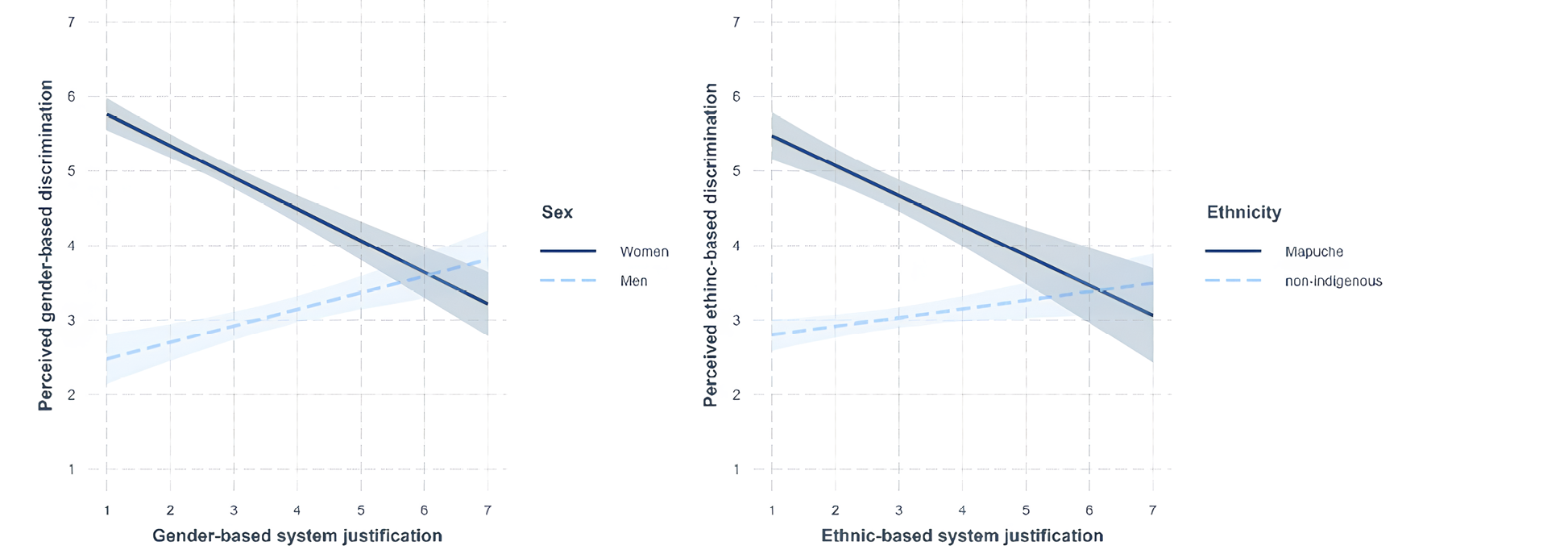
The main models were estimated independently. As reported in Table 2, Model A focused on gender-specific measures of system justification (predictor) and perceived discrimination (outcome), moderated by sex (comparing men and women), whereas B focused on ethnic-specific measures, moderated by ethnicity (comparing non-Indigenous Chileans and Mapuche). Results from Model A, focusing on gender-based comparisons, show that women perceive significantly more discrimination against their gender than men do (b = 1.83, 95% CI [1.59, 2.08], p < .001). Although the main effect shows that gender- specific system justification was negatively associated with perceptions of discrimination (b = -0.14, 95% CI [-0.21, -0.06], p < .001), this association was qualified by sex (b = -0.65, 95% CI [-0.79, -0.51], p < .001). As expected, simple slopes estimation shows that the conditional effect among women is negative (b = -0.42, 95% CI [-0.52, -0.33], p < .001), whereas the slope for men is positive (b = 0.22, 95% CI [0.12, 0.33], p < .001). In other words, consistent with what was hypothesized, defending the current state of gender-based relations leads women to perceive less discrimination against them for being women, while it does the opposite for men. A key aspect of these results is that the gap in perceptions of discrimination between women and men decreases substantially as system justification increases.
The second set of models (B), focused on ethnic-specific measures, revealed similar patterns. As observed in the previous model, there was a gap in the perceptions of discrimination between the Mapuche and non-Indigenous Chileans (b = 1.77, 95% CI [1.51, 2.03], p < .001); The former perceiving themselves as targets of discrimination because of their ethnicity more often than the latter. As hypothesized, the inclusion of the ESJ × Ethnicity interaction in step three increased model predictability, as it was statistically significant (b = -0.52, 95% CI [-0.68, -0.35], p < .001). In other words, the effect of system justification was conditional to participants ethnicity. Indeed, simple slopes analyses revealed that the endorsement of ethnic-specific system justification among the Mapuche correlated with a decreased perception of discrimination (b = -0.40, 95% CI [-0.54, -0.26], p < .001), whereas a positive association was observed among non-Indigenous Chileans (b = 0.12, 95% CI [0.03, 0.21], p = .010). Similar to what was observed for the gender-specific model, the greater the endorsement of ethnic-based system justification, the smaller the perceived discrimination gap between the Mapuche and non-Indigenous Chileans. Figure 1 displays both interaction effects, gender- and ethnic-specific.
Table 2. Regression models predicting gender- (A) and ethnic-specific (B) perceptions of discrimination
|
Gender-specific model (A) |
Step 1 |
Step 2 |
Step 3 |
|||
|
Intercept |
4.26*** |
[ 4.15, 4.38] |
4.26*** |
[ 4.15, 4.38] |
4.11*** |
[ 3.99, 4.23] |
|
Age |
-0.00 |
[-0.01, 0.01] |
-0.00 |
[-0.01, 0.01] |
-0.00 |
[-0.01, 0.01] |
|
PO |
-0.04 |
[-0.14, 0.06] |
-0.00 |
[-0.10, 0.09] |
-0.00 |
[-0.10, 0.09] |
|
Sexa |
1.96*** |
[ 1.72, 2.20] |
1.83*** |
[ 1.59, 2.08] |
1.93*** |
[ 1.69, 2.17] |
|
GSJ |
-0.14*** |
[-0.21, -0.06] |
-0.17*** |
[-0.24, -0.10] |
||
|
GSJ×Sex |
-0.65*** |
[-0.79, -0.51] |
||||
|
R² |
.21 |
.22 |
.28 |
|||
|
∆R² |
-- |
.01 |
.06 |
|||
|
p |
-- |
<.001 |
<.001 |
|||
|
Ethnic-specific model (B) |
Step 1 |
Step 2 |
Step 3 |
|||
|
Intercept |
3.01*** |
[ 2.87, 3.16] |
3.01*** |
[ 2.87, 3.16] |
3.01*** |
[ 2.87, 3.15] |
|
-0.00 |
[-0.01, 0.01] |
-0.00 |
[-0.01, 0.01] |
-0.00 |
[-0.01, 0.01] |
|
|
PO |
0.08 |
[-0.02, 0.18] |
0.09 |
[-0.01, 0.19] |
0.09 |
[-0.01, 0.19] |
|
Ethnicity b |
1.77*** |
[ 1.51, 2.03] |
1.77*** |
[ 1.51, 2.03] |
1.73*** |
[ 1.48, 1.99] |
|
ESJ |
-0.03 |
[-0.11, 0.05] |
0.12* |
[ 0.03, 0.21] |
||
|
ESJ×Ethnicity |
-0.52*** |
[-0.68, -0.35] |
||||
|
R² |
.15 |
.16 |
.19 |
|||
|
∆R² |
-- |
.00 |
.03 |
|||
|
p |
-- |
.454 |
<.001 |
|||
Note: PO = Political Orientation; GSJ = Gender System Justification; ESJ = Ethnic System Justification. a 0 = “Male,” 1 = “Female,” b 0 = “Non-Indigenous,” 1 = “Mapuche.” ***p < .001; **p < .01; *p < .05.
Source: The author.
Figure 1. Perceived gender-(left) and ethnic-(right) based discrimination as a function of sex and gender-specific system justification
Source: The author.
Once these moderated associations were established, an examination was conducted of whether the closure of the discrimination-perception gap associated with higher endorsement of system-justifying beliefs would subsequently translate into a reduced gap in psychological well-being. Accordingly, two mediated moderation models were estimated: one for the gender-specific measures and another for the ethnic-specific measures. Findings from the first set successfully replicated those of previous studies. Specifically, the well-being differential observed as a function of sex was significantly narrowed by the increased endorsement of gender-specific system justification via reductions in perceived gender-based discrimination among women, as displayed in Figure 2. Evidence of this moderated mediation is indicated by the conditional indirect effects reported in Table 3. Indeed, women reported lower well-being at low levels of gender-specific system justification via (increased) perceptions of discrimination (Low GSJ | bIndirect = -0.28, 95% CI [-0.48, -0.03], p = .014). Meanwhile, at high levels of system justification endorsement, this gap was substantially narrower (High GSJ | bIndirect = -0.06, 95% CI [-0.13, -0.01], p = .040), as observed in the statistically significant index of moderated mediation (ω = 0.06, 95% CI [0.01, 0.10], p = .017).
Figure 2. Path diagram of the effect of sex on psychological well-being via perceived gender-based discrimination at high, medium, and low levels of gender-specific system justification
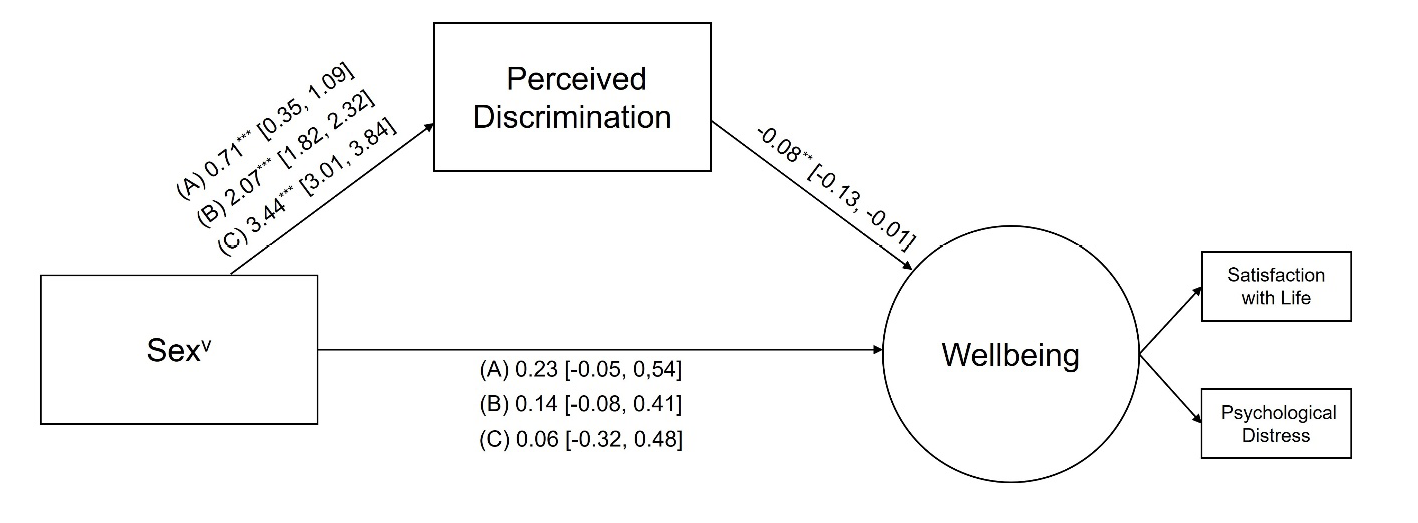
Note: A. High (84th percentile) gender-specific system justification; B. Medium (50th percentile) gender-specific system justification; C. Low (16th percentile) gender-specific system justification. vSex: -0.5 = Male, 0.5 = Female. *p < .05; **p < .01; ***p < .001.
Source: The author.
Table 3. Conditional indirect effect of sex on well-being through perceived gender-based discrimination at different levels of gender-specific system justification
|
Gender system justification |
Indirect effect |
SE |
BC 95% CI |
|
High (84th percentile) |
-0.06* |
0.03 |
[-0.13, -0.01] |
|
Mid (50th percentile) |
-0.17* |
0.07 |
[-0.29, -0.02] |
|
Low (16th percentile) |
-0.28* |
0.11 |
[-0.48, -0.03] |
|
ω indexa |
0.06* |
0.02 |
[0.01, 0.10] |
Note: aIndex of moderated mediation (Hayes 2015). *p < .05; **p < .01; ***p < .001.
Source: The author.
The second model assessing effects on the psychological well-being of participants as a function of their ethnicity, summarized in Figure 3, displayed very similar results. Consistent with the patterns observed in the gender-specific model, the ethnic minoritized group (i.e., Mapuche) reported lower levels of well-being when endorsement of ethnic- specific system justification was low via (increased) perceptions of discrimination (Low ESJ | bIndirect = -0.20, 95% CI [-0.35, -0.02], p = .022). In contrast, the gap was narrower (High ESJ | bIndirect = -0.06, 95% CI [-0.13, -0.01], p = .048) under high levels of ethnic- specific system justification. Here, the index of moderated mediation was also statistically significant (ω = 0.04, 95% CI [0.01, 0.08], p = .033). Table 4 reports the conditional indirect effects at three levels of ethnic-based system justification (i.e., the moderator).
Figure 3. Path diagram of the effect of being a minority on psychological well-being via perceived ethnic-based discrimination at high, medium, and low levels of ethnic-specific system justification

Note: A. High (84th percentile) ethnic-specific system justification; B. Medium (50th percentile) ethnic-specific system justification; C. Low (16th percentile) ethnic-specific system justification. vMinority: -0.5 = Non-Indigenous, 0.5 = Mapuche. *p < .05; **p < .01; ***p < .001.
Source: The author.
Table 4. Conditional indirect effect of being a minority on well-being through perceived ethnic-based discrimination at different levels of ethnic-specific system justification
|
Ethnic system justification |
Indirect effect |
SE |
BC 95% CI |
|
High (84th percentile) |
-0.06* |
0.03 |
[-0.14, -0.01] |
|
Mid (50th percentile) |
-0.14* |
0.06 |
[-0.25, -0.01] |
|
Low (16th percentile) |
-0.20* |
0.09 |
[-0.35, -0.02] |
|
ω indexa |
0.04* |
0.02 |
[0.01, 0.08] |
Note: aIndex of moderated mediation (Hayes 2015). *p < .05; **p < .01; ***p < .001.
Source: The author.
Study 2
In Study 1, findings previously reported in the literature were replicated. However, no research to date has clarified which specific aspects of the system the socially disadvantaged rationalize that lead to the minimization of their perceived rates of discrimination. Accordingly, a second study was conducted to explore a different measurement approach in which people assess system fairness across different domains—namely, equality-based issues (i.e., income, access to rights and perceived class-based differences), perceived societal respect for people’s dignity, and perceived societal respect for tradition. To address these more specific aspects, five items were developed in semantic differential scale format (Osgood et al. 1957) to assess each domain. This format was employed because semantic differential scales are less vulnerable to acquiescence bias, are designed to assess connotative meaning, and offer higher sensitivity and discrimination in their individual differences (Friborg et al. 2006; Heise 1970).
Thus, if minimized perceptions of discrimination are motivated by a biased preference towards different aspects of the societal status-quo (i.e., system justification), members of minoritized groups (e.g., women and ethnic minorities) should report the lowest levels of perceived discrimination at the midpoint of the semantic differential scale, given that deviations from the center of the scale indicate at least some awareness of a systemic problem. For the minimization hypothesis to be supported, and consistent with Study 1, this pattern must appear only among the minoritized.
Method
Procedure and Participants
The recruitment and survey procedures applied in Study 1 were replicated in Study 2. Respondents were contacted nationwide by Offerwise, employing the same quotas by sex (assigned at birth), age, socioeconomic status, and ethnicity. The survey was applied through Qualtrics, including the inform consent procedure, followed by the questionnaire, and participation was rewarded by redeemable points worth approximately USD 5.00. This study was independently approved by the ethics committee at Universidad Católica del Norte (resolution n.° 002/2023).
As with the sampling procedure, the sampling filters designed to secure a minimum quality of responses were replicated from Study 1. A total of n = 777 participants, of Chilean nationality (92%) and foreign residents in Chile for more than five years (8%), aged between 18 and 81 years (M = 34.28, SD = 13.31), took part in the study. The sample consisted of 50.97% women and 49.03% men, who resided in the northern (21.24%), central (49.42%), and southern (29.34%) regions of the country. Of the participants, 84.81% identified as non-Indigenous Chileans, while 12.61% identified as Mapuche Indigenous, and 2.57% belonged to another ethnicity. Regarding the educational level, 1.55% completed only primary education, 28.57% reached a high school diploma, 66.67% had attended or completed a university degree, and a minority of 3.22% obtained a postgraduate degree.
Materials
Unless specified otherwise, all responses to the Likert-type scales were measured in a scale from 1 (“Completely disagree”) to 7 (“Completely agree”).
System fairness domains. Based on widely used measurement instruments that assess prescriptive beliefs in the legitimacy of different dimensions of the sociopolitical system (e.g., social dominance orientation, Right-wing authoritarianism), five semantic differential items were constructed, exclusively for this research, that tap into different aspects of the status quo: (i) income distribution: “The distribution of income is too equal” vs. “The distribution of income is too unequal”; (ii) rights distribution: “People’s rights are too equal” vs. “People’s rights are too unequal”; (iii) perceived favoring of the elites (vs. the people): “The people are favored too much” vs. “The elite is favored too much”; (iv) perceived respect for dignity: “Human dignity is belittled” vs. “Human dignity is respected more than necessary”; (v) perceived respect for traditions: “Traditions are belittled” vs. “Traditions are respected more than necessary.” Although these were originally intended to be used independently, a Parallel Analysis was conducted (Horn 1965), followed by an Exploratory Factor Analysis (EFA), in order to check for item redundancy. Items were organized in three factors: equality (α = .83, ω = .83), dignity, and tradition (for more information, please see online supplementary material).
Both measures of perceived ethnic and gender-based discrimination employed were exactly the same as in Study 1.
Analytical Approach
To examine the quadratic (i.e., non-linear) effects of specific system fairness domains on perceptions of discrimination, contingent on participants’ sex (model A) and ethnicity (model B), this study employed a step-wise multiple regression procedure, similar to the one used in Study 1, but with only two steps—the first including linear effects, and the second, adding quadratic effects for each system fairness domain. No covariates were included, because model complexity is already stringent under minimum recommended statistical power to reliably estimate parameters (for more information, please see supplementary material).
Results and Discussion
Results from preliminary analyses, displayed in Table 5, revealed bivariate associations between perceptions of inequality (vs. too much equality) and dignity as undervalued (vs. overly respected), as well as a perceived excess of respect (vs. disrespect) toward tradition. Interestingly, perceptions of both gender- and ethnic-based discrimination were (linearly) unassociated with all indices.
Table 5. Bivariate correlations and descriptive statistics for study variables
|
1 |
2 |
3 |
4 |
5 |
|
|
1. Equality |
-- |
-.18*** |
.07* |
.05 |
-.04 |
|
2. Dignity |
-- |
.20*** |
-.05 |
.07 |
|
|
3. Tradition |
-- |
.00 |
.03 |
||
|
4. GPD |
-- |
.35*** |
|||
|
5. EPD |
-- |
||||
|
M |
4.79 |
3.59 |
3.78 |
4.50 |
3.17 |
|
SD |
1.63 |
1.65 |
1.62 |
2.04 |
2.03 |
Note: GPD = Gender Perceived discrimination; EPD = Ethnic Perceived Discrimination. ***p < .001; **p < .01; *p < .05.
Source: The author.
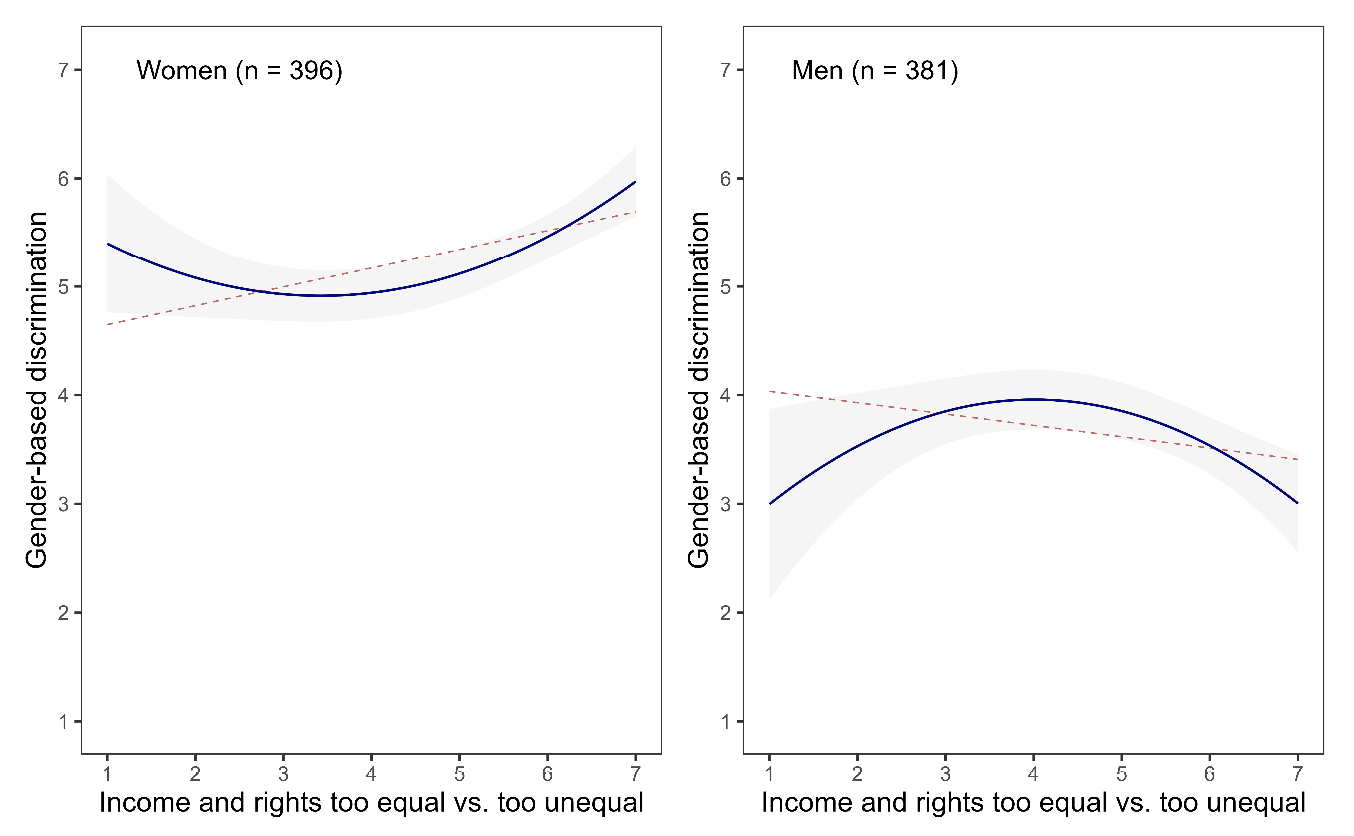
Findings from the main models, testing quadratic (i.e., non-linear) associations between the system fairness domains and perceptions of discrimination revealed partially expected results. First, as reported in Table 6 summarizing the gender-specific models, the linear association between equality assessment (higher perceived inequality) and gender-based discrimination among women (b = 0.17, 95% CI [0.07, 0.27], p < .001) was significant. After adding the quadratic term in step 2, the linear association remained significant, but also indicated a non-linear association between equality-based assessments and perceived gender-specific discrimination (b = 0.07, 95% CI [0.01, 0.13], p = .019). The patterns depicted in Figure 4 show that, as expected, the lowest levels of gender-based discrimination was found among those who score near the center of the scale; that is, those who perceived the least degree of societal issues associated with distribution of assets, such as income and rights. Conversely, the quadratic association between equality and gender-perceived discrimination among men was negative (b = -0.15, 95% CI [-0.23, -0.07], p < .001); indicating that men who more strongly endorse the status quo in terms of distribution of income and rights perceived themselves as targets of discrimination for being men.
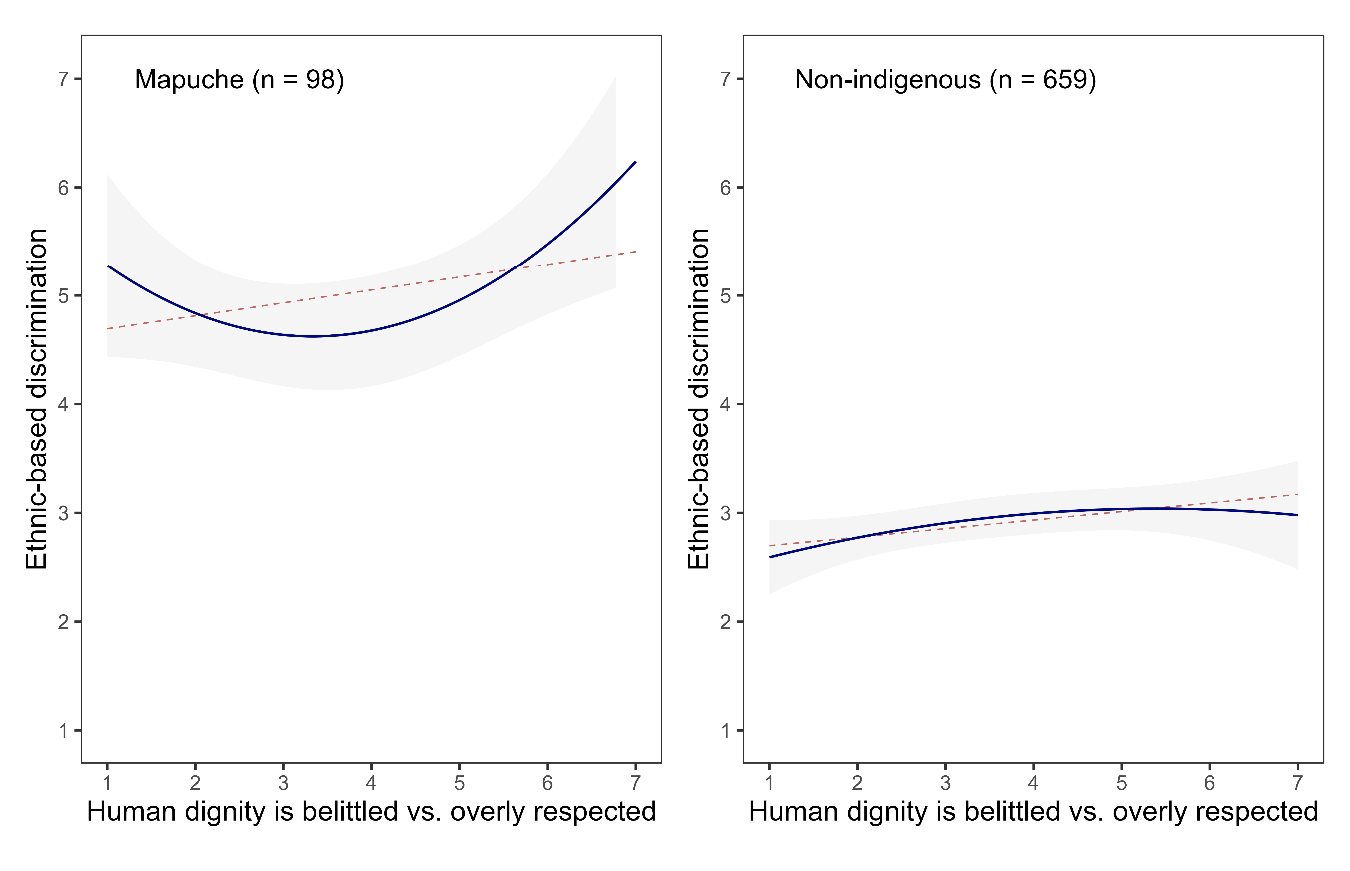
Unlike patterns found in the gender-specific models, perceptions of discrimination on the basis of ethnicity were not motivated by equality-based concerns among Mapuche participants. Results reported in Table 7 show that, among the Mapuche, dignity-based assessments were non-linearly correlated with perceived discrimination (b = 0.13, 95% CI [0.01, 0.25], p = .046). Figure 5 displays this pattern, and reveals that the smallest degree of perceived ethnic-based discrimination is found around moderate scores of dignity assessments. As expected, this finding is unique to Mapuche participants, given that there was a non-significant association for that variable among non-Indigenous Chileans. However, the latter group displayed associations between equality-based assessments and perceptions of ethnic-based discrimination (b = 0.06, 95% CI [-0.11, -0.01], p = .028); the same pattern was observed among men in the previous model.
Table 6. Regression models predicting gender-specific perceptions of discrimination
|
Women |
Men |
||||||||
|
Step 1 |
Step 2 |
Step 1 |
Step 2 |
||||||
|
b |
95%CI |
b |
95%CI |
b |
95%CI |
b |
95%CI |
||
|
Intercept |
5.32*** |
[ 5.15, 5.48] |
5.04*** |
[ 4.77, 5.30] |
3.65 |
[ 3.44, 3.85] |
3.73 |
[ 3.43, 4.03] |
|
|
Equality |
0.17*** |
[ 0.07, 0.27] |
0.21*** |
[ 0.10, 0.32] |
-0.09 |
[ -0.23, 0.04] |
-0.20 |
[-0.34, -0.06] |
|
|
Dignity |
-0.05 |
[ -0.16, 0.05] |
-0.05 |
[-0.16, 0.06] |
0.05 |
[ -0.08, 0.18] |
-0.02 |
[-0.15, 0.11] |
|
|
Tradition |
0.01 |
[ -0.10, 0.11] |
0.01 |
[-0.09, 0.12] |
0.01 |
[ -0.12, 0.15] |
0.05 |
[-0.08, 0.18] |
|
|
Equality2 |
0.07* |
[ 0.01, 0.13] |
-0.15*** |
[-0.23, -0.07] |
|||||
|
Dignity2 |
0.04 |
[-0.02, 0.10] |
0.08* |
[ 0.01, 0.16] |
|||||
|
Tradition2 |
-0.01 |
[-0.06, 0.04] |
0.03 |
[-0.05, 0.10] |
|||||
|
R² |
.03 |
.06 |
.01 |
.05 |
|||||
|
∆R² |
.03 |
.04 |
|||||||
|
p |
.017 |
.001 |
|||||||
Note: ***p < .001; **p < .01; *p < .05.
Source: The author.
Figure 4. Non-linear effect of inequality domain on gender-based perceived discrimination
Source: The author.
Table 7. Regression models predicting ethnic-specific perceptions of discrimination.
|
Mapuche |
Non-Indigenous |
||||||||
|
Step 1 |
Step 2 |
Step 1 |
Step 2 |
||||||
|
b |
95%CI |
b |
95%CI |
b |
95%CI |
b |
95%CI |
||
|
Intercept |
5.00*** |
[ 4.63, 5.37] |
4.53*** |
[ 3.95, 5.11] |
2.90*** |
[ 2.76, 3.05] |
3.07*** |
[ 2.85, 3.29] |
|
|
Equality |
-0.03 |
[-0.26, 0.19] |
0.04 |
[-0.19, 0.27] |
-0.03 |
[-0.12, 0.06] |
-0.07 |
[-0.17, 0.03] |
|
|
Dignity |
0.06 |
[-0.16, 0.28] |
0.01 |
[-0.23, 0.24] |
0.07 |
[-0.02, 0.16] |
0.05 |
[-0.05, 0.15] |
|
|
Tradition |
0.20 |
[-0.02, 0.42] |
0.23* |
[ 0.01, 0.45] |
0.01 |
[-0.08, 0.10] |
0.02 |
[-0.08, 0.11] |
|
|
Equality2 |
0.07 |
[-0.06, 0.21] |
-0.06* |
[-0.11, -0.01] |
|||||
|
Dignity2 |
0.13* |
[ 0.01, 0.25] |
-0.00 |
[-0.05, 0.05] |
|||||
|
Tradition2 |
-0.04 |
[-0.17, 0.08] |
-0.00 |
[-0.05, 0.05] |
|||||
|
R² |
.05 |
.11 |
.01 |
.01 |
|||||
|
∆R² |
.06 |
.00 |
|||||||
|
p |
.081 |
.125 |
|||||||
Note: ***p < .001; **p < .01; *p < .05.
Source: The author.
Figure 5. Non-linear effect of dignity domain on ethnic-based perceived discrimination
Source: The author.
Findings reveal a pattern of results unique to minoritized participants that aligns with the hypotheses concerning system-justifying, motivated perceptions of discrimination. Specifically, those who report the most positive views toward equality-based aspects of the status quo (women) and dignity-based aspects of the status quo (Mapuche) are significantly less likely to perceive themselves as targets of discrimination. Conversely, equality-based assessments were non-linearly associated with perceptions of discrimination among men and non-Indigenous Chileans in the oppositive direction, such that individuals with the most favorable views of the status quo in terms of distribution were the ones who saw themselves as more likely victimized on the basis of their gender or ethnicity.
General Discussion
The present research was designed to replicate and extend previous findings on the system-justifying process by which disadvantaged groups—specifically women and Mapuche individuals—minimize the perception of discrimination. Consistent with prior work (Bahamondes et al. 2019; Bahamondes et al. 2020; Major et al. 2002; Major et al. 2007; Napier et al. 2020; Suppes et al. 2019), Study 1 revealed that women and ethnic minority participants reported lower levels of psychological well-being compared to their higher-status counterparts. However, these disparities were attenuated among those who more strongly endorsed system-justifying beliefs concerning gender and ethnic intergroup relations. As predicted, this palliative effect was mediated by lower perceptions of group-based discrimination, thereby replicating prior findings within the Chilean sociopolitical context.
These results offer meaningful theoretical insights. Because gender and ethnic identities are highly visible and socially salient, they tend to be less permeable than other identities, such as social class or sexual orientation (Blanz et al. 1998). This relative inflexibility may prompt disadvantaged individuals to adopt social creativity strategies—such as cognitive reframing or denial of discrimination—as a means of coping with systemic inequality (Becker 2012). In line with System Justification Theory, these beliefs help rationalize structural inequities, thereby reducing the dissonance between lived experience and dominant societal narratives. As Crosby and colleagues (1989) noted, denying discrimination can serve to preserve a positive view of the social world—though at the cost of suppressing legitimate grievances. This dynamic creates a distinctive psychological tension: the need to reconcile a desire for justice at the group level with the individual need for psychological well-being and self-esteem. This predicament ultimately imbues the hierarchical status quo with legitimacy, and is thus reflective of the tension among ego, group, and system motives that are unique among the disadvantaged (Jost and Burgess 2000).
While Study 1 replicated known effects, it left open the question of which specific facets of the social order are being legitimized to achieve these palliative outcomes. Study 2 addressed this gap by examining whether distinct domains of justice—pertaining to income and rights distribution, dignity and recognition, and tradition—predict perceived group-based discrimination. Results showed that perceived economic and legal inequality were the strongest predictors of perceived gender-based discrimination. In contrast, among Mapuche participants, concerns related to dignity and respect more strongly predicted perceptions of ethnic discrimination. This pattern suggests that different normative standards—material versus symbolic—are used to assess fairness depending on the identity category at stake.
These findings resonate with the many accounts (e.g., Frei and Orchard 2023; Therborn 2018; UNDP 2017) underscoring the importance of symbolic respect and interpersonal treatment alongside material equality. While gender-based discrimination tends to be inferred from disparities in legal rights and access to economic resources—domains frequently emphasized in public discourse—ethnic discrimination in Chile appears more closely tied to perceived violations of cultural respect and personal dignity. This interpretation aligns with Indigenous perspectives on justice in Chile, which often foreground recognition and symbolic inclusion over merely formal equality (Figueiredo et al. 2019; Pairican 2022). Indeed, contemporary examples of symbolic injustice and blatant disrespect towards the Mapuche—such as the public disapproval of the Mapuche culture by renown historians (CNN Chile 2014) or the desecration of Mapuche-Williche sacred symbols by Queilen municipal authorities (Radio La Isla 2023)—continue to underscore the salience of dignity-related grievances.
By contrast, adherence to tradition did not predict perceived discrimination for either group. This may be due to its abstractness and weaker connection to immediate personal outcomes such as income, recognition, or fair treatment. Moreover, tradition may be interpreted ambivalently—either as protective or neutral—particularly among Indigenous communities, where ancestral practices are viewed as affirming. In the gender domain, traditional norms may not be seen as discriminatory unless they manifest in tangible restrictions or exclusions.
Notably, participants from dominant groups—men and non-Indigenous Chileans—who strongly endorsed system-justifying beliefs reported higher levels of perceived discrimination. This counterintuitive finding, consistent with prior research (e.g., Bahamondes et al. 2019), reflects a psychological pattern in which challenges to privilege are experienced as threats to fairness (Wilkins et al. 2018). For high-status groups, the content of the victimization sentiment is mostly framing affirmative action supporting the disadvantaged as unfair (Schmitt and Branscombe 2002). In Chile, such dynamics are evident in resistance to affirmative state measures supporting Indigenous populations—often perceived by non-Indigenous Chileans as unfair (UNDP 2017). Consistent with several theoretical accounts, these findings suggest that system justification not only diminishes perceptions of injustice among the disadvantaged but may also heighten perceived victimization among the advantaged.
System-justifying beliefs thus appear to operate differently across the social hierarchy. For members of disadvantaged groups, they may serve a palliative function in its effects over perceived discrimination of the ingroup, offering psychological relief in the face of structural exclusion. For those in advantaged positions, these beliefs may instead act as identity-protective mechanisms, reinforcing meritocratic narratives and defending the legitimacy of the status quo (Jost and Burgess 2000; Noor et al. 2012). By putting perceptions of injustice “to sleep” among the disadvantaged, making them unlikely to push for alternative arrangements that are more affirming of their identities and their material existence, while motivating the advantaged to perceive themselves as targets of injustice, system-justifying beliefs are an effective stabilizing force that protects the social order that sustains inequality by rewarding the oppressed with psychological comfort. This is consistent with recent accounts demonstrating how system justification dampens collective action efforts to redress inequality among minorities, while motivating the advantaged to defend the status quo (Osborne et al. 2019). Ironically, this dynamic may be especially effective in more egalitarian contexts where overt prejudice is normatively condemned. In such settings, anti-prejudice norms may inadvertently foster subtle rationalizations of inequality, allowing individuals to maintain the belief that society is fundamentally fair (Billig 1991; Janoff-Bulman 1989).
These pressing issues constitute a longstanding concern, especially in Latin America, as Ignacio Martín-Baró (1994) highlighted, overcoming the existential fatalism (that is, a conformist acceptance of their oppressed status) entails, among the Latin American minoritized populations, a direct confrontation with the structural forces that oppress them, deprive them of control over their own existence, and force them to learn submission and expect less from life.
Contributions, Limitations, and Future Directions
This research advances the system justification literature in several important ways. Initially, it replicates a well-established finding—previously documented primarily in WEIRD1 contexts—within the Chilean sociopolitical landscape; namely, that system- justifying beliefs can buffer the psychological costs of belonging to a disadvantaged group by diminishing perceptions of discrimination. Furthermore, it extends this body of work by demonstrating that these beliefs function not merely through diffuse perceptions of system legitimacy, but through specific dimensions of perceived fairness—particularly evaluations of distributive and recognition-based justice. This approach responds to recent critiques of unidimensional measures of ideology and acknowledges the multidimensional nature of how individuals evaluate the fairness of social arrangements (Bahamondes and Barrientos 2024). Crucially, the findings caution against interpreting the palliative effects of ideology as unequivocally beneficial. While such beliefs may fulfill short-term psychological needs—helping individuals reconcile inequality with a desire for order and coherence (Jost and Hunyady 2005)—they may simultaneously dampen the moral indignation necessary for confronting systemic injustice. This soporific function is especially consequential in contexts of entrenched inequality, where recognizing injustice is a prerequisite for political awareness, collective mobilization, and transformative change (Jost 2020).
Despite its contributions, this research has several limitations. First, the cross-sectional design limits causal inference. Although longitudinal and experimental evidence from prior studies supports the proposed directionality (Bahamondes et al. 2021), future research should adopt panel or experimental designs to examine whether changes in system-justifying beliefs predict subsequent shifts in perceived discrimination and well-being within the studied population.
Second, recruitment efforts were made to target Mapuche participants, which was more feasible in Study 1, as a fixed quota of 30% of the sample was employed and successfully reached. However, meeting this quota was the most challenging aspect of the data collection stage. Accordingly, due to significant delays in data collection in Study 1, the ethnicity quota was relaxed for Study 2, resulting in only around 12% of Mapuche participants—still higher than the 8% they represent in the Chilean population. Future studies should better adapt their sampling design to ensure a higher representation of this population.
Third, while Chile provides a compelling context marked by persistent inequality, neoliberal legacies, and ongoing Indigenous resistance, its historical specificity may limit generalizability (Simons et al. 2017). Comparative studies across Latin American countries with varying colonial and state-building trajectories could help clarify the broader applicability of ideological coping strategies, as could within-country studies that further examine their broader societal, cultural, and economic implications.
Future studies should further examine the practical implications of these findings. For instance, understanding power dynamics upheld by social hierarchies as a foundation of social status is key for clinical practitioners to address mental health issues. As noted by Lima et al. (2025), evidence on the palliative effects of ideological beliefs illuminates how members of minoritized populations cope with and navigate societal circumstances of social devaluation. As such, these findings help inform specific dimensions that different minoritized groups employ to rationalize instances of discrimination.
Finally, not all ideological beliefs serve a palliative function. In line with recent meta- analytical observations on the effects of diverse ideological measures on well-being (Vargas-Salfate et al. 2024), the findings of this study suggest that only those beliefs aligned with the most salient dimensions of perceived injustice (e.g., dignity for ethnic minorities, distributive justice for women) are capable of minimizing perceived discrimination and alleviating psychological distress.
Conclusion
This research highlights a central paradox: people do not merely endure inequality—they interpret it, justify it, and at times deny it. For disadvantaged individuals, system-justifying beliefs may serve as psychological safeguards, lowering perceptions of discrimination and fostering a sense of coherence. Yet this comfort often comes at a cost: it can dull the moral outrage needed to challenge systemic injustice and drive collective change. Understanding this duality is essential for scholars and policymakers alike. Ultimately, the divergent predictors of perceived discrimination by gender and ethnicity reflect not only structural disparities, but also the symbolic frameworks through which individuals make sense of justice. Only by attending to both material and recognition-based dimensions of inequality can a fuller understanding—and eventual transformation—of the psychological landscape of social stratification be achieved.
References
- Altemeyer, Bob. 1988. Enemies of Freedom: Understanding Right-Wing Authoritarianism. San Francisco: Jossey-Bass Publishers.
- American Psychological Association. 2017. Ethical Principles of Psychologists and Code of Conduct. Washington, D.C.: American Psychological Association. https://www.apa.org/ethics/code
- Bahamondes, Joaquín, and Jaime Barrientos. 2024. “Adaptación y validación de la versión en español de la escala de justificación del sistema: evaluación psicométrica en tres muestras chilenas.” Revista Iberoamericana de Diagnóstico y Evaluación Psicológica 74 (4): 109-124. https://doi.org/10.21865/RIDEP74.4.07
- Bahamondes, Joaquín, Fabiola Gómez, Jaime Barrientos, Manuel Cárdenas, and Mónica Guzmán-González. 2020. “Numbing the Perception of Stigma: System Justification Decreases Psychological Distress by Reducing Perceived Stigma among Gay Men and Lesbians.” Revista de Psicología Social 35 (2): 282-309. https://doi.org/10.1080/02134748.2020.1721052
- Bahamondes, Joaquín, Chris G. Sibley, and Danny Osborne. 2019. “‘We Look (and Feel) Better Through System-Justifying Lenses’: Evidence of the Palliative Function of Ideology among the Disadvantaged.” Personality & Social Psychology Bulletin 45 (9): 1391-1408. https://doi.org/10.1177/0146167219829178
- Bahamondes, Joaquín, Chris G. Sibley, and Danny Osborne. 2021. “System Justification and Perceptions of Group-Based Discrimination: Investigating the Temporal Order of the Ideologically Motivated Minimization (or Exaggeration) of Discrimination Across Low- and High-Status Groups.” Social Psychological & Personality Science 12 (4): 431-441. https://doi.org/10.1177/1948550620929452
- Banaji, Mahzarin R., Curtis D. Hardin, and Alexander J. Rothman. 1993. “Implicit Stereotyping in Person Judgment.” Journal of Personality and Social Psychology 65 (2): 272-281. https://doi.org/10.1037/0022-3514.65.2.272
- Becker, Julia C. 2012. “The System-stabilizing Role of Identity Management Strategies: Social Creativity can Undermine Collective Action for Social Change.” Journal of Personality and Social Psychology 103 (4): 647-662. https://doi.org/10.1037/a0029240
- Bengoa, José. 2000. Historia del pueblo mapuche: Siglo XIX y XX. Santiago de Chile: LOM.
- Berger, Peter L., and Thomas Luckmann. 1991. The Social Construction of Reality: A Treatise in the Sociology of Knowledge. London: Penguin.
- Billig, Michael. 1991. Ideology and Opinions: Studies in Rhetorical Psychology. Newbury Park, CA: Sage Publications.
- Blanchar, John C., Scott Eidelman, and Eric Allen. 2024. “Social Change Requires More Justification Than Maintaining the Status Quo.” Frontiers in Social Psychology 2: 1360377. https://doi.org/10.3389/frsps.2024.1360377
- Blanz, Mathias, Amélie Mummendey, Rosemarie Mielke, and Andreas Klink. 1998. “Responding to Negative Social Identity: A Taxonomy of Identity Management Strategies.” European Journal of Social Psychology 28 (5): 697-729. https://doi.org/10.1002/(SICI)1099-0992(199809/10)28:5<697::AID-EJSP889>3.0.CO;2-%23
- Brosnan, Sarah F., and Frans B. M. de Waal. 2003. “Monkeys Reject Unequal Pay.” Nature 425 (6955): 297-299. https://doi.org/10.1038/nature01963
- CNN Chile. 2014. “Sergio Villalobos sobre tierras mapuches: ‘no podía seguir ese desperdicio’.” March 21. YouTube. https://www.youtube.com/watch?v=Q9UDTqJw_nA
- Crosby, Faye J., Ann Pufall, Richard C. Snyder, Mary O’Connell, and Patricia Whalen. 1989. “The Denial of Personal Disadvantage Among You, Me, and All the Other Ostriches.” In Gender and Thought: Psychological Perspectives, edited by Mary Crawford and Margaret Gentry, 79-99. New York: Springer-Verlag.
- Duckitt, John. 2001. “A Dual-Process Cognitive-Motivational Theory of Ideology and Prejudice.” In Advances in Experimental Social Psychology, edited by Mark P. Zanna, 33: 41-113. San Diego: Academic Press. https://doi.org/10.1016/S0065-2601(01)80004-6
- Duckitt, John, and Chris G. Sibley. 2009. “A Dual Process Motivational Model of Ideological Attitudes and System Justification.” In Social and Psychological Bases of Ideology and System Justification, edited by John T. Jost, Aaron C. Kay, and Hulda Thorisdottir, 292-313. New York: Oxford University Press.
- Duckitt, John, and Chris G. Sibley. 2017. “The Dual Process Motivational Model of Ideology and Prejudice.” In The Cambridge Handbook of the Psychology of Prejudice, edited by Chris G. Sibley and Fiona Kate Barlow, 188-221. Cambridge: Cambridge University Press.
- Eidelman, Scott, and Christian S. Crandall. 2014. “The Intuitive Traditionalist: How Biases for Existence and Longevity Promote the Status Quo.” In Advances in Experimental Social Psychology, edited by James M. Olson and Mark P. Zanna, 50: 53-104. San Diego: Academic Press. https://doi.org/10.1016/B978-0-12-800284-1.00002-3
- Figueiredo, Ana, Carolina Rocha, Trinidad Ferreiro, Catarina Guerrero, Micaela Varela, Pietro Montagna, et al. 2019. “Representations of History and Present-Day Intergroup Relations between Indigenous and Non-Indigenous People: The Mapuche in Chile.” In History and Collective Memory from the Margins: A Global Perspective, edited by Sahana Mukherjee and Phia S. Salter, 79-104. Hauppauge, NY: Nova Science Publishers.
- Foster, Mindi D., Lisa Sloto, and Rebecca Ruby. 2006. “Responding to Discrimination as a Function of Meritocracy Beliefs and Personal Experiences: Testing the Model of Shattered Assumptions.” Group Processes & Intergroup Relations 9 (3): 401-411. https://doi.org/10.1177/1368430206064641
- Frei, Raimundo, and Macarena Orchard. 2023. “La dignidad como lente analítico en el estudio de la desigualdad: reflexiones desde el caso chileno.” In La desigualdad en nuestras vidas: una mirada microsocial desde América Latina, edited by Catalina Maldonado Graus and Bettina Schorr, 49-72. Madrid: Iberoamericana Vervuert.
- Friborg, Oddgeir, Martin Martinussen, and Jan H. Rosenvinge. 2006. “Likert-Based vs. Semantic Differential-Based Scorings of Positive Psychological Constructs: A Psychometric Comparison of Two Versions of a Scale Measuring Resilience.” Personality and Individual Differences 40 (5): 873-884. https://doi.org/10.1016/j.paid.2005.08.015
- Glick, Peter, and Susan T. Fiske. 2001. “An Ambivalent Alliance: Hostile and Benevolent Sexism as Complementary Justifications for Gender Inequality.” American Psychologist 56 (2): 109-118. https://doi.org/10.1037/ 0003-066X.56.2.109
- Hayes, Andrew F. 2015. “An Index and Test of Linear Moderated Mediation.” Multivariate Behavioral Research 50 (1): 1-22. https://doi.org/10.1080/00273171.2014.962683
- Hayes, Andrew. F. 2022. Introduction to Mediation, Moderation, and Conditional Process Analysis: A Regression-based Approach. New York: The Gilford Press.
- Heise, David R. 1970. “The Semantic Differential and Attitude Research.” In Attitude Measurement, edited by Gene F. Summers, 235-253. Chicago: Rand McNally.
- Henrich, Joseph, Steven J. Heine, and Ara Norenzayan. 2010. "The Weirdest People in the World?” Behavioral and Brain Sciences 33 (2-3): 61-83. https://doi.org/10.1017/S0140525X0999152X
- Horn, John L. 1965. “A Rationale and Test for the Number of Factors in Factor Analysis.” Psychometrika 30 (2): 179-185. https://doi.org/10.1007/BF02289447
- Huepe, David, Nicolás Salas, and Jorge Manzi. 2016. “Estereotipos de género y prejuicio implícito en matemáticas y lenguaje: aportes desde la cognición social.” In Abriendo las puertas del aula: transformación de las prácticas docentes, edited by Jorge Manzi and María Rosa García, 481-514. Santiago de Chile: Ediciones UC.
- Janoff-Bulman, Ronnie. 1989. “The Benefits of Illusions, the Threat of Disillusionment, and the Limitations of Inaccuracy.” Journal of Social and Clinical Psychology 8 (2): 158-175. https://doi.org/10.1521/jscp.1989.8.2.158
- Jost, John T. 2020. A Theory of System Justification. Cambridge, MA: Harvard University Press.
- Jost, John T., and Mahzarin R. Banaji. 1994. “The Role of Stereotyping in System-Justification and the Production of False Consciousness.” British Journal of Social Psychology 33 (1): 1-27. https://doi.org/10.1111/j.2044-8309.1994.tb01008.x
- Jost, John T., and Diana Burgess. 2000. “Attitudinal Ambivalence and the Conflict Between Group and System Justification Motives in Low Status Groups.” Personality and Social Psychology Bulletin 26 (3): 293-305. https://doi.org/10.1177/0146167200265003
- Jost, John T., Christopher M. Federico, and Jaime L. Napier. 2009. “Political Ideology: Its Structure, Functions, and Elective Affinities.” Annual Review of Psychology 60: 307-337. https://doi.org/10.1146/annurev.psych.60.110707.163600
- Jost, John T., and Orsolya Hunyady. 2005. “Antecedents and Consequences of System-Justifying Ideologies.” Current Directions in Psychological Science 14 (5): 260-265. https://doi.org/10.1111/j.0963-7214.2005.00377.x
- Jost, John T., and Aaron C. Kay. 2005. “Exposure to Benevolent Sexism and Complementary Gender Stereotypes: Consequences for Specific and Diffuse Forms of System Justification.” Journal of Personality and Social Psychology 88 (3): 498-509. https://doi.org/10.1037/0022-3514.88.3.498
- KPMG, Diversity Council Australia, and Workplace Gender Equality Agency. 2019. She’s Price(d)less: The Economics of the Gender Pay Gap-Summary Report. https://home.kpmg/content/dam/kpmg/au/pdf/2019/gender-pay-gap-economics-summary-report-2019.pdf
- Larraín, Jorge. 2001. Identidad chilena. Santiago de Chile: LOM.
- Lima, Bruno P. B., Luana E. C. Souza, and John T. Jost. 2025. “System Justification, Subjective Well-being, and Mental Health Symptoms in Members of Disadvantaged Minority Groups.” Clinical Psychology Review 115: 1-14. https://doi.org/10.1016/j.cpr.2024.102532
- Major, Brenda, Richard H. Gramzow, Sarah K. McCoy, Shana Levin, Toni Schmader, and Jim Sidanius. 2002. “Perceiving Personal Discrimination: The Role of Group Status and Legitimizing Ideology.” Journal of Personality and Social Psychology 82 (3): 269-282. https://doi.org/10.1037/0022-3514.82.3.269
- Major, Brenda, and Cheryl R. Kaiser. 2017. “Ideology and the Maintenance of Group Inequality.” Group Processes & Intergroup Relations 20 (5): 582-592. https://doi.org/10.1177/1368430217712051
- Major, Brenda, Cheryl R. Kaiser, Laurie T. O’Brien, and Sarah K. McCoy. 2007. “Perceived Discrimination as Worldview Threat or Worldview Confirmation: Implications for Self-Esteem.” Journal of Personality and Social Psychology 92 (6): 1068-1086. https://doi.org/10.1037/0022-3514.92.6.1068
- Martín-Baró, Ignacio. 1989. Sistema, grupo y poder. San Salvador: UCA editores.
- Martín-Baró, Ignacio. 1994. Writings for a Liberation Psychology. Cambridge, MA: Harvard University Press.
- McCoy, Sarah K., and Brenda Major. 2007. “Priming Meritocracy and the Psychological Justification of Inequality.” Journal of Experimental Social Psychology 43 (3): 341-351. https://doi.org/10.1016/j.jesp.2006.04.009
- Meeus, José, Roberto González, and Jorge Manzi. 2016. “Ser ‘blanco’ o ‘moreno’ en Chile: el impacto de la apariencia en las expectativas educativas y las calificaciones escolares.” In Abriendo las puertas del aula: transformación de las prácticas docentes, edited by Jorge Manzi and María Rosa García, 515-542. Santiago de Chile: Ediciones UC.
- Napier, Jaime L., Alexandra Suppes, and Maria L. Bettinsoli. 2020. “Denial of Gender Discrimination Is Associated with Better Subjective Well-Being Among Women: A System Justification Account.” European Journal of Social Psychology 50 (6): 1191-1209. https://doi.org/10.1002/ejsp.2702
- Neumark, David, Roy J. Bank, and Kyle D. Van Nort. 1996. “Sex Discrimination in Restaurant Hiring: An Audit Study.” The Quarterly Journal of Economics 111 (3): 915-941. https://doi.org/10.2307/2946676
- Noor, Masi, Nurit Shnabel, Samer Halabi, and Arie Nadler. 2012. “When Suffering Begets Suffering: The Psychology of Competitive Victimhood Between Adversarial Groups in Violent Conflicts.” Personality and Social Psychology Review 16 (4): 351-374. https://doi.org/10.1177/1088868312440048
- Osborne, Danny, John. T. Jost, Julia. C. Becker, Vivienne Badaan, and Chris G. Sibley. 2019. “Protesting to Challenge or Defend The System? A System Justification Perspective on Collective Action.” European Journal of Social Psychology 49 (2): 244-269. https://doi.org/10.1002/ejsp.2522
- Osgood, Charles E., George J. Suci, and Percy H. Tannenbaum. 1957. The Measurement of Meaning. Urbana: University of Illinois Press.
- Pairican, Fernando. 2022. La vía política mapuche: apuntes para un estado plurinacional. Santiago de Chile: Paidós.
- Phelan, Jo. C., Bruce G. Link, and John F. Dovidio. 2008. “Stigma and Prejudice: One Animal or Two?” Social Science & Medicine 67 (3): 358-367. https://doi.org/10.1016/j.socscimed.2008.03.022
- Piketty, Thomas. 2020. Capital and Ideology. Cambridge, MA: Harvard University Press.
- Quinn, Diane M., and Jennifer Crocker. 1999. “When Ideology Hurts: Effects of Belief in the Protestant Ethic and Feeling Overweight on the Psychological Well-Being of Women.” Journal of Personality and Social Psychology 77 (2): 402-414. https://doi.org/10.1037/0022-3514.77.2.402
- Radio La Isla. 2023. “Alcalde de Queilen se burló de la comunidad Mapuche Williche en pleno concejo municipal.” Radio La Isla, November 20. https://radiolaisla.cl/alcalde-de-queilen-se-burlo-de-la-comunidad-mapuche-williche-en-pleno-concejo-municipal/
- Riach, P. A., and J. Rich. 2006. “An Experimental Investigation of Sexual Discrimination in Hiring in the English Labor Market.” Advances in Economic Analysis & Policy 6 (2). https://doi.org/https://doi.org/10.2202/1538-0637.1416
- Richeson, Jennifer A., and Nalini Ambady. 2001. “Who’s in Charge? Effects of Situational Roles on Automatic Gender Bias.” Sex Roles 44 (9-10): 493-512. https://doi.org/10.1023/A:1012242123824
- Rosseel, Yves. 2012. “lavaan: An R Package for Structural Equation Modeling.” Journal of Statistical Software 48 (2): 1-36. https://doi.org/10.18637/jss.v048.i02
- Rudman, Laurie A., and Stephen E. Kilianski. 2000. “Implicit and Explicit Attitudes Toward Female Authority.” Personality and Social Psychology Bulletin 26 (11): 1315-1328. https://doi.org/10.1177/0146167200263001
- Saiz, José L., María Eugenia Merino, and Daniel Quilaqueo. 2009. “Meta-estereotipos sobre los indígenas mapuches de Chile.” Interdisciplinaria 26 (1): 23-48. https://www.scielo.org.ar/scielo.php?script=sci_arttext&pid= S1668-70272009000100002
- Saiz, José L., María Eugenia Rapimán, and Antonio Mladinic. 2008. “Estereotipos sobre los Mapuche: su reciente evolución.” Psykhe 17 (2): 27-40. https://doi.org/10.4067/S0718-22282008000200003
- Schmitt, Michael T., and Nyla R. Branscombe. 2002. “The Meaning and Consequences of Perceived Discrimination in Disadvantaged and Privileged Social Groups.” European Review of Social Psychology 12 (1): 167-199. https://doi.org/10.1080/14792772143000058
- Sengupta, Nikhil K., Danny Osborne, and Chris G. Sibley. 2015. “The Status-Legitimacy Hypothesis Revisited: Ethnic-Group Differences in General and Dimension-Specific Legitimacy.” British Journal of Social Psychology 54 (2): 324-340. https://doi.org/10.1111/bjso.12080
- Sidanius, Jim, and Felicia Pratto. 1993. “The Inevitability of Oppression and the Dynamics of Social Dominance.” In Prejudice, Politics, and the American Dilemma, edited by Paul M. Sniderman, Philip E. Tetlock, and Edward G. Carmines, 173-211. Stanford: Stanford University Press.
- Sidanius, Jim, and Felicia Pratto. 1999. Social Dominance: An Intergroup Theory of Social Hierarchy and Oppression. New York: Cambridge University Press.
- Simons, Daniel J., Yuichi Shoda, and D. Stephen Lindsay. 2017. “Constraints on Generality (COG): A Proposed Addition to All Empirical Papers.” Perspectives on Psychological Science 12 (6): 1123-1128. https://doi.org/10.1177/1745691617708630
- Storage, Daniel, Tessa E. S. Charlesworth, Mahzarin R. Banaji, and Andrei Cimpian. 2020. “Adults and Children Implicitly Associate Brilliance with Men More Than Women.” Journal of Experimental Social Psychology 90: 104020. https://doi.org/10.1016/j.jesp.2020.104020
- Suppes, Alexandra, Jamie L. Napier, and Jojanneke van der Toorn. 2019. “The Palliative Effects of System Justification on the Health and Happiness of Lesbian, Gay, Bisexual, and Transgender Individuals.” Personality and Social Psychology Bulletin 45 (3): 372-388. https://doi.org/10.1177/0146167218785156
- Tajfel, Henri. 1981. Human Groups and Social Categories: Studies in Social Psychology. Cambridge: Cambridge University Press.
- The R Core Team. 2024. “R: A Language and Environment for Statistical Computing.” The R Foundation for Statistical Computing, Vienna, Austria. https://cran.r-project.org/doc/manuals/r-release/fullrefman.pdf
- Therborn, Göran, ed. 2006. Inequalities of the World: New Theoretical Frameworks, Multiple Empirical Approaches. London: Verso.
- Therborn, Göran. 2018. “Racism, Existential Inequality and Problems of Categorical Equalisation: Reflections on the South African Experience.” In The Effects of Race, edited by Nina G. Jablonski and Gerhard Maré, 35-52. Stellenbosch: SUN Press.
- Tyler, Tom R. 2006. “Psychological Perspectives on Legitimacy and Legitimation.” Annual Review of Psychology 57: 375-400. https://doi.org/10.1146/annurev.psych.57.102904.190038
- UNDP (United Nations Development Programme). 2017. Desiguales: orígenes, cambios y desafíos de la brecha social en Chile. Santiago de Chile: Uqbar Editores.
- UNDP (United Nations Development Programme). 2019. Human Development Report 2019: Beyond Income, Beyond Averages, Beyond Today - Inequalities in Human Development in the 21st Century. New York: UNDP. https://hdr.undp.org/content/human-development-report-2019
- UNDP (United Nations Development Programme). 2022. Equality of Opportunity as a Measure of Development. New York: UNDP. https://www.undp.org/asia-pacific/publications/equality-opportunity-measure-development
- UNDP (United Nations Development Programme). 2024. Human Development Report 2023/2024: Breaking the Gridlock. New York: UNDP. https://hdr.undp.org/content/human-development-report-2023-24
- Vargas-Salfate, Salvador, Julia Spielmann, and Don A. Briley. 2024. “Supporting the Status Quo Is Weakly Associated with Subjective Well-Being: A Comparison of the Palliative Function of Ideology Across Social Status Groups Using a Meta-Analytic Approach.” Psychological Bulletin 150 (11): 1318-1346. https://doi.org/10.1037/bul0000446
- Wilkins, Clara L., Joseph D. Wellman, Erika L. Flavin, and Juliana A. Manrique. 2018. “When Men Perceive Anti-Male Bias: Status-Legitimizing Beliefs Increase Discrimination Against Women.” Psychology of Men & Masculinity 19 (2): 282-290. https://doi.org/10.1037/men0000097
✽ This work was funded by ANID through Fondecyt iniciación grant n.° 11230903, and VRIDT grant n.° 073/2021 by Universidad Católica del Norte, Chile. Both granted to, and directed by the author.
1 Acronym for Western, Educated, Industrialized, Rich, and Democratic (Henrich et al. 2010).
Ph.D. in Social Psychology, The University of Auckland, New Zeland. Academic at the School of Psychology, Universidad Católica del Norte, Chile. Associate Researcher at the Observatory of Legitimacy and Violence (OLES), and lead researcher of project funded by the Chilean National Agency for Research and Development (ANID) titled “Perceived legitimacy and psychological well-being: Advancing theory on the palliative effect of ideological beliefs” (n.° 11230903, 2023-2026). He currently serves as an Associate Editor for the Journal of Social & Political Psychology and Political Psychology. His research examines how social status, experiences of discrimination, and ideology shape people’s well-being, perceptions of injustice, and collective action intention. https://orcid.org/0000-0002-3777-8233 | jbahamondes@ucn.cl